


UAE President: We Reject any Foreign Interference Undermining Security of Bahrain, Saudi Arabia

King Salman and President Sheikh Khalifa (Asharq al-Awsat)
TT

UAE President: We Reject any Foreign Interference Undermining Security of Bahrain, Saudi Arabia

King Salman and President Sheikh Khalifa (Asharq al-Awsat)

Custodian of the Two Holy Mosques King Salman bin Abdulaziz sent a cable of congratulations to UAE President Sheikh Khalifa bin Zayed Al Nahyan on the occasion of UAE's 46th National Day.

King Salman expressed best felicitations to the president, government and people of the United Arab Emirates, wishing the president constant good health and happiness and his people steady progress and prosperity.

The Custodian also lauded the fraternal ties binding the two countries and peoples, vowing to continue enhancing them in all fields.

In addition, Crown Prince Mohammed bin Salman, Deputy Premier and Minister of Defense of the Kingdom of Saudi Arabia, sent a cable of congratulations to Sheikh Khalifa bin Zayed Al Nahyan.

In his cable, the Crown Prince expressed best felicitations to the president, government and people of UAE, wishing the president constant good health and happiness and his people steady progress and prosperity.

UAE President Sheikh Khalifa stated that the country's foreign policy has proven the soundness of the approach adopted since the establishment of the state, which is characterized by an active vibrancy and presence at regional and international scenes to serve the national interests.

The president renewed UAE's rejection of any "foreign interference undermining our security or security and the stability of our brethren in the Kingdom of Bahrain, the Kingdom of Saudi Arabia or any other sisterly or friendly state.

He also reiterated that extremism and terrorism are fed by policies motivated by ambitions for hegemony and adventures for influence from states supporting and financing terrorist and extremist groups.

The president called upon: "Iranian government to sit at the negotiating table for dialogue or to accept international arbitration to resolve the issue of our three occupied islands as part of efforts to maintain security and stability in the Arabian Gulf region – a top priority in our policy."

According to the president, there can be no exit from this "dark tunnel" without a collective consensus that prevents any party whatsoever to disrupt regional and international efforts to realise stability. He also called for adopting joint measures to hold terrorism sponsors, financiers and supporters accountable.

"We in the United Arab Emirates are at the forefront of the efforts aimed at restoring security and stability in sisterly Yemen, at returning Egypt to its natural leading role in the Arab World, and at restoring security and stability to Syria, Libya, Iraq, Lebanon, Somalia, Afghanistan and others. We are also among the countries that support efforts aimed at making the Middle East a region free from weapons of mass destruction," he declared.

Sheikh Khalifa stated that economic growth is not an end but rather a means to make life more balanced and moderate, reiterating that a development that does not integrate the cultural dimension is not sustainable.

Vice President, Prime Minister and Ruler of Dubai, Sheikh Mohammed bin Rashid Al Maktoum also spoke on the occasion of the 46th National Day, where he said that the 46th anniversary of the establishment of the Union comes at a time UAE has become more stable and powerful.

He attributed the country's stability to the noble legacy passed down through the years and shaped the vision of the founding fathers who instilled values of patriotism and love for the homeland.

"We have already embarked on the UAE Centennial 2071 Strategy, which is a unique, future-oriented, long-term government plan aimed at sustaining UAE’s development into its 100th anniversary, charting a path and laying a solid foundation for the future of the UAE. Our objective is for future generations in the UAE to lead happier lives in a thriving environment with abundant opportunities, more connectivity and global influence," said Sheikh Mohammed bin Rashid

He also noted that many people think that "we are just dreaming, but we remind these people of the fact that our Union started as a dream at the hands of visionary people," referring to the late Sheikh Zayed and his brother, late Sheikh Rashid.

The Sheikh also stated that Emirati people are the backbone of the country and the state’s most cherished asset.
Similarly, Sheikh Mohamed bin Zayed Al Nahyan, Crown Prince of Abu Dhabi and Deputy Supreme Commander of the UAE Armed Forces, spoke on the National Day where he described the 2nd of December as a day that witnessed the establishment of a country that would become, within just a few decades, a model of successful state building and a fine example of a united and cohesive nation.

He reiterated that: "We will save no effort to foster and strengthen our unity and cohesiveness. As we renew this solemn pledge, we realize that our unity is the source of our strength in the face of adversities, and the point from which we move into building and growing our nation."

Sheikh Mohamed bin Zayed Al Nahyan stated that amid all the challenges facing nations around the world, maintaining stability is more pressing than ever.

"This is the path that our country will take so that it remains young and prosperous, so that its people enjoy a life of peace and prosperity, so that we keep our country in the vanguard of great nations," he concluded.
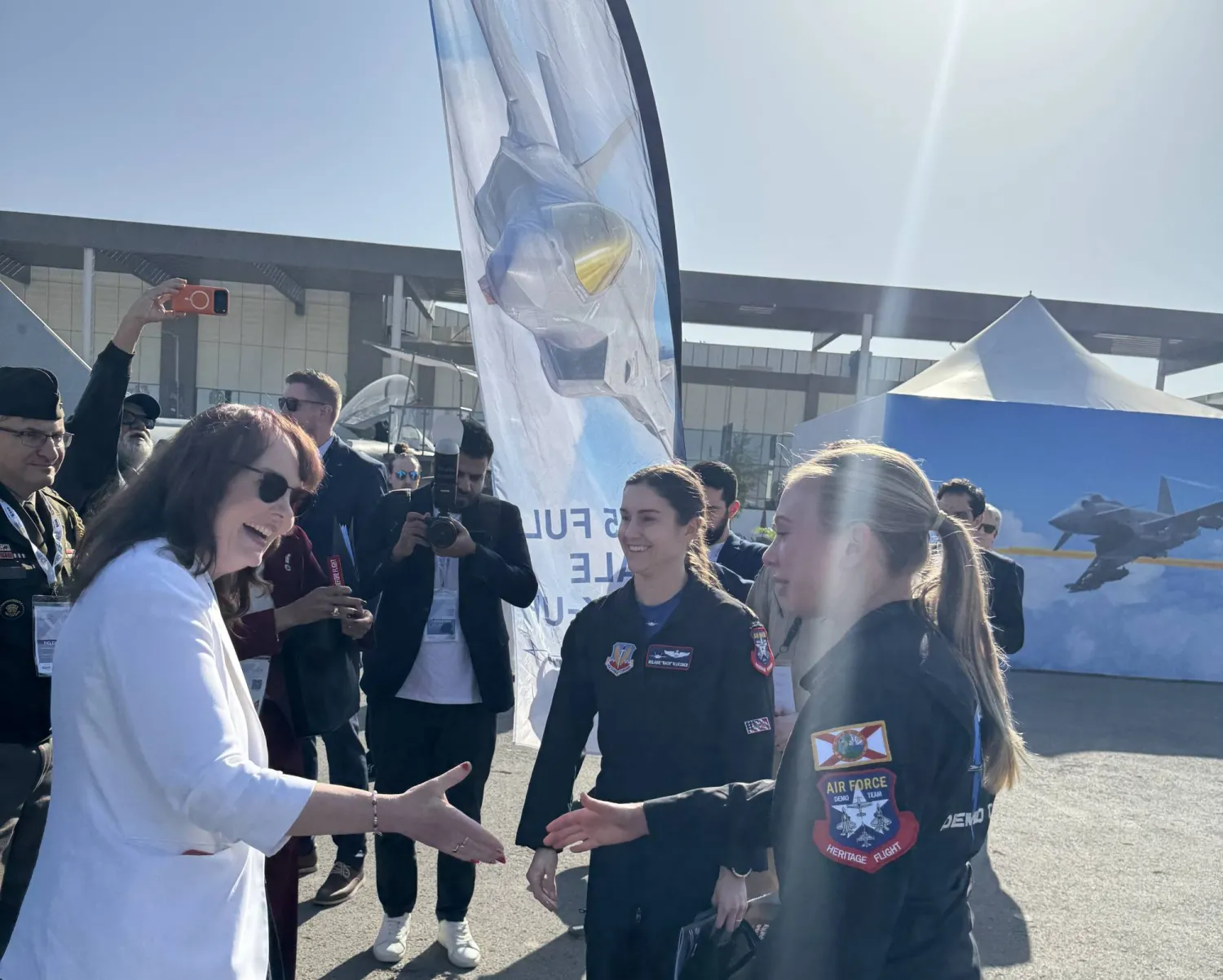



US Affirms Partnership with Riyadh is at its Strongest Level

Alison Dilworth, Charge d’Affaires ad interim to Saudi Arabia, shakes hands with a participant from the United States at the exhibition (Asharq Al-Awsat)
TT

US Affirms Partnership with Riyadh is at its Strongest Level

Alison Dilworth, Charge d’Affaires ad interim to Saudi Arabia, shakes hands with a participant from the United States at the exhibition (Asharq Al-Awsat)

US Charge d’Affaires ad interim to Saudi Arabia, Alison Dilworth, said Sunday that the World Defense Show currently being held in Riyadh reflects the strongest manifestation of the bilateral partnership between the United States and the Kingdom, affirming that relations between the two countries “have never been stronger than they are today.”

In remarks to Asharq Al-Awsat on the sidelines of the Show, Dilworth said the strong US participation in the exhibition clearly demonstrates the strength of cooperation between Washington and Riyadh. She pointed out that the partnership has witnessed sustained and strengthening growth in recent years.

Dilworth added that the Show brings together major global names in defense and aviation, such as Boeing and Lockheed Martin, alongside small and medium-sized US companies working in artificial intelligence, cybersecurity, and advanced defense systems, reflecting the diversity of American participation and the broad scope of technical and industrial cooperation.

She highlighted that US companies aim to grow with Saudi partners, supporting the Kingdom’s security and prosperity in line with Vision 2030.

On the Saudi-US political momentum that has strengthened bilateral relations in recent years, Dilworth said that 2025 saw what she described as a “historic” visit by US President Donald Trump to the Kingdom, followed by a visit by the Saudi Crown Prince to Washington in November.

The two visits resulted in the signing of 23 agreements which she described as “pivotal achievements” in the trajectory of US-Saudi cooperation.

Regarding the military displays at the exhibition, the diplomat highlighted that the F-35 and the scheduled aerial demonstrations underscore the US commitment as a long-term partner to Saudi Arabia.


World Defense Show in Riyadh Witnesses Signing of Important Agreements

Saudi Minister of Defense Prince Khalid bin Salman bin Abdulaziz signs an agreement with his Slovakian counterpart. SPA
TT

World Defense Show in Riyadh Witnesses Signing of Important Agreements

Saudi Minister of Defense Prince Khalid bin Salman bin Abdulaziz signs an agreement with his Slovakian counterpart. SPA

Saudi Minister of Defense and Vice Chairman of the Board of Directors of the General Authority for Military Industries (GAMI) Prince Khalid bin Salman bin Abdulaziz inaugurated in Riyadh the third edition of the World Defense Show, organized by GAMI until February 12.

At the Saudi Arabian Military Industries (SAMI) Group pavilion, the Defense Minister launched on Sunday SAMI Land Company, SAMI Autonomous Company, SAMI Land Industrial Complex, and the HEET Program.

He also unveiled the SAMI Local Content Program (RUKN), the group's flagship supply chain program.

Prince Khalid and his South Korean counterpart witnessed the signing of a memorandum of understanding between the Saudi General Authority for Defense Development and the Korean Agency for Defense Development.

The agreement focuses on defense research, development, and innovation in advanced military technologies and systems.

The Saudi Defense Minister also signed three defense cooperation agreements with Slovakia, Malaysia, and Somalia.

Furthermore, the National Industrial Development Center signed a cooperation memorandum with European aerospace corporation Airbus to explore opportunities for developing and localizing the aviation and helicopter industry in Saudi Arabia.

Under the memorandum, the two sides aim to strengthen collaboration to establish an integrated aviation industrial base in the Kingdom. They will study the creation of an engineering center to develop national capabilities in manufacturing, assembly, maintenance, and repair, alongside a supporting logistics network.

The agreement also covers technology and knowledge transfer, encouraging global suppliers to invest in Saudi Arabia, and developing Saudi talent through educational and training partnerships with domestic institutions. It includes coordination with relevant authorities to examine procurement options, support the shift toward exports, and explore incentives and financing mechanisms to enhance project readiness and competitiveness.

GE Aerospace and the Middle East Propulsion Company Ltd. (MEPC) announced signing three new agreements to enhance operational readiness for the Royal Saudi Air Force (RSAF) F110 fleet and build in-country capabilities.

Leveraging their decade-old partnership, are focused on the RSAF’s F110-129 engines and will also support F110-129 customers across the broader region.

These agreements represent Phase 3 of a long-term initiative, building on the success of similar Phase 1 and 2 agreements, which saw GE Aerospace providing repair and overhaul services support to MEPC.

The agreements seek to ensure sustained material supply and comprehensive maintenance and repair services support for the RSAF F110 Engine Structural Integrity Program (ENSIP).

They highlight the shared vision of both companies to advance the safety, efficiency, and operational excellence of defense aircraft in the wider Middle East.

MEPC Managing Director Mohammed Alnawkhani said: “These agreements represent the next phase of our strategic partnership with GE Aerospace and a major step forward in enhancing readiness for the RSAF F110 fleet.”

“Together, we are expanding in-Kingdom F110-129 sustainment capabilities, ensuring long-term material availability, and delivering the high standards of safety and performance required by our customers in the Kingdom and across the region.”

“This milestone also strengthens localization efforts in support of Saudi Vision 2030, contributing to national industrial development and building sovereign aerospace sustainment capabilities,” he added.

Salim Mousallam, Vice President, Defense & Systems for the Middle East, Africa, and Türkiye at GE Aerospace said that the enduring partnership with MEPC is a testament to the company’s shared vision of enhancing in-country capabilities and ensuring peak operational readiness through maximized availability for its customers.

“These agreements will significantly increase engine availability, streamline MRO processes, and directly support the RSAF’s critical missions. As a trusted partner to the Kingdom, we are proud to provide high-quality services to MEPC, reducing maintenance burden and service disruptions for their mission-critical F110 fleet,” he said.

Under the F110-129 Material Support Agreement, GE Aerospace will provide essential ENSIP Kits (F110-129 parts) to support MEPC in performing the necessary overhaul of RSAF F110-129 engines within the Kingdom.

The F110-129 repair and overhaul agreement further solidifies the provision of comprehensive repair and overhaul services specifically for the Royal Saudi Air Force fleet. GE Aerospace also signed a new F110-129 services agreement to extend critical repair and overhaul capabilities to support other F110 customers across the region.


Kuwait Includes 8 Lebanese Hospitals on 'Terror' List

Kuwait indicated that it had listed eight hospitals in Lebanon as part of regulations related to "combating terrorism.” KUNA
TT

Kuwait Includes 8 Lebanese Hospitals on 'Terror' List

Kuwait indicated that it had listed eight hospitals in Lebanon as part of regulations related to "combating terrorism.” KUNA

Kuwait's foreign ministry issued on Sunday a circular indicating that it had listed eight hospitals in Lebanon as part of regulations related to "combating terrorism.”

Lebanon's health ministry expressed surprise and said it would seek clarification.

It said it received the Kuwaiti statement "with great surprise", adding it had not been provided with "any information or notification from any Kuwaiti entity about this matter.”

"The hospitals mentioned in the statement are registered with the syndicate of private hospitals in Lebanon and carry out their role in providing treatment and health services to all Lebanese without exception," the ministry statement said.

It called the facilities "an essential part of the Lebanese health system,” and said it would contact the relevant authorities to request clarification and "protect Lebanon's health system.”

It noted that "Kuwait has numerous joint projects with the ministry... and has been among the most prominent countries that have stood by the health system during the successive crises that Lebanon has faced.”

The latest move was "unprecedented and inconsistent" with the Gulf country's usual approach, it added.