


US Calls for Ending ‘Brutal Repression’ by Iranian-Backed Militias in Yemen

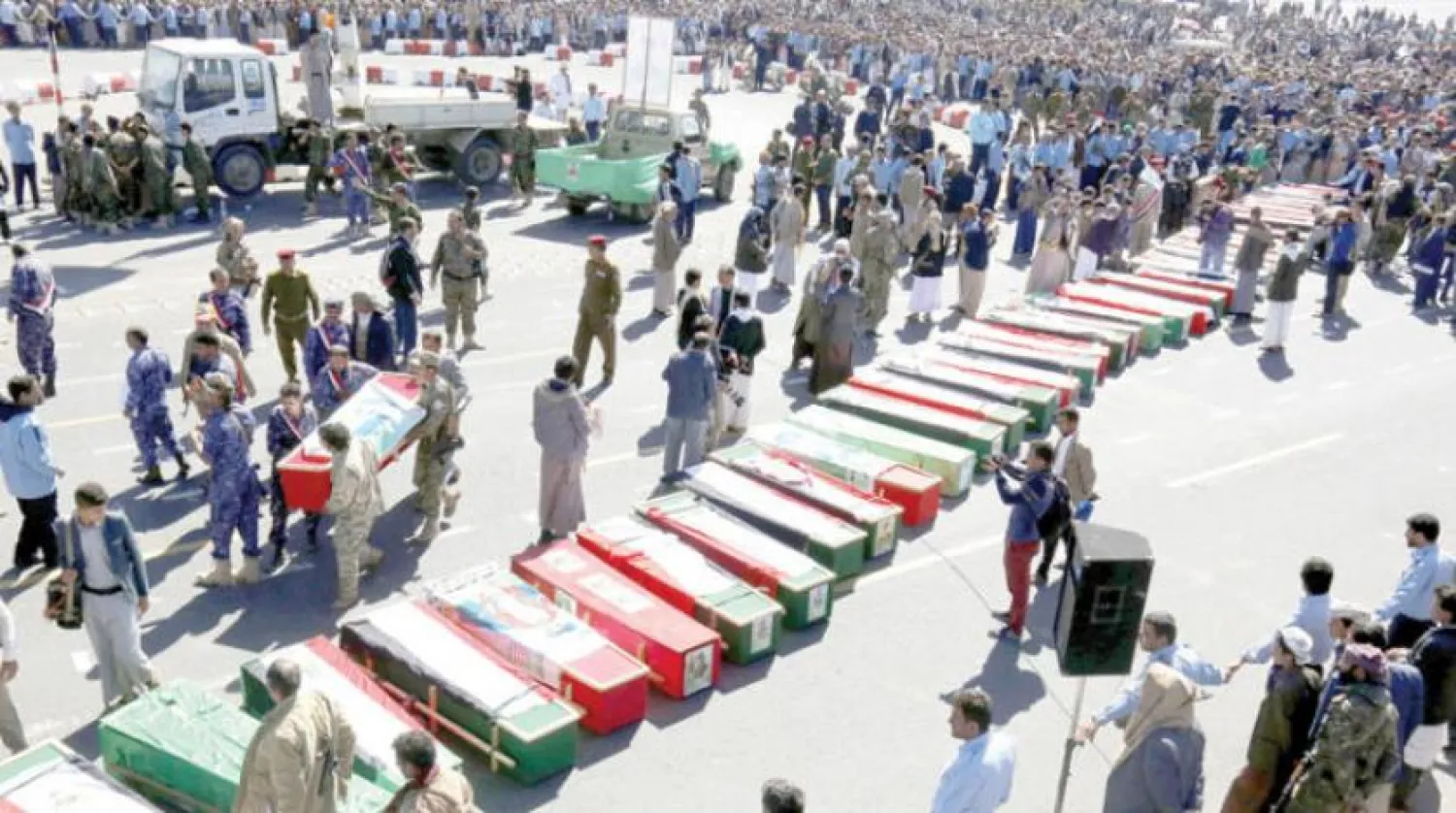
Houthis at a mass funeral of those killed in  clashes with the pro-Saleh forces, EPA
Houthis at a mass funeral of those killed in clashes with the pro-Saleh forces, EPA
TT

US Calls for Ending ‘Brutal Repression’ by Iranian-Backed Militias in Yemen

Houthis at a mass funeral of those killed in  clashes with the pro-Saleh forces, EPA
Houthis at a mass funeral of those killed in clashes with the pro-Saleh forces, EPA

The United States condemned on Friday Houthi militants suppressing political opponents (loyal to the General People's Congress), including the killing of former Yemeni president Ali Abdullah Saleh.

“We condemn the Houthis’ brutal repression of political opponents in Sana’a,” Friday’s statement by White House spokeswoman Sarah Sanders said.

That includes the Houthis’ killing last weekend of Saleh to punish him for switching sides.

The White House statement said that political negotiations were necessary to end the conflict in Yemen and to free the country from the malicious influence of Iranian-backed militias.

The White House also called on the Houthis to allow food, medicine and fuel to be distributed and accused them of political repression and brutality.

“The Iranian-backed Houthi militias must allow food, medicine, and fuel to be distributed throughout the areas they control, rather than diverted to sustain their military campaign against the Yemeni people,” Sanders added.

Houthi militiamen overrunning Sana’a have managed to isolate it, blocking social networks and text messages, and terrorizing locals.

The pro-Iranian group continues to carry out attacks and arrests against members of the GPC and loyalists of Saleh in Sana'a and neighboring provinces.

GPC sources said that the group is seeking to launch a second wave of arrests and executions against second and third ranking officials who refuse to pledge their allegiance under coercion.

A source close to GPC leader Qassem Labooza told Asharq Al-Awsat that the politician is under house arrest in Sana’a.

“They are trying to convince him along other leaders, including the head of the coup government, Abdul Aziz bin Habtour, to rejoin insurgency ranks and to head the GPC after Saleh’s death,” the source added.

In the meantime, Houthis on Friday put to death MPs from the pro-Saleh party in Khokha in the province of Hodeidah.  


Iraq’s Newly Elected Parliament Holds First Session

A view of the Iraqi Parliament building in Baghdad, Iraq, Monday, Dec. 29, 2025. (AP)
TT

Iraq’s Newly Elected Parliament Holds First Session

A view of the Iraqi Parliament building in Baghdad, Iraq, Monday, Dec. 29, 2025. (AP)

Iraq's newly elected parliament convened ​on Monday for its first session since the November national election, opening the ‌way for ‌lawmakers ‌to begin ⁠the ​process ‌of forming a new government.

Parliament is due to elect a speaker and ⁠two deputies ‌during its first meeting. ‍

Lawmakers ‍must then ‍choose a new president by within 30 days of ​the first session.

The president will subsequently ⁠ask the largest bloc in parliament to form a government, a process that in Iraq typically drags on for ‌months.


Death Toll in Attack in Syria's Latakia Rises to 4, 108 Injured

Syrian security forces are deployed in the city of Latakia, Syria, 28 December 2025. (EPA)
TT

Death Toll in Attack in Syria's Latakia Rises to 4, 108 Injured

Syrian security forces are deployed in the city of Latakia, Syria, 28 December 2025. (EPA)

Authorities in Syria's Latakia province announced on Monday that the death toll has risen to four from the armed attack carried out by remnants of the ousted regime on Sunday.

It added that 108 people were injured in the violence.

The Syrian Defense Ministry announced on Sunday the deployment of military forces in the coastal cities of Latakia and Tartus in wake of the attack against security forces and civilians during protests.

State television said a member of the security forces was killed and others were injured while they were protecting protests in Latakia.

Head of the security forces in the Latakia province Abdulaziz al-Ahmed said the attack was carried out by terrorist members of the former regime.

Al-Ahmed added that masked gunmen were spotted at the protests and they were identified as members of Coastal Shield Brigade and Al-Jawad Brigade terrorist groups, reported the official SANA news agency.


Syria Secures Assad-Era Mass Grave Revealed by Reuters and Opens Criminal Investigation

A drone view of the mass grave site in the desert near the eastern Syrian town of Dhumair, February 27, 2025. (Reuters)
TT

Syria Secures Assad-Era Mass Grave Revealed by Reuters and Opens Criminal Investigation

A drone view of the mass grave site in the desert near the eastern Syrian town of Dhumair, February 27, 2025. (Reuters)

Syria’s government has ordered soldiers to guard a mass grave created to conceal atrocities under Bashar al-Assad and has opened a criminal investigation, following a Reuters report that revealed a yearslong conspiracy by the fallen dictatorship to hide thousands of bodies on the remote ​desert site.

The site, in the Dhumair desert east of Damascus, was used during Assad’s rule as a military weapons depot, according to a former Syrian army officer with knowledge of the operation.

It was later emptied of personnel in 2018 to ensure secrecy for a plot that involved unearthing the bodies of thousands of victims of the dictatorship buried in a mass grave on the outskirts of Damascus and trucking them an hour’s drive away to Dhumair.

The plot, orchestrated by the dictator’s inner circle, was called “Operation Move Earth.”

Soldiers are stationed at the Dhumair site again, this time by the government that overthrew Assad.

The Dhumair military installation was also reactivated as a barracks and arms depot in November, after seven years of disuse, according to an army officer posted there in early December, a military official and Sheikh Abu Omar Tawwaq, who is the security chief of Dhumair.

The Dhumair site ‌was completely unprotected over ‌the summer, when Reuters journalists made repeated visits after discovering the existence of a mass grave ‌there.

Within ⁠weeks ​of the ‌report in October, the new government created a checkpoint at the entrance to the military installation where the site lies, according to a soldier stationed there who spoke to Reuters in mid-December. Visitors to the site now need access permits from the Defense Ministry.

Satellite images reviewed by Reuters since late November show new vehicle activity around the main base area.

The military official, who spoke on condition of anonymity, said the reactivation of the base is part of efforts to “secure control over the country and prevent hostile parties from exploiting this open strategic area.” The road through the desert connects one of ISIS’ remaining Syrian strongholds with Damascus.

POLICE INVESTIGATION

In November, police opened an investigation into the grave, photographing it, carrying out land surveys and interviewing witnesses, according to Jalal Tabash, head of the ⁠al-Dhumair police station. Among those interviewed by police was Ahmed Ghazal, a key source for the Reuters investigation that exposed the mass grave.

“I told them all the details I told you about the ‌operation and what I witnessed during those years,” said Ghazal, a mechanic who repaired trucks ‍carrying bodies that broke down at the Dhumair grave site.

Ghazal confirmed ‍that during the time of “Operation Move Earth,” the military installation appeared vacant except for the soldiers involved in accompanying the convoys.

Syria’s Information Ministry ‍did not respond to requests for comment about the re-activation of the base or the investigation into the mass grave.

The National Commission for Missing Persons, which was established after Assad’s ouster to investigate the fate of tens of thousands of Syrians who vanished under his rule, told Reuters it is in the process of training personnel and creating laboratories in order to meet international standards for mass grave exhumations.

Exhumations at Syria’s many Assad-era mass graves, including the site at Dhumair, are scheduled for ​2027, the commission told Reuters.

The police have referred their report on Dhumair to the Adra district attorney, Judge Zaman al-Abdullah.

Al-Abdullah told Reuters that information about Assad-era suspects involved in the Dhumair operation, both inside and outside Syria, is being cross-referenced ⁠with documents obtained by security branches after the dictator’s fall in December 2024. He would not describe the suspects, citing the ongoing investigation.

According to military documents reviewed by Reuters and testimony from civilian and military sources, logistics for “Operation Move Earth” were handled by a key man, Col. Mazen Ismander.

Contacted through an intermediary, Ismander declined to comment on the initial Reuters report or the new investigation into the mass grave.

When the conspiracy was hatched in 2018, Assad was verging on victory in the civil war and hoped to reclaim legitimacy in the international community after years of sanctions and allegations of brutality.

He had been accused of detaining and killing Syrians by the thousands, and the location of a mass grave in the Town of Qutayfah, outside Damascus, had been reported by local human rights activists.

So an order came from the presidential palace: Excavate Qutayfah and hide the bodies on the military installation in the Dhumair desert.

For four nights a week for nearly two years, from 2019 to 2021, Ismander oversaw the operation, Reuters found . Trucks hauled corpses and dirt from the exposed mass grave to the vacated military installation in the desert, where trenches were filled with bodies as the Qutayfah site was excavated.

In revealing the conspiracy, Reuters spoke to 13 people with direct ‌knowledge of the two-year effort and analyzed more than 500 satellite images of both mass graves.

Under the guidance of forensic geologists, Reuters used aerial drone photography to create high-resolution composite images that helped corroborate the transfer of bodies by showing
color changes in the disturbed soil around Dhumair’s burial trenches.
