


Manchester United Were Too Passive in Derby – Mourinho Must Take the Blame

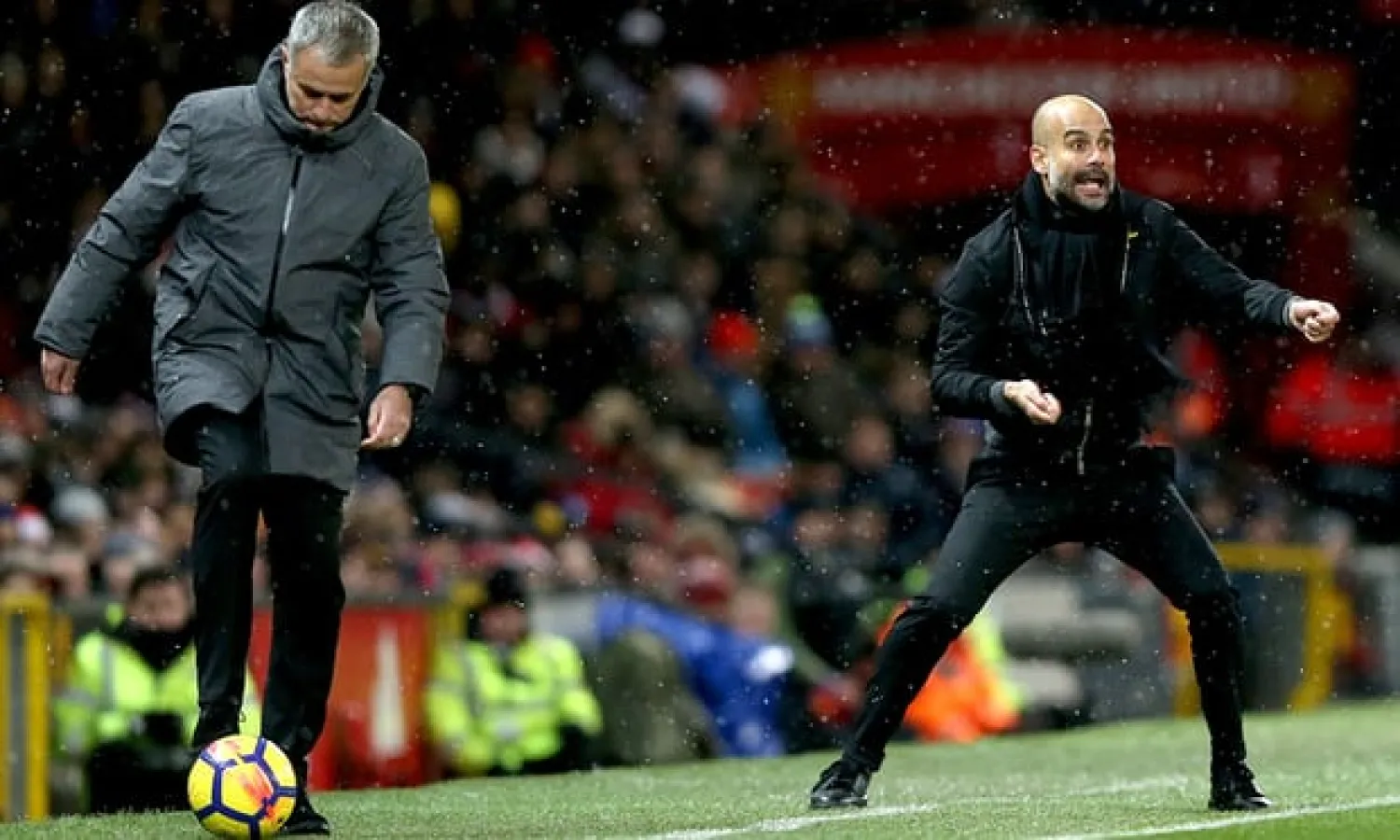
 José Mourinho could not halt the winning run of Pep Guardiola’s Manchester City, whose 2-1 win at Old Trafford was a record-equalling 14th consecutive Premier League victory. Photograph: Nigel Roddis/EPA
José Mourinho could not halt the winning run of Pep Guardiola’s Manchester City, whose 2-1 win at Old Trafford was a record-equalling 14th consecutive Premier League victory. Photograph: Nigel Roddis/EPA
TT

Manchester United Were Too Passive in Derby – Mourinho Must Take the Blame

 José Mourinho could not halt the winning run of Pep Guardiola’s Manchester City, whose 2-1 win at Old Trafford was a record-equalling 14th consecutive Premier League victory. Photograph: Nigel Roddis/EPA
José Mourinho could not halt the winning run of Pep Guardiola’s Manchester City, whose 2-1 win at Old Trafford was a record-equalling 14th consecutive Premier League victory. Photograph: Nigel Roddis/EPA

About 10 minutes before half-time, the plea went up around Old Trafford: “Attack! Attack! Attack!” It’s a chant that dates back to the 1960s. It was heard, for instance, at Wembley in 1968 when Manchester United beat Benfica to win the European Cup as fans revelled in the refusal of Matt Busby’s side to rest on a 1-0 lead even in a game so freighted with emotion and importance. By Louis van Gaal’s time, the chant had taken on a different tone: something between mockery of an approach based on risk-free possession and a demand for something more uplifting. It’s hard to interpret this latest outbreak as being anything other than a complaint.

José Mourinho was always going to have his side sit deep. That’s just how he plays in big games and the evidence of City’s last three league games – and particularly Pep Guardiola’s evident frustration at the approach – was that City don’t find it easy against teams who set out with few ambitions but to deny them space. This City pose challenges few other teams have ever posed: Mourinho’s approach was both predictable and, up to a point, understandable. But only up to a point.

That he began with Marcus Rashford, Jesse Lingard and Anthony Martial behind Romelu Lukaku was misleading. Four forwards looks positive, but he did that at Internazionale as well, when he would field Goran Pandev, Wesley Sneijder and Samuel Eto’o behind Diego Milito and, in big games, watch them defend with great discipline. Mourinho’s greatest gift, perhaps, is his capacity to persuade forwards to defend. That, and the management of expectations.

United’s front four did defend: clumsily and, as it turned out, counterproductively in the case of Lukaku, efficiently and diligently in the case of the wide men tracking the full-backs. At half-time, City had had 75% of the ball and United only three shots.

Little wonder, then, that some home fans became a little restive as they watched a string of long punts aimed in the vague direction of Lukaku, or at least the half of the pitch in which he was mournfully loping. Reactive football is, after all, as the great Russian writer Lev Filatov put it, justifying Krylya Sovetov’s use of a proto-catenaccio in the early 50s, the “right of the weak”. But United are not weak; they are the richest club in the world. Playing like that sits uncomfortably with their self-image. What may work at Chelsea or Porto or even Inter, where reactivity can be accepted as necessary to take on the establishment, doesn’t work when you are the establishment, as United are, as Real Madrid are.

United had played like this against Tottenham, waiting for a mistake that did eventually come. They had played like this at Liverpool, waiting for a mistake that never came. Here, there were mistakes and they served to highlight how many more there might have been had United just applied a little more pressure a little earlier in the game. City, having dominated, became oddly sloppy in the five minutes before half-time. Their opening goal came just after a couple of uncharacteristic misplaced passes, as though they had mesmerised themselves with their possession. Three mistakes in dealing with one simple cross led to the equaliser. At no stage did City seem comfortable dealing with direct balls.

Nicolás Otamendi had one of his shaky days. Fabian Delph for once looked like a midfielder playing at the back, as did Fernandinho for the quarter of an hour he did so before being rescued by the introduction of Eliaquim Mangala. Lukaku and Rashford had chances even before the Ederson double save. With five minutes to go, City were rattled enough to take the ball into the corners, despite their manager’s oft-expressed ideological commitment to attacking football.

City were vulnerable and United, just as against Liverpool, not only did not take advantage but did not seek to take advantage. There is a line between reactivity and passivity and in the first half United were on the wrong side of it. When Mourinho did finally have a go, it was two hours too late and he was complaining about the volume of the music in the visitors’ dressing room. United are not, to use the metaphor Mourinho himself deployed in his first season back at Chelsea to pre-empt and explain the failure of a nascent title challenge, a “little horse”. They are Manchester United, the biggest, most successful team in English football, and their transfer spending is a net £250m in the two years he has been there. A team of that stature cannot be reliant on Paul Pogba – and certainly not on Marouane Fellaini.

Even in the corporatised, sanitised modern Old Trafford fans expect more than that, and directors will come to. Fans, by and large, will accept any means if the ends follow. Sir Alex Ferguson was not the habitual cavalier many like to portray him as, but he won.

Resistance for now is limited but the bigger the gap at the top of the table becomes, the more stylistic questions are going to be asked: why betray tradition or self-image, romanticised as it may be, if the result is defeat? And particularly when the suspicion is that a more proactive, more palatable approach might actually have been more effective, might have exposed an opponent’s weaknesses?

And this is the second season. This is supposed to be Mourinho’s golden time before third-season syndrome strikes.

The Guardian Sport


Jota’s Sons to Join Mascots When Liverpool Face Wolves at Anfield

 Jota died ‌in ⁠a ​car ‌crash alongside his younger brother in July in northwestern Spain. (AFP)
Jota died ‌in ⁠a ​car ‌crash alongside his younger brother in July in northwestern Spain. (AFP)
TT

Jota’s Sons to Join Mascots When Liverpool Face Wolves at Anfield

 Jota died ‌in ⁠a ​car ‌crash alongside his younger brother in July in northwestern Spain. (AFP)
Jota died ‌in ⁠a ​car ‌crash alongside his younger brother in July in northwestern Spain. (AFP)

Diogo Jota's two sons will join ​the mascots at Anfield when Liverpool face Wolverhampton Wanderers in the Premier League on Saturday, the club confirmed on Friday.

Portuguese forward Jota, who played for both ‌Premier League ‌clubs, died ‌in ⁠a ​car ‌crash alongside his younger brother in July in northwestern Spain. He was 28.

Jota joined Wolves on loan from Atletico Madrid in 2017 and made ⁠a permanent move to the club ‌the following year. ‍He then ‍signed a five-year deal in ‍2020 with Liverpool, where he won the league title earlier this year.

Saturday's match marks the ​first time Liverpool and Wolves have met since Jota's ⁠death.

Jota's wife Rute Cardoso and her two sons, Dinis and Duarte, were present for the Premier League home openers for both Liverpool and Wolves in August.

Liverpool also permanently retired his jersey number 20 following his death.


Too Hot to Handle? Searing Heat Looming Over 2026 World Cup

A view of the field is seen from the stands at SoFi Stadium in Inglewood, California, on December 9, 2025. (AFP)
TT

Too Hot to Handle? Searing Heat Looming Over 2026 World Cup

A view of the field is seen from the stands at SoFi Stadium in Inglewood, California, on December 9, 2025. (AFP)

With less than six months to go before the 2026 World Cup kicks off, organizers are bracing for what could be their most challenging opponent yet: extreme heat.

Soaring temperatures across the United States, Mexico and Canada pose safety issues for players and fans and a host of logistical issues that remain far from settled.

In the depths of the $5.5 billion SoFi Stadium in Los Angeles, which will host eight World cup matches, around 15 industrial misting fans more than two meters sit in storage, waiting to be deployed. If temperatures climb above 80F (26.7C), the fans will be rolled out around the stadium.

A roof suspended some 45 meters above the SoFi Stadium pitch offers some shade for spectators, while large openings along the sides of the stadium allow for breezes from the nearby Pacific Ocean to provide a form of natural air conditioning.

"Knowing that you can put 70,000 people into a building, the energy, the excitement, the activity that comes with that, and the higher temperature, that's where we want to make sure we respond," Otto Benedict, vice president of operations for the company that manages the stadium, told AFP.

Not all of the World Cup's 16 stadiums are as modern. And Southern California is not considered to be among the highest-risk areas for a competition scheduled from June 11 to July 19, three and a half years after a winter World Cup in Qatar.

- Automatic cooling breaks -

A study published in the International Journal of Biometeorology in January warned of "serious concern" for the health of players and match officials at the 2026 World Cup due to extreme heat.

The study identified six "high-risk" host cities: Monterrey, Miami, Kansas City, Boston, New York and Philadelphia.

The "Pitches in Peril" report by the Football for Future non-profit noted that in 2025 those cities each recorded at least one day above 35C on the wet-bulb globe temperature (WBGT) scale, which factors in humidity and is considered the upper limit of human heat tolerance.

The issue of heat featured prominently at this year's FIFA Club World Cup in the United States, which drew complaints from players and coaches.

Extreme heat also marked the 1994 World Cup, the last men's edition held in the United States.

FIFA has responded by mandating cooling breaks in the 22nd and 67th minutes of all matches at the World Cup, regardless of conditions.

The World Cup match schedule released after December's draw in Washington shows daytime games largely assigned to air-conditioned stadiums in Dallas, Houston and Atlanta, while higher-risk venues are set to host evening kickoffs.

"You can clearly see an effort to align the competition schedule planning and venue selection with the concerns around player health, but also player performance," a spokesperson for the FIFPro players union told AFP. "This is a clear outcome, which we welcome, and a lesson learned from the Club World Cup."

- 'High-risk matches' -

FIFPRO says the biggest takeaway is that heat will play an increasingly central role in organizing competitions on a warming planet.

The union believes though that several World Cup fixtures remain "high-risk" and recommends postponements when WBGT readings exceed 28C.

Among those fixtures causing FIFPro concern: group-stage matches scheduled for mid-afternoon in New York, Boston and Philadelphia, as well as the final, set for a 3:00 p.m. kickoff in New York.

While teams and players work to mitigate effects of the conditions, some officials say the risks to spectators both inside stadiums and in fan zones have been underestimated.

"There is a risk and importantly, we feel like it's an underappreciated risk," said Chris Fuhrmann, deputy director of the Southeast Regional Center of the US National Oceanic and Atmospheric Administration.

"When you're cheering, you're actually generating a lot of metabolic heat and your heart rate's going up. Spectators obviously compared to professional athletes are generally not in as good physical health.

"They have a lot of comorbidities that increase the likelihood that they would have a negative health outcome or succumb to heat stress."

Stadium temperatures are also amplified by the "urban heat island" effect of concrete, asphalt and metal.

Adequate air circulation, plenty of shaded areas and access to hydration are crucial, Fuhrmann said.

FIFA has yet to clarify whether fans will be allowed to bring refillable water bottles into venues or whether water will be sold inside. FIFA did not respond to requests for comment.

- Prevention -

For National Weather Service meteorologist Benjamin Schott, who has advised FIFA and its World Cup task force, the priority is prevention, particularly for foreign visitors unfamiliar with local climates.

Another lesson from the Club World Cup, he said, is the need for multilingual messaging to ensure heat-safety warnings are clearly understood.

"The lesson learned is just trying to maybe better educate fans as they come to the United States to have a better understanding of what the weather could be like during those two months," Schott said.


Palladino’s Atalanta on the up as Serie A Leaders Inter Visit

Atalanta's Italian head coach Raffaele Palladino looks on during the Italian Serie A soccer match between Genoa Cfc and Atalanta BC at Luigi Ferraris stadium in Genoa, Italy, 21 December 2025. (EPA)
TT

Palladino’s Atalanta on the up as Serie A Leaders Inter Visit

Atalanta's Italian head coach Raffaele Palladino looks on during the Italian Serie A soccer match between Genoa Cfc and Atalanta BC at Luigi Ferraris stadium in Genoa, Italy, 21 December 2025. (EPA)

Atalanta are on the comeback trail ahead of Sunday night's visit of Serie A leaders Inter Milan, with coach Raffaele Palladino leading the charge for the revitalized Bergamo club.

Since Palladino replaced Ivan Juric last month Atalanta have rediscovered their groove, as witnessed by the way they dealt with Eintracht Frankfurt and Chelsea in the Champions League.

Atalanta sit fifth in the Champions League, level on points with mega-bucks Paris Saint-Germain and Manchester City, and now they're heading back up the Serie A table.

A last-gasp win at Genoa last weekend put Atalanta back in the top half of Italy's top flight and only three points off the European spots.

"It wasn't one of our better performances but today winning was what counted," said Palladino after the victory over Genoa.

"Those three points were hugely important for us to keep our run going and get us up the right end of the table."

Sunday's clash in Bergamo is the first of three fixtures against direct rivals for Champions League football.

Fourth-placed Roma, who are eight points clear of Atalanta, travel north at the turn of the year before the short journey to Bologna, who sit in the Conference League spot.

Atalanta have won six of their eight matches in all competitions under Palladino, who already looks more like the right replacement for Gian Piero Gasperini than Juric ever did.

However, Palladino will be without key attacker Ademola Lookman and defender Odilon Kossounou who are representing Nigeria and Ivory Coast at the Africa Cup of Nations.

"We keep scaling a mountain that a month ago seemed impossible," said Palladino.

"Let's enjoy the moment because we've got three big matches coming up and we can take them on in the right spirit."

Inter lead local rivals AC Milan -- who host Verona -- by a single point at the top of the table with champions Napoli a further point back in third ahead of their tricky trip to Jamie Vardy's Cremonese.

But Inter have been on a trip to Saudi Arabia for a failed attempt to win the Italian Super Cup, a tournament won by Napoli which has further clogged up their schedule and left them, Milan, Napoli and Bologna with a game in hand on Roma and fifth-placed Juventus.

The first two weeks of January each have midweek rounds of matches in store for the Super Cup clubs, with the following two weeks containing the decisive final fixtures of the Champions League's expanded league phase.

Inter coach Cristian Chivu has lost Ange-Yoan Bonny to a knee injury picked up in training, the Frenchman joining Denzel Dumfries, Franceco Acerbi and Hakan Calhanoglu on the treatment table.

Man to watch: Daniele De Rossi

De Rossi will make an emotional return to the Stadio Olimpico on Monday night when his Genoa team travel to the Italian capital hoping to bounce back after two unfortunate defeats to Inter and Atalanta.

The Roma icon and World Cup-winning midfielder took his boyhood club to the 2024 Europa League semi-final but was fired after a poor start last season.

He was sacked following a draw at Genoa in September last year, sparking furious protests from Roma fans, and he will be given a hero's welcome from home supporters.

Genoa sit two points above the drop zone while Roma are three points behind Inter having played a game more.
