
Welcome to China’s Florida: Sun, Sand and Retired Snowbirds

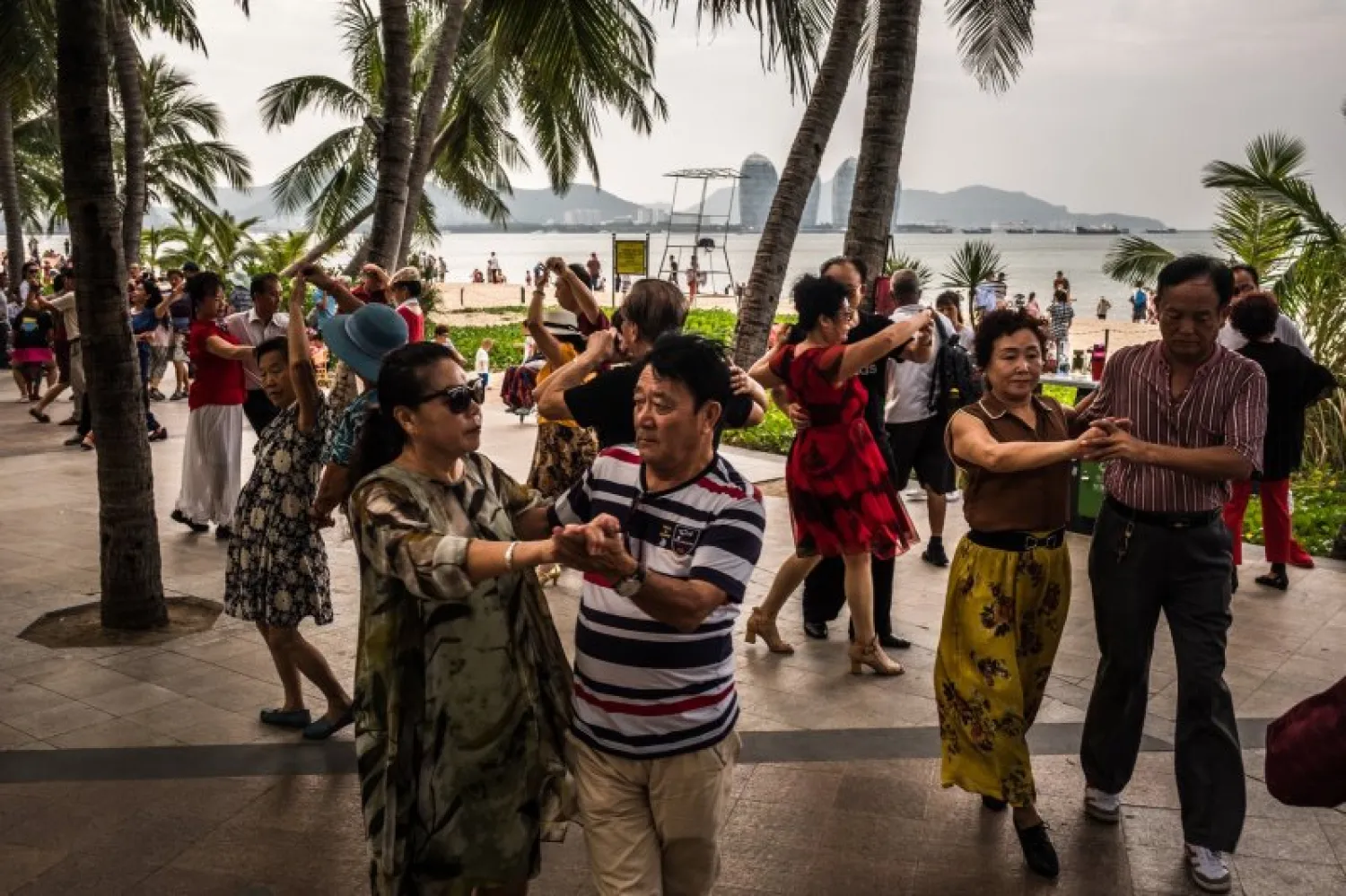
A Latin dance gathering. Credit Bryan Denton for The New York Times
TT

Welcome to China’s Florida: Sun, Sand and Retired Snowbirds

A Latin dance gathering. Credit Bryan Denton for The New York Times

While the white-sand beaches and five-star international resorts are meant to be the main attraction, for the hundreds of thousands of Chinese retirees who descend upon this tropical city every winter, dancing on the seaside promenade is often the real draw.

On a recent, balmy morning, palm trees swayed along the beachfront promenade as gray-haired dancers twirled and sashayed about. Retired men in head-to-toe Hawaiian print and women in floppy hats and flowery skirts sat on wheelchairs and folding stools, exchanging gossip over card games. Nearby, singers took turns belting out Mao-era favorites on an outdoor karaoke machine.

Nearly every corner of the promenade was occupied by older snowbirds looking to escape the dreary, bone-chilling winter of the north. And here, in this seaside city on Hainan island, the southernmost edge of China, was their wintertime paradise.

Welcome to China’s Florida.

“Oh, we absolutely love it here,” said Xu Yan, 70, sporting a dyed perm and big sunglasses as she sat beneath a palm tree near a gaggle of ballroom dancers.

Splayed out on a pink towel next to Ms. Xu was her companion, a toothless white Chihuahua named Maomao, who was burying his snout into a mound of torn-up hot dog pieces. Every winter for the past 13 years, Ms. Xu, a retired airline worker, and Maomao have left their home in the frigid northeastern city of Harbin to stay in Sanya.

Like Ms. Xu and Maomao, more than half of the nearly 400,000 retired snowbirds who flock to Sanya every year are said to hail from China’s northeast.

China’s population is rapidly aging; experts predict that by 2055, 400 million Chinese — or about a quarter of the country’s population — will be over age 65. And dramatically improved life expectancy and rising incomes have afforded these older people a freedom to enjoy life post-retirement in a way that would have been unthinkable for their parents’ generation.

“Retired life is better than we could have ever imagined,” said Sheng Shengmin, 67, a retired building contractor from Beijing.

Last year, Mr. Sheng joined the wave of snowbirds who have laid down roots here, buying an apartment in the city for the equivalent of $272,000. After years of living in Beijing, Mr. Sheng said, “the pollution, the migrant workers, and the cold” had made the capital city uninhabitable.

“Once you retire and you’ve saved up enough money, you don’t want to go back to living in the big cities,” Mr. Sheng said as he took a sip from his tea thermos, a common accessory for many older Chinese.

That so many Chinese retirees would leave behind their homes to live in an unfamiliar city is all the more remarkable given China’s tradition of filial piety. For generations, children in China have grown up with the expectation that they would one day care for their aging parents.

But there are growing concerns that responsibility may be too much for the generation of only children produced by the “one-child” policy to handle on their own. As a result, more empty nesters in China are adopting the snowbird lifestyle with the aim of easing the burden on their children.

“Right now, it’s fine because we’re healthy,” said Zhao Kaile, 62, a retired railway bureau administrator and a native of Mudanjiang in northeastern China. “But twenty years from now, will we be able to take care of ourselves without our children? Everybody is thinking about this problem now.”

As the head of the migrants association in a suburban community all but taken over by snowbirds, Mr. Zhao spends much of his time coordinating meetings and music rehearsals.

On a recent morning, more than 60 retirees gathered together in the community recreation room to rehearse sentimental favorites like “Onwards, Chinese Communist Party” and more recent hits like “Together Build the Chinese Dream.” Accompanying the chorus was a boisterous band of graying musicians, including a piccoloist and an electric guitarist.

“Before, we thought retired life would be very dull, just sitting on little stools in the sun and shriveling up and growing old,” said Mr. Zhao. “But our lives have transformed. We had no idea that after coming here we would be so happy and have so many friends.”

Not everyone is happy with the presence of Sanya’s snowbirds. The annual influx, which began in the early 2000s, has created tensions with local residents, who are increasingly outnumbered by their seasonal visitors. Locals complain that the retirees have driven up the cost of housing and food while simultaneously taking advantage of public services like transportation and hospitals.

They find peace only in the off-season summer months, when the snowbirds retreat to their homes up north to escape the sweltering temperatures and monsoon rains.

Several years ago, the local government began razing large tracts of housing in the city, in what many see as an ongoing effort to drive out the often frugal snowbirds by denying them places to rent. Others say the goal is instead to attract high-spending vacationers to boost local tourism, already one of the city’s main industries in addition to agriculture.

“Sanya wants to be known as an international tourism destination, not as an elderly retirement community,” said Huang Cheng, a lecturer at the University of Sanya who has studied the local snowbird phenomenon.

Several months ago, Wen Zhiguo, manager of a local hotel that caters to aging snowbirds, was forced to move to the outskirts of the city after the local government tore down his seaside facilities. Despite the change in location, Mr. Wen continues to run a brisk business renting out rooms to retirees who pay about $350 a month in exchange for simple accommodation and three meals a day.

On a recent afternoon, the lobby of Mr. Wen’s hotel began to stir as guests rose from their lunchtime naps. The choice of activities was plentiful — calligraphy, mah-jongg, cards and table tennis — and the faint scent of medicinal ointment infused the sunlit room.

A stately looking man with a snow-white coif sat quietly at a table playing a game of mah-jongg solitaire. A retired soldier in the People’s Liberation Army, Wang Xingeng, 89, remembered the first time he visited Sanya more than a half-century ago, just after the Communist Party’s 1949 takeover.

“Back then, the island was all shabby little huts, there were no buildings,” Mr. Wang said. “It was the poorest place I’d ever seen. It’s where they sent criminals.”

“I never thought I’d be back here,” he added, looking around pensively at his fellow snowbirds. “But now I’ve come full circle.”

The New York Times


Iraqis Cover Soil with Clay to Curb Sandstorms

Excavators clear sand dunes and extract clay in the desert south of Samawah on December 21, 2025. (Photo by AHMAD AL-RUBAYE / AFP)
TT

Iraqis Cover Soil with Clay to Curb Sandstorms

Excavators clear sand dunes and extract clay in the desert south of Samawah on December 21, 2025. (Photo by AHMAD AL-RUBAYE / AFP)

Deep in Iraq's southern desert, bulldozers and earthmovers spread layers of moist clay over sand dunes as part of a broader effort to fight increasingly frequent sandstorms.

Iraq has long suffered from sand and dust storms, but in recent years they have become more frequent and intense as the country falls prey to the effects of climate change.

Sand and dust storms -- driven by severe drought, rising temperatures and deforestation -- have cloaked cities and villages in an endless ochre haze, grounded flights and filled hospitals with patients suffering from breathing difficulties.

Iraqi authorities have warned that these suffocating storms will intensify further, adding urgency to address the root of the problem.

In a relatively small area between the cities of Nasiriyah and Samawah, not far from ancient Sumerian ruins, laborers are working hard to stabilize the soil by applying a layer of moist clay 20-25 centimeters thick.

The project also includes planting heat-tolerant seedlings like Prosopis and Conocarpus to further stabilize the soil.

"The main goal is to reduce the impact of transboundary dust storms, which may reach Kuwait, Saudi Arabia and Qatar," said Udai Taha Lafta from UN-Habitat, which is leading the project to combat sandstorms with Iraqi expertise.

"It is a vital area despite its small size, and will hopefully help reduce dust storms next summer," AFP quoted Lafta as saying.

A short-term objective is to shield a southern highway where many traffic accidents have occurred due to poor visibility during dust storms.

The Ministry of Environment estimates that Iraq now faces about 243 storms per year, and the frequency is expected to increase to 300 "dust days" by 2050 unless drastic mitigation measures are adopted.

In 2023, Iraqi authorities teamed up with the UN-Habitat and the Kuwait Fund for Arab Economic Development in areas that have been identified as major sources of sandstorms.

The project has been implementing several methods in three southern areas, including digging water canals and supplying electricity to pump water from the Euphrates river, preparing barren lands for vegetation.

One of the project's ultimate goals is to increase green spaces and for farmers to eventually sustain the lands after droughts and chronic water shortages have drastically reduced agricultural areas.

Qahtan al-Mhana, from the agriculture ministry, said that stabilizing the soil gives agricultural efforts in sandy areas a chance to endure.

He added that Iraq has extensive "successful" experience in combating desertification and dust storms by stabilizing sand dunes.

Since the 1970s, the country has implemented such projects, but after decades of turmoil, environmental challenges have largely fallen by the wayside.

With the severe recent impact of climate change, "work has resumed," said Najm Abed Taresh from Dhi Qar University.

"We are making slow but steady progress," Taresh said.


'Acoustic Hazard': Noise Complaints Spark Vietnam Pickleball Wars

This photo taken on December 23, 2025, shows children playing pickleball in the playground of a residential area in Hanoi. (Photo by Nhac NGUYEN / AFP)
TT

'Acoustic Hazard': Noise Complaints Spark Vietnam Pickleball Wars

This photo taken on December 23, 2025, shows children playing pickleball in the playground of a residential area in Hanoi. (Photo by Nhac NGUYEN / AFP)

The piercing pop-pop of pickleball paddles starts before sunrise and ends after midnight at dozens of newly built courts across Hanoi, as residents relish one of Vietnam's fastest-growing sports -- or rage at the noise it makes.

The initial craze saw more people in Vietnam pick up a paddle per capita than anywhere else in Asia, according to one survey.

Now unwitting spectators are yelling fault, filing noise complaints and petitions to curb playing hours that have left authorities in a pickle.

In the country's densely packed cities, courts are wedged between tight alleyways and nestled beneath high-rises, disturbing thousands of people at once.

"It drives me nuts," said Hoa Nguyen, 44, who lives with her family behind a multicourt complex in Hanoi's northeastern outskirts.

"People are playing in the middle of the night and there's nothing we can do about it," Nguyen told AFP, adding that she had filed a complaint with local authorities.

"The noise makes it impossible for me to sleep. It just keeps going pop-pop-pop."

Most noise complaints on the capital's iHanoi app stem from pickleball, according to state media, which has dubbed the sport an "acoustic hazard".

Associated noise-related issues range from unruly crowds to honking horns in overcrowded parking lots.

Lam Thanh, 50, who manages a dormitory for workers near one of Ho Chi Minh City's estimated 1,000 courts, says the cacophony is proving to be costly.

"Many tenants couldn't stand the noise and have moved elsewhere," she said.

"There's the popping sound of paddles, cheering, shouting and joking around -- it's all extremely exhausting for us."

Vietnam's pickleball boom began around two years ago, players and coaches say, well after its popularity surged in the United States and Canada.

But the country is now the sport's second-fastest-growing market in Asia after Malaysia, according to pickleball rating company DUPR.

Regional professional circuit PPA Tour Asia says more than 16 million people in Vietnam have picked up a paddle, though that figure is extrapolated from a survey of around 1,000 respondents.

Hanoi's Long Bien district, its pickleball center, has more than 100 courts, up from 54 in less than a year, according to state media.

Pickleholic Club, Victory Pickleball and Pro Pickleball Vn are all within a five-minute walk, with dozens more a short drive away.

Coach Pham Duc Trung, 37, said the sport's accessibility was key to its popularity.

"The paddle is light and the ball is light... Children can play it, and so can adults," he said.

"The sound of the ball hitting the paddle is quite appealing," he added.

Not everyone agrees.

Around the world, the plinks and pops of pickleball have spawned outrage, provoking protests and even lawsuits.

But Vietnam's widespread embrace of the sport, and its cities' rapid growth in recent decades as the economy boomed, help explain the intense frustration.

Ho Chi Minh City already ranks among the loudest cities in Asia, according to the United Nations, with noise pollution levels high enough to damage hearing.

And experts say pickleball sounds are louder and higher-pitched than tennis or badminton.

A nationwide noise ordinance is supposed to limit the din, especially late at night, but residents say the courtside clatter often goes unmuted.

Hanoi high school student Duong, 16, cannot focus on his homework.

"The sound made by this ball is very unpleasant," he said. "My mind feels blank because I cannot concentrate."

Vietnam's sports ministry did not reply to AFP's request for comment.
But pressure is building to smash the problem, with state media carrying health warnings from doctors.

"The constant bouncing of the pickleball is not only annoying but also subtly triggers stress, disrupts sleep, and increases the risk of cardiovascular disease," according to state-run VTC News website.

Ball strikes register "like the ticking of a clock against the temples", it said this month, adding many people are "haunted by the sound of popping".


Hong Kongers Bid Farewell to 'King of Umbrellas'

Yau Yiu-wai, 73, one of the few remaining umbrella repairmen in Hong Kong, is closing his 183-year-old family-run business at the end of the year. Tommy WANG / AFP
TT

Hong Kongers Bid Farewell to 'King of Umbrellas'

Yau Yiu-wai, 73, one of the few remaining umbrella repairmen in Hong Kong, is closing his 183-year-old family-run business at the end of the year. Tommy WANG / AFP

Scores of residents flocked to a cramped shop in Hong Kong's old district to bid farewell to the city's "king of umbrellas", who is retiring after spending decades repairing umbrellas at his family business.

Established in 1842 during the Qing Dynasty, the Sun Rise Company was founded by the Yau family in the southern Chinese city of Guangzhou.

Current proprietor Yau Yiu-wai, 73, announced earlier this month that his 183-year-old family business would close its doors at year's end.

The family-run shop has been passed down through five generations, but due to shifting consumer habits towards online shopping and his advancing age, it has to cease operations, Yau told AFP on Friday.

"We've upheld our family's reputation, and this legacy has come down to me... It truly pains me to end it," Yau said. "I'm sorry to my ancestors."

After enduring wartime turmoil, the shop relocated to Hong Kong, eventually finding its place amid the bustling meat and vegetable vendors in Sham Shui Po district.

"(Today's) wheel of time rolled over me and crushed me beneath its weight," Yau said.

News of the closure spread across social media, with one user calling it "another loss of a wonderful community business".

"He genuinely cared about selling customers a good, practical umbrella," student Niki Lum told AFP, referring to Yau.

"I could tell he put his heart into running this shop," said the 20-year-old.

Resident Peter Tam, 60, said witnessing the disappearance of these classic shops felt like the end of an era.

"It's such a pity... These are all pieces of history," he said. "And we ourselves are becoming history too."

While most retailers rely on customers replacing damaged umbrellas with new ones, Yau said he aims for durability.

"This is for environmental protection. It's a social responsibility."

Those who brought umbrellas for repair included couples hoping to mend their relationships and married couples who had used umbrellas as tokens of affection.

Yau said fewer than five repairmen like him remain in Hong Kong practicing this "barely profitable" umbrella trade.

But now, Yau said he has no choice but to end the service he took pride in.

"I'm getting old. You have to forgive me, I just can't carry on any more," he said, adding he had suffered a stroke several years ago.

"The most important thing for you is to stay smart... and learn to be eco-friendly," he added.