

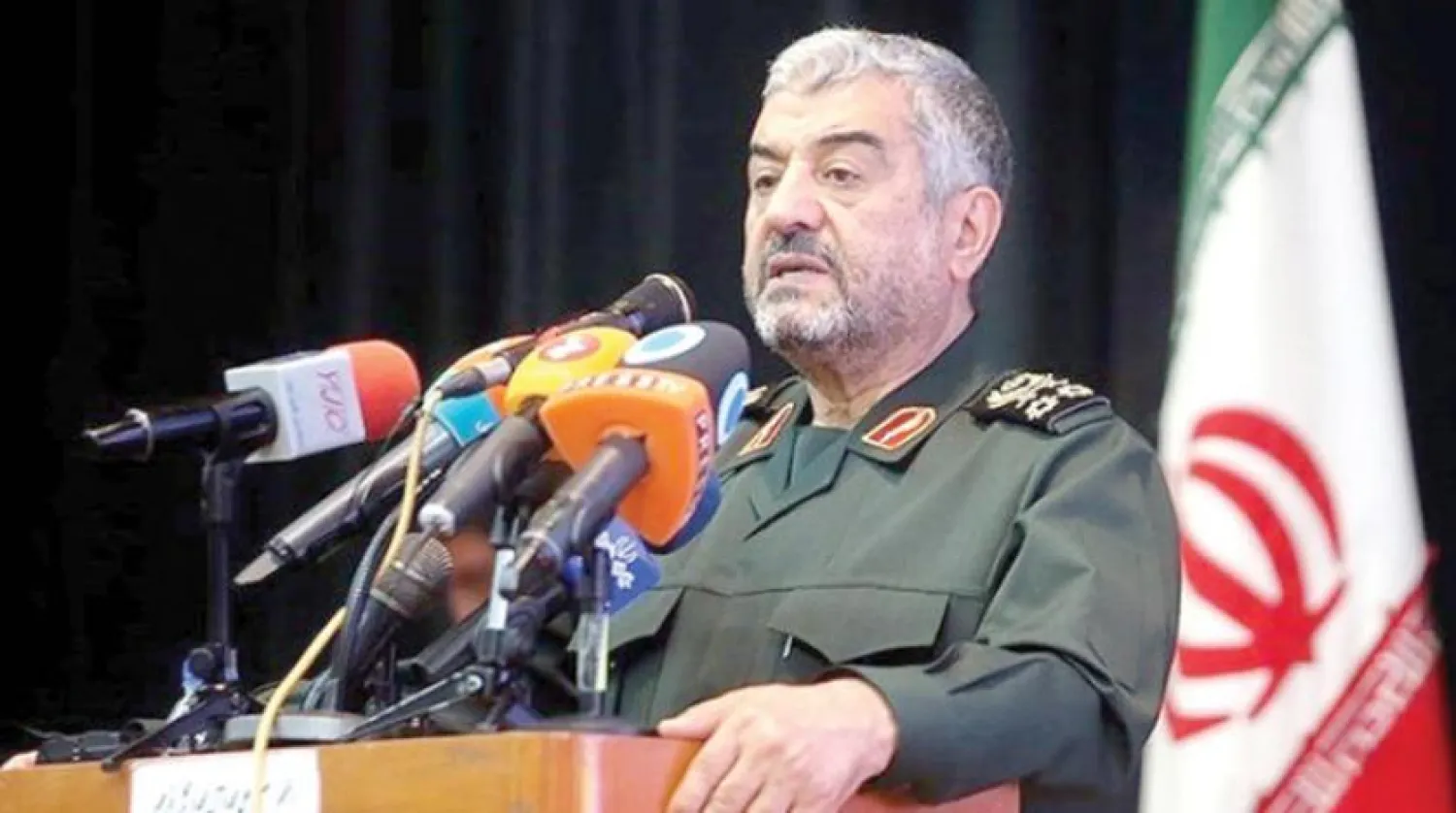

Revolutionary Guards Commander: Coup Militias Play Tehran Regime’s Bidding in Region

Revolutionary Guards Commander Mohammad Ali Jafari addresses a crowd of students at military universities in Tehran. (Tasnim)
TT

Revolutionary Guards Commander: Coup Militias Play Tehran Regime’s Bidding in Region

Revolutionary Guards Commander Mohammad Ali Jafari addresses a crowd of students at military universities in Tehran. (Tasnim)

Iran’s Revolutionary Guards Chief-Commander Major General Mohammad Ali Jafari announced on Thursday the body’s decision to reinforce forces in Iraq and Syria.

Backing the announcement, Supreme Leader representative Ali Saidi said regional developments have weighed in significantly to Tehran’s benefit, especially in shifting its Middle East strategy away from conventional warfare.

However, both leaders denied Iran was taking on a negative role in the region.

Jafari told an audience of students at Revolutionary Guard-affiliated universities that the broad outlines of his forces’ approach, on both external and internal levels, is part of the role played in "guarding the regime".

The military chief also highlighted the role Iran actively plays in five Arab countries: Lebanon, Iraq, Syria, Yemen and Palestine, calling for consolidating the victories of the Iranian axis in the region.

Jafari also said that “victory in Yemen is near," referring to coup forces as an extension of the Iranian revolution, Iran-based ISNA news agency reported.

At the end of November, Jafari revealed Iran's unbound support for Houthi militias in Yemen. However, he said that the support was limited to an "advisory role."

Iran has labeled its presence in each of Syria and Iraq as “advisory” as well.

Jafari implicitly linked regional developments and Iranian internal events, saying that "despite the problems facing Iran, it remains in a good standing abroad."

He said that the Iranian regime is facing threats on cultural, political and economic levels, stressing the need to rehabilitate universities to face “threats”.

"Today we have overcome security and defense threats, but that does not mean there are no threats," he said.

Jafari implicitly referred to the widening rift between the Iranian President Hassan Rouhani’s reformist approach and Tehran conservatives, who look to Iranian Supreme Leader Ali Khamenei for ultimate guidance.

Conservatives in Iran continue to fear Western cultural impact on the public, calling it a “soft” threat in terms of it not being a direct act of war, but still a threat to the Revolutionary Guards’ authority.

He also vaguely criticized Rouhani, pointing out that some officials seek to "appease others, especially when they need votes," describing it as "the reason for not making the right decisions in the country."

In a related context, Supreme Leader Representative Saidi said regional equations changed in favor of Iran after “growing resistance forces spread across the region.”

According to Saidi, the Revolutionary Guards has successfully shifted the status quo from the notion of waging balanced wars to “asymmetric” and proxy wars—tilting the table to its benefit. He said that “Hezbollah’s” war with Israel was a result of this shift.

“Asymmetric” war is a military strategy which capitalizes on the strength gap between warring parties, and highly relies on forming paramilitary gangs and militias to fight organized armies.

Saidi claimed that the region is witnessing a war between the “holy” and the “satanic”—with the "sacred" being a coalition consisting of Iran and pro-Iranian groups, such as “Hezbollah” and Afghan and Fatimid militias, as well as Iraqi and Syrian groups.



Trump Hints at Land Strike as Venezuela Pressure Mounts

A US Air Force C-130J Super Hercules aircraft approaches for landing at Rafael Hernandez Airport, amid tensions between US President Donald Trump's administration and the government of Venezuelan President Nicolas Maduro, in Aguadilla, Puerto Rico, December 28, 2025. (Reuters)
TT

Trump Hints at Land Strike as Venezuela Pressure Mounts

A US Air Force C-130J Super Hercules aircraft approaches for landing at Rafael Hernandez Airport, amid tensions between US President Donald Trump's administration and the government of Venezuelan President Nicolas Maduro, in Aguadilla, Puerto Rico, December 28, 2025. (Reuters)

A throwaway remark last week by President Donald Trump has raised questions about whether US forces may have carried their first land strike against drug cartels in Venezuela.

Trump said the US knocked out a "big facility" for producing trafficking boats, as he was discussing his pressure campaign against Venezuelan President Nicolas Maduro in an interview broadcast Friday.

"They have a big plant or a big facility where they send, you know, where the ships come from," Trump said in an interview with billionaire supporter John Catsimatidis on the WABC radio station in New York.

"Two nights ago we knocked that out. So we hit them very hard."

Trump did not say where the facility was located or give any other details. US forces have carried out numerous strikes in both the Caribbean Sea and eastern Pacific Ocean since September, killing more than 100 people.

The Pentagon referred questions about Trump's remarks to the White House. The White House did not respond to requests for comment from AFP.

There has been no official comment from the Venezuelan government.

Trump has been saying for weeks that the United States will "soon" start carrying out land strikes targeting drug cartels in Latin America, but there have been no confirmed attacks to date.

The Trump administration has been ramping up pressure on Maduro, accusing the Venezuelan leader of running a drug cartel himself and imposing an oil tanker blockade.

Maduro has accused Washington of attempting regime change.


UN Chief Says ‘Get Serious’ in Grim New Year Message

 UN Secretary-General Antonio Guterres. (AFP)
UN Secretary-General Antonio Guterres. (AFP)
TT

UN Chief Says ‘Get Serious’ in Grim New Year Message

 UN Secretary-General Antonio Guterres. (AFP)
UN Secretary-General Antonio Guterres. (AFP)

The United Nations urged global leaders Monday to focus on people and the planet in a New Year's message depicting the world in chaos.

"As we enter the new year, the world stands at a crossroads. Chaos and uncertainty surround us. Division. Violence. Climate breakdown. And systemic violations of international law," UN Secretary-General Antonio Guterres said in a video message.

In 2026, as war rages in Ukraine and elsewhere, world leaders must work to ease human suffering and fight climate change, he added.

"I call on leaders everywhere: Get serious. Choose people and planet over pain," said Guterres, criticizing the global imbalance between military spending and financing for the poorest countries.

Military spending is up nearly 10 percent this year to $2.7 trillion, which is 13 times total world spending on development aid and equivalent to the entire gross domestic product of Africa, he said.

Wars are raging at levels unseen since World War II, he added.

"In this New Year, let's resolve to get our priorities straight. A safer world begins by investing more in fighting poverty and less in fighting wars. Peace must prevail," said Guterres, who will be serving his last year as secretary general.


Türkiye and Armenia Agree to Simplify Visa Procedures to Normalize Ties

Türkiye’s President Recep Tayyip Erdogan, right, and Armenia's Prime Minister Nikol Pashinyan shake hands before a meeting at Prague Castle in Prague, Czech Republic, Thursday, Oct. 6, 2022. (Turkish Presidency via AP, File)
TT

Türkiye and Armenia Agree to Simplify Visa Procedures to Normalize Ties

Türkiye’s President Recep Tayyip Erdogan, right, and Armenia's Prime Minister Nikol Pashinyan shake hands before a meeting at Prague Castle in Prague, Czech Republic, Thursday, Oct. 6, 2022. (Turkish Presidency via AP, File)

Türkiye and Armenia have agreed to simplify visa procedures as part of efforts to normalize ties, Türkiye’s Foreign Ministry announced Monday, making it easier for their citizens to travel between the two countries.

Relations between Türkiye and Armenia have long been strained by historic grievances and Türkiye’s alliance with Azerbaijan. The two neighboring countries have no formal diplomatic ties and their joint border has remained closed since the 1990s.

The two countries, however, agreed to work toward normalization in 2021, appointing special envoys to explore steps toward reconciliation and reopening the frontier. Those talks have progressed in parallel with efforts to ease tensions between Armenia and Azerbaijan.

Türkiye supported Azerbaijan during its 2020 conflict with Armenia for control of the Karabakh region, known internationally as Nagorno-Karabakh, a territorial dispute that had lasted nearly four decades.

The Turkish Foreign Ministry said in a statement posted on social platform X that Ankara and Yerevan agreed that holders of diplomatic, special and service passports from both countries would be able to obtain electronic visas free of charge as of Jan. 1.

“On this occasion, Türkiye and Armenia reaffirm once again their commitment to continue the normalization process between the two countries with the goal of achieving full normalization without any preconditions,” the ministry said.

Türkiye and Armenia also have a more than century-old dispute over the deaths of an estimated 1.5 million Armenians in massacres, deportations and forced marches that began in 1915 in Ottoman Türkiye. Historians widely view the event as genocide.

Türkiye denies the deaths constituted genocide, saying the toll has been inflated and those killed were victims of civil war and unrest. It has lobbied to prevent countries from officially recognizing the massacres as genocide.