


China’s Next Potential Boom Spot: The Places People Overlook

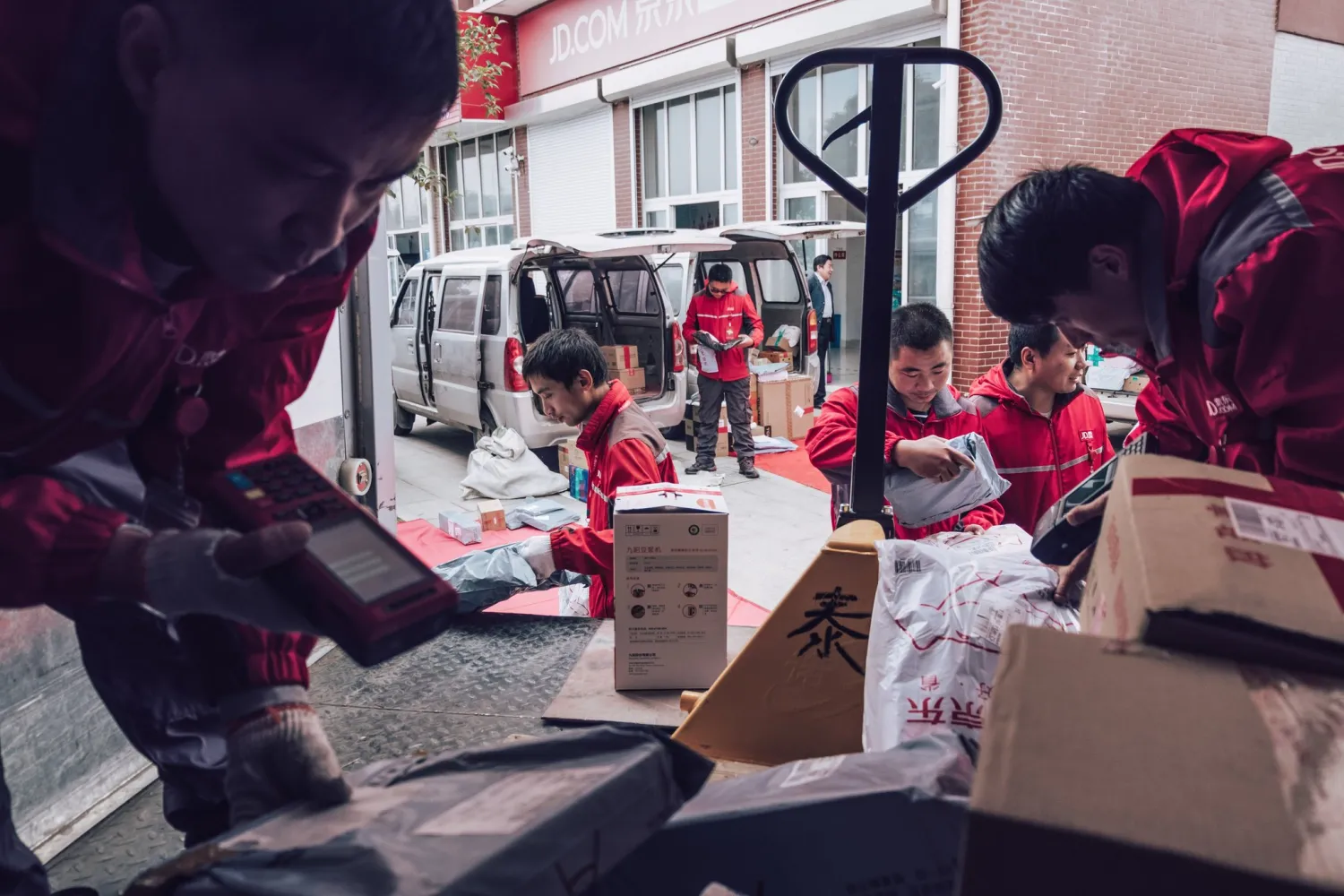
Delivery personnel for JD.com, a Chinese e-commerce company, sorting packages in Liangduo in eastern China. Online shopping has expanded into less developed parts of the country as incomes have risen. Credit Photographs by Yuyang Liu for The New York Times
TT

China’s Next Potential Boom Spot: The Places People Overlook

Delivery personnel for JD.com, a Chinese e-commerce company, sorting packages in Liangduo in eastern China. Online shopping has expanded into less developed parts of the country as incomes have risen. Credit Photographs by Yuyang Liu for The New York Times

One crisp October morning, Han Youjun got into his silver delivery van and left this small town in eastern China. Within minutes, his van brimming with boxes of every size and shape, he was rumbling through rice paddies, down narrow village lanes and past modest farmhouses, deeper and deeper into China’s vast hinterland.

In the past, delivery drivers like Mr. Han would have had little reason to travel so far. China’s boom over the past four decades made its crowded metropolises wealthy. Much of the rest of the country, especially farming communities like those surrounding Liangduo, in the eastern province of Jiangsu, remained relatively poor.

But more and more, the benefits of China’s economic miracle are penetrating into smaller cities and countryside hamlets — as Mr. Han, a 32-year-old deliveryman for JD.com, an online retailer, knows all too well. The 70 packages crammed into his van that day were double the amount he usually hauled only 18 months earlier.

“The workdays have been getting longer,” he said.

China needs spenders in those places. The government is trying to shift the country’s growth engine away from its traditional dependence on factories and building things. Those old growth sources are no longer dependableand require more and more costly debt.

Thanks to China’s digital revolution, advances in farming and billions of dollars spent on thousands of miles of new highways and railways, Chinese people away from the biggest cities are responding. Many of China’s more remote areas are catching up to rich metropolises and connecting to the broader economy in ways they had not before, with potential long-term benefits for the Chinese economy and the world.

In the prefecture that contains Liangduo, Yancheng, locals’ wallets are fattening more quickly than the national rate, and their household spending — which surged 8 percent per person in 2016 — outpaced the rises in Beijing and Shanghai.

Signs of that new prosperity can be seen at Auto City, a jumble of ramshackle, boxy buildings in Yancheng where Toyota, Ford and just about every other major brand compete for customers. Zhou Zhengguo, owner of a dealership for the Chinese automaker Geely, expects to sell 2,000 cars this year, four times more than just two years ago.

“Most people who bought cars were private businessmen,” Mr. Zhou said. “Now working-class people buy, too.”

Those who live in China’s less developed places could be crucial to the next stage of China’s development.

Robin Xing, an economist at Morgan Stanley, believes consumer spending in places like Yancheng’s urban center will continue to outperform bigger cities. As a result, two-thirds of all additional private consumption growth will come from these less developed areas through 2030.

“We do expect them to catch up, to narrow the income gap with the large cities,” Mr. Xing said.

Businesses are looking at such areas in a new light. New highways and high-speed railways make relocating factories and other operations into smaller cities easier, allowing companies to take advantage of their lower costs. Industrial output in Yancheng expanded more quickly than the national rate last year.

The gains are not limited to the hinterland’s main towns. Farms are becoming bigger, more efficient and more lucrative.

In Xinling, a nearby village, Luo Jianhai, 37, is typical of a new breed of farmer-entrepreneur. He has steadily expanded the farm where he tills rice and wheat by renting land from his neighbors. He also invested in two new tractors, which he lends out to other farmers who need them to work their own larger plots. Over the past three years his annual income has increased seven times, to $100,000, and his spending has quadrupled, mainly on higher-quality clothing for his three children and a new, $17,000 car from a General Motors joint venture.

His improved lifestyle, Mr. Luo said, “is the difference between being poor and having money.”

Nearby, Cheng Zhiguo, 47, also enlarged his farm this year, increasing his net income to about $23,000 — five times greater than just three years ago. His reward: his first car, a Hyundai, bought in August.

Such change is luring urban entrepreneurs such as Zhou Jian. Mr. Zhou, a 33-year-old resident of Nanjing, a major city in eastern China, figured that large-scale farming would also need more money. In 2013, he founded Nongfenqi E-Commerce Company, which helps arrange loans for farming families from banks and other lenders.

Nongfenqi has since arranged about $150 million in loans, opened more than 100 offices spread around rural China and hired 800 employees. “The upgrading of the market allows businesses like us to serve these big farmers,” Mr. Zhou said.

Such opportunity has attracted JD.com. Over the past three years, JD.com has more than doubled its army of deliverymen, many aimed at reaching into rural towns and villages.

“Building a rural logistics network is one of our most important strategies,” said Wang Hui, JD.com’s head of delivery services. “With consumption developing in rural areas, we hope we can catch this opportunity to expand our business.”

That chilly morning in Liangduo, where the delivery station opened last year, a giant JD.com truck squeezed down a cluttered central street to disgorge hundreds of packages, which were sorted and carried to customers by nine full-time delivery personnel. The station is intended to help introduce residents to how e-commerce works. Next door, a merchant transformed his appliance shop into a JD.com outlet, where farmers, often unfamiliar with e-commerce, can test products available online and place orders.

It’s an “online-to-offline” experiment to educate these new consumers in online shopping. The delivery station “is not just a logistics center,” said the JD.com manager in Liangduo, Ye Huanglong. “Anyone can come in and ask questions.”

Not all rural regions are advancing as quickly as Liangduo. Hu Bingchuan, deputy researcher at the Rural Development Institute of the Chinese Academy of Social Sciences in Beijing, fears companies may discover, at least for now, that their profits from countryside customers do not match their efforts to chase them.

“Most rural areas are not that successful yet,” he said. “E-commerce platforms won’t be able to copy their success in cities to rural regions.”

The future, though, holds promise. One of Mr. Han’s first stops is at the home of Han Aifeng, a farmer. She ordered cartons of milk, which, she said, make for a convenient refreshment when tending her fish-farming ponds.

The milk is among China’s most expensive brands, but Ms. Han, 64, can now afford it. Her husband works at a furniture factory, while she has increased the family income by raising crayfish and selling them in the local marketplace.

In all, the household’s annual income doubled in the past two years, to about $30,000, and Ms. Han’s spending on food and other goods has increased as well, much of it ordered online, using her smartphone. Discarded delivery boxes for pomelo, rice wine and yogurt are stacked on top of old rice hulls in a corner of her home’s courtyard.

“I used to have to ride an electric bike to the market when I needed to go shopping,” Ms. Han said. “Now people bring everything to my door.”

The New York Times


Mawani, Arabian Chemical Terminals Sign Land Lease for Jubail Port Storage Tanks

Mawani, Arabian Chemical Terminals Sign Land Lease for Jubail Port Storage Tanks
TT

Mawani, Arabian Chemical Terminals Sign Land Lease for Jubail Port Storage Tanks

Mawani, Arabian Chemical Terminals Sign Land Lease for Jubail Port Storage Tanks

The Saudi Ports Authority (Mawani) signed a contract with Arabian Chemical Terminals Ltd. to establish storage tanks for chemical and petrochemical materials at Jubail Commercial Port, with an investment exceeding SAR500 million on an area of 49,000 square meters.

The project will contribute to enhancing operational efficiency and increasing handling capacity in line with the objectives of the National Transport and Logistics Strategy to consolidate the Kingdom’s position as a global logistics hub, SPA reported.

This step is part of Mawani’s efforts to strengthen the role of the private sector in supporting the gross domestic product and to reinforce the position of Jubail Commercial Port as a driver of commercial activity. The project’s storage capacity will reach 70,000 cubic tons, boosting the competitiveness of the Kingdom’s ports at both regional and international levels.

The project aims to develop and expand storage capacity and the export of chemical and petrochemical materials in accordance with the highest international standards while supporting supply chains. It includes the establishment and development of specialized facilities for storing and exporting chemical and petrochemical products, as well as the provision of storage and distribution services for local and international import and export of chemicals in line with global quality and safety standards.

The project will contribute to supporting national supply chains, boosting the Kingdom’s chemical logistics capabilities, and raising operational efficiency and capacity, thereby improving customer competitiveness. It also supports the achievement of Saudi Vision 2030 objectives by promoting the development of infrastructure to advance the energy, industry, and supply chain sectors in the Kingdom.


Oil Prices Stable as Investors Seek Clarity on Russia-Ukraine Talks

A view shows the crude oil terminal Kozmino on the shore of Nakhodka Bay near the port city of Nakhodka, Russia August 12, 2022. REUTERS/Tatiana Meel
TT

Oil Prices Stable as Investors Seek Clarity on Russia-Ukraine Talks

A view shows the crude oil terminal Kozmino on the shore of Nakhodka Bay near the port city of Nakhodka, Russia August 12, 2022. REUTERS/Tatiana Meel

Oil prices were little changed on Tuesday as investors took stock of ​dented hopes of a Russia-Ukraine peace deal and rising geopolitical tensions in the Middle East around Yemen, Reuters reported.

Brent crude futures for February delivery, which expire on Tuesday, were up 15 cents at $62.09 a barrel as of 0918 GMT. The more active March contract was at $61.61, up 12 cents.

US West Texas Intermediate ‌crude gained 14 ‌cents to $58.22.

The Brent and ‌WTI ⁠benchmarks ​settled ‌more than 2% higher in the previous session as Saudi Arabia launched airstrikes against Yemen and after Moscow accused Kyiv of targeting Putin's residence, denting hopes of a peace deal.

Kyiv dismissed Moscow's accusation as baseless and designed to undermine peace negotiations. After a phone call ⁠with Putin, US President Donald Trump said he was angered by details ‌of the alleged attack.

"I think the ‍markets are sensing that ‍a deal is going to be very hard ‍to come by," said Marex analyst Ed Meir.

Traders also watched other Middle East developments after Trump said the United States could support another major strike on Iran were Tehran to resume rebuilding its ballistic missile or nuclear weapons programs.

Despite renewed fears of potential supply disruptions, perceptions of an oversupplied global market remain and could cap prices, analysts say.

Marex's Meir said prices would trend downwards in the first quarter of 2026 due to ‌a "growing oil glut".


Meta Buys China-founded AI Agent Manus

FILE PHOTO: The logo of Meta is seen at Porte de Versailles exhibition center in Paris, France, June 11, 2025. REUTERS/Gonzalo Fuentes/File Photo/File Photo
TT

Meta Buys China-founded AI Agent Manus

FILE PHOTO: The logo of Meta is seen at Porte de Versailles exhibition center in Paris, France, June 11, 2025. REUTERS/Gonzalo Fuentes/File Photo/File Photo

Facebook owner Meta has agreed to acquire Manus, an artificial intelligence agent created by a company founded in China but now based in Singapore, the two firms said.

However, analysts warned the deal could fall foul of regulators at a time of fierce technological rivalry between Washington and Beijing.

Exceeding the capabilities of AI chatbots like ChatGPT, AI agents can autonomously perform complex tasks for users, and are seen as having huge potential.

Manus, created by startup Butterfly Effect, can for example sift through and summarize resumes or create a stock analysis website, according to its website.

Meta said Monday that the deal -- the financial details of which were not disclosed -- will "bring a leading agent to billions of people and unlock opportunities for businesses across our products".

"The era of AI that doesn't just talk, but acts, creates, and delivers, is only beginning," Manus chief executive Xiao Hong said on X.

"And now (with Meta), we get to build it at a scale we never could have imagined."

Meta CEO Mark Zuckerberg is making a huge push into AI, spending billions of dollars on acquisitions, hiring engineers and building data centers.

Bloomberg Intelligence analysts said the purchase is likely aimed at expanding Meta's AI agent task capabilities, and that it could be worth more than $2 billion.

However, "it could draw regulatory scrutiny given that Singapore-based Manus was founded in China", the analysts said.
