


Austria to Become First Western European Country with Far-Right in Govt.

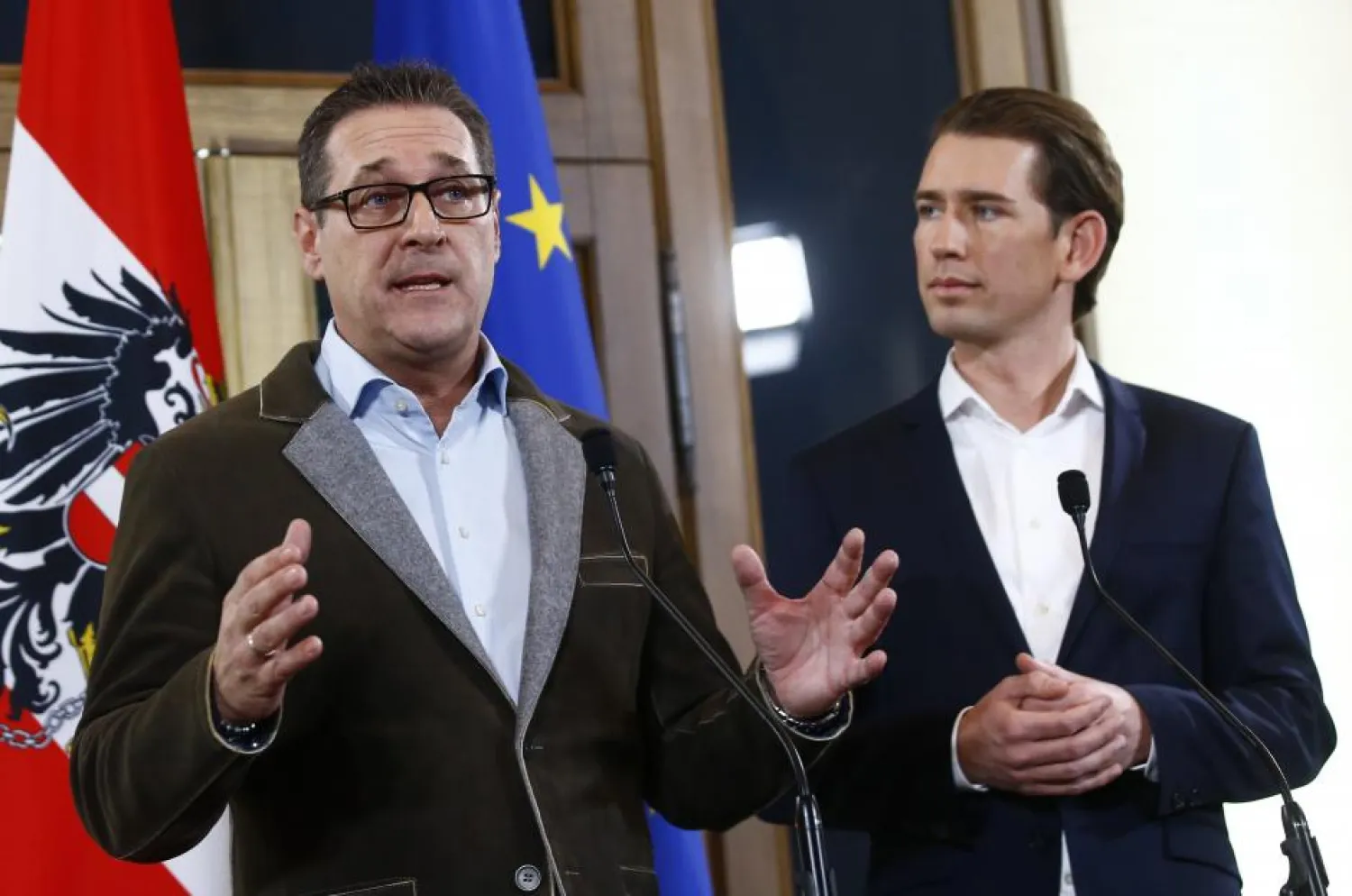
Head of the Freedom Party Heinz-Christian Strache (L) and head of the People's Party Sebastian Kurz address a news conference in Vienna, Austria, December 15, 2017. (Reuters)
TT

Austria to Become First Western European Country with Far-Right in Govt.

Head of the Freedom Party Heinz-Christian Strache (L) and head of the People's Party Sebastian Kurz address a news conference in Vienna, Austria, December 15, 2017. (Reuters)

Austrian People’s Party Sebastian Kurz’s conservatives struck a coalition deal on Saturday with the anti-immigration Freedom Party, which would make Austria the only western European country with a far-right party in government.

The two sides agreed to share power almost equally. Under the deal reached late Friday night, Sebastian Kurz, head of the Austrian People's Party, will become chancellor, which will make him Europe's youngest leader when he is sworn in on Monday at age 31.

Right-wing Freedom Party (FPO) leader Heinz-Christian Strache will be vice chancellor and minister for sports and public servants.

Kurz said the new government would not hold a referendum on European Union membership.

Strache announced their deal on Friday night, handing the far right a share of power for the third time in the Alpine republic, after more than a decade in opposition.

The FPO will take control of much of Austria’s security apparatus, in charge of the foreign, interior and defense ministries. The People’s Party (OVP) led by Kurz will control the powerful finance ministry as well the justice and agriculture portfolios.

“No one need be afraid,” Austrian news agency APA quoted the incoming interior minister and chairman of the FPO, Herbert Kickl, as saying. Kickl began his career as a speechwriter for the late Joerg Haider, who praised Adolf Hitler’s employment policies and led the party to its first mainstream electoral success.

Kurz has repeatedly said his government will be pro-European despite including the FPO, which was founded by former Nazis and campaigned against Austria joining the bloc when it was put to a referendum in 1994.

The coalition plans to make referendums more widely available. Unlike France’s National Front, the FPO has backed away from calling for a referendum on leaving the European Union but Kurz obtained a guarantee that a Brexit-style vote will not be held.

“There will be no votes on our membership of international organizations, including the European Union,” Kurz told a joint news conference with Strache.

Kurz’s office will also take over some European departments from the FPO-run foreign ministry to give him greater control over EU matters.

The 180-page coalition agreement listed plans such as sinking taxes and cutting public spending through streamlined administration though it often did not say how such goals would be achieved.

Austria’s parliamentary election two months ago was dominated by Europe’s migration crisis, in which the affluent country took in a large number of asylum seekers.

Kurz’s party won with a hard line on immigration that often overlapped with the FPO‘s, pledging to cut benefits for refugees and never to allow a repeat of 2015’s wave of arrivals. The FPO came third in the election with 26 percent of the vote.

Kurz and Strache held their news conference outlining the agreement on the Kahlenberg, a hill on the outskirts of the capital famed as the site of the 1683 Battle of Vienna, which ended a siege of the city by Ottoman Turks.

While there was no specific mention of repelling that Muslim invasion, the symbolism is clear for two parties that have warned Muslim “parallel societies” are emerging in Austria.

Kurz, however, told reporters: “I did not take the decision on where the press conference should be held.... I would not read too much symbolism into it.”

The coalition agreement calls for bolstering the country's police forces with another 2,100 officers, as well as immigration policies that "can be sustained by the population." It also says asylum should only be offered to people "for the duration of their persecution, who really need Austria's help."

Strache and Kurz oppose Turkish membership of the EU, a position that polls regularly show most Austrians support.

“We both recognize about 75 percent of ourselves in the program,” said Strache, who accused Kurz during the campaign of stealing his party’s ideas. “That might have something to do with the fact that one or the other maybe took on the other’s policy points before the election.”

Anti-establishment parties have been winning over more voters in Europe, capitalizing on dissatisfaction with mainstream politicians’ handling of the economy, security and immigration.

While other far-right parties have gained ground this year, entering parliament in Germany and making France’s presidential run-off, the FPO is going further by entering government and securing key ministries.

“It is excellent news for Europe,” Marine Le Pen said of the coalition deal at a Prague meeting of her National Front party’s European grouping, which includes the FPO. “These successes show that the nation states are the future, that the Europe of tomorrow is a Europe of the people.”

Both the OVP and FPO believe the EU should focus on fewer tasks, like securing its external borders, and hand more power back to member states.

When the FPO last entered government in 2000 other EU countries imposed sanctions on Vienna in protest. There is unlikely to be a similar outcry this time, given the rise of anti-establishment parties across the continent.



Trump Hints at Land Strike as Venezuela Pressure Mounts

A US Air Force C-130J Super Hercules aircraft approaches for landing at Rafael Hernandez Airport, amid tensions between US President Donald Trump's administration and the government of Venezuelan President Nicolas Maduro, in Aguadilla, Puerto Rico, December 28, 2025. (Reuters)
TT

Trump Hints at Land Strike as Venezuela Pressure Mounts

A US Air Force C-130J Super Hercules aircraft approaches for landing at Rafael Hernandez Airport, amid tensions between US President Donald Trump's administration and the government of Venezuelan President Nicolas Maduro, in Aguadilla, Puerto Rico, December 28, 2025. (Reuters)

A throwaway remark last week by President Donald Trump has raised questions about whether US forces may have carried their first land strike against drug cartels in Venezuela.

Trump said the US knocked out a "big facility" for producing trafficking boats, as he was discussing his pressure campaign against Venezuelan President Nicolas Maduro in an interview broadcast Friday.

"They have a big plant or a big facility where they send, you know, where the ships come from," Trump said in an interview with billionaire supporter John Catsimatidis on the WABC radio station in New York.

"Two nights ago we knocked that out. So we hit them very hard."

Trump did not say where the facility was located or give any other details. US forces have carried out numerous strikes in both the Caribbean Sea and eastern Pacific Ocean since September, killing more than 100 people.

The Pentagon referred questions about Trump's remarks to the White House. The White House did not respond to requests for comment from AFP.

There has been no official comment from the Venezuelan government.

Trump has been saying for weeks that the United States will "soon" start carrying out land strikes targeting drug cartels in Latin America, but there have been no confirmed attacks to date.

The Trump administration has been ramping up pressure on Maduro, accusing the Venezuelan leader of running a drug cartel himself and imposing an oil tanker blockade.

Maduro has accused Washington of attempting regime change.


UN Chief Says ‘Get Serious’ in Grim New Year Message

 UN Secretary-General Antonio Guterres. (AFP)
UN Secretary-General Antonio Guterres. (AFP)
TT

UN Chief Says ‘Get Serious’ in Grim New Year Message

 UN Secretary-General Antonio Guterres. (AFP)
UN Secretary-General Antonio Guterres. (AFP)

The United Nations urged global leaders Monday to focus on people and the planet in a New Year's message depicting the world in chaos.

"As we enter the new year, the world stands at a crossroads. Chaos and uncertainty surround us. Division. Violence. Climate breakdown. And systemic violations of international law," UN Secretary-General Antonio Guterres said in a video message.

In 2026, as war rages in Ukraine and elsewhere, world leaders must work to ease human suffering and fight climate change, he added.

"I call on leaders everywhere: Get serious. Choose people and planet over pain," said Guterres, criticizing the global imbalance between military spending and financing for the poorest countries.

Military spending is up nearly 10 percent this year to $2.7 trillion, which is 13 times total world spending on development aid and equivalent to the entire gross domestic product of Africa, he said.

Wars are raging at levels unseen since World War II, he added.

"In this New Year, let's resolve to get our priorities straight. A safer world begins by investing more in fighting poverty and less in fighting wars. Peace must prevail," said Guterres, who will be serving his last year as secretary general.


Türkiye and Armenia Agree to Simplify Visa Procedures to Normalize Ties

Türkiye’s President Recep Tayyip Erdogan, right, and Armenia's Prime Minister Nikol Pashinyan shake hands before a meeting at Prague Castle in Prague, Czech Republic, Thursday, Oct. 6, 2022. (Turkish Presidency via AP, File)
TT

Türkiye and Armenia Agree to Simplify Visa Procedures to Normalize Ties

Türkiye’s President Recep Tayyip Erdogan, right, and Armenia's Prime Minister Nikol Pashinyan shake hands before a meeting at Prague Castle in Prague, Czech Republic, Thursday, Oct. 6, 2022. (Turkish Presidency via AP, File)

Türkiye and Armenia have agreed to simplify visa procedures as part of efforts to normalize ties, Türkiye’s Foreign Ministry announced Monday, making it easier for their citizens to travel between the two countries.

Relations between Türkiye and Armenia have long been strained by historic grievances and Türkiye’s alliance with Azerbaijan. The two neighboring countries have no formal diplomatic ties and their joint border has remained closed since the 1990s.

The two countries, however, agreed to work toward normalization in 2021, appointing special envoys to explore steps toward reconciliation and reopening the frontier. Those talks have progressed in parallel with efforts to ease tensions between Armenia and Azerbaijan.

Türkiye supported Azerbaijan during its 2020 conflict with Armenia for control of the Karabakh region, known internationally as Nagorno-Karabakh, a territorial dispute that had lasted nearly four decades.

The Turkish Foreign Ministry said in a statement posted on social platform X that Ankara and Yerevan agreed that holders of diplomatic, special and service passports from both countries would be able to obtain electronic visas free of charge as of Jan. 1.

“On this occasion, Türkiye and Armenia reaffirm once again their commitment to continue the normalization process between the two countries with the goal of achieving full normalization without any preconditions,” the ministry said.

Türkiye and Armenia also have a more than century-old dispute over the deaths of an estimated 1.5 million Armenians in massacres, deportations and forced marches that began in 1915 in Ottoman Türkiye. Historians widely view the event as genocide.

Türkiye denies the deaths constituted genocide, saying the toll has been inflated and those killed were victims of civil war and unrest. It has lobbied to prevent countries from officially recognizing the massacres as genocide.