

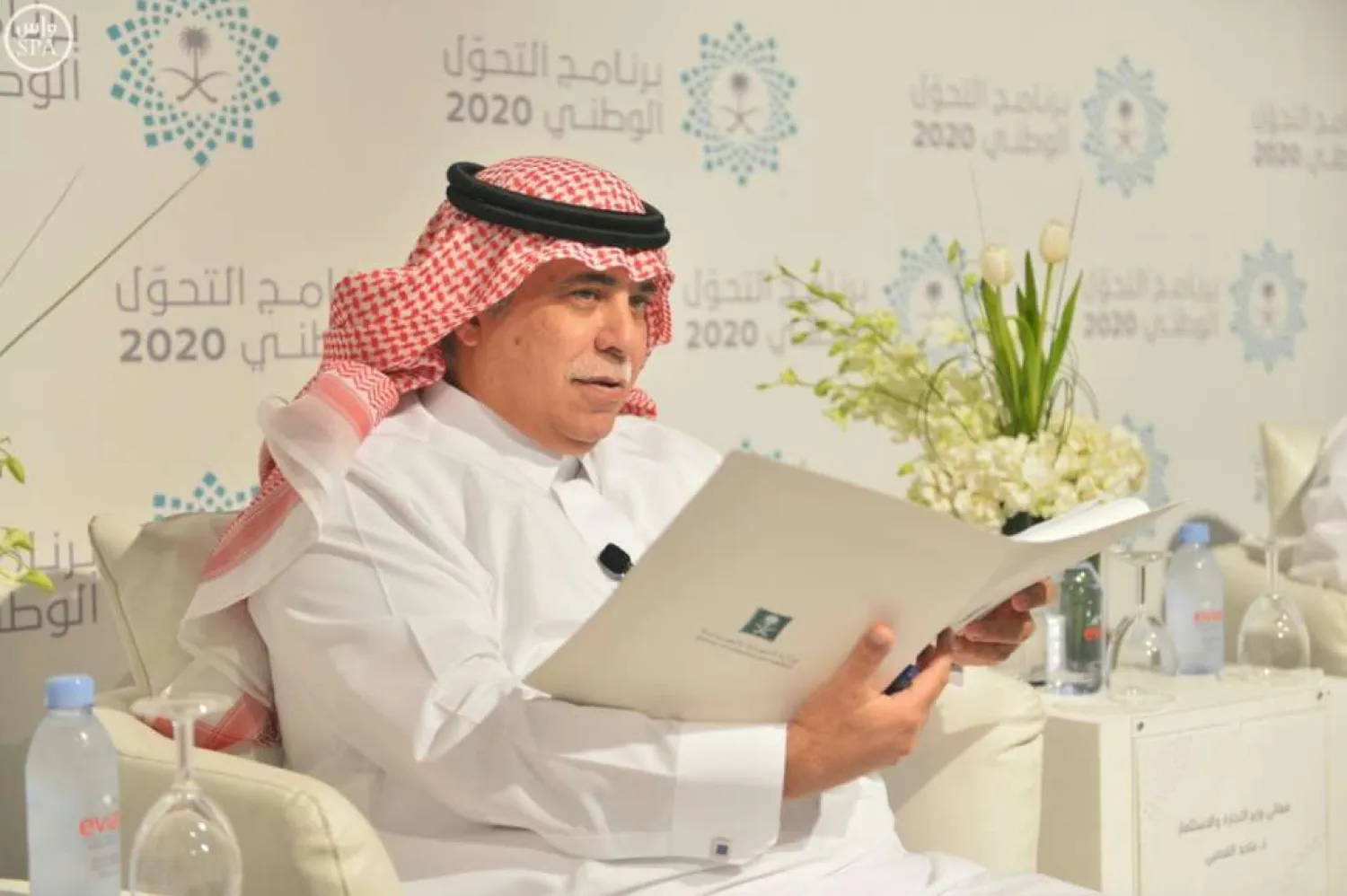

Saudi Minister of Commerce: Building Code Fundamental Pillar of National Economy

Saudi Minister of Commerce and Investment Majid al-Qasabi. (SPA)
TT

Saudi Minister of Commerce: Building Code Fundamental Pillar of National Economy

Saudi Minister of Commerce and Investment Majid al-Qasabi. (SPA)

Saudi Minister of Commerce and Investment, Majid al-Qassabi, Chairman of the Saudi Standards, Metrology and Quality Organization, affirmed the importance of the Saudi Building Code as one of the most important pillars in supporting the national economy and enhancing citizens' safety measures.

Speaking during the first introductory workshop on "Saudi Building Code", the minister urged all members of the technical teams in the National Committee of Building Code to work hard to complete the basic requirements, ahead of the phase of obligatory compliance with the code.

The workshop was held on Saturday with the participation of members and representatives of technical teams and a number of specialists and interested parties.

Qasabi expressed his confidence that the Saudi Building Code represents a qualitative addition to the country and the citizen, including its technical requirements and operational and legal requirements that will achieve more safety rates in the construction sector of the Kingdom.

The Minister thanked all the representatives of the government bodies participating in the workshop wishing their work success, with its positive impact on the sustainability of buildings and public safety.

Meanwhile, Chairman of the National Committee of the Saudi Building Code Saad al-Qasabi, pointed out that the issuance of Royal Decree No. (M / 43) dated 26/4/1438 AH requires the application of the code on all construction and building sectors.

Saudi Building Code is the reference code for the GCC Building Code, as agreed by all Gulf Cooperation Council (GCC) member states.

Saad al-Qasabi revealed that the National Committee of Building Code is working diligently ahead of the implementation stage through integrated regulations through the preparation of the implementing regulations for the code system and preparation of the classification list of violations.

The National Committee is also working to address gaps in the current national system of building code to reach an integrated institutional framework which ensures efficiency in the implementation of the code and updating it through an integrated focus of corporate governance and strategy.

The first workshop included an introduction of the work of the National Committee of Building Code, and draft of the executive regulations and the classification of violations.

The workshop also included the presentation of 11 subcommittees involved in the preparation, review and development of the code, with the participation of over 14 governmental agencies, including the Ministry of Interior, Ministry of Transport, Ministry of Energy, Industry and Mineral Resources, Ministry of Trade and Investment, Ministry of Environment, Water and Agriculture, King Abdulaziz City for Science and Technology, Saudi Standards, Metrology, and Quality Organization, Royal Commission for Jubail and Yanbu, Saudi Council for Engineers, Saudi Geological Survey and Saudi Aramco.

The National Committee of Building Code is currently finalizing the code update and preparing for the second workshop where the technical outputs of the working teams will be introduced to specialists of public and private sectors in various fields. The third introductory workshop will be for all interested parties and it is expected to be finalized over the next few months.


Chile to Restore Global Leadership in Lithium Production

Aerial view of brine ponds and processing areas of the lithium mine of the Chilean company SQM (Sociedad Quimica Minera) in the Atacama Desert, Calama, Chile, on September 12, 2022. (AFP)
TT

Chile to Restore Global Leadership in Lithium Production

Aerial view of brine ponds and processing areas of the lithium mine of the Chilean company SQM (Sociedad Quimica Minera) in the Atacama Desert, Calama, Chile, on September 12, 2022. (AFP)

Chile's state-owned copper producer, Codelco, together with Chinese-backed private miner, SQM, announced on Saturday the creation of a giant company to exploit lithium, often referred to as "white gold."

The South American country is the world’s second-largest producer of lithium, a key component of EVs and other clean technologies and has about 40% of the world’s lithium reserves.

The partnership between the firms will allow them to jointly ramp up the exploration of lithium in the Atacama region of northern Chile.

The public-private partnership will be named Nova Andino Litio SpA, said Codelco, which described the agreement as one of the most significant deals in Chilean business history.

The Chinese firm Tianqi holds 22% stake in SQM.

In a statement, Codelco said the new partnership will carry out lithium exploration, extraction, production, and commercialization activities in the Atacama salt flat until 2060.

The agreement was approved by more than 20 national and international regulatory authorities, including those in China, Brazil, Saudi Arabia, and the European Union.

Chile was the last of the countries to clear the deal. Last month, China gave the green light to the planned partnership between Codelco and SQM.

The new venture is intended to help Chile regain global leadership in lithium production, a position it lost to Australia nearly a decade ago.

The partnership aims to expand lithium output in the Atacama region, with plans to increase production by around 300,000 tons per year. In 2022, Chile produced 243,100 tons of lithium.

The partnership also aligns with Chile’s National Lithium Strategy, announced in 2023 by the leftist government of President Gabriel Boric, aimed at reclaiming Chile’s global leadership in lithium production.


China's BYD Poised to Overtake Tesla in 2025 EV Sales

The Tesla logo is seen in this illustration taken July 23, 2025. (Reuters)
TT

China's BYD Poised to Overtake Tesla in 2025 EV Sales

The Tesla logo is seen in this illustration taken July 23, 2025. (Reuters)

Growing Chinese auto giant BYD stands poised to officially surpass Tesla as the world's biggest electric vehicle company in annual sales.

The two groups are expected soon to publish their final figures for 2025, and based on sales data so far this year, there is almost no chance the American company led by Elon Musk will retain its leadership position.

At the end of November, Shenzhen-based BYD, which also produces hybrid vehicles, had sold 2.07 million EVs so far in 2025.

Tesla, for its part, had sold 1.22 million by the end of September.

Tesla's September figures included a one-time boost in sales, to nearly half-a-million vehicles in a three-month period, before the expiration of a US tax credit for buyers of electric vehicles -- which ended under legislation backed by President Donald Trump, a climate change skeptic.

But Tesla's sales in the coming quarter are expected to fall to 449,000, according to a FactSet analysis consensus. That would give Tesla about 1.65 million sales for all of 2025, a drop of 7.7 percent and well below the level BYD had attained by end November.

Deutsche Bank, which projects just 405,000 Tesla EV sales during the fourth quarter, sees the company's sales down by around one-third in both North America and Europe, and by one-tenth in China.

- Transition period -

Industry watchers say it will take time for EV demand to reach a level of equilibrium in the United States following the elimination of the $7,500 US tax credit at the end of September 2025.

Even prior to that, Tesla had seen sales struggle in key markets over CEO Musk's political support of Trump and other far-right politicians. Tesla has also faced rising EV competition from BYD and other Chinese companies and from European giants.

"We believe Tesla will see some weakness on deliveries" in the fourth quarter, said Dan Ives of Wedbush Securities.

Sales of 420,000 would be "good enough to show stable demand," with Wall Street "laser focused on the autonomous chapter kicking off in 2026," Ives added, referring to plans for self-driving vehicles.

Even as it has grown quickly, BYD has faced challenges in its home market.

With profitability in China weighed down by price-wary consumers, the company has sought to strengthen its foothold in foreign markets.

BYD is "one of the pioneers to establish overseas production capacity and supply chains for EVs," Jing Yang, Director of Asia-Pacific Corporate Ratings at Fitch Ratings, told AFP.

"Going forward, its geographical diversification is likely to help it to navigate an increasingly complicated global tariff environment," said Yang.

Overseas rivals to BYD have balked at Chinese state subsidies and other state supports that have allowed the company to sell vehicles cheaply.

Trump's predecessor Joe Biden imposed 100 percent tariffs on Chinese EV imports that could potentially go even higher under Trump. Europe has also imposed tariffs on Chinese imports, but BYD is building manufacturing capacity in Hungary.

While the chance of Tesla reclaiming its global leadership in EVs looks uncertain, the American company is also potentially positioned for growth.

Michaeli of TD Cowen sees autonomous technology playing an increasingly important role for Tesla, with breakthroughs in its "full self-driving" or "FSD" offerings potentially boosting sales.

"As Tesla really begins to roll out eyes-off features and expand FSDs capability, if they do that successfully, that should generate more demand for their vehicles," Michaeli said.

Musk has said the Cybercab, an autonomous robotaxi model, will begin production in April 2026. The company has also unveiled lower-priced versions of the Models 3 and Y that could boost sales.


China Says to Launch Digital Currency Action Plan

People walk past a shopping mall in Beijing on December 28, 2025. (AFP)
TT

China Says to Launch Digital Currency Action Plan

People walk past a shopping mall in Beijing on December 28, 2025. (AFP)

China will on January 1 launch an "action plan" for boosting management and operations of its digital currency, a deputy governor of the country's central bank said Monday.

"The future digital yuan will be a modern digital payment and circulation means issued and circulated within the financial system," People's Bank of China (PBoC) Deputy Governor Lu Lei wrote in Financial News, a media outlet under the central bank.

In the next step towards that goal, a "new generation" arrangement for digital yuan will be launched on January 1, Lu said, encompassing a "measurement framework, management system, operating mechanism and ecosystem".

The "action plan" will see banks pay interest on balances held by clients in digital yuan -- a move to incentivize broader adoption of the currency.

The plan also includes a proposal to establish an international digital yuan operations center in the eastern financial hub of Shanghai, the report said.

Monetary authorities around the world have in recent years been exploring ways to digitalize currencies, propelled by a boom in online payments during the pandemic and the increased popularity of cryptocurrencies such as bitcoin.

The PBoC has been working on a digital currency since 2014 and has been testing the use of a "digital yuan" or "e-CNY" in various pilot programs.

Consumers across the country already widely use mobile and online payments, but the digital yuan could allow the central bank -- rather than the big tech giants -- access to more data and control over payments.