

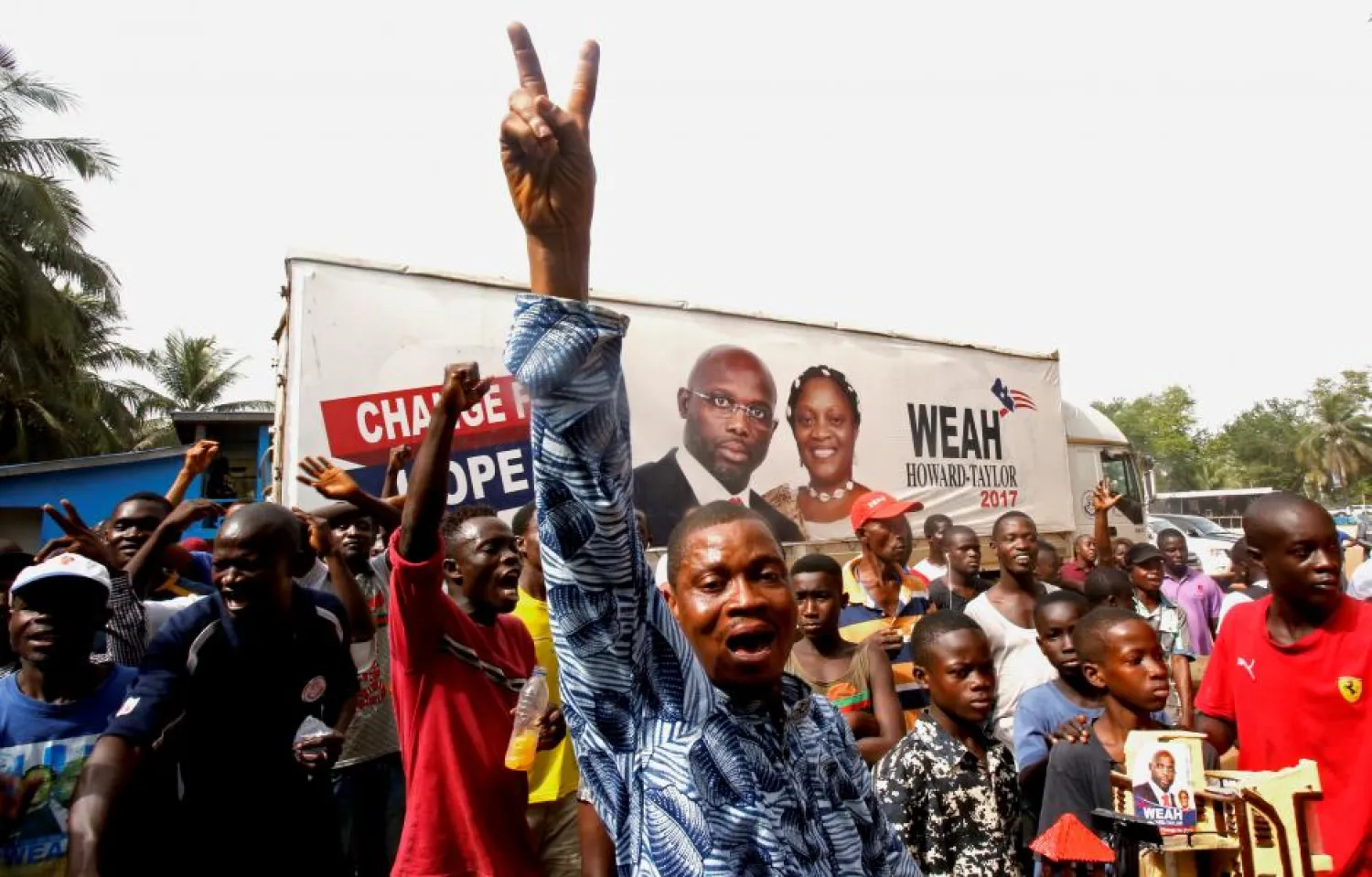

Former Football Star Weah Elected Liberia President

Supporters of George Weah, former football player and presidential candidate, celebrate after the announcement of the elections results in Monrovia, Liberia. (Reuters)
TT

Former Football Star Weah Elected Liberia President

Supporters of George Weah, former football player and presidential candidate, celebrate after the announcement of the elections results in Monrovia, Liberia. (Reuters)

George Weah, the former FIFA World Player of Year, won an emphatic victory in Liberia’s presidential elections amid jubilant celebrations among his supporters.

He now faces the daunting task of delivering tangible benefits to his expectant supporters in the face of a gutted economy and waning donor support.

He was met by hundreds of screaming supporters on his arrival at his party headquarters on Friday. Many have waited over a decade -- since his failed bid for the presidency in 2005 -- to see a man they consider their own come to power.

Those supporters come with high expectations that the former football star may have to carefully temper if he is to hold onto his widespread support, particularly among the West African country’s disaffected youth.

“People are expecting too much of him, but we know he will do us proud,” said Diane Fbarh, a 24-year-old accounting student as she waited for Weah to appear at his party headquarters on Friday. “I don’t think he will let us down.”

Weah, who grew up kicking a raggedy football ball on the dusty streets of the capital Monrovia’s Clara Town slum and later played for top European clubs, successfully tapped into dissatisfaction with Ellen Johnson Sirleaf’s 12-year presidency.

Johnson Sirleaf won the Nobel Peace Prize in 2011 for helping cement peace after civil wars from 1989-2003 but has been criticized over persistent poverty and corruption scandals.

The challenge of lending substance to vague campaign promises is steep in a country that ranks 177th out of 188 on the UN Human Development Index.

Chronic problems with electricity delivery leave most of the country without power and even downtown Monrovia is frequently in the dark. Much of rural Liberia is effectively cut off from the capital when summer rains flood the pitted dirt roads.

Hit hard by a 2014-16 Ebola outbreak that killed thousands, low prices for chief exports iron ore and rubber and declining foreign aid, Liberia’s economy has sputtered and relies on overseas remittances for more than a quarter of GDP.

The economy contracted last year and the International Monetary Fund last month revised down its GDP growth forecasts for 2017 and 2018 due to sluggish commodity prices and the drawdown of the country’s UN peacekeeping mission.

Johnson Sirleaf’s administration was also dogged by several corruption scandals. She suspended her son and 45 other government officials in 2012 for failing to declare their assets to anti-corruption authorities and faced accusations of nepotism. She denied those charges.

Weah, 51, has vowed to form a “government of inclusion” in a country still riven by divisions based on ethnicity, class and political affiliation, but opponents have criticized his lack of political experience and education.

“It boils down to the team he puts together. He needs people with integrity and skill to implement change,” said political analyst Robtel Neajai Pailey.

“He needs to focus on two or three things. He can’t do it all -- that would be impossible,” Pailey said.

Vice President Joseph Boakai conceded defeat to Weah on Friday, urging his supporters to rally behind the president-elect. But Boakai’s supporters remained skeptical.

“It is a bad thing that Weah was elected,” said Victor Smith, an IT consultant “He lacks the experience. He never gave a platform. He doesn’t have the skills to be a leader.”

Besides a tweet he sent out after results were announced on Thursday, Weah has yet to address the public. His press team says he has been busy taking congratulatory calls from world leaders.

On the domestic front, the hard work will begin soon.

On Thursday, Johnson Sirleaf announced plans to immediately form a joint presidential transition team to coordinate the transfer of power and ensure Weah receives regular national security briefings.

Nigeria’s President Muhammadu Buhari George Weah on his election, commending the Liberian people "on the peaceful conduct of the historic presidential runoff election. "

He called Tuesday's vote "another plus on Africa's democratic scoreboard."

Buhari said Nigeria is ready to work with Liberia on issues of mutual interest and called Weah's victory "an affirmation of the will of the Liberian people to remain united, peaceful and prosperous."

French President Emmanuel Macron called Weah to congratulate him and invite him to visit. The French presidency said in a statement that Weah accepted the invitation.

Macron said the former football star still has "a special place in the French's hearts."

Weah played with AS Monaco and Paris Saint-Germain, among others.


Trump Hints at Land Strike as Venezuela Pressure Mounts

A US Air Force C-130J Super Hercules aircraft approaches for landing at Rafael Hernandez Airport, amid tensions between US President Donald Trump's administration and the government of Venezuelan President Nicolas Maduro, in Aguadilla, Puerto Rico, December 28, 2025. (Reuters)
TT

Trump Hints at Land Strike as Venezuela Pressure Mounts

A US Air Force C-130J Super Hercules aircraft approaches for landing at Rafael Hernandez Airport, amid tensions between US President Donald Trump's administration and the government of Venezuelan President Nicolas Maduro, in Aguadilla, Puerto Rico, December 28, 2025. (Reuters)

A throwaway remark last week by President Donald Trump has raised questions about whether US forces may have carried their first land strike against drug cartels in Venezuela.

Trump said the US knocked out a "big facility" for producing trafficking boats, as he was discussing his pressure campaign against Venezuelan President Nicolas Maduro in an interview broadcast Friday.

"They have a big plant or a big facility where they send, you know, where the ships come from," Trump said in an interview with billionaire supporter John Catsimatidis on the WABC radio station in New York.

"Two nights ago we knocked that out. So we hit them very hard."

Trump did not say where the facility was located or give any other details. US forces have carried out numerous strikes in both the Caribbean Sea and eastern Pacific Ocean since September, killing more than 100 people.

The Pentagon referred questions about Trump's remarks to the White House. The White House did not respond to requests for comment from AFP.

There has been no official comment from the Venezuelan government.

Trump has been saying for weeks that the United States will "soon" start carrying out land strikes targeting drug cartels in Latin America, but there have been no confirmed attacks to date.

The Trump administration has been ramping up pressure on Maduro, accusing the Venezuelan leader of running a drug cartel himself and imposing an oil tanker blockade.

Maduro has accused Washington of attempting regime change.


UN Chief Says ‘Get Serious’ in Grim New Year Message

 UN Secretary-General Antonio Guterres. (AFP)
UN Secretary-General Antonio Guterres. (AFP)
TT

UN Chief Says ‘Get Serious’ in Grim New Year Message

 UN Secretary-General Antonio Guterres. (AFP)
UN Secretary-General Antonio Guterres. (AFP)

The United Nations urged global leaders Monday to focus on people and the planet in a New Year's message depicting the world in chaos.

"As we enter the new year, the world stands at a crossroads. Chaos and uncertainty surround us. Division. Violence. Climate breakdown. And systemic violations of international law," UN Secretary-General Antonio Guterres said in a video message.

In 2026, as war rages in Ukraine and elsewhere, world leaders must work to ease human suffering and fight climate change, he added.

"I call on leaders everywhere: Get serious. Choose people and planet over pain," said Guterres, criticizing the global imbalance between military spending and financing for the poorest countries.

Military spending is up nearly 10 percent this year to $2.7 trillion, which is 13 times total world spending on development aid and equivalent to the entire gross domestic product of Africa, he said.

Wars are raging at levels unseen since World War II, he added.

"In this New Year, let's resolve to get our priorities straight. A safer world begins by investing more in fighting poverty and less in fighting wars. Peace must prevail," said Guterres, who will be serving his last year as secretary general.


Türkiye and Armenia Agree to Simplify Visa Procedures to Normalize Ties

Türkiye’s President Recep Tayyip Erdogan, right, and Armenia's Prime Minister Nikol Pashinyan shake hands before a meeting at Prague Castle in Prague, Czech Republic, Thursday, Oct. 6, 2022. (Turkish Presidency via AP, File)
TT

Türkiye and Armenia Agree to Simplify Visa Procedures to Normalize Ties

Türkiye’s President Recep Tayyip Erdogan, right, and Armenia's Prime Minister Nikol Pashinyan shake hands before a meeting at Prague Castle in Prague, Czech Republic, Thursday, Oct. 6, 2022. (Turkish Presidency via AP, File)

Türkiye and Armenia have agreed to simplify visa procedures as part of efforts to normalize ties, Türkiye’s Foreign Ministry announced Monday, making it easier for their citizens to travel between the two countries.

Relations between Türkiye and Armenia have long been strained by historic grievances and Türkiye’s alliance with Azerbaijan. The two neighboring countries have no formal diplomatic ties and their joint border has remained closed since the 1990s.

The two countries, however, agreed to work toward normalization in 2021, appointing special envoys to explore steps toward reconciliation and reopening the frontier. Those talks have progressed in parallel with efforts to ease tensions between Armenia and Azerbaijan.

Türkiye supported Azerbaijan during its 2020 conflict with Armenia for control of the Karabakh region, known internationally as Nagorno-Karabakh, a territorial dispute that had lasted nearly four decades.

The Turkish Foreign Ministry said in a statement posted on social platform X that Ankara and Yerevan agreed that holders of diplomatic, special and service passports from both countries would be able to obtain electronic visas free of charge as of Jan. 1.

“On this occasion, Türkiye and Armenia reaffirm once again their commitment to continue the normalization process between the two countries with the goal of achieving full normalization without any preconditions,” the ministry said.

Türkiye and Armenia also have a more than century-old dispute over the deaths of an estimated 1.5 million Armenians in massacres, deportations and forced marches that began in 1915 in Ottoman Türkiye. Historians widely view the event as genocide.

Türkiye denies the deaths constituted genocide, saying the toll has been inflated and those killed were victims of civil war and unrest. It has lobbied to prevent countries from officially recognizing the massacres as genocide.
