



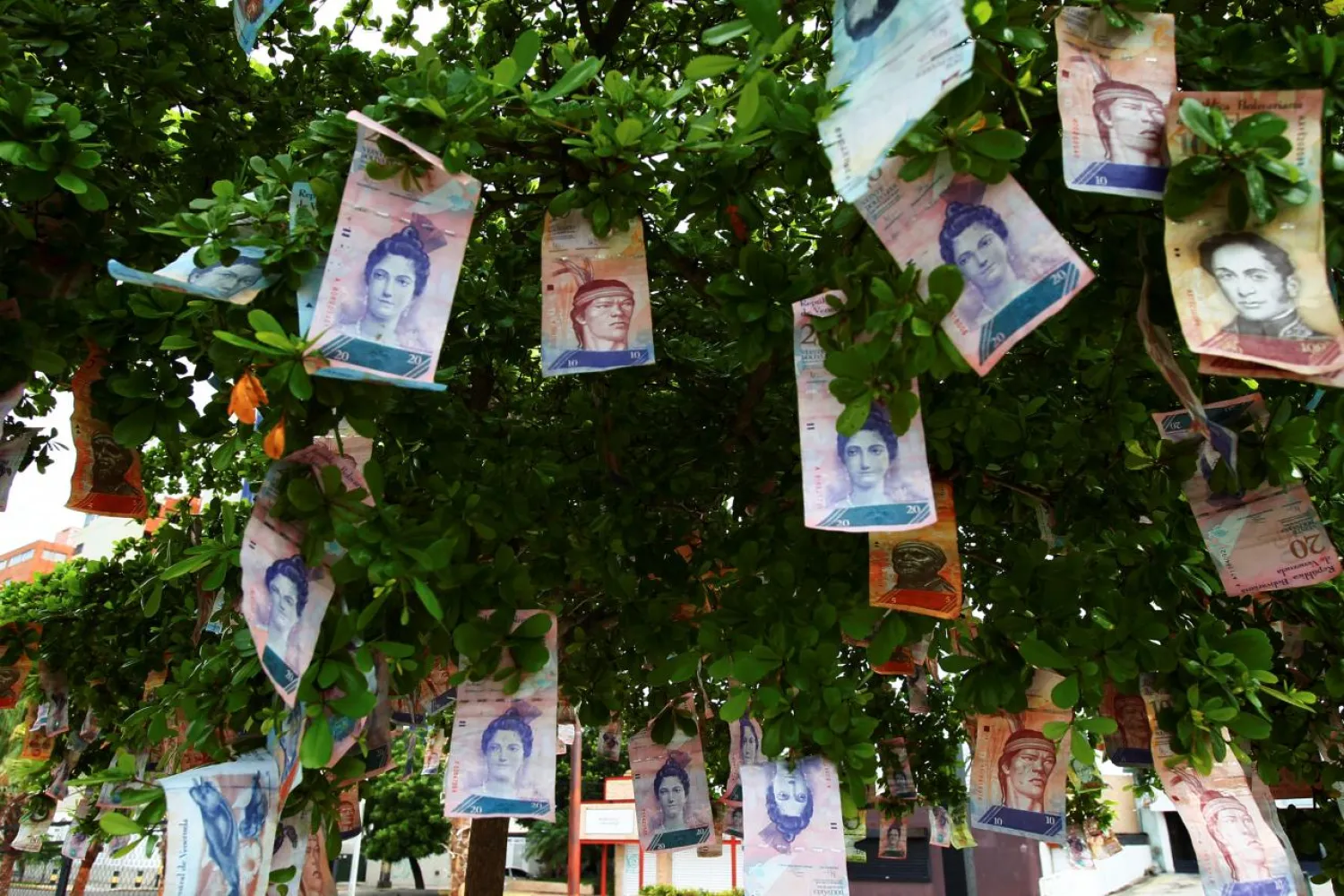

They were the cheapest in the store, but the Converse knockoffs were still 500,000 bolívars a pair. “Son locos” — they’re crazy — Viviana Acosta had said, gingerly placing the sneakers back on the shelf.
Just before the holiday season, the world’s worst inflation crisis in nearly a decade was escalating — bringing a country of nearly 32 million, once Latin America’s richest per capita, to its knees. Shoes for the kids had been Viviana’s plan for the holidays. But multiply by three — for two daughters and one son — and it was three months worth of what she earned doing house-call hair and nails.
She walked outside, to the half-empty shopping street, rubbing the fatigue out of her eyes. The treat she’d just given the kids for breakfast — oatmeal, sold by a man on the street — had nearly doubled in price in one month, to 5,000 bolívars a cup. Viviana and Enrique Alvarado, her husband, had gone without.
They were passing an image of Venezuela’s late leader Hugo Chávez — “Always with us,” the writing underneath proclaimed — when she spotted real trouble.
The toy store.
“Don’t get too excited,” Viviana, 29, called out as squealing Victoria, 4, Ruben, 9, and Michel, 12, dashed inside.
“Mommy, look!” said Ruben, pointing at a box of Transformers.
She leaned in, reading the price.
“Five million,” she mouthed, aghast. Ten months’ pay.
Ruben looked up at his mother. She looked embarrassed.
Then Ruben was blushing, too.
“Mommy,” he said, taking her hand. “Let’s go look at something else.”
A broken economy
Venezuelans are calling this “Infeliz Navidad” — Unhappy Christmas — a holiday season devastated by hyperinflation.
Under Chavez, who came to power in 1999, oil-rich Venezuela proclaimed itself a socialist paradise. Industries were nationalized. Government handouts multiplied.
But Venezuela’s economy no longer works.
The past six months have brought the kind of shocking price surges that the world last saw in Zimbabwe in 2008. Venezuela hasn’t released official inflation data since 2015. But last month, according to the Caracas-based statistical firm Ecoanalitica, the country slipped into hyperinflation — and hit an annualized rate of nearly 2,000 percent.
The cash-strapped government is now teetering on default, printing reams of bills to keep the economy afloat. That fuels inflation. Venezuela has tried to prop up an official exchange rate as low as 10 bolívars to the dollar. But the thriving black market has effectively set its own exchange rate, in which the bolívar has fallen 97 percent against the dollar since Jan. 1.
Then, it took 3,164 bolívars to buy a dollar.
Now, it takes 123,000.
The nearly worthless bolívar means that imports — which are generally purchased in dollars — are prohibitively expensive and that Venezuelan businesses can’t afford to buy foreign-made inputs, slowing their production.
As inflation soars, hospitals are increasingly running short of antibiotics, gauze, and HIV antiretroviral and cancer drugs. Parents unable to feed their children are abandoning them at orphanages. Because public utilities can’t afford new electricity cords or spare parts, the country is experiencing frequent blackouts. The government just minted a 100,000-bolívar note.
Consumer prices here have been rising for years, particularly since President Nicolás Maduro took over after Chávez’s death in 2013. The plunge in the global price for oil has been one big factor. Another is sharply falling oil production, as the industry here buckles under the weight of corruption, neglect and a flight of expertise.
The government has sought to aid citizens with additional cash handouts and the promise of extra food baskets. It blames the economic woes on speculators, hoarding by greedy oligarchs and attacks by foreign powers — particularly the Trump administration, which in August imposed sanctions that made it harder for Venezuela to access the U.S. financial system.
Yet the vastly accelerated slide into hyperinflation came after a July election tainted by fraud. It created a new super-legislature of government loyalists that replaced the opposition-controlled National Assembly, and gave Maduro virtually dictatorial power.
Modern currency values are linked to the credibility and solvency of national governments. Critics now say Venezuela’s government lacks both.
Hard decisions
Downtown Caracas was once festooned with lights during the holidays. Now, as Enrique and Viviana strolled with their kids down a major Caracas shopping street, it was devoid of holiday decor.
“It’s like Christmas isn’t even happening this year,” said Enrique, 30, as he carried his 4-year-old, Victoria, in his arms.
As the family walked the Boulevard Sabana Grande, they passed long lines at ATMs. In Venezuela, larger transactions are now mostly made by bank card. Financial institutions are rationing cash withdrawals to 10,000 bolívars a day, about 8 cents at the black-market rate. To have enough cash to buy smaller items, many Venezuelans must go to the ATM day after day.
Viviana and Enrique had some cash on hand — but for all the wrong reasons.
To keep up with inflation, the government is constantly raising the monthly minimum wage. The last hike, in November — from 325,000 to 456,000 bolívars, in cash and food stamps — was too much for the construction company that employed Enrique. It laid off nearly half its staff — including him.
“I don’t blame them,” said Enrique, adjusting his L.A. Lakers hat. “Nobody is building. Everything has stopped.”
Enrique and his wife had decided that Enrique would use his 1 million bolívar severance payment to go to Colombia in January. Following in the footsteps of tens of thousands of Venezuelans, he’d cross the border illegally — passports were too expensive, and took too long to get — to look for work. They’d be apart, but he’d send money home.
Both Ruben and his eldest sister sensed how bad things were. To spare their parents, they hadn’t even turned in gift lists this year.
Little Victoria was a different story.
In her father’s arms, she smiled wide, pulling out a creased piece of paper from her pocket and holding it in front of her pink plaid shirt. The letter was decorated with a Christmas tree and Santa’s face.
“Dear Santa Claus,” she began reading aloud, “I want roller skates, makeup, a puppy and a baby doll.”
She folded her hands.
“That’s what I want, Daddy,” she said. “Can I have it?”
Enrique blinked.
“Little daughter,” he said, burying his face in her shoulder.
‘The Maduro diet’
Two days later in their townhouse an hour west of Caracas, Viviana had almost forgotten about gifts. She was too busy worrying about food.
The family had never seen themselves as quite middle class, but for a while, they got close. They took holiday trips to the beach. Last year, with inflation growing, the vacations stopped and they cut back on food, but they’d still managed a traditional holiday dinner of baked ham, chicken salad and hallacas — meat-stuffed tamales.
This year, it was going to be just the hallacas — if they could find, and afford, the ingredients.
That morning, she’d prepared herself for the hours-long line at the grocery store to get beef at government-regulated prices. But she’d heard from a cousin who had just been at the market. “Don’t bother,” she’d said. There was none on the shelves.
It had been like this for days. Chicken, too, had almost disappeared. The government has sought to limit the inflationary pain by regulating prices for foodstuffs like meat, cornmeal and bread. But it only appeared to be making the shortages worse. Producers, their costs soaring, were refusing to sell at a loss.
So far this year, Viviana had lost 20 pounds, skipping meals so she could feed the kids.
“It’s the Maduro diet,” she said. “The kids are joking at school that even Santa is thin this year.”
At the same time, hyperinflation was eating away at her income. This month, she was charging 25,000 bolívars for doing nails — the same as she did in November. Yet the cost of the nail hardener she used had tripled in one month, to 3,000 bolívars. If her blow dryer went, so too would her sideline business in hair. A replacement now would run 1.5 million.
The holiday season was just making the stress worse.
“I wish we could just fall asleep for a day and not wake up for Christmas,” Viviana said. “That would be better.”
“But,” she said, “the kids.”
They were born-again Christians, and hadn’t put up a tree in years — didn’t really believe in it. Like many in their neighborhood, though, they decorated every year, with bunting and lights. This year, it wasn’t happening. Only one street in the neighborhood had bothered to decorate — and that was just five plastic lights.
Victoria had insisted on a tree this year. They had struck a compromise: They would take some old pine garland and glue it to the wall in the shape of a tree.
But “her tree” needed lights, Victoria had insisted.
At a moment of raging inflation and food shortages, it was an absurd luxury — a 40,000-bolívar hit. Enrique needed that money for his Colombia trip. But it was Christmas, and she was his 4-year-old.
Viviana sighed when her husband walked in the door with the box.
“Twenty lights for 40,000?” she exclaimed.
And then the “tree” was twinkling with the tiny, blinking white lights. Victoria was beaming. Enrique was smiling, too.
(The Washington Post)


