

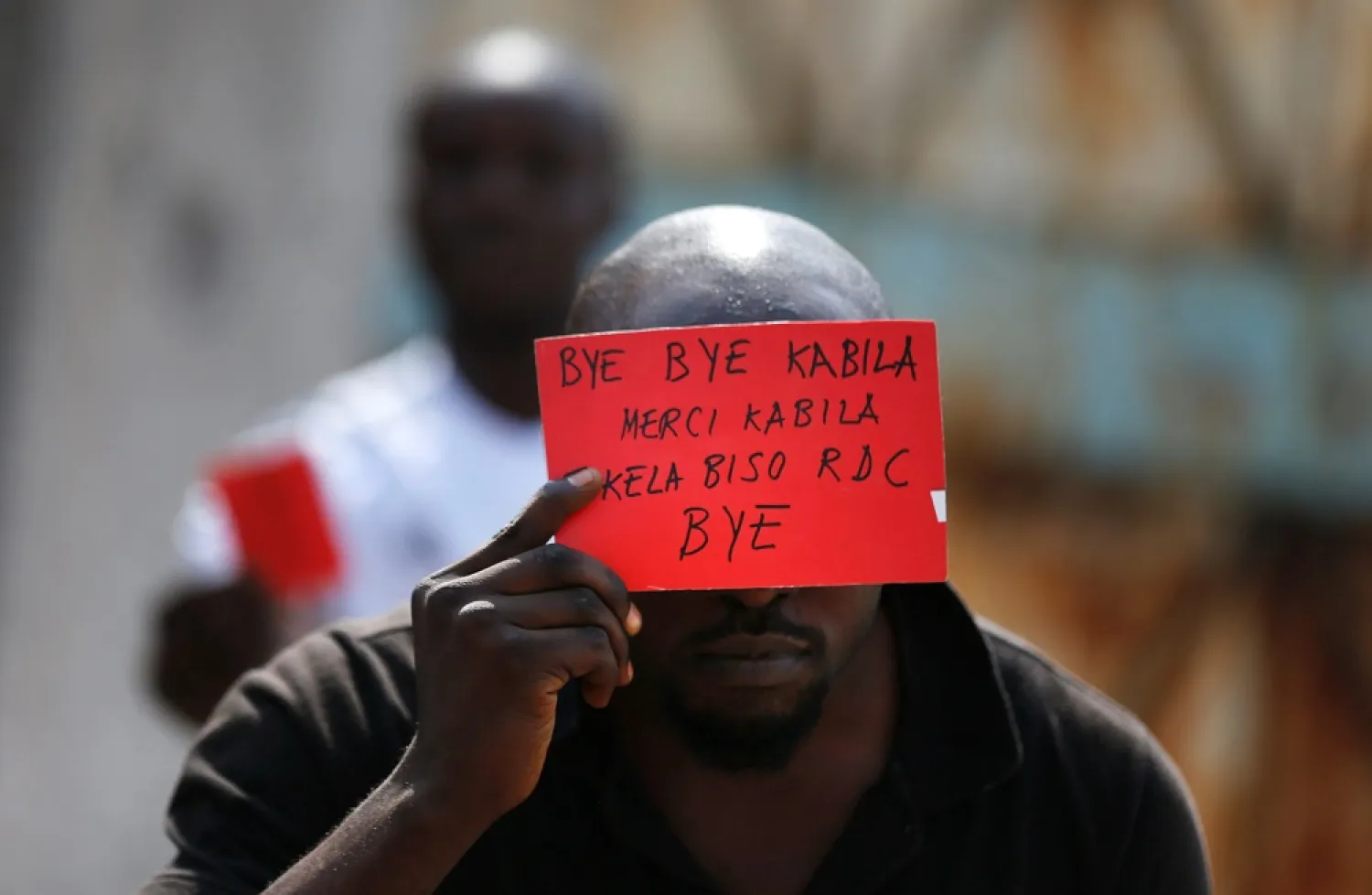

2 Killed in Anti-Kabila Protests in Congo

A Congolese opposition party supporter displays a red card against President Joseph Kabila in Kinshasa, Congo in 2016. (Reuters)
TT

2 Killed in Anti-Kabila Protests in Congo

A Congolese opposition party supporter displays a red card against President Joseph Kabila in Kinshasa, Congo in 2016. (Reuters)

Two demonstrators were killed on Sunday by security forces during rallies against Congolese President Joseph Kabila's refusal to step down from office, Human Rights Watch said.

The two men were killed outside St. Alphonse church in Kinshasa's Matete district, the advocacy group's Central Africa director, Ida Sawyer, told Reuters.

Police and soldiers had set up earlier Sunday checkpoints across the capital and fired teargas at opposition supporters who had gathered outside churches to protest against Kabila.

Authorities ordered internet and SMS services to be cut following calls by Catholic activists for protest marches after Sunday mass. The activists are demanding that Kabila commit to not changing the constitution to stand for a third term and to release political prisoners.

The police have banned demonstrations and said that all gatherings of more than five people will be dispersed. Across Kinshasa, police and soldiers searched vehicles and checked passengers’ identifications.

Some 40 percent of Congo’s population is Roman Catholic and the Church enjoys rare credibility with the public, even though its leadership has not formally backed the protests.

At the Notre Dame du Congo cathedral in Kinshasa’s Lingwala district, where opposition leader Felix Tshisekedi was attending mass, dozens of police and soldiers blocked the path of more than 100 opposition supporters as they prepared to try to march.

Tshisekedi, however, who had backed the activists’ call to march, left the church in a vehicle, spurring angry shouts from the crowd, which said he was abandoning them.

At the Paroisse Saint Michel in Bandalungwa district, security forces fired teargas into the church, creating panic, opposition leader Vital Kamerhe, who was present at the mass, told Reuters.

“All of the neighboring community came out (to protest) and I think that this shows the will of the people and marks the beginning of the end of the dictatorship,” Kamerhe said.

At another church in the working class district of Barumbu, a few dozen police officers used teargas and stun grenades against some 300 churchgoers, who waved bibles and sang religious songs as they tried to march, a Reuters witness said.

A police spokesman could not be immediately reached for comment.

Opposition appeals for protests this year have been easily suppressed by security forces but the Catholic activists’ appeal has managed to unite nearly all of Congo’s fractious opposition.

Kabila has been in power since 2001 when he succeeded his assassinated father Laurent Kabila.

He refused to step down at the end of his second and final term in December 2016.

That refusal led to protests and a bloody crackdown. Demonstrations have been banned or else widely repressed since September 2016 but several have nonetheless gone ahead since with many ending in bloodshed.

Elections were due to take place by the end of this year under a church-mediated deal aimed at avoiding more violence in a vast, mineral-rich country which has never had a peaceful transition of power since independence from Belgium in 1960.

After multiple postponements -- officially due to violence in the Kasai region -- the delayed poll is now scheduled for December 23 next year.

Clinging on to power, Kabila is banned by the constitution from running for a third term, but the deal allows him to stay on until the next poll is held.



North Korean Leader's Daughter in First Visit to Symbolic Mausoleum

North Korean leader Kim Jong Un watching a New Year's performance with his daughter Kim Ju Ae (L) at the May Day Stadium in Pyongyang. STR / KCNA VIA KNS/AFP
TT

North Korean Leader's Daughter in First Visit to Symbolic Mausoleum

North Korean leader Kim Jong Un watching a New Year's performance with his daughter Kim Ju Ae (L) at the May Day Stadium in Pyongyang. STR / KCNA VIA KNS/AFP

The North Korean leader's daughter Kim Ju Ae has made her first visit to a mausoleum housing her grandfather and great-grandfather, state media images showed Friday, further solidifying her place as her father's successor.

The Kim family has ruled North Korea with an iron grip for decades, and a cult of personality surrounding their so-called "Paektu bloodline" dominates daily life in the isolated country.

Current leader Kim Jong Un is the third in line to rule in the world's only communist monarchy, following father Kim Jong Il and grandfather Kim Il Sung.

The two men -- dubbed "eternal leaders" in state propaganda -- are housed in the Kumsusan Palace of the Sun, a vast mausoleum in downtown Pyongyang.

The state-run Korean Central News Agency (KCNA) reported that Kim Jong Un had visited the palace, accompanied by top officials.

And images released by the agency showed daughter Ju Ae in tow.

South Korea's spy agency said last year she was now understood to be the next in line to rule North Korea after she accompanied her father on a high-profile visit to Beijing.

Ju Ae was publicly introduced to the world in 2022, when she accompanied her father to an intercontinental ballistic missile launch.

North Korean state media have since referred to her as "the beloved child", and a "great person of guidance" -- "hyangdo" in Korean -- a term typically reserved for top leaders and their successors.

Before 2022, the only confirmation of her existence had come from former NBA star Dennis Rodman, who made a visit to the North in 2013.


Russia Blames Ukraine for Deadly New Year Drone Strike

The Russia-appointed governor of the Kherson region said 'the enemy' had fired three drones that struck a cafe and hotel. The Governor of Kherson region Vladimir Saldo/AFP
TT

Russia Blames Ukraine for Deadly New Year Drone Strike

The Russia-appointed governor of the Kherson region said 'the enemy' had fired three drones that struck a cafe and hotel. The Governor of Kherson region Vladimir Saldo/AFP

Russia on Thursday said Kyiv was behind a drone strike on a hotel in the Moscow-held part of Ukraine's southern Kherson region that killed at least 20 people celebrating the New Year, accusing it of "torpedoing" peace attempts.

The accusation came at a crunch moment, after weeks of diplomacy aimed at brokering an end to the nearly four-year war, and as Ukrainian President Volodymyr Zelensky said his country was "10 percent" away from a peace deal.

Tens of thousands of people have been killed, eastern Ukraine decimated and millions forced to flee their homes since Russia launched its all-out offensive in 2022.

According to the Russia-appointed governor of the Kherson region, Vladimir Saldo, "the enemy" fired three drones that struck a cafe and hotel on the Black Sea coast in Khorly where "civilians were celebrating the New Year".

A building gutted by fire, piles of smoldering rubble and charred bodies were seen in pictures he posted on Telegram.

Kyiv has not commented on the allegations.

Russia's Investigative Committee said it had opened a probe into the attack, which had "killed more than 20 people and injured many more". The Russian foreign ministry said the death toll was still being clarified.

According to Saldo, more than 100 revelers gathered at the hotel the night of the attack.

The Russian foreign ministry accused Ukraine of carrying out a "terrorist attack", called on international organizations to condemn it and warned Kyiv of "appropriate consequences" in a statement.

It also accused the Ukrainian authorities of "deliberately torpedoing any attempts to find a peaceful resolution to the conflict".

Zelensky meanwhile said Russia was carrying the war "into the New Year" with more than 200 drones fired overnight, mainly targeting energy facilities.

"A significant number of consumers" had their electricity cut, said Ukraine's power operator Ukrenergo. Railway and port infrastructure was also damaged in the latest barrage.

In the Kharkiv region, Russia struck a park with a zoo, wounding one person. The attack also wounded animals, including lions, and killed pheasants and parrots, the park's owner Oleksandr Feldman told Ukrainian media.

New talks in sight

Ukraine came under intense pressure in 2025, both from Russian bombardment and on the battlefield, where it has steadily ceded ground to Russia's army.

An AFP analysis based on Ukrainian air force data showed a slight fall in overnight Russian drone and missile attacks on Ukraine in December.

Russia fired at least 5,134 drones in overnight attacks in the final month of 2025, six percent less than the month before, while the number of missiles declined by 18 percent in the same period, according to the data.

However, the same data showed Ukraine destroyed a smaller share of the total sum of missiles and drones in December -- 80 percent, compared with 82 percent in November.

US President Donald Trump, who regularly complains he does not receive credit as a peacemaker, has engaged in talks with both sides in a bid to end the fighting.

Ukraine says Russia is not interested in peace and is deliberately trying to sabotage diplomatic efforts to seize more Ukrainian territory.

Moscow earlier this week accused Ukraine of attempting a drone attack on one of Russian President Vladimir Putin's residences, drawing a sharp rebuttal from Kyiv, which said there was no "plausible" evidence of such an attack.

Ukraine's allies have also expressed skepticism about Russia's claim -- but Moscow on Thursday said it would hand over to the United States "decrypted data" from the drone that was allegedly targeting the secluded residence.

"These materials will be transferred to the American side through established channels," Russia's defense ministry said in a statement.

Zelensky said on Tuesday he would hold a meeting with leaders of Kyiv's allies from the so-called coalition of the willing next week in France.

The summit will be preceded by a meeting of security advisers from the allied countries on Saturday in Ukraine.


Maduro Elusive on US Attack, Open to Dialogue

Venezuela's President Nicolas Maduro says the door is open to dialogue with Washington. STRINGER / AFP/File
TT

Maduro Elusive on US Attack, Open to Dialogue

Venezuela's President Nicolas Maduro says the door is open to dialogue with Washington. STRINGER / AFP/File

President Nicolas Maduro Thursday dodged a question about an alleged US attack on a dock in Venezuela but said he was open to cooperation with Washington after weeks of American military pressure.

"Wherever they want and whenever they want," Maduro said of the idea of dialogue with the United States on drug trafficking, oil and migration in an interview on state TV.

Maduro's government has neither confirmed nor denied what President Donald Trump announced Monday: a US attack on a docking facility that served Venezuelan drug trafficking boats.

Asked point-blank if he confirmed or denied the attack, Maduro said Thursday "this could be something we talk about in a few days."

The attack would amount to the first known land strike of the US military campaign against drug trafficking from Latin America.

Trump on Monday said the United States hit and destroyed a docking area for alleged Venezuelan drug boats.

Trump would not say if it was a military or CIA operation or where the strike occurred, noting only that it was "along the shore."

"There was a major explosion in the dock area where they load the boats up with drugs," he told reporters at his Mar-a-Lago resort in Florida.

"So we hit all the boats and now we hit the area, it's the implementation area, that's where they implement. And that is no longer around."

In the interview, Maduro insisted that Venezuela has defended itself well as the US carried out its military campaign at sea.

"Our people are safe and in peace," he said.

Colombian President Gustavo Petro fueled rumors about the location of the attack, saying "Trump bombed a factory in Maracaibo" where "they mix coca paste to make cocaine."

That led some to speculate on social media that a fire at wholesale chemical distributor Primazol's warehouses in Maracaibo may have been related to the attack.

Primazol chief Carlos Eduardo Siu denied those rumors, saying "President Petro, not here -- we neither package nor manufacture any kind of narcotics."

Unpleasant evolution

Maduro said he has not spoken to Trump since a conversation they had on November 12, which he described as cordial and respectful.

"I think that conversation was even pleasant, but since then the evolution has not been pleasant. Let's wait," he said.

"If they want to talk seriously about an agreement to fight drug trafficking, we are ready," the Venezuelan leader said.

The Trump administration has accused Maduro of heading a drug cartel and says it is cracking down on trafficking, but the leftist leader denies any involvement in the narcotics trade, saying the US seeks a coup because Venezuela has the largest known reserves of oil on Earth.

Washington has ramped up pressure on Caracas by informally closing Venezuela's airspace, imposing more sanctions and ordering the seizure of tankers loaded with Venezuelan oil.

For weeks Trump has threatened ground strikes on drug cartels in the region, saying they would start "soon," but this is the first apparent example.

US forces have also carried out numerous strikes on boats in both the Caribbean Sea and eastern Pacific Ocean since September, targeting what Washington says are drug smugglers.

The deadly maritime campaign has killed at least 107 people in at least 30 strikes, according to information released by the US military.

The administration has provided no evidence that the targeted boats were involved in drug trafficking, however, prompting debate about the legality of these operations.

International law experts and rights groups say the strikes likely amount to extrajudicial killings, a charge that Washington denies.