


South Korea Offers Talks with North on Pyeongchang Olympics

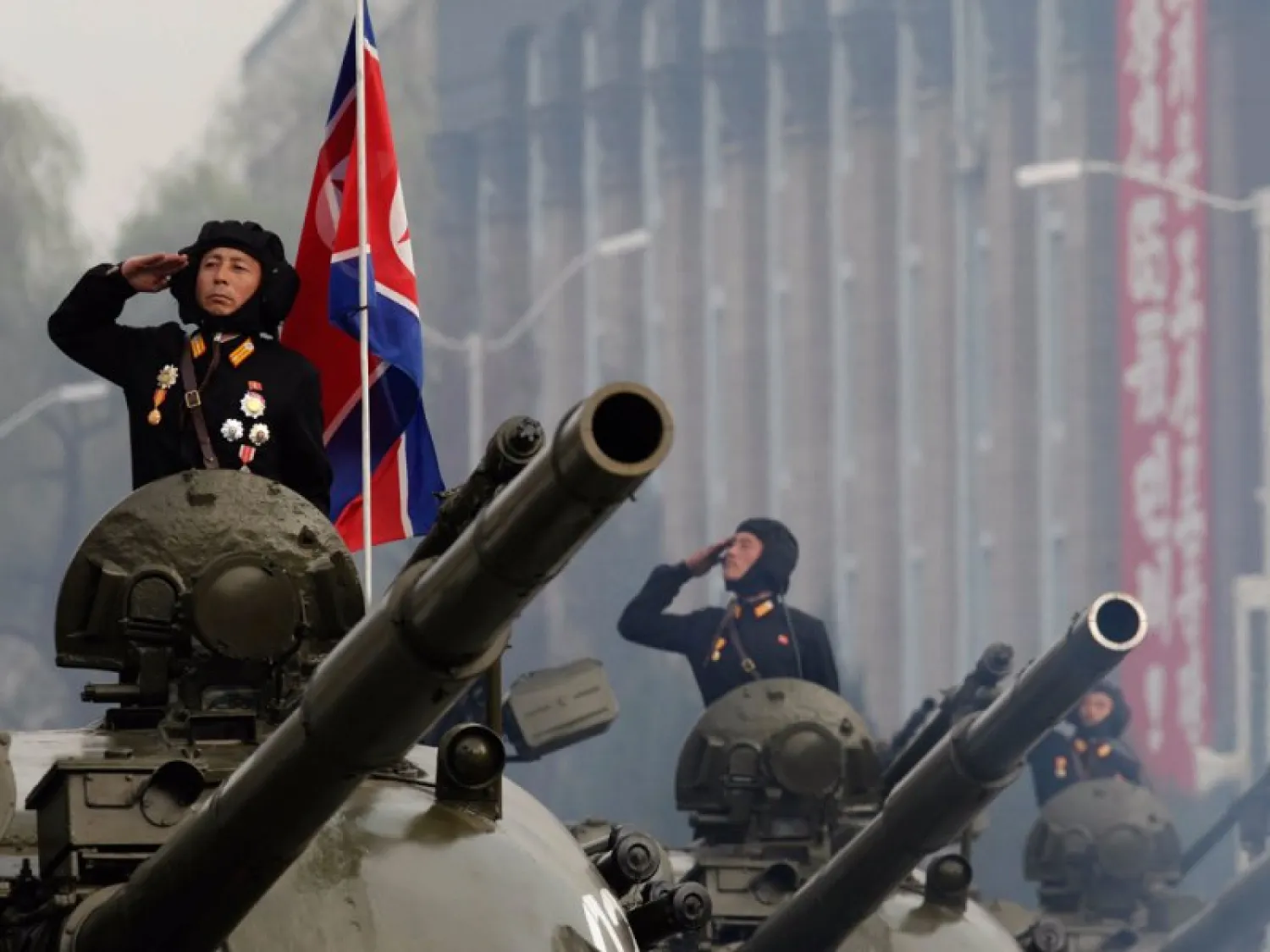
North Korean soldiers salute during a parade. (Reuters)
TT

South Korea Offers Talks with North on Pyeongchang Olympics

North Korean soldiers salute during a parade. (Reuters)

South Korea announced on Tuesday its readiness to hold talks with the North ahead of next month’s Winter Olympics, a day after Kim Jong Un said he was open to negotiations.

“We look forward to candidly discussing interests from both sides face-to-face with North Korea along with the North’s participation in the Pyeongchang Winter Olympics,” Unification Minister Cho Myong-gyon told reporters.

“I repeat, the government is open to talking with North Korea, regardless of time, location and form.”

Kim said on Monday said he was open to negotiations, but that North Korea would push ahead with “mass producing” nuclear warheads.

The offer for high-level talks next Tuesday had been discussed with the United States, the South’s unification minister said, while a decision on whether to push back a massive joint military drill between South Korea and the United States until after the Olympics was pending.

Tension has been rising over North Korea’s nuclear and missile programs, which it pursues in defiance of years of UN Security Council resolutions, with bellicose rhetoric coming from both Pyongyang and the White House. The North sees the regular war drills between the South and the United States as preparations for war.

Cho said he expects the dialogue at the border village of Panmunjom, if it happens, to be focused on North Korea’s participation at the Olympics in February, but other issues would likely arise, including the decentralization of North Korea.

Should the talks be held on January 9, it would be the first such dialogue since a vice-ministerial meeting in December 2015.

The offer landed after a New Year’s Day speech by Kim who said he was “open to dialogue” with Seoul, and for North Korean athletes to possibly take part in the Winter Games, but he persistently declared North Korea a nuclear power.

“North Korea’s participation in the Winter Games will be a good opportunity to showcase the national pride and we wish the Games will be a success. Officials from the two Koreas may urgently meet to discuss the possibility,” Kim said.

After welcoming Kim’s address, South Korean President Moon Jae-in had asked his government earlier in the day to move as quickly as possible to bring North Korea to the Olympics. North Korea did not immediately react.

Chinese Foreign Ministry spokesman Geng Shuang said the recent positive comments from both sides about improving relations, and Kim’s remarks about participating in the upcoming Olympics, were a “good thing”.

“China welcomes and supports North Korea and South Korea taking earnest efforts to treat this as an opportunity to improve mutual relations, promote the alleviation of the situation on the Korean peninsula and realize denuclearization on the peninsula.”

Chun Yung-woo, a former South Korean national security adviser, said Seoul should have taken more time before reacting to Kim’s comments.

“I regret the government had even lost the flexibility to spend one day or two taking a deep breath and meticulously analyzing Kim Jong Un’s ulterior motive before hastily issuing a welcoming statement,” he said.

“The government will have to strive more to come up with a countermeasure not to get caught in a trap set by Kim Jong Un.”

Choi Moon-soon, governor of Gangwon Province where the Olympics are to be held next month, has proposed South Korea send cruise ships to bring North Korean athletes and officials to Pyeongchang, according to South Korean media.

Choi met North Korean sports official Mun Woong in China on December 18 on the sidelines of an international youth football tournament where North and South Korea football teams competed, the Dong-A Ilbo newspaper reported.

Analysts said Kim may be trying to drive a wedge between Seoul and its ally Washington in a bid to reduce international isolation and sanctions against North Korea.

Talks could provide a temporary thaw in strained inter-Korean ties, but conservative critics worry that they may only earn the North time to perfect its nuclear weapons.

After the Olympics, inter-Korean ties could become frosty again because the North has made it clear it has no intention of accepting international calls for nuclear disarmament and instead wants to bolster its weapons arsenal in the face of what it considers increasing US threats.

"Kim Jong Un's strategy remains the same. He's developing nukes while trying to weaken international pressure and the South Korea-US military alliance and get international sanctions lifted," said Shin Beomchul of the Seoul-based Korea National Diplomatic Academy.

He said the North might also be using its potential Olympic participation as a chance to show its nuclear program is not intended to pose a threat to regional peace.



Israeli Air Force Deploys First Laser Interception System

FILED - 26 March 2024, Israel, Jerusalem: Israel Katz attends a meeting at a hotel in Jerusalem. Photo: Christoph Soeder/dpa
TT

Israeli Air Force Deploys First Laser Interception System

FILED - 26 March 2024, Israel, Jerusalem: Israel Katz attends a meeting at a hotel in Jerusalem. Photo: Christoph Soeder/dpa

Israel's defense ministry said on Sunday it had deployed a new "Iron Beam" laser system for the air force to intercept aerial threats.

The laser system's main developers, the ministry's research and development department and defense contractor Rafael, delivered it to the air force at a ceremony in northern Israel.

"For the first time globally, a high-power laser interception system has achieved full operational maturity, successfully executing multiple interceptions," Defense Minister Israel Katz said at the ceremony, according to a statement.

"This monumental achievement... delivers a critical message to our enemies, near and far alike: do not challenge us, or face severe consequences," AFP quoted him as saying.

The handover marks a major milestone in a project more than a decade old.
"Israel has become the first country in the world to field an operational laser system for the interception of aerial threats, including rockets and missiles," said Yuval Steinitz, chairman of Rafael.

The laser system seeks to enhance and slash the cost of Israel's interception of projectiles, and will supplement other aerial defense capacities such as the more well-known Iron Dome.

Iron Dome offers short-range protection against missiles and rockets. The David's Sling system and successive generations of Arrow missiles are Israeli-American technology built to bring down ballistic missiles.

The defense ministry announced in early December that the laser system was complete, and would be deployed by the end of the month.

During the 12-day war launched by Israel against Iran in June, the country's missile defense system failed to intercept all the projectiles fired by Tehran toward Israeli territory.

Israel has since acknowledged being hit by more than 50 missiles during the war with Iran, resulting in 28 deaths.


Trump Says Had 'Productive' Call with Putin Ahead of Zelensky Meeting

US President Donald Trump takes part in a Christmas Eve dinner in the ballroom of his Mar-a-Lago club in Palm Beach, Florida, US, December 24, 2025. REUTERS/Jessica Koscielniak
TT

Trump Says Had 'Productive' Call with Putin Ahead of Zelensky Meeting

US President Donald Trump takes part in a Christmas Eve dinner in the ballroom of his Mar-a-Lago club in Palm Beach, Florida, US, December 24, 2025. REUTERS/Jessica Koscielniak

US President Donald Trump said he had a productive telephone call with his Russian counterpart Vladimir Putin on Sunday ahead of a planned meeting in Florida with Ukraine's leader Volodymyr Zelensky.

"I just had a very good and productive telephone call with President Putin of Russia" before the planned talks with Zelensky at Trump's Florida estate at 1:00 pm local time (1800 GMT), the US leader said on Truth Social.

Putin said Ukraine was in no hurry for peace and if it did not want to resolve their conflict peacefully, Moscow would accomplish all its goals by force.

Putin's remarks on Saturday, carried by state news agency TASS, followed a vast Russian drone and missile attack that prompted Zelensky to say Russia was demonstrating its wish to continue the war while Kyiv wanted peace.


Russia Sends 3 Iranian Satellites into Orbit, Report Says

In this photo released by Roscosmos space corporation on Thursday, Feb. 29, 2024, the Soyuz-2.1b rocket blasts off at the Vostochny cosmodrome outside the city of Tsiolkovsky, about 200 kilometers (125 miles) from the city of Blagoveshchensk in the far eastern Amur region, Russia. A Russian Soyuz rocket successfully put an Iranian satellite into orbit along with 18 Russian satellites on Thursday. (Roscosmos space corporation via AP)
TT

Russia Sends 3 Iranian Satellites into Orbit, Report Says

In this photo released by Roscosmos space corporation on Thursday, Feb. 29, 2024, the Soyuz-2.1b rocket blasts off at the Vostochny cosmodrome outside the city of Tsiolkovsky, about 200 kilometers (125 miles) from the city of Blagoveshchensk in the far eastern Amur region, Russia. A Russian Soyuz rocket successfully put an Iranian satellite into orbit along with 18 Russian satellites on Thursday. (Roscosmos space corporation via AP)

Russia on Sunday sent three Iranian communications satellites into orbit, the second such launch since July, Iranian state television reported.

The report said that a Russian rocket sent the satellites to circle the Earth on a 500-kilometer (310-mile) orbit from the Vostochny launchpad in eastern Russia. The three satellites are dubbed Paya, Kowsar and Zafar-2.

The report said that Paya, weighing 150 kilograms (330 pounds), is the heaviest satellite that Iran has ever deployed into orbit. Kowsar weighs 35 kilograms (77 pounds), but the report didn't specify how heavy Zafar-2 is.

The satellites feature up to 3-meter resolution images, applicable in the management of water resources, agriculture and the environment. Their life span is up to five years.

Russia occasionally sends Iran's satellites into orbit, highlighting the strong ties between the two countries. In July, a Russian rocket sent Iranian communications satellite Nahid-2 into orbit.

Russia, which signed a “strategic partnership” treaty with Iran in January, strongly condemned the Israeli and US strikes on Iran that came during a 12-day air war in June and killed nearly 1,100 Iranians, including military commanders and nuclear scientists. Retaliatory missile barrages by Iran killed 28 people in Israel.

As a long-standing project, Iran from time-to-time launches satellite carriers to send its satellites into space.

The United States has said that Iran’s satellite launches defy a UN Security Council resolution and called on Tehran to undertake no activity involving ballistic missiles capable of delivering nuclear weapons. UN sanctions related to Iran’s ballistic missile program expired in 2023.