


How Did European Diplomacy Rein in Iran?

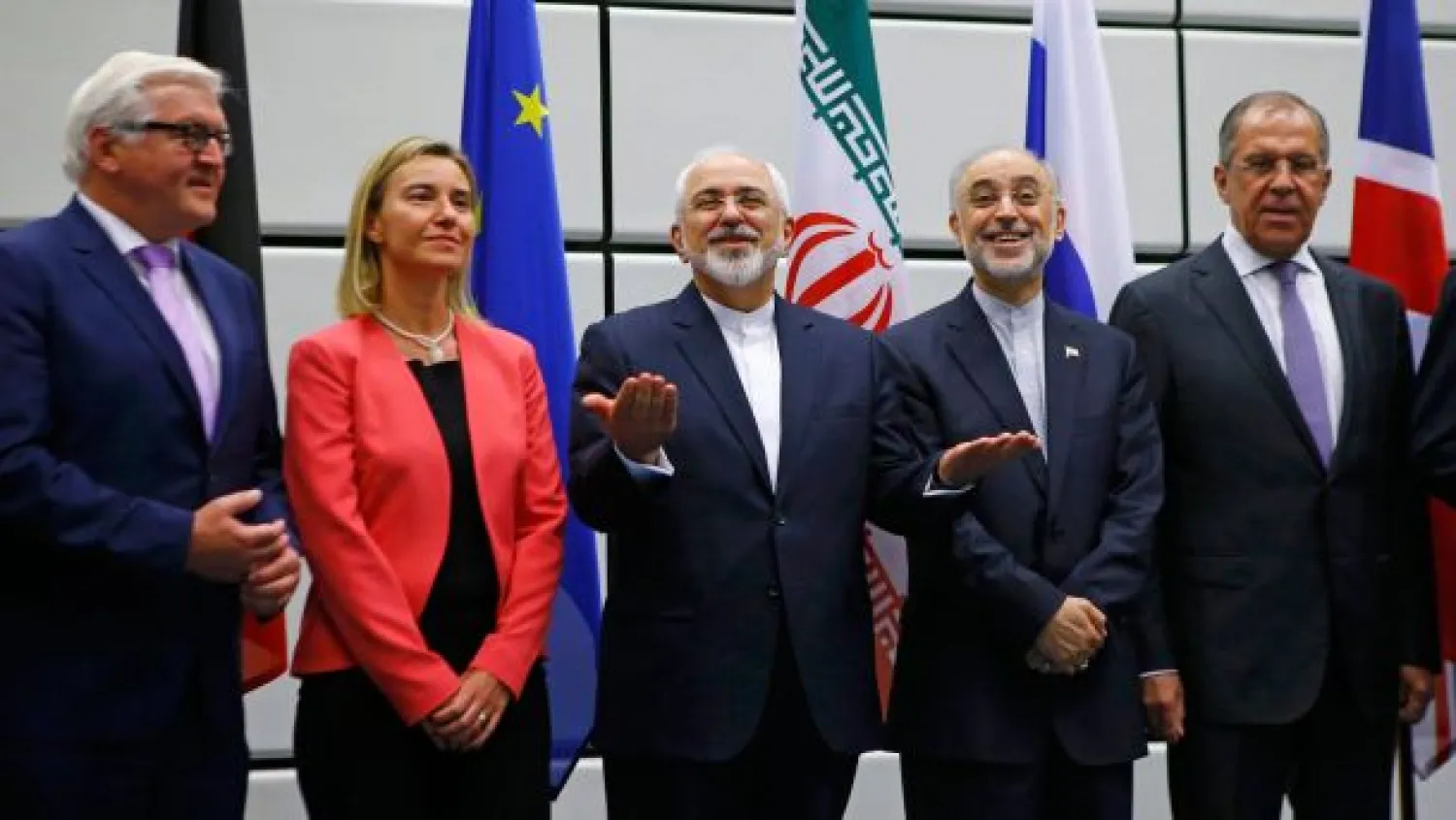
Frank-Walter Steinmeier, Federica Mogherini, Mohammad Javad Zarif, Iranian ambassador to IAEA  Ali Akbar Salehi and Russian Foreign Minister Sergey Lavrov (L-R) Vienna, 14 July, 2015. Reuters
Frank-Walter Steinmeier, Federica Mogherini, Mohammad Javad Zarif, Iranian ambassador to IAEA Ali Akbar Salehi and Russian Foreign Minister Sergey Lavrov (L-R) Vienna, 14 July, 2015. Reuters
TT

How Did European Diplomacy Rein in Iran?

Frank-Walter Steinmeier, Federica Mogherini, Mohammad Javad Zarif, Iranian ambassador to IAEA  Ali Akbar Salehi and Russian Foreign Minister Sergey Lavrov (L-R) Vienna, 14 July, 2015. Reuters
Frank-Walter Steinmeier, Federica Mogherini, Mohammad Javad Zarif, Iranian ambassador to IAEA Ali Akbar Salehi and Russian Foreign Minister Sergey Lavrov (L-R) Vienna, 14 July, 2015. Reuters

Astrid Viaud’s “EU Diplomacy and the Iran Nuclear Deal” has gained growing importance in light of the current wave of protests hitting the cleric-led country.

Most demonstrations are demanding the delivery on economic promises made by the regime after poverty and unemployment have taken toll on the public. Even more, protesting for freedom, the Iranian people have also demanded a change in authority and instating a healthy democracy.

Written by Viaud, who is a doctoral researcher at the Louvain-Europe Institute of Political Science at the Catholic University of Louvain, the work was published by Belgium’s KU Leuven publishing house.

Seeking to decipher the Iranian nuclear program, the book sheds light on the role played by the European Union in limiting the chances of Iran possessing a nuclear bomb, especially in light of massive distrust hindering the West’s relationship with the Tehran regime.

The author also highlights dimensions of professional coordination between foreign policies of EU member countries, which played an active role aided in preventing Tehran’s ambitions in seeking nuclear armament.

Viaud reveals details on German, French and Britain politics which fostered the later European consensus.

First, diplomatic efforts worked on garnering a unified position among the three countries on the Iranian nuclear file and then presented it to EU Foreign Policy offices.

Being a thorny bush to tackle, most political maneuvers took place outside the European Council. It would have been no easy task to reach European agreement on negotiations with Tehran within the tight corridors of European institutions.

Relaxing from detailed European framework, the three countries found it possible to push the negotiation process on this heated topic.

Reviewing the EU’s vision of the Iranian nuclear issue, the author also chose to highlight the EU relying on its economic weight so that it increases the political power of each country partaking in the international scene.

The EU insisting on imposing economic sanctions against the Iranian regime for over six years confirms the union's desire to lay this matter to rest.

But despite Iran's signing of the Nuclear Non-Proliferation Treaty (NPT) in 1968 and its ratification in 1970, Western society feared that Iran would not comply and still seek out nuclear weapons.

Each of Germany, France and Britain based their positions on principles set by great powers at the time of the resumption of negotiations in 2013, which demanded strong guarantees to prevent Iran from putting its hands on nuclear weapons.

The nuclear agreement signed between the international community and Iran on July 14, 2015 represents the fruits of a serious and arduous diplomacy that stretched for more than 21 months.

Standing as proof to the success of European diplomacy, the EU’s “carrot and stick" policy had won over the other robust option on the table, military intervention.

Some NATO member states, and some countries such as Israel and others had long eyed a decisive military choice.

In the midst of troubled politics and intertwined interests, Europe has always worked to create constructive dialogue with Iran, a dialogue that has seen ups and downs. Nevertheless, Europe has generally succeeded in reaching constructive and effective talks.

The EU played both good cop and bad cop—at a point the group not only directed and implemented UN Security Council sanctions but sought to impose other sanctions on Tehran in coordination with the US.

These sanctions were made more stringent from 2010 to 2012 and have had a direct impact not only on the Iranian economy but also on the power circles there.

On the other hand, Europe succeeded in strengthening its position as an honest broker between the main international partners (Russia and China) on the one hand and the Americans on the other, in an attempt to find an appropriate place in negotiations with Iran while respecting other geographical balances in the region.

Europe has sought, through this position, to preserve the social fabric of the region, which is in a state of imbalance against the backdrop of the Iraqi unsettled situation. This is in addition to the Ukrainian crisis, which has also begun to affect the international arena since 2014, which tipped the scales in its own ways in files within and outside the regional scope.

Another important reason for the success of the dialogue was the European negotiating team enjoying a largely diverse and collective flexibility, away from the particular interests of each EU member state.




Madrasat Addeera Empowers AlUla Youth Through Traditional Crafts

The school focuses on empowering girls, teaching craft skills rooted in ancestral trades and presenting them in modern ways that create sustainable and creative opportunities - SPA
TT

Madrasat Addeera Empowers AlUla Youth Through Traditional Crafts

The school focuses on empowering girls, teaching craft skills rooted in ancestral trades and presenting them in modern ways that create sustainable and creative opportunities - SPA

Madrasat Addeera in AlUla Governorate offers specialized training programs and workshops to develop the skills of local youth in traditional crafts and arts, preserving cultural heritage while connecting it to contemporary life.

The school focuses on empowering girls, teaching craft skills rooted in ancestral trades and presenting them in modern ways that create sustainable and creative opportunities, SPA reported.

Throughout the year, the school contributes to the cultural vibrancy of the governorate by taking part in festivals and exhibitions. Through its workshops, visitors can explore traditional industries such as pottery, weaving, carpets, and natural products.

According to SPA, Madrasat Addeera's programs go beyond training, transforming craft skills into sustainable income, with handcrafted items sold locally and online, all entirely Saudi-made and inspired by AlUla’s culture and environment.

Since its establishment as the first girls’ school in AlUla and as the region’s first center for arts and design, the school has become a hub for nurturing talent, rediscovering heritage crafts, and attracting both local and global expertise.


British Treasury to Cover Bayeux Tapestry for Estimated £800 Million

This photo provided by Bayeux townhall shows a technician inspecting the famed Bayeux tapestry in Bayeux, Normandy, in 8th January, 2020. (Ville de Bayeux via AP/File photo)
TT

British Treasury to Cover Bayeux Tapestry for Estimated £800 Million

This photo provided by Bayeux townhall shows a technician inspecting the famed Bayeux tapestry in Bayeux, Normandy, in 8th January, 2020. (Ville de Bayeux via AP/File photo)

The British Treasury is set to insure the Bayeux Tapestry against damage for an estimated £800 million while it is on loan to the British Museum next year, reported the BBC.

The 70m-long embroidery depicting the Battle of Hastings in 1066 will travel from France to London as part of a deal between the two nations' governments.

The artifact's transit and its time in storage and on display will be covered under the Government Indemnity Scheme (GIS). Indemnity insurance covers situations like loss or damage.

The Treasury said without the long-standing scheme, “public museums and galleries would face a substantial commercial insurance premium, which would be significantly less cost effective.”

There are concerns about the move, as some French art experts have suggested the nearly 1,000-year-old work was in far too a delicate state to be transported - something French officials have denied.

It is understood the Treasury has received an initial valuation for covering the Bayeux Tapestry that has been provisionally approved. The loan will not be formally confirmed until it receives the final valuation.

That final valuation is estimated to be around £800 million.

The Bayeux Tapestry will be displayed in the Sainsbury Exhibitions Gallery of the British Museum from next September until July 2027 while its current home, the Bayeux Museum, undergoes renovations.

Comprising 58 scenes, 626 characters and 202 horses, the huge masterpiece charts a contested time in Anglo-French relations when William The Conqueror took the English throne from Harold Godwinson, becoming the first Norman king of England.

The government's indemnity scheme allows art and cultural objects to be shown publicly in the UK which "might not have been otherwise because the cost of insurance would have been too high".

The scheme - first set up in 1980 - has facilitated numerous high-value loans, including Vincent van Gogh's 1888 work "The Bedroom" to the National Gallery.

In exchange for the Bayeux Tapestry, the British Museum will loan items to France, including the 7th Century Anglo-Saxon artifacts discovered at the Sutton Hoo burial site in Suffolk and the 12th Century Lewis chess pieces.


Kolkata’s Iconic Trams Face Final Stop as Modernization Rolls in

Passengers sit inside a decorated tram during the 152nd anniversary celebrations of trams in Kolkata, India, February 24, 2025. (Reuters)
TT

Kolkata’s Iconic Trams Face Final Stop as Modernization Rolls in

Passengers sit inside a decorated tram during the 152nd anniversary celebrations of trams in Kolkata, India, February 24, 2025. (Reuters)

For more than a century, trams have rumbled past Kolkata's crumbling colonial facades, with their chiming bells contributing to the city's soundtrack as they ferried generations of ​commuters.

Now, Asia's oldest tram network is on the brink of disappearing as authorities consider pulling the plug on a mode of transport that has become more nostalgia than necessity.

The West Bengal government plans to shut down the 152-year-old system, keeping only a short heritage route. The decision has sparked a court battle as residents and heritage advocates fight to keep ‌the trams ‌rolling.

"As children, we would take the ‌trams ⁠for ​fun, ‌but as I grew older it became a necessity," said Abha Maity, 44, recalling rides to school and college. "I can’t imagine Kolkata without them."

Once a highlight of the city's streets, the wobbly trams now struggle for space amid traffic jams - competing with buses and yellow taxis - as Kolkata builds modern infrastructure and seeks faster transport.

Kolkata introduced ⁠horse-drawn trams in 1873 and electrified them in 1902. At its peak, the ‌network boasted more than 340 trams and ‍covered the entire city. Today, ‍only two routes remain, with a fleet of about 10.

"When ‍I joined, more than 340 trams were running. Now it's down to seven or eight," said Bacchu Sidda, a conductor for 36 years who still checks his duty roster pinned on a board ​at the last functioning depot in Gariahat.

The government began selling depots and scrapping cars years ago, prompting a citizens' ⁠group called Calcutta Tram Users Association (CTUA) to take the fight to court. CTUA has campaigned since 2016 to save what remains of the system.

"I love my trams more than myself," said Deep Das, 19, a journalism student and CTUA member. "If they disappear, it will be like a part of my body has left me."

Despite resistance, authorities are pouring billions into upgrading Kolkata's infrastructure, focusing on metro expansion, wider roads and new highways to ease congestion.

For now, the fate of Kolkata's aging trams awaits a ‌court review, as they continue carrying some passengers who view them as living memories of the city's past.