



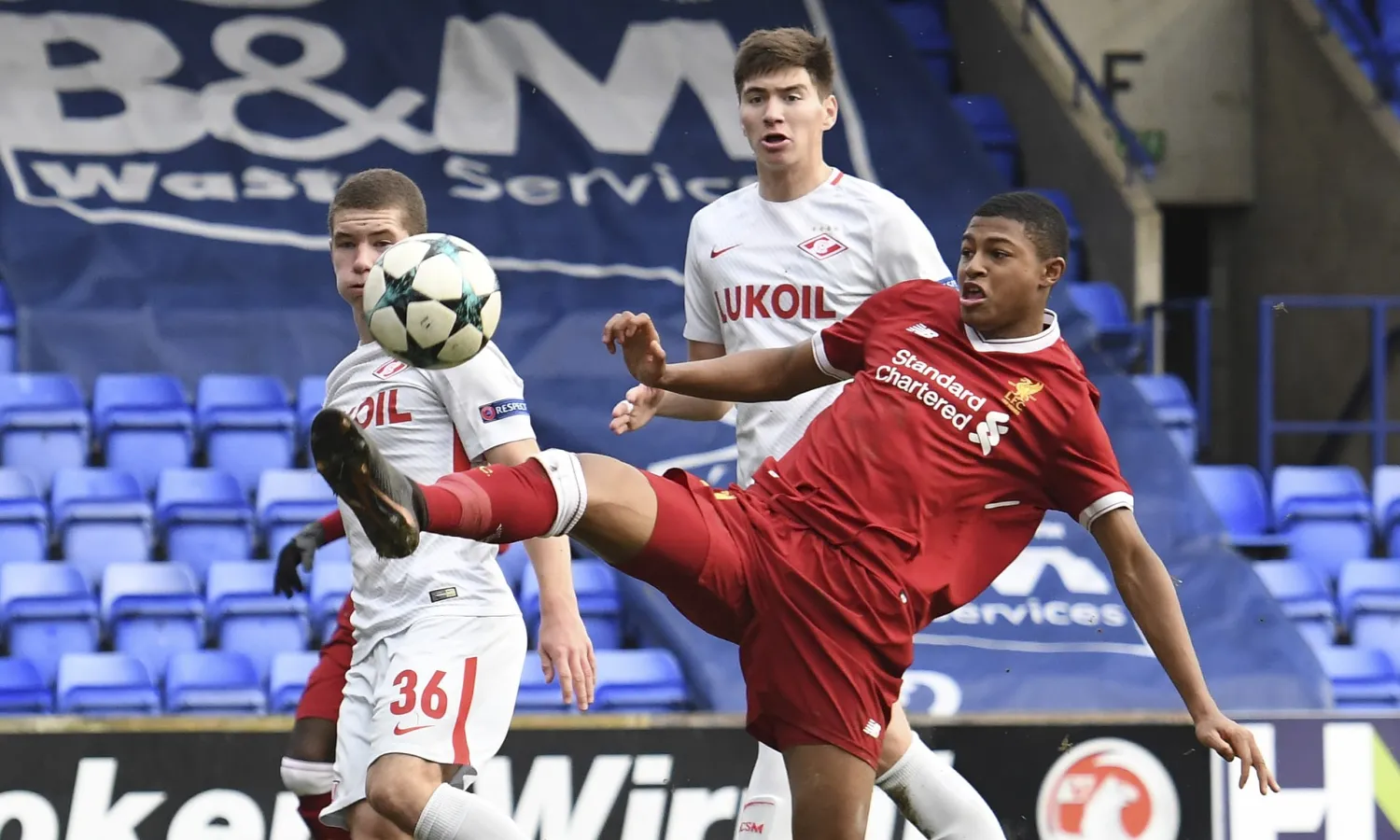

In an exclusive interview, the England Under-17 World Cup-winning forward opens up about abuse he has suffered in the last year and his dismay over the lack of action from the authorities
In different circumstances there would be so much else to discuss when Rhian Brewster pulls up his seat for the first major interview of what promises to be a thrilling career. The young man – or boy, really – sitting here is not short of highlights when he looks back on 2017. He is a World Cup winner with England’s Under-17s, as well as being the owner of the golden boot trophy from the same tournament, and there will be plenty of other opportunities, almost certainly, in the future to talk about the star qualities that have established him as one of the rising young hopes of English football.
Yet we are here, on his request, because he wants to talk about his other experiences over the past year and go through a story, at the age of 17, that can make you despair. He is speaking with a courage that goes beyond his years and he hopes, in the process, that what he says can go all the way to the top of the sport – if, that is, the relevant people are willing to listen. And, frankly, he could probably be forgiven for having a few doubts.
Uefa, in particular, needs to pay attention because this is a cry for help and it all feels so desperately wrong that over the course of an hour a teenage footballer, still to make his professional debut, can recall seven occasions when he says he has been racially abused or witnessed the same happening to a team-mate. Five of the alleged incidents are from the past seven months. Two have been while playing for England and one occurred in the World Cup final when, amid all the golden memories of beating Spain’s Under-17s, Brewster says he can vividly remember one of his team-mates being called a “monkey” by an opposition player.
To speak out takes courage because it cannot be easy for any player, especially one of his age, to go through the more excruciating details. Yet it is also clear that Brewster has been thinking about going public for some time and, importantly, that he has a strong support network in place. Mike Gordon, Liverpool’s co-owner, has been personally involved, ringing Brewster several times to let him know he has the backing of the people at the top of the club. Jürgen Klopp, the manager, is aware of this interview and full of admiration for what the teenager is trying to do. Steven Gerrard, one of Brewster’s mentors at the club’s academy, is the same. Troy Townsend, Kick it Out’s education manager, is in regular contact and Alex Inglethorpe, Liverpool’s academy director, is here to offer his support, sitting in the next seat as Brewster explains why he feels compelled to speak out. Liverpool, very understandably, are proud of what their player is doing.
“I said to them that I wanted to do it,” Brewster explains. “They said I should speak to my parents before doing anything and see what my mum and dad think. My mum and dad are unnerved because this is not the first time. They’re angry and they don’t want it to keep happening. And they’re angry because nothing has been done about it.”
Behind his polite smile and quietly spoken demeanour, he is angry, too, and the reasons quickly become clear when he explains, in uncensored form, what prompted Liverpool to submit an official complaint after playing Spartak Moscow in a Uefa Youth League tie at Prenton Park, home of Tranmere Rovers, three weeks ago.
“I got fouled,” Brewster says. “I was on the floor and I had the ball in my hands. One of their players started saying stuff in Russian to the ref. I said: ‘It’s a foul, man, what you playing at?’ I was still sitting down at this stage. Then their player leaned over me, right down to my face and said: ‘Suck my dick, you nigger, you negro.’
“I jumped to my feet and the ref came running over because obviously he realised something had been said. He [the referee] said to me he couldn’t do anything because he hadn’t heard it and ‘the only thing I can do is report it’. I said: ‘Come on, then – let’s go and report it.’ He started doing something else and I said: ‘No, now.’ We went over to the fourth official and told him. I told Steven [Gerrard] what had happened and we made a complaint there.”
It is jarring, to say the least, to hear the words that were allegedly used. But this, Brewster says, is only the latest in a long line of incidents where he has been targeted this year, starting with England’s encounter against Ukraine during the European Under-17 Championship in Croatia in May.
England won that game 4-0, with Brewster scoring the second goal. Yet the striker also angered one of the Ukraine players after chasing a ball into the penalty area and colliding with the goalkeeper. “I didn’t mean to hurt the goalkeeper and I said sorry – just left it there. But then there was an incident [with the same outfield player] later in the match. It was a bad challenge and I pushed him. We got into an argument and he called me a nigger.”
The Football Association lodged an official complaint but Uefa, with no video footage, concluded there was not enough evidence for disciplinary action. Nobody, however, has ever informed Brewster of that decision. To the teenager, it feels like the case “disappeared”.
The next incident happened in September when Liverpool’s Under-19s, managed by Gerrard, had a Uefa Youth League tie at home against Sevilla. “We were on a break,” Brewster says. “A ball came down the left. I was trying to get up with play when one of their players started running across me, trying to block my line and stop me running. I grabbed him and he fell over, theatrically. He’s come back and said something to me in Spanish. We were arguing and then he said it.”
The N-word again? “Yeah, and I’ve reacted. I was going to walk off the pitch and go straight down the tunnel, I was that angry. Steven grabbed me and said: ‘What’s happened?’ Obviously he realised something was wrong and he put his arm round me. I told them [Liverpool’s coaching staff] and they told the fourth official. But the fourth official told the ref their player had been accused of bullying. He [the referee] went to the player to say he had been accused of bullying and the player looked like he didn’t know what was happening.”
The Sevilla player denied any wrongdoing and Uefa eventually ruled there was insufficient evidence to take disciplinary action. Liverpool, however, have understandable concerns about the apparent lack of investigation once the club had submitted a complaint. None of their staff was interviewed to establish if there were witnesses or why, as Brewster says, “a few challenges went flying in from our players” throughout the rest of the match. Brewster was never contacted for a follow-up interview and Liverpool’s belief is that neither were the match officials. It seems remarkable and it is easy to understand why Liverpool, and the player at the heart of this story, have doubts about the processes Uefa employs and the effort, or lack of it, that goes into establishing the truth.
Two weeks later, Liverpool had another game in the same competition, this time flying to Russia to play Spartak Moscow, and Brewster was being substituted when his replacement, the Nigeria-born Bobby Adekanye, aged 18, ran on to monkey chants from the crowd.
Brewster’s first thought was to support his team-mate “because I know how he feels and I didn’t want him to think he was on his own”. Uefa subsequently ordered Spartak to close 500 seats of their academy stadium for the next match and display a banner – “Equal Game” – in that section of the ground. But was that enough? “It’s not really a punishment, is it?” Brewster says. “It was nothing really, a slap on the wrist. They weren’t even using those seats. It would be like us being asked to close 500 seats at Prenton Park in a stand that was already empty. It should have been more severe – a whole stadium ban.”
As for the incident in the World Cup final, that relates to Morgan Gibbs-White, a 17-year-old from Wolverhampton Wanderers, and maybe explains why there were a number of flashpoints later in the match. “Something happened in the box,” Brewster says. “As Morgan was running away, he [a Spain player] has called him a monkey. It was a goal-kick and I was getting into position. ‘Morgan,’ I said, ‘did you hear that?’ He said: ‘Yeah, yeah, I thought I was the only one.’”
In the final minutes of that 5-2 victory, Brewster became embroiled in an argument with one of his opponents. “They were telling us to win respectfully. I started laughing. I said: ‘How can you tell us to win respectfully when one of your players has been racist? What about your team-mate being respectful to us?’”
What has gone under the radar until now is that the FA reported the incident to Fifa in the hope that sanctions would follow. The FA followed that up last month with further evidence but, as yet, has not been informed whether or not any action will be taken.
On the face of it, Brewster has shown impressive restraint not to have taken matters into his own hands. That, however, has not been easy and when it comes to the latest incident, involving the Spartak player, the London-born teenager had to be held back at the final whistle. That was the closest, he says, he has come to seeking personal retribution.
“I remember a goal-kick coming up and going up for a header. I just jumped into him. They got a foul and the ref told me to be careful. After the game my team-mates were trying to grab me and calm me down. Alex and Steven tried to stop me. But I was so upset.
“I didn’t even want to put in a complaint. ‘Nothing’s going to happen,’ that was my attitude. I was walking down the tunnel after the match and I was just swearing – ‘Fuck the system, it’s not going to do anything’, stuff like that. Obviously you have to do it [make a complaint]. But if something is ever done about it, that’s another story.”
Brewster’s reaction that night led to newspaper headlines and Liverpool’s second complaint about Spartak in 10 weeks and, though he would like to be mistaken, he cannot help wonder whether Uefa is “only taking it seriously because of the way I reacted. If I’d have knocked him out, I would have been banned, 100%. Nothing has happened to him yet, and nothing might happen. I hope something happens and he gets banned but I don’t know if anything will.”
Uefa has directed the matter to its control, ethics and disciplinary body but no date has been set for the hearing. The player in question is the 19-year-old Spartak captain, Leonid Mironov, who denies the allegations. His agent has described the complaint as “built on guesses” and “quite absurd”.
For Brewster, the emphasis is on trying to remain positive and remember one piece of advice in particular when it comes to the people who have targeted him. “I’ve spoken to my dad and he says: ‘They’re only doing it because they can’t get to you – they have no other way. They’ve tried to tackle you and it’s not working so the only thing they can do is try to get into your head.’ I just think they’re haters. They’re doing it because I’m better than them.”
It has still been a harrowing experience and the frequency with which it has happened, he says, does not make it any easier. Brewster is a resilient kid but he has clearly suffered. “On the day it happens, that night my head won’t be there. I just want to be left alone. I want to be by myself and left to think. The next day I’ll still be thinking about it.”
It does not help, either, that there has been only one occasion when an opposition player has been punished, relating to a youth tournament with Liverpool in the Czech Republic in 2015. “He admitted he had said it and they banned him from the rest of the tournament,” Brewster recalls. “After the game he tried to apologize but I wouldn’t shake his hand.”
Brewster was 15 at the time and even younger on the first occasion he was targeted, going back to his days in Chelsea’s junior system and a tournament in Russia. “I was warming up with a couple of team-mates. We were all coloured and there were monkey chants. There were about 10 of them doing it. I didn’t know what to do. It had never happened to me before. I told my coach and he went mad. The game was still playing and he went straight to the organisers to tell them what had happened and get the people who were doing it kicked out. I was 12.”
The only small ray of light, perhaps, is that Brewster has never experienced anything of this nature from another English player. “If someone in my team said something like that [to an opponent] I’d pull them up myself: ‘Well, if you’re saying that to him, you’re basically calling me that as well.’ But it’s different in England. We have different players from different races, even in the lower leagues. They don’t have that in some places abroad. Every time it’s happened to me I don’t remember a single black player being on their team.”
He nods in agreement when Inglethorpe talks about the solution being better education and again when Liverpool’s academy director says the first-team players from the relevant clubs should help that process. What Brewster would also like, however, is hard evidence that Uefa is doing more than merely paying lip-service to the problem. “Everyone stands behind the anti-racism banners. You have the adverts for Champions League games saying ‘no to racism’ in all the different languages. Idols of the game take part – but it still happens.
“Before the last Spartak game I was talking to [Liverpool team-mate] Ben Woodburn and I said to him: ‘This doesn’t mean anything, I don’t know why I’m standing behind this banner anyway.’ We started laughing. It was a case of: ‘Just stand behind it, get your picture done and walk away.’ We did it against Sevilla and it still happened, we did it against Spartak away and we did it in the Euros. I’m thinking to myself: ‘Well, I’m standing behind a banner but does it really stop them from saying it?’ To be honest, I don’t think there is any point. It needs more severe punishments.
“I love the game. I’m never going to stop loving it. It’s just disappointing to know it’s still in the game. If it wasn’t in the game, it would be so much better. You wouldn’t have to worry about playing abroad, worrying about what the fans are going to say, or what another player is going to say. I wouldn’t have to worry that if I score they are going to call me all types of names.”
All he can do is try to effect change and hope, without any real experience of these matters, that the voice of a 17-year-old may be heard. He has done his bit, speaking with clarity and distinction, and though it was not ever his intention he has also shown a strength of personality that makes it clear why the people at Anfield think so highly of him. Now, more than anything, he hopes he can be proven wrong. “I don’t think Uefa take this thing seriously. They don’t really care. That is how it feels anyway, like it has been brushed under the carpet.”
(The Guardian)


