


Beijing Turns Its Back On Migrant Workers

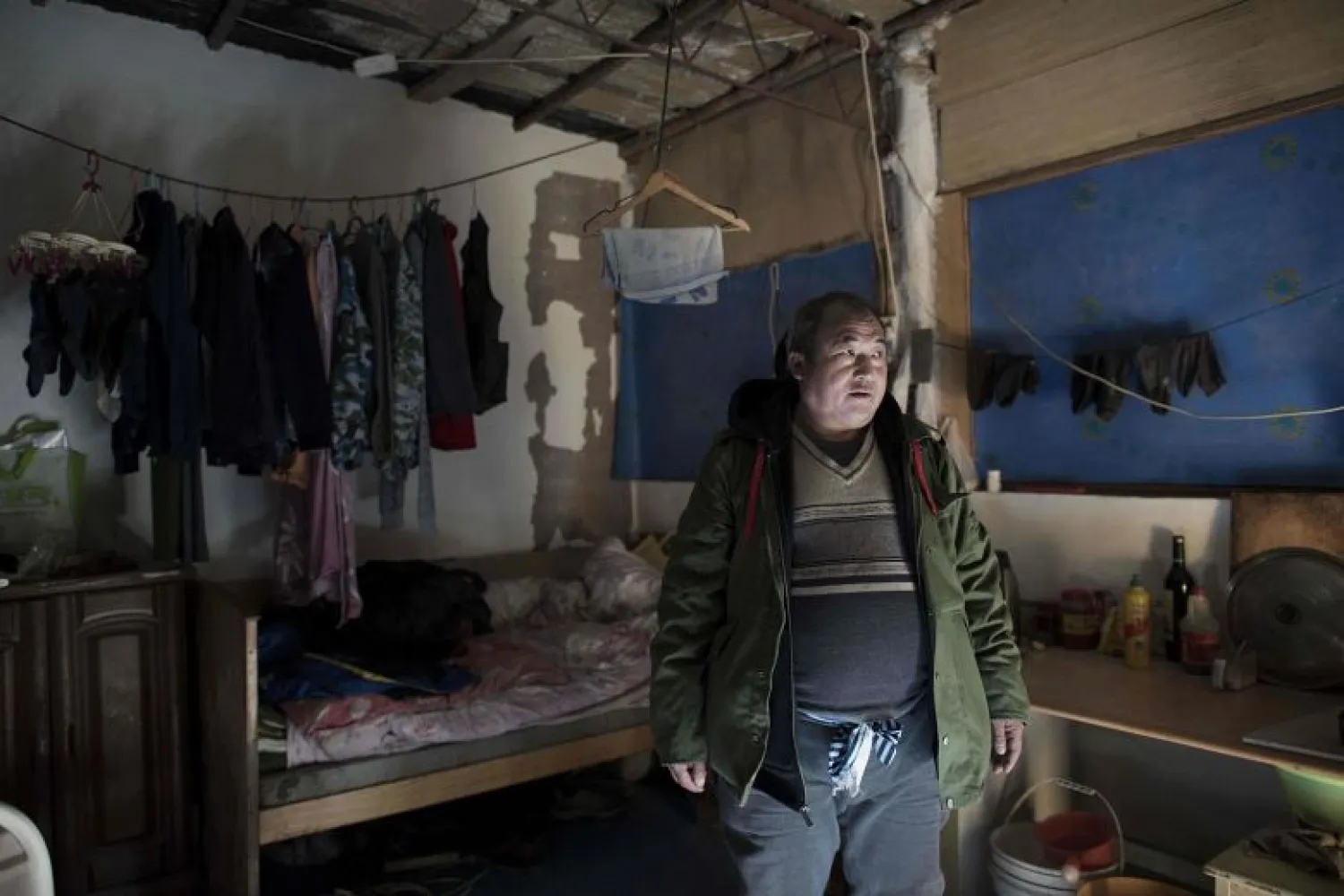
Lin Huiqing, who works for a moving company, stands inside his cousin's room where he now lives temporarily after he was evicted from his room at a migrant village on the outskirts of Beijing.PHOTO: AFP
TT

Beijing Turns Its Back On Migrant Workers

Lin Huiqing, who works for a moving company, stands inside his cousin's room where he now lives temporarily after he was evicted from his room at a migrant village on the outskirts of Beijing.PHOTO: AFP

They fuelled their nation's dramatic economic rise, toiling in jobs far from home, but China's migrant workers are now finding themselves increasingly unwelcome as authorities try to cap the population explosions in key cities.

Mr. Lin Huiqing moved to Beijing to look for work when his children were still in diapers.

For the last 18 years, he has seen his family just once a year, the rest spent doing the hard labor most Beijingers would prefer to avoid.

The 50-year-old is one of hundreds of millions of migrants who moved from the countryside to the cities, a colossal demographic shift that made China's ascent possible.

But last month (Dec 2017), Mr. Lin was evicted from the village where he lived on the capital's outskirts, another victim of a city-wide demolition plan to limit Beijing's population to 23 million by 2020 - a target that could come at the cost of its economy.

"If I go home, I have no way to support my wife and kids," Mr. Lin lamented.

According to the Communist Party mouthpiece People's Daily, the city plans to demolish 40 million sqm of "illegal" structures.

Many are the homes and shops of low-income migrants such as Mr. Lin.

When he first arrived in Beijing, Mr. Lin and his friends pooled their money and took out loans to purchase delivery trucks.

He made a living hauling the wares of small-scale shopkeepers and traders, but the moving business has taken a hit as the city condemns buildings en masse, evicting tens of thousands into the winter cold.

"Our customers are commoners like us," he said. "With their small businesses shut down, there's no stock for us to move. We're basically unemployed now."

Authorities say the campaign, which kicked into high gear after a fire in an illegal structure killed 19 in November, is needed to clean the city up once and for all.

But it is also removing vibrant chunks of Beijing's economy, such as retail and small-scale manufacturing, and throwing into chaos other sectors like delivery, the bedrock of the booming e-commerce trade.

Relegated to the periphery, migrants have kept China's economy humming, handling the difficult, dirty and sometimes dangerous work that the city's permanent residents would not do.

Urban industries such as construction, domestic work and sanitation are almost completely staffed by migrants.

Associate professor of international and comparative labor Eli Friedman at Cornell University said China's biggest cities "simply cannot function without migrant workers".

"If every non-local were to actually be removed from cities like Beijing, Shanghai and Guangzhou, these economic engines for the whole country would completely collapse," he told AFP.

But that is exactly what is happening, said Mr. Li Ning, one of the 60,000 delivery drivers who criss-cross Beijing's streets.

Mr. Li was recently evicted from a village on the city's outskirts, forcing him into an apartment where the rent quadrupled.

Then authorities came for his delivery company's warehouse, forcing staff to sort packages on the sidewalk and sending his income plummeting.

"In Beijing, all the migrants are leaving. We can't make it here anymore," he said, adding that he plans to leave for good during the upcoming spring festival.

Another delivery franchise owner surnamed Wang said she will "give up" if authorities knock down her current warehouse, which they marked in black paint with the character "chai", or demolish in Chinese, in mid-December.

She had just moved in on Dec 1, after she had to close two other delivery hubs, forcing her to cut her workforce from 240 couriers to 60.

"There's no stability. I don't know what I'll be facing tomorrow," she said, tears welling in her eyes.

The demolitions have also hit Beijing's retail sector, decimating once affordable mom and pop shops and pushing consumers online or into high-end malls.

Two years ago, Mr. Ge Guoxiang moved with his wife from their home province of Jiangsu to take over his brother's textiles stall.

It had thrived for over 20 years in Beijing's Tuanjiehu Tianyu market. But three months ago, they received notice that authorities will shutter the market.

Dozens of small-scale community markets have been forced to shut down this year - including the iconic Beijing Zoo market, where hundreds of merchants organized rare street protests against the evictions.

Officials said they have designated certain areas in the neighboring Hebei province where merchants can move their businesses to.

But Mr. Ge is unconvinced.

"It takes years for businesses like ours to build up clientele. Now we have to start over," he said. "Our clients are mostly older people who don't know how to shop online. Where will they go?"


Leading Harvard Trade Economist Says Saudi Arabia Holds Key to Success in Fragmented Global Economy

Professor Pol Antràs speaks during a panel discussion at the AlUla Conference for Emerging Market Economies (Asharq Al-Awsat).
TT

Leading Harvard Trade Economist Says Saudi Arabia Holds Key to Success in Fragmented Global Economy

Professor Pol Antràs speaks during a panel discussion at the AlUla Conference for Emerging Market Economies (Asharq Al-Awsat).

Harvard University economics professor Pol Antràs said Saudi Arabia represents an exceptional model in the shifting global trade landscape, differing fundamentally from traditional emerging-market frameworks. He also stressed that globalization has not ended but has instead re-formed into what he describes as fragmented integration.

Speaking to Asharq Al-Awsat on the sidelines of the AlUla Conference for Emerging Market Economies, Antràs said Saudi Arabia’s Vision-driven structural reforms position the Kingdom to benefit from the ongoing phase of fragmented integration, adding that the country’s strategic focus on logistics transformation and artificial intelligence constitutes a key engine for sustainable growth that extends beyond the volatility of global crises.

Antràs, the Robert G. Ory Professor of Economics at Harvard University, is one of the leading contemporary theorists of international trade. His research, which reshaped understanding of global value chains, focuses on how firms organize cross-border production and how regulation and technological change influence global trade flows and corporate decision-making.

He said conventional classifications of economies often obscure important structural differences, noting that the term emerging markets groups together countries with widely divergent industrial bases. Economies that depend heavily on manufacturing exports rely critically on market access and trade integration and therefore face stronger competitive pressures from Chinese exports that are increasingly shifting toward alternative markets.

Saudi Arabia, by contrast, exports extensively while facing limited direct competition from China in its primary export commodity, a situation that creates a strategic opportunity. The current environment allows the Kingdom to obtain imports from China at lower cost and access a broader range of goods that previously flowed largely toward the United States market.

Addressing how emerging economies should respond to dumping pressures and rising competition, Antràs said countries should minimize protectionist tendencies and instead position themselves as committed participants in the multilateral trading system, allowing foreign producers to access domestic markets while encouraging domestic firms to expand internationally.

He noted that although Chinese dumping presents concerns for countries with manufacturing sectors that compete directly with Chinese production, the risk is lower for Saudi Arabia because it does not maintain a large manufacturing base that overlaps directly with Chinese exports. Lower-cost imports could benefit Saudi consumers, while targeted policy tools such as credit programs, subsidies, and support for firms seeking to redesign and upgrade business models represent more effective responses than broad protectionist measures.

Globalization has not ended

Antràs said globalization continues but through more complex structures, with trade agreements increasingly negotiated through diverse arrangements rather than relying primarily on multilateral negotiations. Trade deals will continue to be concluded, but they are likely to become more complex, with uncertainty remaining a defining feature of the global trading environment.

Interest rates and artificial intelligence

According to Antràs, high global interest rates, combined with the additional risk premiums faced by emerging markets, are constraining investment, particularly in sectors that require export financing, capital expenditure, and continuous quality upgrading.

However, he noted that elevated interest rates partly reflect expectations of stronger long-term growth driven by artificial intelligence and broader technological transformation.

He also said if those growth expectations materialize, productivity gains could enable small and medium-sized enterprises to forecast demand more accurately and identify previously untapped markets, partially offsetting the negative effects of higher borrowing costs.

Employment concerns and the role of government

The Harvard professor warned that labor markets face a dual challenge stemming from intensified Chinese export competition and accelerating job automation driven by artificial intelligence, developments that could lead to significant disruptions, particularly among younger workers. He said governments must adopt proactive strategies requiring substantial fiscal resources to mitigate near-term labor-market shocks.

According to Antràs, productivity growth remains the central condition for success: if new technologies deliver the anticipated productivity gains, governments will gain the fiscal space needed to compensate affected groups and retrain the workforce, achieving a balance between addressing short-term disruptions and investing in long-term strategic gains.


Aljadaan: Emerging Markets Account for 70% of Global Growth

Al-Jadaan speaking to the attendees at the "AlUla Conference for Emerging Market Economies" (Asharq Al-Awsat
TT

Aljadaan: Emerging Markets Account for 70% of Global Growth

Al-Jadaan speaking to the attendees at the "AlUla Conference for Emerging Market Economies" (Asharq Al-Awsat

Saudi Minister of Finance Mohammed Aljadaan stressed Sunday that the world economy is going through a “profound transition,” saying emerging markets and developing economies now account for nearly 60 percent of the global Gross Domestic Product (GDP) in purchasing power terms and over 70 percent of global growth.

In his opening remarks at the AlUla Conference for Emerging Market Economies, organized by the Saudi Ministry of Finance and the IMF in AlUla, the minister said these economies have become an increasingly important driver of global growth with their share of global economy more than doubling since 2010.

“Today, the 10 emerging economies in the G20 alone account for more than half of the world growth. Yet, they face a more complex and fragmented environment, elevated debt levels, slower trade growth and increasing exposure to geopolitical shocks.”

“Unfortunately, more than half of low income countries are either in or at the risk of debt distress. At the same time global trade growth has slowed at around half of what it was pre the pandemic,” Aljadaan added.

The Finance Minister stressed that the Saudi experience over the past decade has reinforced three lessons that may be relevant to the discussions at the two-day conference, which brings together a select group of ministers and central bank governors, leaders of international organizations, leading investors and academics.

“First, macroeconomic stability is not the enemy of growth. It is actually the foundation,” he said.

“Structural reforms deliver results only when institutions deliver. So there is no point of reforming ... if the institutions are unable to deliver,” he stated.

Finally, he said that “international cooperation matters more, not less, in a fragmented world.”


Georgieva from AlUla: Growth Still Lacks Pre-pandemic Levels

Kristalina Georgieva speaking to attendees at the second edition of the AlUla Conference for Emerging Market Economies (Asharq Al-Awsat)
TT

Georgieva from AlUla: Growth Still Lacks Pre-pandemic Levels

Kristalina Georgieva speaking to attendees at the second edition of the AlUla Conference for Emerging Market Economies (Asharq Al-Awsat)

International Monetary Fund (IMF) Managing Director Kristalina Georgieva said Sunday that world growth still lacks pre-pandemic levels, expressing concern as she expected more shocks amid high spending and rising debt levels in many countries.

Georgieva spoke at the AlUla Conference for Emerging Market Economies, organized by the Saudi Ministry of Finance and the IMF in AlUla.

The two-day conference brings together a select group of ministers and central bank governors, leaders of international organizations, leading investors and academics to deliberate on policies to global stability, prosperity, and multilateral collaboration.

Georgieva said that the conference was launched last year in recognition of the growing role of emerging market economies in a world of sweeping transformations.

“I came out of this gathering .... With a sense of hope for the pragmatic attitude and determination to pursue good policies and build strong institutions,” she said.

Georgieva stressed that “good policies pay off,” and said that growth rates across emerging economies reached four percent this year, exceeding by a large margin those of advanced economies that are around 1.5 percent.