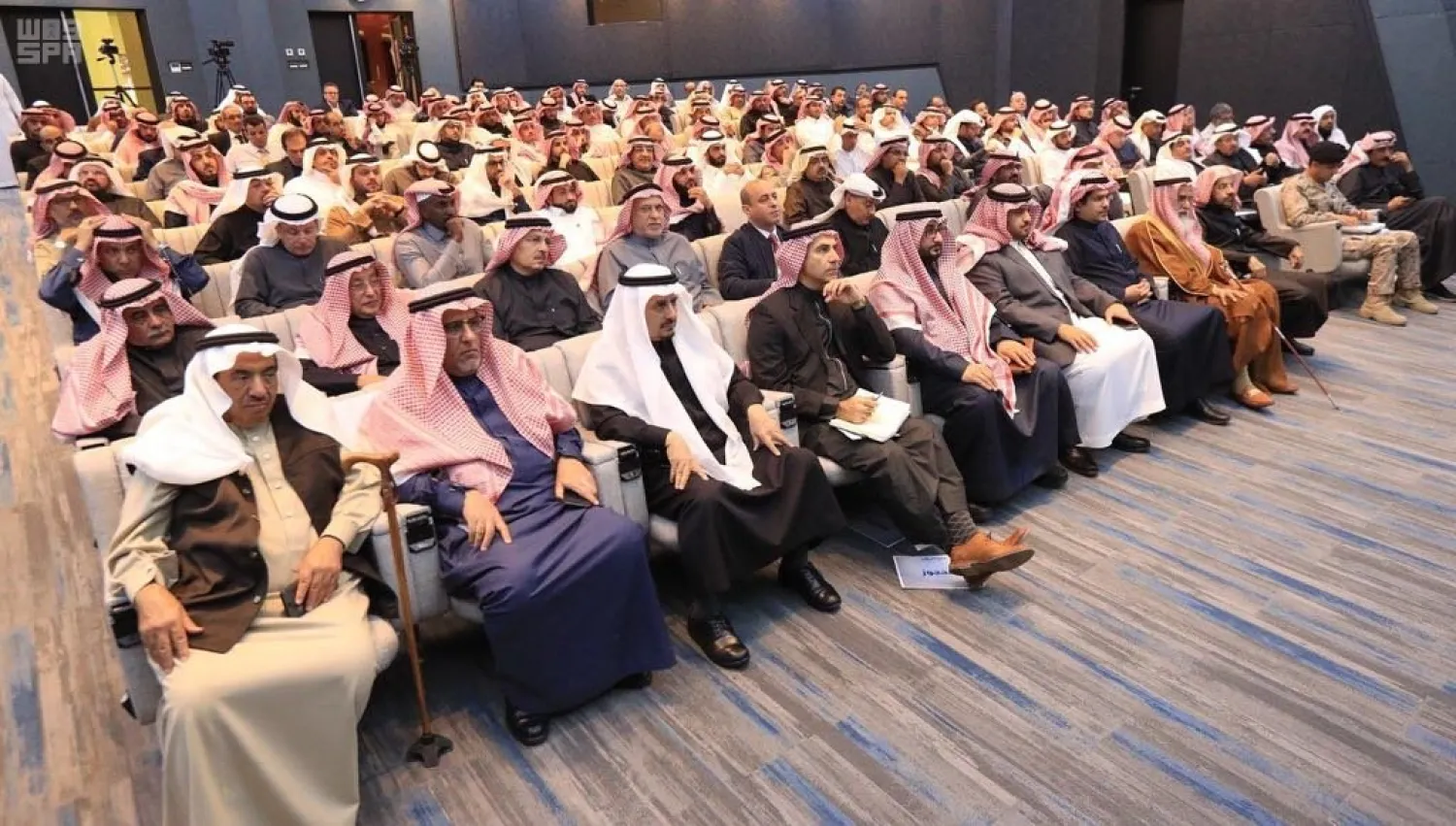
Saudi Initiative on Military Manufacturing to Achieve Self-Sufficiency

Officials from the public and private sectors met to discuss developing the local military industry. (SPA)
TT

Saudi Initiative on Military Manufacturing to Achieve Self-Sufficiency

Officials from the public and private sectors met to discuss developing the local military industry. (SPA)

A Saudi official affirmed that the kingdom is moving forward with reinforcing the military industrial content, providing spare parts to achieve self-sufficiency and exporting to global markets amid expectations of a sector growth ranging between 1 and 2 percent in 2018.

General Department for Local Manufacturing Support General Director Engineer Atiyah al-Maleki told Asharq Al-Awsat that the 2018 Armed Forces Exhibition for Diversity of Requirements and Capabilities (AFED) will present 46,000 categories that provide partnership opportunities between the public and private sectors.

He added that 18 government and private bodies and 48 international companies will present their products at AFED at the Riyadh International Convention and Exhibition Center from February 25 to March 3.

He asserted that the kingdom is committed to enhancing the local content. He lauded the importance of the private sector participation in nationalization and boosting capabilities, stressing that the Ministry of Defense is committed to using private sector products and reinforcing the local factories' work.

Engineer Osama al-Zamil, chairman of Industrial Committee of Riyadh Chamber, expected the Saudi military sector to grow up to 1-2 percent in 2018, adding that the chamber’s meeting on Thursday with the Ministry of Defense endorsed this approach.

The meeting aims at launching an initiative to reinforce partnership between the Ministry of Defense and the Saudi industrial sector in order to provide military spare parts, stated Zamil.

It was also a chance to evaluate the overall condition and to showcase achievements made in the field of building local capabilities in military manufacturing in both the public and private sectors.

Zamil declared that the meeting resulted in launching an initiative of a strategic partnership chamber in cooperation with the Ministry of Defense and AFED to form a team from the private sector that would determine capabilities and provide information.


Saudi Arabia, Syria Sign Joint Airline and Telecoms Deals

Officials pose after signing a framework agreement for developmental cooperation and the launch of 45 development initiatives between the Syrian Development Fund and Saudi Arabia's Development Committee at the People's Palace in Damascus, Syria, Saturday, Feb. 7, 2026. (AP)
TT

Saudi Arabia, Syria Sign Joint Airline and Telecoms Deals

Officials pose after signing a framework agreement for developmental cooperation and the launch of 45 development initiatives between the Syrian Development Fund and Saudi Arabia's Development Committee at the People's Palace in Damascus, Syria, Saturday, Feb. 7, 2026. (AP)

Syria and Saudi Arabia signed deals Saturday that include a joint airline and a $1-billion project to develop telecommunications, officials said, as Syria seeks to rebuild after years of war.

The new authorities in Damascus have worked to attract investment and have signed major agreements with several companies and governments.

Syrian Investment Authority chief Talal al-Hilali announced a series of deals including "a low-cost Syrian-Saudi airline aimed at strengthening regional and international air links".

The agreement also includes the development of a new international airport in the northern city of Aleppo, and redeveloping the existing facility.

Hilali also announced an agreement for a project called SilkLink to develop Syria's "telecommunications infrastructure and digital connectivity".

Syrian Telecommunications Minister Abdulsalam Haykal told the signing ceremony that the project would be implemented "with an investment of around $1 billion".

For decades, Syria was unable to secure significant investments because of Assad-era sanctions.

But the United States fully removed its remaining sanctions on Damascus late last year, paving the way for the full return of investments.

Syria and Saudi Arabia also inked an agreement on water desalination and development cooperation on Saturday.

At the ceremony, Saudi Investment Minister Khalid Al-Falih announced the launch of an investment fund for "major projects in Syria with the participation of the (Saudi) private sector".

The deals are part of "building a strategic partnership" between the two countries, he said.

Syria's Hilali said the agreements targeted "vital sectors that impact people's lives and form essential pillars for rebuilding the Syrian economy".

Syria has begun the mammoth task of trying to rebuild its shattered infrastructure and economy.

In July last year, Riyadh signed investment and partnership deals with Damascus valued at $6.4 billion to help rebuild the country's infrastructure, telecommunications and other major sectors.

A month later, Syria signed agreements worth more than $14 billion, including investments in Damascus airport and other transport and real estate projects.

This week, Syria signed a preliminary deal with US energy giant Chevron and Qatari firm Power International to explore for oil and gas offshore.


India’s Modi Lauds Interim Trade Pact After US Tariff Rollback

Indian Prime Minister Narendra Modi addresses the media before the budget session of Parliament at Parliament House in New Delhi, India, 29 January 2026. (EPA)
TT

India’s Modi Lauds Interim Trade Pact After US Tariff Rollback

Indian Prime Minister Narendra Modi addresses the media before the budget session of Parliament at Parliament House in New Delhi, India, 29 January 2026. (EPA)

Indian Prime Minister Narendra Modi on Saturday hailed an interim trade agreement with the United States, saying it would bolster global growth and deepen economic ties between the two countries.

The pact cuts US "reciprocal" duties on Indian products to 18 percent from 25 percent, and commits India to large purchases of US energy and industrial goods.

US President Donald Trump, while announcing the deal Tuesday, had said Modi promised to stop buying Russian oil over the war in Ukraine.

The deal eases months of tensions over India's oil purchases -- which Washington says fund a conflict it is trying to end -- and restores the close ties between Trump and the man he describes as "one of my greatest friends."

"Great news for India and USA!" Modi said on X on Saturday, praising US President Donald Trump's "personal commitment" to strengthening bilateral ties.

The agreement, he said, reflected "the growing depth, trust and dynamism" of their partnership.

Modi's remarks came hours after Trump issued an executive order scrapping an additional 25 percent levy imposed over New Delhi's purchases of Russian oil, in a step to implement the trade deal announced this week.

Modi, who has faced criticism at home about opening access of Indian agricultural markets to the United States and terms on oil imports, did not mention Russian oil in his statement.

"This framework will also strengthen resilient and trusted supply chains and contribute to global growth," he said.

It would also create fresh opportunities for Indian farmers, entrepreneurs and fishermen under the "Make in India" initiative.

In a separate statement, Commerce Minister Piyush Goyal said the pact would "open a $30 trillion market for Indian exporters".

Goyal also said the deal protects India's sensitive agricultural and dairy products, including maize, wheat, rice, soya, poultry and milk.

Other terms of the agreement include the removal of tariffs on certain aircraft and parts, according to a separate joint statement released Friday by the White House.

The statement added that India intends to purchase $500 billion of US energy products, aircraft and parts, precious metals, tech products and coking coal over the next five years.

The shift marks a significant reduction in US tariffs on Indian products, down from a rate of 50 percent late last year.

Washington and New Delhi are expected to sign a formal trade deal in March.


Gold Bounces Back on Softer Dollar, US-Iran Concerns; Silver Rebounds

Gold and silver bars are stacked in the safe deposit boxes room of the Pro Aurum gold house in Munich, Germany, January 10, 2025. REUTERS/Angelika Warmuth
TT

Gold Bounces Back on Softer Dollar, US-Iran Concerns; Silver Rebounds

Gold and silver bars are stacked in the safe deposit boxes room of the Pro Aurum gold house in Munich, Germany, January 10, 2025. REUTERS/Angelika Warmuth

Gold rebounded on Friday and was set for a weekly gain, helped by bargain hunting, a slightly weaker dollar and lingering concerns over US-Iran talks in Oman, while silver recovered from a 1-1/2-month low.

Spot gold rose 3.1% to $4,916.98 per ounce by 09:31 a.m. ET (1431 GMT), recouping losses posted during a volatile Asia session that followed a fall of 3.9% on Thursday. Bullion was headed for a weekly gain of about 1.3%.

US gold futures for April delivery gained 1% to $4,939.70 per ounce.

The US dollar index fell 0.3%, making greenback-priced bullion cheaper for the overseas buyers.

"The gold market is seeing perceived bargain hunting from bullish traders," said Jim Wyckoff, senior analyst at Kitco Metals.

Iran and the US started high-stakes negotiations via Omani mediation on Friday to try to overcome sharp differences over Tehran's nuclear program.

Wyckoff said gold's rebound lacks momentum and the metal is unlikely to break records without a major geopolitical trigger.

Gold, a traditional safe haven, does well in times of geopolitical and economic uncertainty.

Spot silver rose 5.3% to $74.98 an ounce after dipping below $65 earlier, but was still headed for its biggest weekly drop since 2011, down over 10.6%, following steep losses last week as well.

"What we're seeing in silver is huge speculation on the long side," said Wyckoff, adding that after years in a boom cycle, gold and silver now appear to be entering a typical commodity bust phase.

CME Group raised margin requirements for gold and silver futures for a third time in two weeks on Thursday to curb risks from heightened market volatility.

Spot platinum added 3.2% to $2,052 per ounce, while palladium gained 4.9% to $1,695.18. Both were down for the week.