The Moroccan government decided on Friday to start the gradual floating of its currency dirham on next Monday, after months of hesitation and urgent requests by the International Monetary Fund (IMF).
The government revealed in a statement that Morocco would adopt a flexible exchange rate regime, in which the dirham exchange rate would range between +2.5 percent and -2.5 percent.
IMF announced in the beginning of last year that conditions have become appropriate for reforming the exchange rate regime in Morocco, but the Central Bank of Morocco postponed the step six months due to forming a new government.
Morocco then revealed the intention to adopt a flexible exchange rate regime end of June, causing a turmoil in the exchange market and pushing the central bank to intervene to protect the currency. This affected the country’s foreign currency reserves negatively.
The Moroccan government said in Saturday’s statement that adopting a flexible exchange rate aims at cementing the national economy immunity towards foreign disruption and supporting the economy's competitiveness.
Currently, the dirham is fixed via a peg that is 60 percent weighted to the euro and 40 percent to the US dollar.
Moroccan Economy and Finance Ministry stressed that the new exchange regime is not an adventure and the step was studied for years.
Unlike Egypt, which floated its pound in 2016, Morocco isn’t facing a currency crisis and wasn’t under pressure to take immediate action. It has an investment-grade credit rating and an expanding private sector, according to Bloomberg.
The country's economy grew by 4.1 percent in 2017, compared with 1.2 percent a year earlier. Inflation rate remained around 0.7 percent in 2017, lower from 1.6 percent in 2016, while the budget deficit rate dipped to 3.5 percent in 2017 from 4.1 percent in 2016.
Saudi Arabia, Canada Open New Investment Era in AI, Mininghttps://english.aawsat.com/business/5294234-saudi-arabia-canada-open-new-investment-era-ai-mining
Saudi Arabia, Canada Open New Investment Era in AI, Mining
Officials are seen at the Saudi-Canadian Investment Forum in Jeddah. (Asharq Al-Awsat)
Saudi Arabia and Canada have entered a new phase of strategic economic partnership, with both countries seeking to translate diplomatic momentum into commercial deals in mining, energy, artificial intelligence, data centers, financial services, and advanced industries.
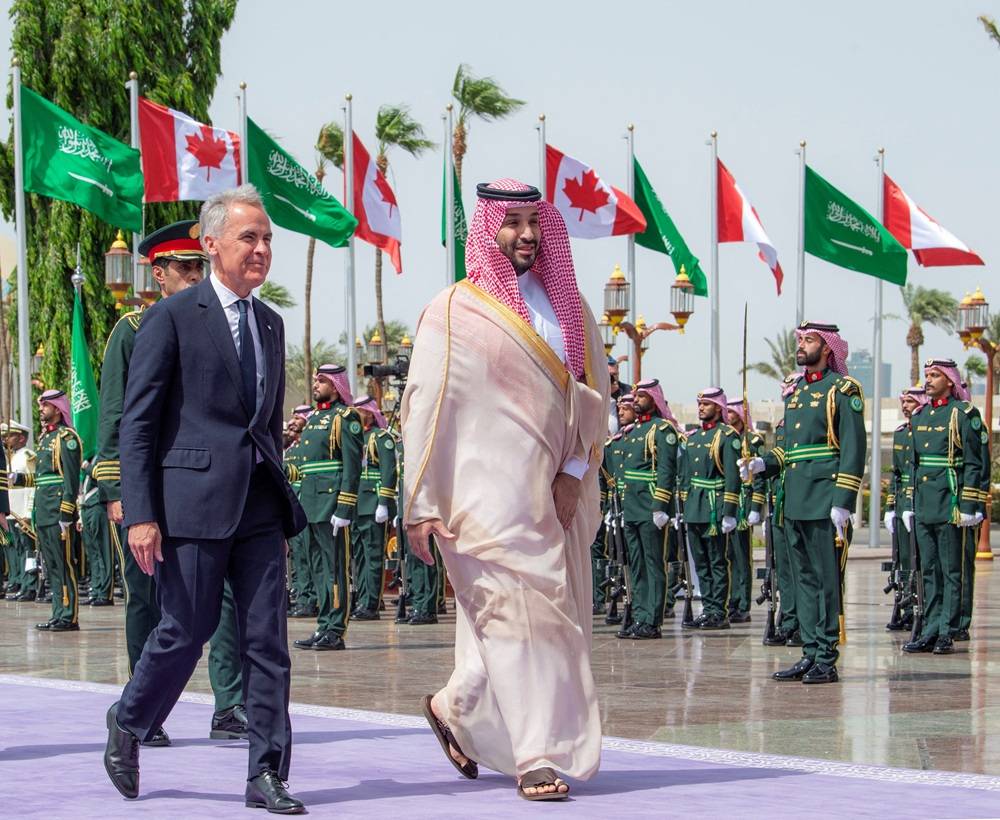
Prince Mohammed bin Salman bin Abdulaziz, Saudi Crown Prince and Prime Minister, received Canadian Prime Minister Mark Carney on an official visit that capped a year of intensified diplomatic and investment activity between the two countries.
The visit coincided with the Saudi-Canadian Investment Forum in Jeddah, where senior officials and business leaders from both sides met to shape a practical road map for moving relations from discussion to implementation.
Carney said Saudi Arabia had become one of the main pillars of the global economy, praising the sharp acceleration in its economic growth and the structural transformation taking place under Vision 2030.
Speaking on the sidelines of the forum, he said Canada was firmly committed to deepening cooperation with the Kingdom in strategic sectors, led by energy and mining.
The joint push aims to connect Canadian technology, innovation and capital with the scale of opportunities created by Vision 2030, particularly in financial services, mining, advanced industries, artificial intelligence and data centers.
Saudi Investment Minister Fahad Al-Saif said the Kingdom’s economy had grown from about $720 billion in 2017 to nearly $1.3 trillion. Non-oil activities now account for more than 50% of gross domestic product, while non-oil and non-government investment represent about 77% of total investment.
Al-Saif said the forum offered a practical platform to link Canada’s strengths in capital, innovation, natural resources, education and professional expertise with opportunities being created in Saudi Arabia.
He said the presence of investors, companies, entrepreneurs and government representatives from both countries created the right mix to move from talks to execution.
The next phase of Saudi-Canadian investment ties should be more specific, more ambitious and more commercially focused, he said. It should link Canadian capital, technology and entrepreneurship with opportunities in the Kingdom, while opening new channels for Saudi capital, companies and national institutions in Canada.
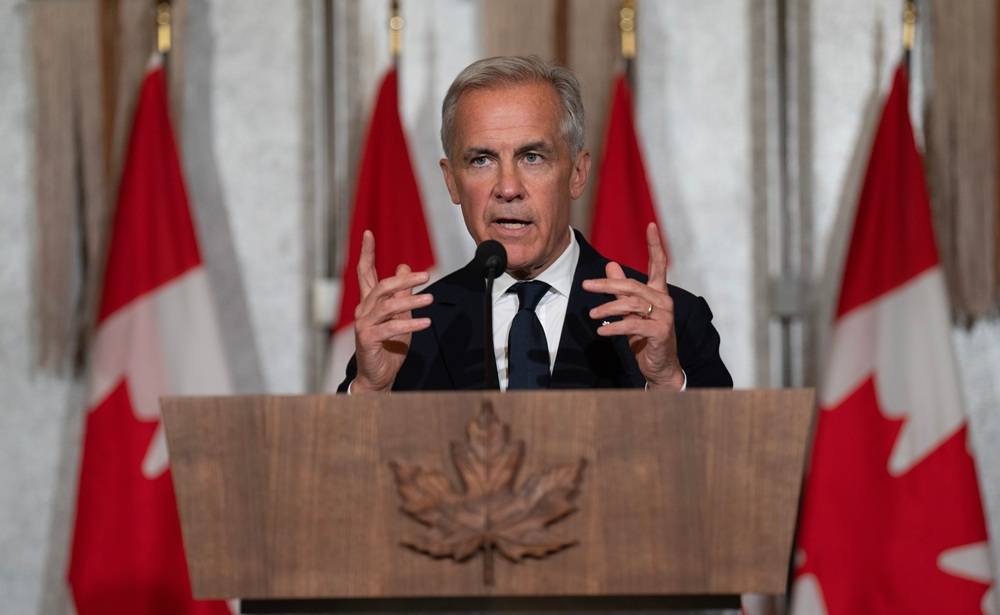
Canadian Prime Minister Mark Carney speaks during a media availability in Jeddah, Saudi Arabia, Thursday, July 9, 2026. (Adrian Wyld/The Canadian Press via AP)
Natural partners
Mining emerged as a central pillar of the talks.
Carney said the mineral wealth sector offered a major base for cooperation and recalled his earlier participation in the Future Minerals Forum in Saudi Arabia. He said the Kingdom had become one of the most important suppliers and active players in global mining, backed by major financial investment in the sector.
He called for faster integration of Canadian experts, capital and advanced geological expertise with Saudi opportunities, and for steering the partnership toward mutual education and training. The goal, he said, was to turn geological science and modern technology into sustainable jobs for workers in Saudi Arabia’s mining sector.
Carney said Canadian educational institutions, including Niagara College, were ready to help train the Saudi national workforce and develop its digital and technical skills to use artificial intelligence tools.
He said about 40% of major mining companies worldwide were linked through close partnerships at several levels, strengthening prospects for joint work, operational development and the exploration of opportunities and calculated risks.
Carney said Canada and Saudi Arabia were natural partners in minerals and mining, adding that their cooperation would help meet growing global market needs.
Human dimension
David Morrison, Senior Diplomatic and International Affairs Advisor to the Prime Minister, said trade and investment ties between Ottawa and Riyadh were at their strongest point in history.
Speaking to Asharq Al-Awsat on the sidelines of the forum, Morrison said mining and minerals were a strategic pillar in Carney’s Jeddah talks because of the fit between Canada’s long experience in the sector and the opportunities offered by Vision 2030.
He said the strong Canadian business presence at the forum and Carney’s visit reflected a full commitment to supporting Vision 2030 targets.
The next phase would bring major partnerships and high-value deals focused on modern technologies, led by artificial intelligence, the digital economy, infrastructure and mining, he added.
Morrison also stressed the human dimension of the partnership, saying Canadian institutions and colleges, including Niagara College, were helping train young Saudis for the jobs of the future.
Success in healthcare, aviation and mining was now closely tied to the ability to lead the use of artificial intelligence tools, an area Canada is working to develop with Saudi Arabia, he remarked.
Prince Mohammed bin Salman bin Abdulaziz, Saudi Crown Prince and Prime Minister, welcomes Canadian Prime Minister Mark Carney in Jeddah on Thursday. (SPA)
Agreements
Mohammed Al-Dulaim, chairman of the Saudi-Canadian Business Council, said that about 15 agreements to be signed on the sidelines of the event in the presence of the Canadian prime minister would be worth more than $1 billion.
He told Asharq Al-Awsat that the agreements would expand trade between the two sides, which has exceeded 66 billion over the past five years, and said the visit would mark a new stage in bilateral relations.
Al-Dulaim said Canada has expertise and technical capabilities in technology, mining, health, insurance, infrastructure, and artificial intelligence, while Saudi Arabia has a dynamic economy and a Vision 2030 agenda that makes Riyadh an investment destination.
The Kingdom and Canada are also positioned to build an integrated value chain for critical minerals. Saudi Arabia’s mineral resources are estimated at about $2.5 trillion and include more than 50 minerals across more than 2.1 million square kilometers.
Exploration opportunities and downstream value chains are expanding rapidly in areas that align with Canadian mining expertise.
Saudi Arabia is offering Canadian partners investment opportunities in artificial intelligence, data centers, financial services and mining, while highlighting progress in developing its investment environment.
The stock of Canadian direct investment in financial and insurance activities reached 177 million riyals, or $47.2 million, in 2024.
Saudi Arabia also offers access to the largest economy in the Middle East and a Gulf market worth about $2.3 trillion. Since last February, foreign investors have had full direct access to the Saudi main market, where market capitalization reached 8.82 trillion riyals, or $2.35 trillion.
Türkiye, Iraq to Sign 12-month Extension of Oil Pipeline Dealhttps://english.aawsat.com/business/5294158-t%C3%BCrkiye-iraq-sign-12-month-extension-oil-pipeline-deal
Türkiye's Energy Minister Alparslan Bayraktar speaks as he meets with reporters at Antalya Diplomacy Forum in Antalya, Türkiye, April 18, 2026. REUTERS/Umit Bektas
Türkiye, Iraq to Sign 12-month Extension of Oil Pipeline Deal
Türkiye's Energy Minister Alparslan Bayraktar speaks as he meets with reporters at Antalya Diplomacy Forum in Antalya, Türkiye, April 18, 2026. REUTERS/Umit Bektas
Türkiye and Iraq are set to sign, within days, a one-year agreement to keep open the crude oil pipeline between the two countries, Turkish Energy Minister Alparslan Bayraktar said on Thursday. Their decades-old pipeline agreement, which governs exports through the pipeline, is due to expire on July 27.
"We have brought the agreement that will cover the next 12 months to the final stage. We aim to sign it in the coming days," Bayraktar, who was in Baghdad for an official visit, said in a statement, adding that oil flow from Iraq to Türkiye's port of Ceyhan on the eastern Mediterranean coast will continue.
The pipeline had remained offline for 2-1/2 years after an arbitration court ruled for Ankara to pay $1.5 billion in damages for unauthorized Iraqi exports Türkiye received between 2014 and 2018.
Flows resumed late last year. In an earlier post on X, Bayraktar said he had a fruitful meeting with Iraq Oil Minister Basim Mohammed, during which they discussed oil and gas cooperation. Iraqi Prime Minister Ali al-Zaidi also met with Bayraktar during his visit, according to his office.
Egypt June Annual Core Inflation Rises to 14.3%https://english.aawsat.com/business/5294156-egypt-june-annual-core-inflation-rises-143
The sun behind high-voltage power lines and electricity pylons along the River Nile during a heatwave in Al-Qanatir al-Khairia, on the outskirts of Cairo, Egypt, July 4, 2026. REUTERS/Amr Abdallah Dalsh
The sun behind high-voltage power lines and electricity pylons along the River Nile during a heatwave in Al-Qanatir al-Khairia, on the outskirts of Cairo, Egypt, July 4, 2026. REUTERS/Amr Abdallah Dalsh
Egypt's annual urban consumer inflation slowed slightly to 14.3% in June from 14.6% in May, statistics agency CAPMAS said on Thursday.
Annual core inflation, calculated by the Central Bank of Egypt, rose to 14.3% in June from 13.8% in May, Reuters reported.
The monthly decline compared with a drop of 0.1% in June 2025 and a rise of 1.6% in May 2026, according to CAPMAS.
Core inflation on a monthly basis rose 0.3% in June, compared with a fall of 0.2% in June 2025 and a rise of 1.6% in May 2026.
لم تشترك بعد
انشئ حساباً خاصاً بك لتحصل على أخبار مخصصة لك ولتتمتع بخاصية حفظ المقالات وتتلقى نشراتنا البريدية المتنوعة