


Saudi Deposit Rescues the Collapsing Yemeni Riyal

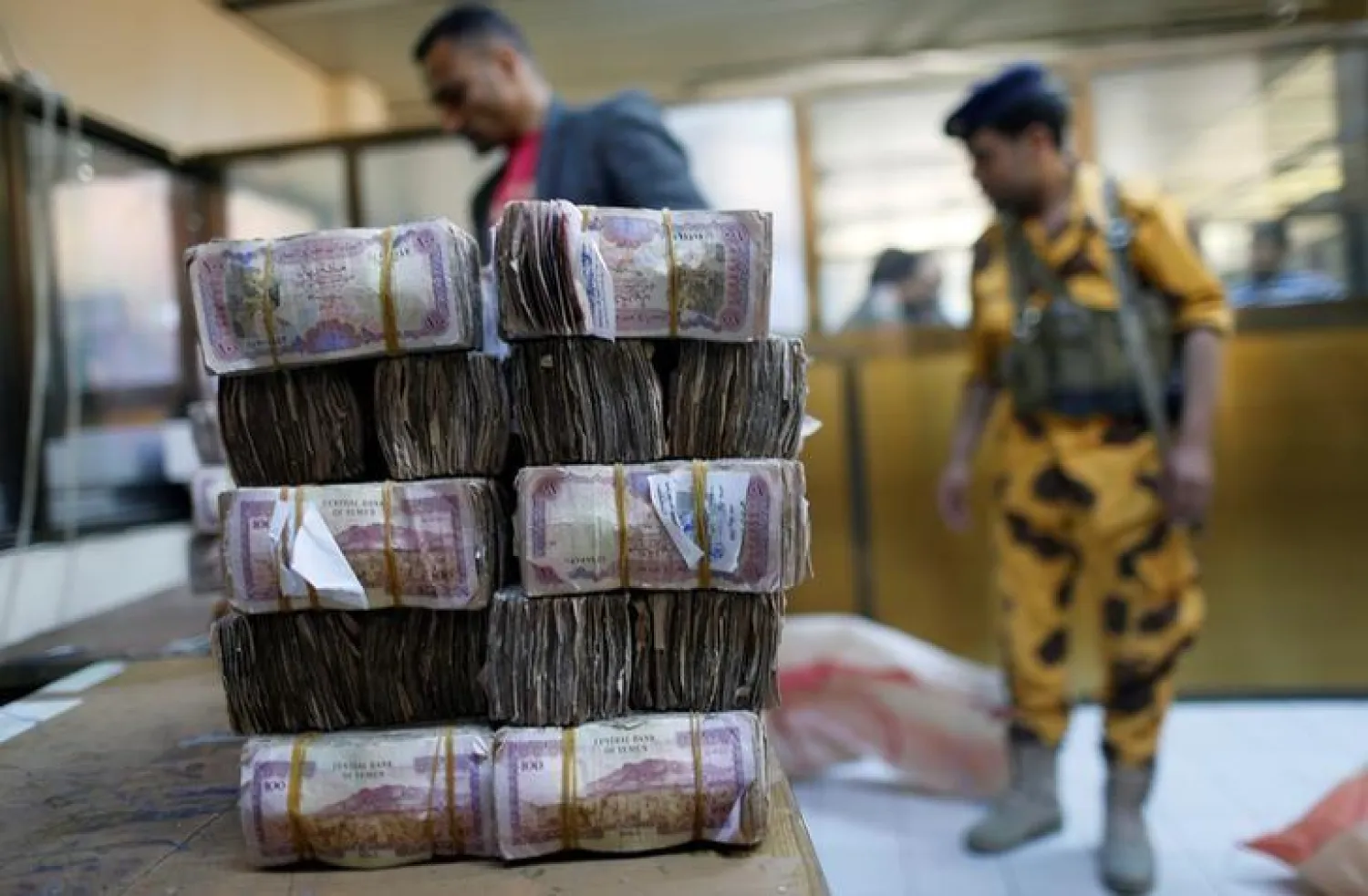
 Bundles of Yemeni currency are pictured at a post office before being handed to public sector employees as salaries in Sanaa, Yemen January 25, 2017. REUTERS/Khaled Abdullah/File Photo
Bundles of Yemeni currency are pictured at a post office before being handed to public sector employees as salaries in Sanaa, Yemen January 25, 2017. REUTERS/Khaled Abdullah/File Photo
TT

Saudi Deposit Rescues the Collapsing Yemeni Riyal

 Bundles of Yemeni currency are pictured at a post office before being handed to public sector employees as salaries in Sanaa, Yemen January 25, 2017. REUTERS/Khaled Abdullah/File Photo
Bundles of Yemeni currency are pictured at a post office before being handed to public sector employees as salaries in Sanaa, Yemen January 25, 2017. REUTERS/Khaled Abdullah/File Photo

The "sudden decline" in the Yemeni rial on Wednesday, slowed down following the announcement of the Saudi deposit of two billion dollars. As soon as the announcement was made, price of the Yemeni currency rial jumped about 15 percent against the US dollar, several bankers told Asharq Al-Awsat.

Most of the exchange and money transfer companies in Sanaa resumed their business. Ibrahim, an employee at a famous exchange company in the center of Sanaa, said that following the announcement of the Saudi deposit, the deterioration of the riyal exchange rate declined significantly.

Asharq Al-Awsat toured a number of exchange companies to ask about the exchange rate and the workers confirmed that the price of the dollar fell to 460 riyals, after it had reached 530 riyals on Wednesday.

The legitimate government stated the reason currency collapsed to this level was due to Houthis' economic policies and their looting of the central bank reserves of hard currency, amounting to about $5 billion, plus two trillion Yemeni rial.

President Abed Rabbo Mansour Hadi ordered the transfer of the central bank to the interim capital of Aden in September 2016, but it was too late, according to specialists in Yemeni affairs, as the militias took the reserves to fund their wars during the two years of the coup.

The collapse of the Yemeni rial to more than 120 percent during the three years of the coup could have caused a humanitarian catastrophe in terms of rising commodity prices and the inability of millions of poor families to provide for themselves.

About one million government employees have not received their salaries in Sanaa and other areas controlled by Houthis for at least 16 months.

Meanwhile, President Abd-Rabbu Mansour Hadi sent a cable of thanks to the King of Saudi Arabia the Custodian of the Two Holy Mosques Salman bin Abdulaziz for the urgent economic support to Yemen including a deposit of $2 billion to support Yemen's currency.

In his cable, Hadi appreciated King Salman's directives "to support the Yemeni Riyal" and the Kingdom's eagerness to supply the means of stability to Yemen.

Yemen's Cabinet held a meeting in Aden on Wednesday on the brotherly Saudi bailout to stabilize the country's currency, according to Saba news.

"In the name of the Cabinet, I highly appreciate the orders of King Salman bin Abdulaziz Al Saud to deposit $2 billion into the Central Bank in order to lift the suffering of the Yemeni people," said Prime Minister Ahmed bin-Daghr at the opening of the cabinet's meeting.

The cabinet said "this generous support comes at a time we are facing complicated economic circumstances as a result of the war ignited by Iran's proxies and tools in Yemen – the Houthi rebel militia."

The government reiterated the importance of establishing a clear partnership mechanism between the traders, businessmen, bank, and exchange companies. It added that the central bank and relevant institutions should take responsibility and activate funds control.

The Central Bank of Yemen said that it received confirmation that the Saudi government had deposited $2 billion in its foreign accounts, hours after the directives by King Salman.

Monasser al-Quaiti, governor of the bank, said the central bank will move towards strengthening the commercial banks to manage their domestic and foreign banking operations from their headquarters in Aden in addition to regulate and control the foreign exchange market.

Quaiti stated that the Saudi deposit would "create real opportunities to meet the obligations arising from foreign exchange as a result of commercial transactions between the local and foreign economies to cover the living needs of Yemen. It will also implement government programs aiming at providing the local market needs of basic goods and services."

Over the past two days, the price commodities in various parts of Yemen increased, which was accompanied by the collapse of the local currency. Traders in Houthi controlled areas also refused to trade with the rial and conditioned using the dollar or its equivalent of foreign currencies.

Yemeni economists believed recent Saudi deposit will help stabilize the currency in the near term, but they asserted that saving the economic situation completely requires governmental measures to improve the country's revenues by resuming export of gas and oil in its areas of control and terminating the Houthi coup.



China's Finance Ministry: Fiscal Policies Will be More 'Proactive' in 2026

A man walks on a street in Beijing, China, 24 December 2025. EPA/WU HAO
TT

China's Finance Ministry: Fiscal Policies Will be More 'Proactive' in 2026

A man walks on a street in Beijing, China, 24 December 2025. EPA/WU HAO

China's finance ministry on Sunday said fiscal policies will be more proactive next year, reiterating its focus on domestic demand, technological innovation and a social safety net.

The statement comes as trading partners urge the world's second-biggest economy to reduce its reliance on exports, underscoring the urgency to revive confidence at home where a prolonged property crisis has rippled ⁠through the economy, weighing on sentiment.

China will boost consumption and actively expand investment in new productive forces and people's overall development, the ministry said in a statement after a two-day meeting at which it set ⁠2026 goals.

In addition, Reuters quoted the ministry as saying that it will support innovation to foster new growth engines, and improve the social security system by providing better healthcare and education services.

Other tasks for next year include promoting integration between urban and rural areas, and propelling China's transformation into a greener society.

China is likely to stick to ⁠its annual economic growth target of around 5% in 2026, government advisers and analysts told Reuters, a goal that would require authorities to keep fiscal and monetary spigots open as they seek to snap a deflationary spell.

Leaders this month promised to maintain a "proactive" fiscal policy next year that would stimulate both consumption and investment to maintain high economic growth.


Bulgaria Adopts Euro Amid Fear and Uncertainty

Customers shop in a grocery store in the village of Chuprene, northwestern Bulgaria on December 7, 2025. (Photo by Nikolay DOYCHINOV / AFP)
TT

Bulgaria Adopts Euro Amid Fear and Uncertainty

Customers shop in a grocery store in the village of Chuprene, northwestern Bulgaria on December 7, 2025. (Photo by Nikolay DOYCHINOV / AFP)

Bulgaria will become the 21st country to adopt the euro on Thursday, but some believe the move could bring higher prices and add to instability in the European Union's poorest country.

A protest campaign emerged this year to "keep the Bulgarian lev", playing on public fears of price rises and a generally negative view of the euro among much of the population.

But successive governments have pushed to join the eurozone and supporters insist it will boost the economy, reinforce ties to the West and protect against Russia's influence.

The single currency first rolled out in 12 countries on January 1, 2002, and has since regularly extended its influence, with Croatia the last country to join in 2023.

But Bulgaria faces unique challenges, including anti-corruption protests that recently swept a conservative-led government from office, leaving the country on the verge of its eighth election in five years.

Boryana Dimitrova of the Alpha Research polling institute, which has tracked public opinion on the euro for a year, told AFP any problems with euro adoption would be seized on by anti-EU politicians.

Any issues will become "part of the political campaign, which creates a basis for rhetoric directed against the EU", she said.

While far-right and pro-Russia parties have been behind several anti-euro protests, many people, especially in poor rural areas, worry about the new currency.

"Prices will go up. That's what friends of mine who live in Western Europe told me," Bilyana Nikolova, 53, who runs a grocery store in the village of Chuprene in northwestern Bulgaria, told AFP.

The latest survey by the EU's polling agency Eurobarometer suggested 49 percent of Bulgarians were against the single currency.

After hyperinflation in the 1990s, Bulgaria pegged its currency to the German mark and then to the euro, making the country dependent on the European Central Bank (ECB).

"It will now finally be able to take part in decision making within this monetary union," Georgi Angelov, senior economist at the Open Society Institute in Sofia, told AFP.

An EU member since 2007, Bulgaria joined the so-called "waiting room" to the single currency in 2020, at the same time as Croatia.

The gains of joining the euro are "substantial", ECB president Christine Lagarde said last month in Sofia, citing "smoother trade, lower financing costs and more stable prices".

Small and medium-sized enterprises stand to save an equivalent of some 500 million euros ($580 million) in exchange fees, she added.

One sector expected to benefit in the Black Sea nation is tourism, which this year generated around eight percent of the country's GDP.

Lagarde predicted the impact on consumer prices would be "modest and short-lived", saying in earlier euro changeovers, the impact was between 0.2 and 0.4 percentage points.

But consumers -- already struggling with inflation -- fear they will not be able to make ends meet, according to Dimitrova.

Food prices in November were up five percent year-on-year, according to the National Statistical Institute, more than double the eurozone average.

Parliament this year adopted empowered oversight bodies to investigate sharp price hikes and curb "unjustified" surges linked to the euro changeover.

But analysts fear wider political uncertainty risks delaying much needed anti-corruption reforms, which could have a knock-on effect on the wider economy.

"The challenge will be to have a stable government for at least one to two years, so we can fully reap the benefits of joining the euro area," Angelov said.


Syria Prepares to Launch New Currency Amid Major Challenges

Syrian Central Bank Governor Abdulkader Husrieh (X)
TT

Syria Prepares to Launch New Currency Amid Major Challenges

Syrian Central Bank Governor Abdulkader Husrieh (X)

Syria’s central bank governor, Abdulkader Husrieh, said the new Syrian pound is not merely a means of exchange but a symbol of the success of the Syrian revolution, national belonging, and confidence in the country’s ability to recover.

In a Facebook post, Husrieh said that with the launch of the new currency, Syrians were not just celebrating a banknote, but also celebrating their sovereignty and national identity, noting that many international experiences show that national currencies become strong when people rally around them, according to the Syrian Arab News Agency.

He pointed to Germany’s experience, where the introduction of the mark after the war marked the starting point of economic recovery, and to France, where the new French franc became the financial symbol of the new republic, known as the Fifth Republic.

Husrieh said the central bank would carry out its role with a clear understanding of the challenges and opportunities, while committing to responsibility, transparency, and the protection of the national currency. He added that the cornerstone remains public solidarity and trust, because a strong currency begins with the people's belief in it.

He called for turning the launch into a dignified national occasion through which Syrians express awareness, confidence, and adherence to the pound as a symbol of sovereignty and a national choice.

Husrieh added that supporting the pound is supporting the nation, and taking pride in it is a matter of pride in the future for Syrians and their children. He described the move as an opportunity for a new success following the success of the revolution in liberation and the lifting of economic sanctions that had shackled Syria’s economy for nearly fifty years.

Husrieh had recently announced that Jan. 1, 2026, would mark the launch of the new Syrian currency and the start of the exchange process for the old notes, with the exchange to be carried out through 66 companies and 1,000 designated outlets.

Restoring confidence

Political and economic researcher Bassel Kouwefi said the exchange plans, if well implemented, could serve as an entry point for rebuilding confidence in the national economy, encouraging domestic investment, and paving the way for broader reforms in the financial sector. However, he warned against failing to address the root causes of inflation and economic collapse during the previous regime's rule.

Speaking to Asharq Al-Awsat, Kouwefi described currency exchange and the removal of zeros as complex economic measures.

He said their main benefits include simplifying daily transactions, reducing the volume of banknotes in circulation, boosting confidence in stability, lowering printing and transportation costs, simplifying accounting records and financial software, and reducing currency speculation driven by corruption networks seeking to undermine stability in Syria.

Kouwefi said the exchange plans, if well-executed, could help restore confidence in the macroeconomy, but stressed the challenges posed by failing to tackle the fundamental causes of past inflation and collapse, including fiscal deficits, instability, and weak production. He said a comprehensive economic and financial program was therefore essential.

He added that the process also requires strong banking infrastructure, an organized transition period, and sufficient liquidity in the new denominations.

He said these remain major challenges under current Syrian conditions, alongside the need to mitigate social impacts that could lead to public confusion, market exploitation, and difficulties for less informed segments of society.