


Cyrille Regis: A Pioneer on The Pitch and The Leader of a Generation

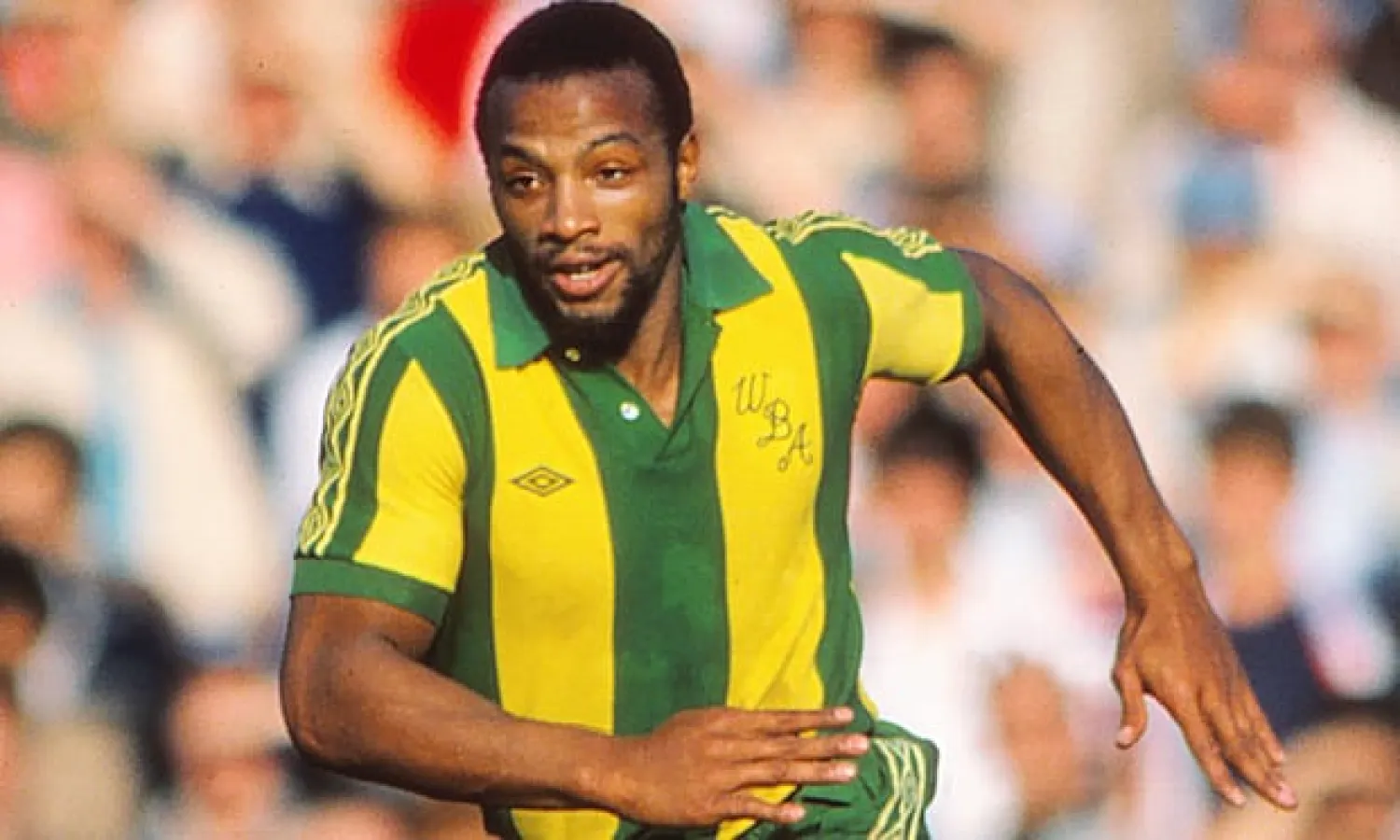
 Cyrille Regis in action for West Brom in 1980. Photograph: Colorsport/Rex/Shutterstock
Cyrille Regis in action for West Brom in 1980. Photograph: Colorsport/Rex/Shutterstock
TT

Cyrille Regis: A Pioneer on The Pitch and The Leader of a Generation

 Cyrille Regis in action for West Brom in 1980. Photograph: Colorsport/Rex/Shutterstock
Cyrille Regis in action for West Brom in 1980. Photograph: Colorsport/Rex/Shutterstock

As a player, Cyrille Regis used his strength and control to burst through the defences. As a man, he endured unspeakable abuse in order to ease the way for others

The sun was shining on the Baseball Ground, which didn’t seem to happen very often at a ground traditionally reduced by early winter weather to a bog of sand and mud. But on that Saturday afternoon at the end of the 1970s – the exact details, including the score, don’t matter – even the climate seemed to be welcoming the visitors, Ron Atkinson’s West Bromwich Albion.

Out they came, into the sunlight. Cyrille Regis, Laurie Cunningham, Brendon Batson, Ally Brown, Len Cantello and the rest. They were wearing their change strip, to avoid a clash with Derby County’s white and black. Their shirts were broad vertical stripes of yellow and bright green. Their shorts were that same green, their socks yellow. They looked like Brazil. And that, sometimes, was how they played.

Regis was a player worth driving to another town to watch. So was Cunningham. You knew that, whatever the outcome, you’d be seeing something to remember.

The importance of Atkinson’s Three Degrees – a nickname fondly bestowed, lest subsequent events should persuade us otherwise – manifested itself on many levels. Yes, there was the sheer pleasure of witnessing them at work. But, as they braved the boos and the bananas, their significance as role models for succeeding generations of young black footballers had a value beyond price.

You could hear it on Monday as English football began to mourn Regis’s unexpected passing from a heart attack at the age of 59. Andy Cole called him “my hero, my pioneer, the man behind the reason I wanted to play football”. Mark Bright described him as “an inspiration to myself and many players of my era – he blazed a trail for every black player who followed him”.

Regis was the third black player to represent England at senior level, after Viv Anderson and Cunningham. There would be only five caps for him, between 1982 and 1987, and on each occasion he was either substituted after starting the match (twice) or a substitute himself (three times). It felt absurd at the time, and seems even worse now. Even an admirer of Emile Heskey’s unselfishness and work ethic could not deny that his 62 caps versus Regis’s five represents a bizarre anomaly.

A cultural crossover played its part in the way some of us on the terraces viewed the rise of black players at a time when the expression of racial prejudice was still commonplace. If you were more or less the same age as Regis, there was a chance that you might have grown up loving the music of Marvin Gaye, Aretha Franklin, Otis Redding, John Coltrane and Jimi Hendrix. And if that was how you felt, it was easy to welcome the arrival of black footballers, in the belief that they might have something to add to the English game.

After all Pelé, at that point the greatest player in the history of the game, was black. So were Jairzinho and other great Brazilians. If there was a chance that the benefits from Commonwealth immigration could include the addition of a new dimension to the game as played by Nobby Stiles, Peter Storey and Norman Hunter, it seemed like something to be celebrated.

And yet, 40 years ago, few English managers trusted black players, whom they saw as athletes rather than footballers. They tended to set their reservations aside only for wingers such as Vince Hilaire, Mark Chamberlain, John Barnes, Mark Walters, Dave Bennett, Paul Canoville, Franz Carr and, of course, the sublime Cunningham. It would be a while before the success of Paul McGrath, Remi Moses, Paul Davis and Chris Whyte began to convince many of them that black and mixed-race players had the bottle to defend and the brains to control the game.

As a black centre-forward, Regis was a rarity at the top level of the English game. Clyde Best, West Ham’s burly Bermudan, had preceded him; his contemporaries included Justin Fashanu and Luther Blissett. Regis shared Best’s physical presence, but there was more to his game. With the power conferred by his well-muscled 6ft frame, his surprising agility in confined spaces, his speed off the mark and the power of his shot, he resembled a Jairzinho transferred to the central areas, or a foreshadowing of the mighty George Weah.

So many of his goals were the kind that tended to stick in the memory, sometimes for their significance as well as their quality. The winning header in the 3-2 victory over Manchester United in the 1977-78 FA Cup fourth‑round match on a mudheap at the Hawthorns would take a prize for anticipation and commitment rather than artistic impression. But his fifth against United in a 5-3 league win at Old Trafford later that year came with a majestic flourish, and a couple of years later, against Norwich City, there was a goal of the season when he chested down a high pass, turned and accelerated through a thicket of defenders and blasted the ball past Chris Woods from 30 yards.

That’s how he’ll be remembered as a player, using his strength and control to burst through the last line of defence, eating up the ground before hammering the ball home. As a man – charming, thoughtful, humble, generous with his time, keen to make the world a better place – he had emerged from a raw background in the Notting Hill and Stonebridge Park of the 1960s, and from the rough and tumble of non-league football, to become one of the courageous leaders of a generation who endured unspeakable abuse in order to ease the way for others. And on his memory that sun will forever shine.

The Guardian Sport


Chelsea Injuries up 44% After Club World Cup but Report Says Event Has Had ‘Minimal’ Impact

Chelsea's Reece James, center, lifts the trophy following the Club World Cup final soccer match between Chelsea and PSG at MetLife Stadium in East Rutherford, N.J., Sunday, July 13, 2025. (AP)
TT

Chelsea Injuries up 44% After Club World Cup but Report Says Event Has Had ‘Minimal’ Impact

Chelsea's Reece James, center, lifts the trophy following the Club World Cup final soccer match between Chelsea and PSG at MetLife Stadium in East Rutherford, N.J., Sunday, July 13, 2025. (AP)

Chelsea suffered a 44% spike in injuries after competing in the supersized Club World Cup this year, according to findings published on Tuesday.

But the newly expanded tournament has so far had a “minimal impact” on injuries overall, the latest edition of the Men’s European Football Injury Index found.

There was fierce opposition to FIFA's new flagship club event when it was confirmed in 2023 that it would increase from seven to 32 teams, with players' unions warning of physical and mental burnout of players due to an ever expanding match schedule. But FIFA pressed ahead and staged the tournament in the United States in June-July.

Chelsea went on to win the inaugural competition, receiving the trophy from US President Donald Trump at MetLife Stadium and taking home prize money of around $125 million. But, according to the Index, from June-October, Chelsea picked up more injuries — 23 — than any of the nine clubs from Europe's top leagues that participated in the Club World Cup.

They included star player Cole Palmer, and was a 44% increase on the same period last year.

While Chelsea, which played 64 games over the entire 2024-25 season, saw an increase in injuries, the Index, produced by global insurance firm Howden, found that overall there was a decrease.

“In principle you would expect this increased workload to lead to an increase in the number of injuries sustained, as a possible rise in overall injury severity,” the Index report said, but added: “The data would suggest a minimal impact on overall injury figures.”

Despite the figures, the authors of the report accept it was too early to assess the full impact of the Club World Cup, with the findings only going up to October.

“We would expect to see the impact to spike in that sort of November to February period,” said James Burrows, Head of Sport at Howden. “What we’ve seen previously is that’s where the impact is seen from summer tournaments."

Manchester City has sustained 22 since the tournament, which is the highest among the nine teams from Europe's top leagues — England, Spain, Italy, Germany and France.

Those teams have recorded 146 injuries from June-October, which is down on the previous year's figure of 174.

From August-October that number is 121, the lowest for that three-month period in the previous six years of the Index.


Sunderland Worst Hit by Losing Players to African Cup of Nations 

14 December 2025, United Kingdom, London: Sunderland's Habib Diarra (L) and Leeds United's Gabriel Gudmundsson battle for the ball during the English Premier League soccer match between Brentford and Leeds United at the Gtech Community Stadium. (dpa)
TT

Sunderland Worst Hit by Losing Players to African Cup of Nations 

14 December 2025, United Kingdom, London: Sunderland's Habib Diarra (L) and Leeds United's Gabriel Gudmundsson battle for the ball during the English Premier League soccer match between Brentford and Leeds United at the Gtech Community Stadium. (dpa)

Premier League Sunderland will have to do without six players over the next few weeks and are the club worst hit as the Africa Cup of Nations takes its toll on European clubs competing over the holiday season.

Sunderland, eighth in the standings, had four of their African internationals in action when they beat Newcastle United on Sunday, but like 14 other English top-flight clubs will now lose those players to international duty.

The timing of the African championship, kicking off in Morocco on Sunday and running through to January 18, has long been an irritant for coaches, with leagues in Belgium, France, Germany, Italy, Netherlands, Portugal, and Spain also affected.

Hosting the tournament in the middle of the season impacts around 58% of the players at the Cup of Nations, though the Confederation of African Football did try to mitigate the impact by moving the start to before Christmas, so it is completed before the next round of Champions League matches.

The impact on European clubs was also lessened by allowing them to release players seven days, rather than the mandatory 14 days, before the tournament, meaning they could play for their clubs last weekend.

Sunderland's Congolese Arthur Masuaku and Noah Sadiki, plus full back Reinildo (Mozambique), midfielder Habib Diarra (Mali), and attackers Chemsdine Talbi (Morocco) and Bertrand Traore (Burkina Faso) have now departed for Morocco.

Ironically, Mohamed Salah’s absence from Liverpool to play for Egypt should lower the temperature at the club after his recent outburst against manager Arne Slot, but Manchester United will lose three players in Noussair Mazraoui, Bryan Mbeumo and Amad Diallo, who scored in Monday’s 4-4 draw with Bournemouth.

France is again the country with the most players heading to the Cup of Nations, and with 51 from Ligue 1 clubs. But their absence is much less impactful than previously as Ligue 1 broke after the weekend’s fixtures and does not resume until January 2, by which time the Cup of Nations will be into its knockout stage.

There are 21 players from Serie A clubs, 18 from the Bundesliga, and 15 from LaLiga teams among the 24 squads at the tournament in Morocco.


Rodgers Takes Charge of Saudi Team Al-Qadsiah After Departure from Celtic 

Then-Celtic head coach Brendan Rodgers greets supporters after a Europa League soccer match between Red Star and Celtic at Rajko Mitic Stadium in Belgrade, Serbia, Sept. 24, 2025. (AP)
TT

Rodgers Takes Charge of Saudi Team Al-Qadsiah After Departure from Celtic 

Then-Celtic head coach Brendan Rodgers greets supporters after a Europa League soccer match between Red Star and Celtic at Rajko Mitic Stadium in Belgrade, Serbia, Sept. 24, 2025. (AP)

Brendan Rodgers has returned to football as the coach of Saudi Arabian club Al-Qadsiah, six weeks after resigning from Scottish champion Celtic.

Al-Qadsiah, whose squad includes Italian striker Mateo Retegui and former Real Madrid defender Fernandez Nacho, is in fifth place in the Saudi Pro League in its first season after promotion.

Rodgers departed Celtic on Oct. 27 and has opted to continue his managerial career outside Britain for the first time, having previously coached Liverpool, Leicester and Swansea.

In its statement announcing the hiring of Rodgers on Tuesday, Al-Qadsiah described him as a “world-renowned coach” and said his arrival “reflects the club’s ambitious vision and its rapidly growing sporting project.”

Aramco, the state-owned Saudi oil giant, bought Al-Qadsiah in 2023 in a move that has helped to transform the club’s status.

“This is a landmark moment for the club,” Al-Qadsiah chief executive James Bisgrove said. “The caliber of his experience and track record of winning reflects our ambition and long-term vision to establish Al-Qadsiah as one of Asia’s leading clubs.”

Rodgers is coming off winning back-to-back Scottish league titles with Celtic, where he won 11 major trophies across his two spells. He also won the FA Cup with Leicester.

Al-Qadsiah's last two coaches were former Liverpool striker Robbie Fowler and former Spain midfielder Michel.
