

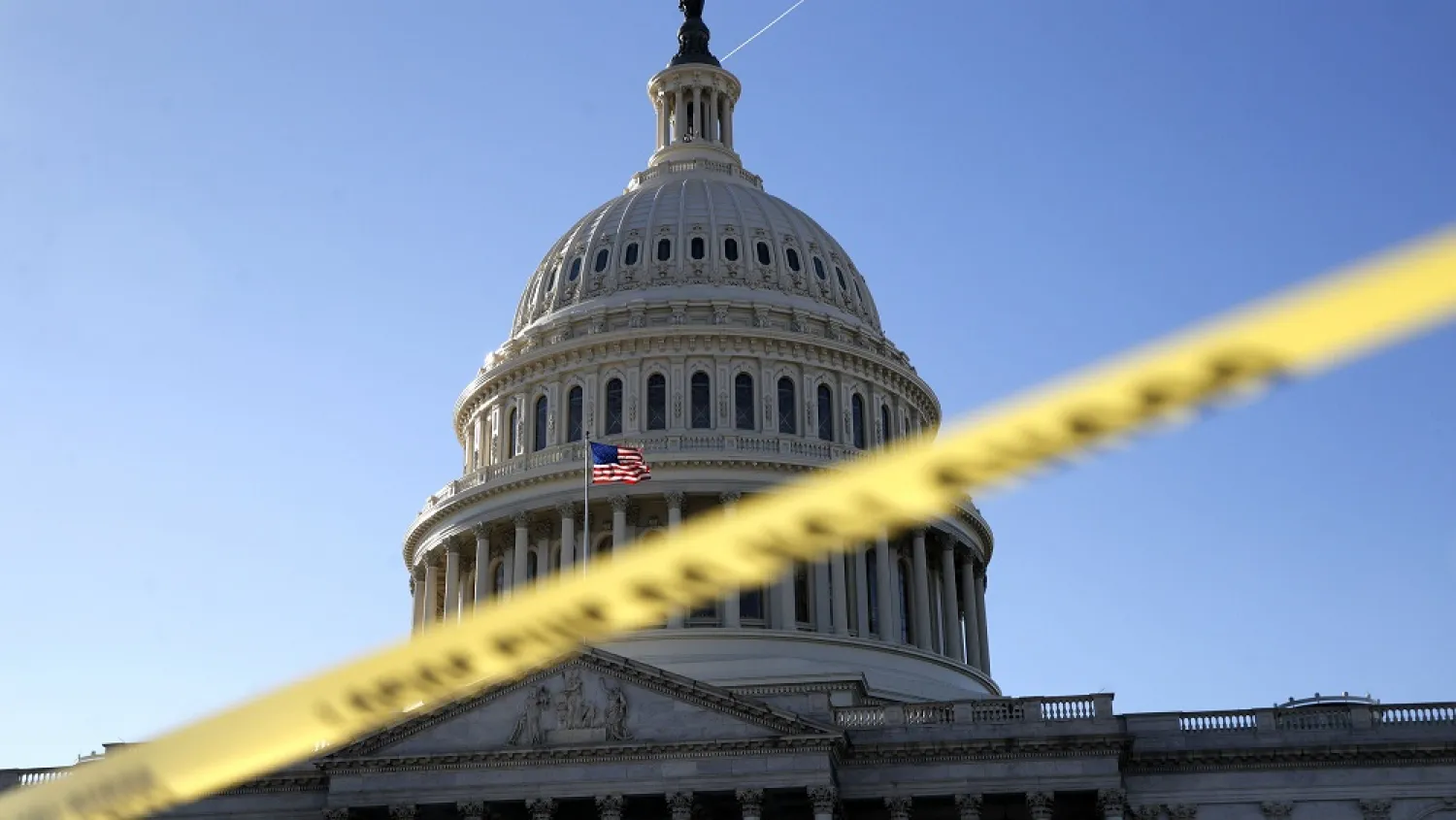

Disagreement over Funding for Federal Agencies Force US Govt. Shutdown

The US government was forced into a shutdown for the first time since 2013. (AP)
TT

Disagreement over Funding for Federal Agencies Force US Govt. Shutdown

The US government was forced into a shutdown for the first time since 2013. (AP)

A year to the day that he assumed office, President Donald Trump faced the greatest challenge of his term as difference between Republicans and Democrats forced the shutdown of the US government.

Disputes over the funding for federal agencies led to the shutdown, the first since October 2013.

Trump’s inability to cut a deal despite having a Republican majority in both houses of Congress marks arguably the most debilitating setback for his crisis-plagued administration and highlights the country’s deep political divisions.

Democrats had insisted that any bill to renew government funding also contain permanent protections for approximately 700,000 young, undocumented immigrants who were brought illegally into the United States as children.

Last week, Trump rejected a bipartisan Senate deal that would have accomplished that as well as hand the White House $2.7 billion in new money for immigration enforcement at America’s borders.

Minutes before Friday’s midnight deadline for a funding deal, Trump’s White House issued a statement blaming Democrats for the shutdown. “We will not negotiate the status of unlawful immigrants while Democrats hold our lawful citizens hostage over their reckless demands,” it said.

The shutdown was cemented when the Senate, meeting late into Friday night, blocked a bill to maintain the federal government’s funding through February 16.

The vote was 50-49, well short of the 60 needed in the 100-member chamber to vault the bill over a procedural hurdle.

Four Republicans joined most Democrats in killing the measure. A fifth Republican, Senate Majority Leader Mitch McConnell, voted “no” too, but only as part of a parliamentary maneuver to make it easier to bring another bill to the floor.

The breakdown ended a long day of closed-door meetings in Congress and at the White House.

Even as they promised to work on getting the government back up again as soon as possible, Republicans and Democrats blamed each other for the predicament.

Senate Majority Leader Mitch McConnell joined Trump in attacking Democrats.

“What we’ve just witnessed on the floor was a cynical decision by Senate Democrats to shove aside millions of Americans for the sake of irresponsible political games,” McConnell said.

Senate Democratic Leader Chuck Schumer said his party took significant steps to reach a deal, including raising the possibility of funding for Trump’s proposed wall along the US border with Mexico, which they have ardently opposed.

“It’s almost as if you were rooting for a shutdown,” Schumer said in comments on the Senate floor aimed directly at Trump.

Republican and Democratic leaders were expected to renew negotiations on Saturday in the hope of restoring government financing before Monday.

The immediate impact of the government shutdown was also eased somewhat by its timing, starting on a weekend when most government employees normally do not work anyway.

No matter the timing, the Defense Department said its combat operations in Afghanistan and other military activities would continue, while federal law enforcement officers also would remain on duty.

Without a quick deal, most day-to-day operations in the federal government will be disrupted. Hundreds of thousands of government employees will be put on temporary unpaid leave, including many of the White House’s 1,700 workers. Many Capitol maintenance workers were being instructed to stay home.

The shutdown will start to have more serious consequences on Monday as government employees ranging from financial regulators and tax collectors to scientists and civilian staff at the Pentagon will have to stay away from work.

Early on Saturday, McConnell offered up a new plan. Instead of the February 16 end date for the temporary spending bill, he proposed February 8.

Senate Democrats had argued this week for an extension of just four or five days to force both sides into serious negotiations on the immigration issue.

Shutdowns have led to furloughs of several hundred thousand federal employees, required many government activities to be stopped or curtailed and affected wide swaths of the economy.

During Jimmy Carter's administration, shutdowns happened nearly every year, averaging 11 days each. During Ronald Reagan's two terms in the 1980s, there were six shutdowns, typically just one or two days apiece.

Legal opinions issued in 1980 and 1981 made shutdowns more impactful. Opinions by then-Attorney General Benjamin Civiletti determined that failure to pass new spending bills required government functioning to shut down in whole or in part. Earlier "shutdowns" did not always entail an actual stop to government functioning and often were simply funding gaps will little real-world effect.

The 16-day partial shutdown of October 2013 came as tea party conservatives, cheered on by outside groups, demanded that language to block implementation of President Barack Obama's health care law be added to a must-do funding bill. Then-Speaker John Boehner tried to avoid a shutdown by funding the government piecemeal, but the effort faltered.

The shutdown affected most government operations and resulted in the furlough of 850,000 employees, costing the government 6.6 million days of work and more than $2.5 billion in lost productivity, according to a report by the Congressional Research Service.



Trump Hints at Land Strike as Venezuela Pressure Mounts

A US Air Force C-130J Super Hercules aircraft approaches for landing at Rafael Hernandez Airport, amid tensions between US President Donald Trump's administration and the government of Venezuelan President Nicolas Maduro, in Aguadilla, Puerto Rico, December 28, 2025. (Reuters)
TT

Trump Hints at Land Strike as Venezuela Pressure Mounts

A US Air Force C-130J Super Hercules aircraft approaches for landing at Rafael Hernandez Airport, amid tensions between US President Donald Trump's administration and the government of Venezuelan President Nicolas Maduro, in Aguadilla, Puerto Rico, December 28, 2025. (Reuters)

A throwaway remark last week by President Donald Trump has raised questions about whether US forces may have carried their first land strike against drug cartels in Venezuela.

Trump said the US knocked out a "big facility" for producing trafficking boats, as he was discussing his pressure campaign against Venezuelan President Nicolas Maduro in an interview broadcast Friday.

"They have a big plant or a big facility where they send, you know, where the ships come from," Trump said in an interview with billionaire supporter John Catsimatidis on the WABC radio station in New York.

"Two nights ago we knocked that out. So we hit them very hard."

Trump did not say where the facility was located or give any other details. US forces have carried out numerous strikes in both the Caribbean Sea and eastern Pacific Ocean since September, killing more than 100 people.

The Pentagon referred questions about Trump's remarks to the White House. The White House did not respond to requests for comment from AFP.

There has been no official comment from the Venezuelan government.

Trump has been saying for weeks that the United States will "soon" start carrying out land strikes targeting drug cartels in Latin America, but there have been no confirmed attacks to date.

The Trump administration has been ramping up pressure on Maduro, accusing the Venezuelan leader of running a drug cartel himself and imposing an oil tanker blockade.

Maduro has accused Washington of attempting regime change.


UN Chief Says ‘Get Serious’ in Grim New Year Message

 UN Secretary-General Antonio Guterres. (AFP)
UN Secretary-General Antonio Guterres. (AFP)
TT

UN Chief Says ‘Get Serious’ in Grim New Year Message

 UN Secretary-General Antonio Guterres. (AFP)
UN Secretary-General Antonio Guterres. (AFP)

The United Nations urged global leaders Monday to focus on people and the planet in a New Year's message depicting the world in chaos.

"As we enter the new year, the world stands at a crossroads. Chaos and uncertainty surround us. Division. Violence. Climate breakdown. And systemic violations of international law," UN Secretary-General Antonio Guterres said in a video message.

In 2026, as war rages in Ukraine and elsewhere, world leaders must work to ease human suffering and fight climate change, he added.

"I call on leaders everywhere: Get serious. Choose people and planet over pain," said Guterres, criticizing the global imbalance between military spending and financing for the poorest countries.

Military spending is up nearly 10 percent this year to $2.7 trillion, which is 13 times total world spending on development aid and equivalent to the entire gross domestic product of Africa, he said.

Wars are raging at levels unseen since World War II, he added.

"In this New Year, let's resolve to get our priorities straight. A safer world begins by investing more in fighting poverty and less in fighting wars. Peace must prevail," said Guterres, who will be serving his last year as secretary general.


Türkiye and Armenia Agree to Simplify Visa Procedures to Normalize Ties

Türkiye’s President Recep Tayyip Erdogan, right, and Armenia's Prime Minister Nikol Pashinyan shake hands before a meeting at Prague Castle in Prague, Czech Republic, Thursday, Oct. 6, 2022. (Turkish Presidency via AP, File)
TT

Türkiye and Armenia Agree to Simplify Visa Procedures to Normalize Ties

Türkiye’s President Recep Tayyip Erdogan, right, and Armenia's Prime Minister Nikol Pashinyan shake hands before a meeting at Prague Castle in Prague, Czech Republic, Thursday, Oct. 6, 2022. (Turkish Presidency via AP, File)

Türkiye and Armenia have agreed to simplify visa procedures as part of efforts to normalize ties, Türkiye’s Foreign Ministry announced Monday, making it easier for their citizens to travel between the two countries.

Relations between Türkiye and Armenia have long been strained by historic grievances and Türkiye’s alliance with Azerbaijan. The two neighboring countries have no formal diplomatic ties and their joint border has remained closed since the 1990s.

The two countries, however, agreed to work toward normalization in 2021, appointing special envoys to explore steps toward reconciliation and reopening the frontier. Those talks have progressed in parallel with efforts to ease tensions between Armenia and Azerbaijan.

Türkiye supported Azerbaijan during its 2020 conflict with Armenia for control of the Karabakh region, known internationally as Nagorno-Karabakh, a territorial dispute that had lasted nearly four decades.

The Turkish Foreign Ministry said in a statement posted on social platform X that Ankara and Yerevan agreed that holders of diplomatic, special and service passports from both countries would be able to obtain electronic visas free of charge as of Jan. 1.

“On this occasion, Türkiye and Armenia reaffirm once again their commitment to continue the normalization process between the two countries with the goal of achieving full normalization without any preconditions,” the ministry said.

Türkiye and Armenia also have a more than century-old dispute over the deaths of an estimated 1.5 million Armenians in massacres, deportations and forced marches that began in 1915 in Ottoman Türkiye. Historians widely view the event as genocide.

Türkiye denies the deaths constituted genocide, saying the toll has been inflated and those killed were victims of civil war and unrest. It has lobbied to prevent countries from officially recognizing the massacres as genocide.