

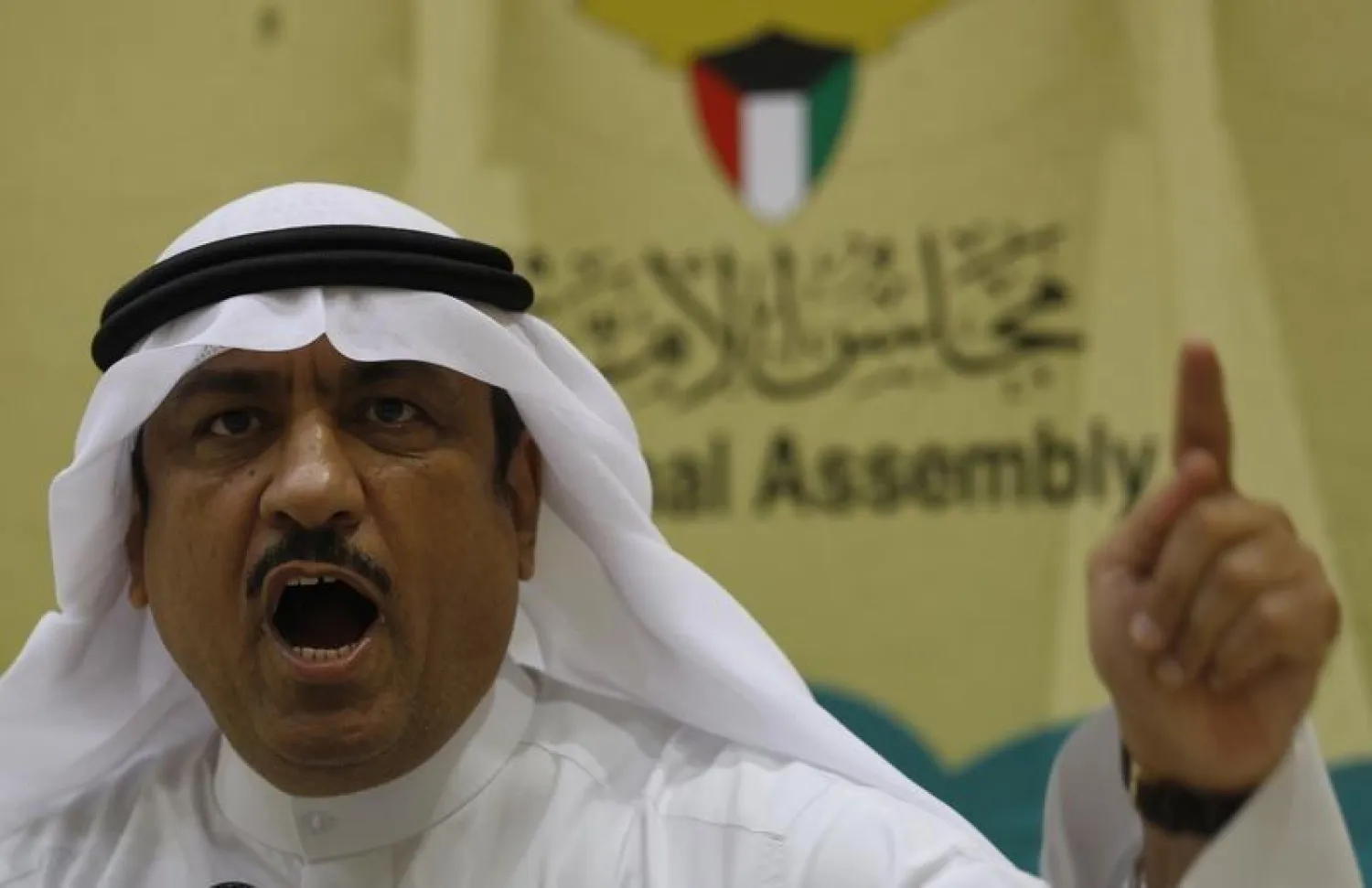

Kuwait: Musallam Al Barrak Turns Himself In

Kuwaiti lawmaker Musallam al-Barrak gestures while speaking to journalists at Parliament's media center in Kuwait City November 20, 2011. REUTERS/Hamad I Mohammed
TT

Kuwait: Musallam Al Barrak Turns Himself In

Kuwaiti lawmaker Musallam al-Barrak gestures while speaking to journalists at Parliament's media center in Kuwait City November 20, 2011. REUTERS/Hamad I Mohammed

Kuwaiti authorities detained former member of Kuwaiti parliament (National Assembly) and member of the opposition Musallam al-Barrak upon his arrival in the country through Nuwaisib land border with Saudi Arabia.

In light of reports stating that Kuwait may apply for extradition, Barrak chose to turn himself in before the legal deadline to challenge his sentence issued by the Court of Cassation. This comes 50 days after Court of Appeal ordered the imprisonment of Barrak and other deputies along with 67 other defendants in the case of forcible entry into the National Assembly in November 2011.

Sentences against the defendants, including deputies, ranged from one to seven years in prison. The court sentenced former MP Barrak to seven years in prison.

Other than Barrak, three current deputies are also sentenced: Juman al-Harbash and Waleed al-Tabtabai (sentenced to 7 years each) and MP Mohammed al-Mutair (one year). The sentence also included former MPs MubarakaAl-Waalan, Salem al-Namlan, Faisal al-Musallam, Khalid al-Tahous, each sentenced to 5 years, and former MP Mohammed al-Khalifa to three years.

As soon as he arrived at the crossing point, Barrak was arrested by Kuwaiti security forces, while lawyers say that he could have appealed to the Court of Cassation, but the court will not accept the appeal unless he turns himself in. However, Barrak left Kuwait to Saudi Arabia before the verdict.

Before arriving at the crossing point, Barrak recorded a video saying he was on his way to Kuwait to turn himself in to execute the court sentence which he described as "political."

In November 2011, demonstrators and opposition MPs stormed Kuwait's parliament building demanding that the then prime minister step down, and they occupied the main chamber and sang the national anthem before leaving a short time later.

Despite the resignation of PM Sheikh Nasser days after the incident and the appointment of Sheikh Jaber al-Mubarak al-Sabah as his successor, the issue has been in the courts, where the Court of First Instance acquitted the deputies and activists in December 2013.

Sheikh Sabah al-Ahmad Al-Jaber al-Sabah described the incident as "Black Wednesday", saying that those responsible for attacking the security men will be held accountable.

Barrak can appeal the ruling before the Court of Cassation.

Kuwaiti constitutional expert Muhammad al-Faily explained that the issuance of a penal judgment by the Court of Appeal makes it enforceable in itself. He added to Asharq Al-Awsat that an appeal before the Court of Cassation does not stop the enforcement of ruling unless a request was submitted to the cassation judge to halt the sentence from coming into force.

On April 20, 2017, Kuwaiti authorities released Barrak, after two years in prison on charges of insulting and undermining the status of the Emir during a seminar organized by the Kuwaiti opposition forces in 2012.

On 15 April 2013, Court of First Instance sentenced Barrack to five years' imprisonment on charges of insulting the Emir On April 22, 2013, the judge of the Court of Appeal ordered the suspension of the sentence provisionally pending dismissal of the appeal. He was released from prison on 20 April 2017.

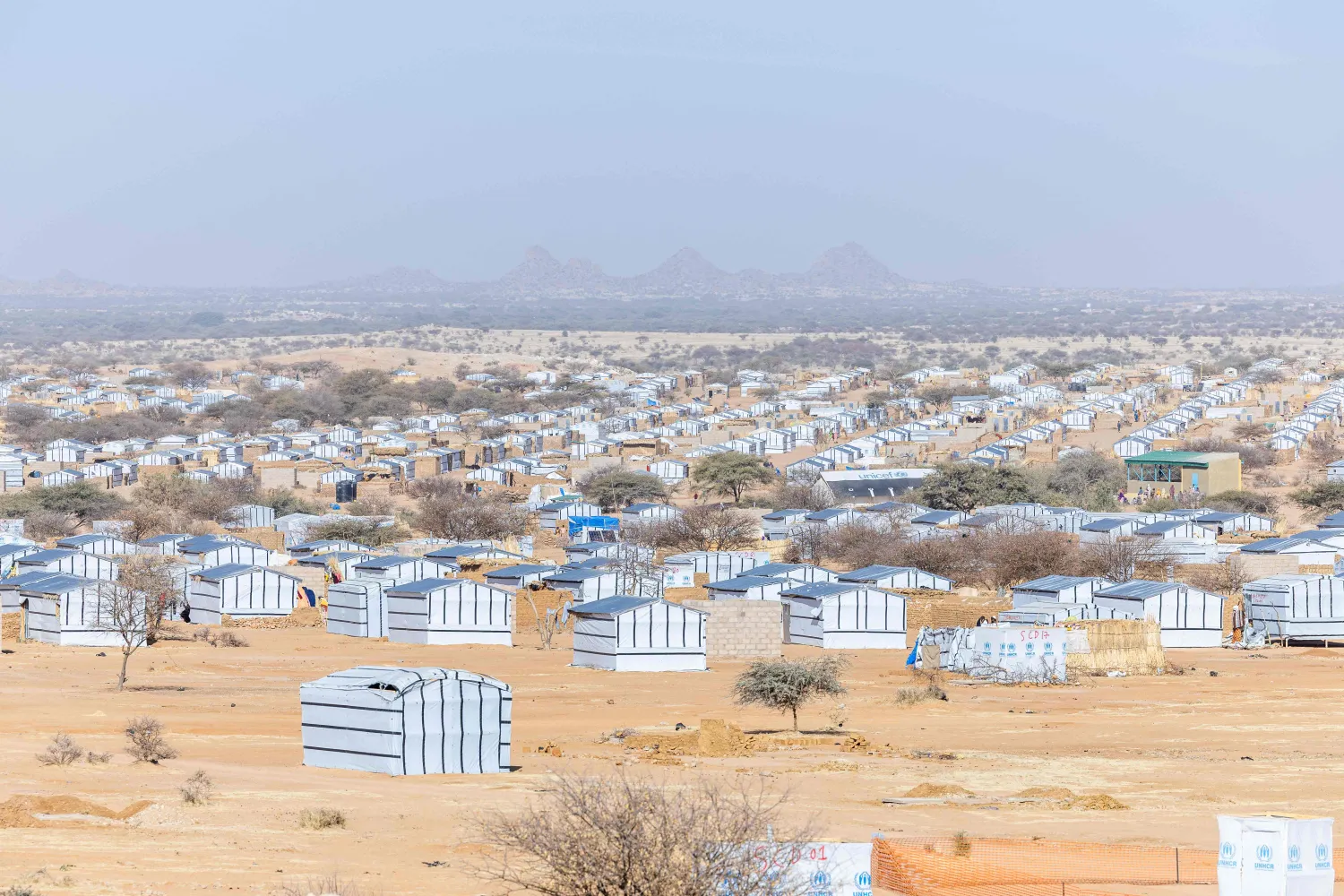


Over 68 Million Visitors to Two Holy Mosques during Jumada Al Akhira

The authority uses advanced sensor technology to monitor the number of worshippers and pilgrims among visitors at the main entrances - SPA
TT

Over 68 Million Visitors to Two Holy Mosques during Jumada Al Akhira

The authority uses advanced sensor technology to monitor the number of worshippers and pilgrims among visitors at the main entrances - SPA

The General Authority for the Care of the Affairs of the Grand Mosque and the Prophet’s Mosque announced that the total number of worshippers and visitors to the Two Holy Mosques during Jumada Al Akhira 1447 AH reached 68,741,853.

The authority said that the number of worshippers at the Grand Mosque totaled 30,016,073, including 94,776 worshippers in Hijr Ismail (Al-Hateem), while the number of Umrah performers reached 11,863,477, SPA reported.

It noted that the number of worshippers at the Prophet’s Mosque during the same month reached 23,116,271, including 1,319,653 worshippers in Al-Rawdah Al-Sharifa. Meanwhile, 2,331,603 visitors greeted the Prophet and his two companions.

The authority uses advanced sensor technology to monitor the number of worshippers and pilgrims among visitors at the main entrances of the Grand Mosque and the Prophet’s Mosque.

This step aims to enhance operational efficiency by monitoring flows and crowds, empowering relevant authorities to manage crowds in partnership with associated entities better.


Saudi Arabia Urges Yemen’s STC to 'Urgently’ Withdraw from Hadhramaut and al-Mahra

Saudi Arabia Urges Yemen’s STC to 'Urgently’ Withdraw from Hadhramaut and al-Mahra
TT

Saudi Arabia Urges Yemen’s STC to 'Urgently’ Withdraw from Hadhramaut and al-Mahra

Saudi Arabia Urges Yemen’s STC to 'Urgently’ Withdraw from Hadhramaut and al-Mahra

The Saudi Ministry of Foreign Affairs issued a statement on Thursday expressing concern over the recent military movements witnessed in the governorates of Hadhramaut and al-Mahra.

It noted that “the actions carried out by the Southern Transitional Council were taken unilaterally, without the approval of the Presidential Leadership Council or coordination with the coalition leadership”.

The Kingdom described the moves as an “unjustified escalation” that has harmed the interests of the Yemeni people across all segments of society, undermined the Southern cause, and weakened the coalition’s efforts.

The Kingdom further emphasized that, in recent months, it has focused on maintaining unity and has undertaken intensive efforts to reach peaceful solutions to address the situation in the two governorates, as part of its ongoing endeavors to restore stability.

The statement added that these efforts were “coordinated with the brethren United Arab Emirates, the Chairman of the Presidential Leadership Council, and the Yemeni government to contain the situation”.

It said that a “joint Saudi–Emirati military team was dispatched to coordinate with the Southern Transitional Council in Aden, ensuring the withdrawal of its forces from the two governorates and the handover of camps to the National Shield Forces and local authorities under the coalition’s supervision”.

The Foreign Ministry stressed that efforts are still underway to restore the situation to its previous state, expressing the Kingdom’s hope that the public interest will prevail and that the Southern Transitional Council will take the initiative to de-escalate tensions and urgently and peacefully withdraw its forces from the two governorates.

Saudi Arabia also underscored the importance of cooperation among all Yemeni forces and components, exercising restraint, and avoiding actions that could undermine security and stability.

The Kingdom reiterated its position that the “Southern cause is a just issue with historical and social dimensions and can only be resolved through dialogue that brings all Yemeni parties together at one table, within a comprehensive political process that ensures a lasting solution in Yemen”.

The statement concluded by affirming the Kingdom’s “support for the Chairman and members of the Presidential Leadership Council and the Yemeni government, in a manner that achieves security, stability, development, and peace in the sisterly Republic of Yemen”.


MWL Condemns Attack Targeting Pakistani Police

The Muslim World League (MWL) logo
TT

MWL Condemns Attack Targeting Pakistani Police

The Muslim World League (MWL) logo

The Muslim World League (MWL) strongly condemned the attack targeting police personnel in Pakistan’s Khyber Pakhtunkhwa Province, the Saudi Press Agency reported on Thursday.

In a statement issued by its General Secretariat, MWL Secretary-General and Chairman of the Organization of Muslim Scholars, Sheikh Mohammed Al-Issa, affirmed the League’s solidarity with the Islamic Republic of Pakistan in the face of all threats to its security and stability. He reiterated the MWL’s firm rejection and condemnation of violence and terrorism in all their forms and under any pretext.

He also extended his sincere condolences and sympathies to the families of the victims and to the Pakistani people.