


Fatwa against Suicide Bombings Causes Dispute between Islamabad, Kabul

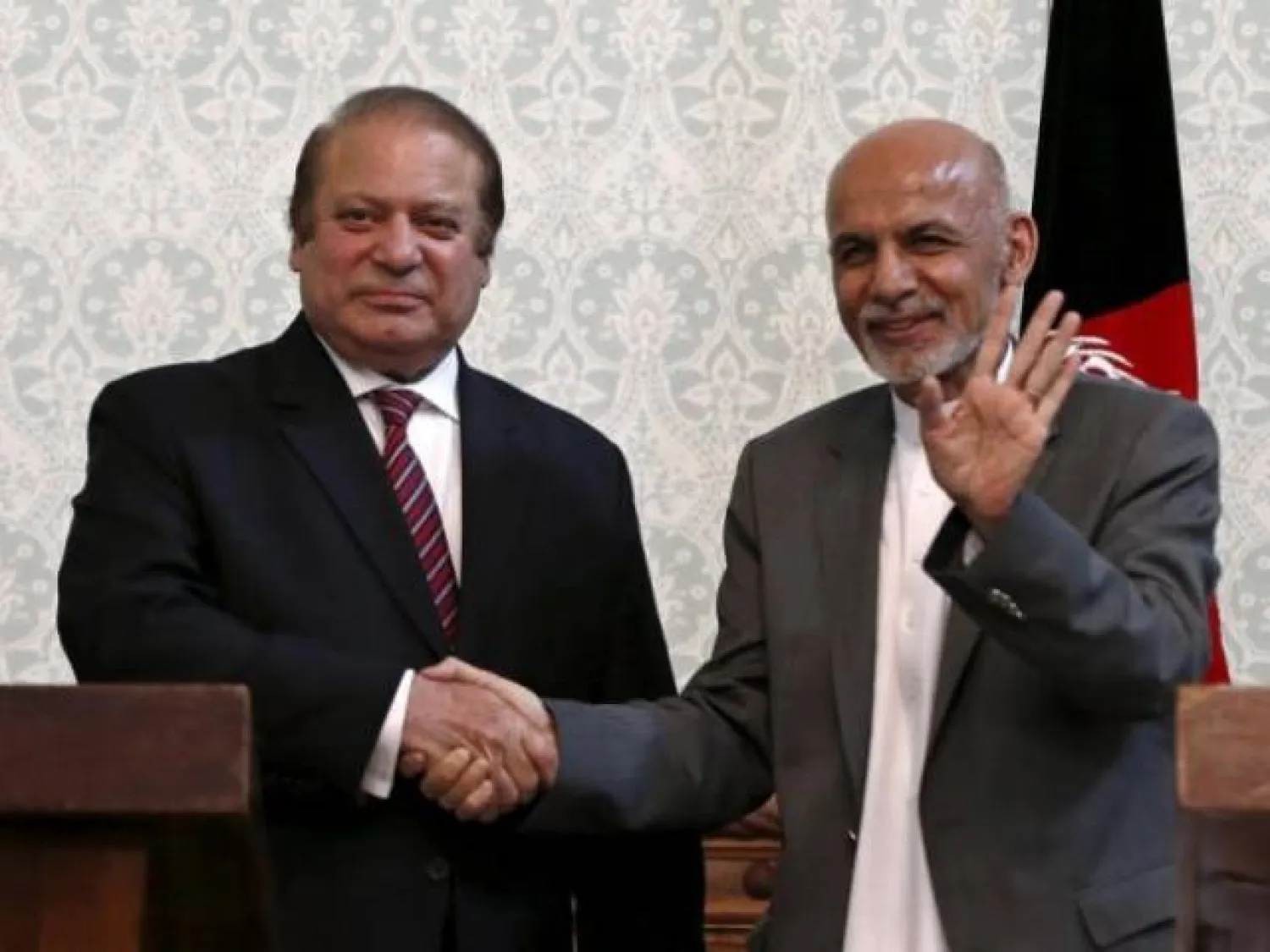
Pakistan's former Prime Minister Nawaz Sharif shaking hands with Afghan President Ashraf Ghani after a news conference in Kabul, May 12, 2015. (File photo: Reuters)
TT

Fatwa against Suicide Bombings Causes Dispute between Islamabad, Kabul

Pakistan's former Prime Minister Nawaz Sharif shaking hands with Afghan President Ashraf Ghani after a news conference in Kabul, May 12, 2015. (File photo: Reuters)

A dispute has arisen between governments of Pakistan and Afghanistan over issuing a fatwa banning suicide bombings, with each government blaming the other for failing to comply with an understanding reached between the two governments in October 2017.

Officials from Pakistan and Afghanistan reached an understanding in 2017 whereby the two governments agreed to try to persuade as many religious leaders as possible to issue a fatwa against suicide bombings that cover both countries.

The agreement was reached during a meeting between Afghan President Ashraf Ghani and Pakistani Army Chief of Staff Qamar Javed Bajwa in Kabul in October 2017. Both governments agreed during the meeting to organize a meeting between religious leaders from the two countries asking them to issue a fatwa against suicide bombings as something prohibited by religion.

Currently, a dispute has arisen between the two governments as the Afghan president questions the feasibility and legitimacy of a fatwa issued by 1,800 Pakistani religious scholars condemning suicide bombings in general, but does not mention Afghanistan specifically.

President Ghani criticized the fatwa, saying it must cover all of the Muslim world, including Afghanistan.

More than 1,800 Pakistani Muslim clerics have issued an Islamic directive forbidding suicide bombings, in a book published by the government last week entitled "Paigham-e-Pakistan".

The announcement of the publication of the book during a spectacular ceremony in Islamabad, with President Mamnoun Hussein as the main guest.

During the ceremony, the President delivered a speech in which he expressed confidence that the fatwa issued by a large group of clerics from various schools would help address the challenges posed by terrorism, extremism and sectarianism.

President Ashraf Ghani said the Pakistani fatwa should have included the entire Muslim world including Afghanistan.

Foreign Minister Khawaja Asif, however, clarified that the suicide bombing was un-Islamic “whether it takes place on the moon or in any part of the world” in an effort to dispel the impression the move was not sufficient enough to cover Afghanistan.

However, Pakistani government blamed its Afghan counterpart for failing to rally Afghan clerics and urging them to issue a similar fatwa against suicide bombings inside Afghanistan itself.

Speaking to Asharq Al-Awsat, a senior Pakistani official said that they are waiting for the Afghan government to issue a request for clerics inside Afghanistan to issue a similar fatwa against suicide bombings in their country.

The official stressed that Pakistan has committed to that part of the agreement by issuing the directive, reiterating that according to Islamic ideology, any religious fatwa is applicable everywhere in the world.

"Now, we expect Afghanistan to honor its own part of the agreement," the official indicated.


Putin to Meet Trump Envoy Over US Push to End War

Jared Kushner (L), American businessman and Steve Witkoff (R), United States Special Envoy to the Middle East and special envoy for peace missions walk in the corridors during the 56th annual meeting of the World Economic Forum (WEF) in Davos, Switzerland, 20 January 2026. (EPA)
TT

Putin to Meet Trump Envoy Over US Push to End War

Jared Kushner (L), American businessman and Steve Witkoff (R), United States Special Envoy to the Middle East and special envoy for peace missions walk in the corridors during the 56th annual meeting of the World Economic Forum (WEF) in Davos, Switzerland, 20 January 2026. (EPA)

Russian President Vladimir Putin will meet US special envoy Steve Witkoff for talks on Thursday, the Kremlin said, as the US seeks to negotiate an end to the nearly four-year Ukraine war.

"Yes, indeed, such contacts for tomorrow are on the president's schedule," Kremlin spokesman Dmitry Peskov told the RBK news outlet on Wednesday.

Witkoff said earlier he planned to leave for Moscow from the World Economic Forum in Davos on Thursday night alongside Jared Kushner, Trump's son-in-law.

US President Donald Trump has tasked both officials with negotiating an exit from the Russia-Ukraine conflict.

"Jared and I will leave Thursday night and arrive in Moscow late at night," Witkoff told Bloomberg TV in an interview.

Witkoff said Russia had requested the meeting, and that he believed the two sides were close to reaching the final "10 percent" of a deal.

He said he would meet officials from the Ukrainian side later Wednesday.

The United States has in recent months intensified efforts to craft a deal to end Europe's deadliest conflict since World War II.

Ukraine says it has agreed to "90 percent" of a deal but key issues, including the thorny question of territory, remain unresolved.

Kyiv is also seeking clarity from its allies on post-war security guarantees, which it sees as key to deterring Moscow from launching a new assault.

The talks come as the fourth anniversary of Moscow's offensive looms and as Moscow has pounded Ukraine's energy facilities throughout the winter.


North Produces Enough Nuclear Material a Year for 10-20 Weapons, Says S. Korea President

South Korean President Lee Jae Myung speaks during his new year press conference at the presidential Blue House in Seoul, South Korea, 21 January 2026. (EPA)
TT

North Produces Enough Nuclear Material a Year for 10-20 Weapons, Says S. Korea President

South Korean President Lee Jae Myung speaks during his new year press conference at the presidential Blue House in Seoul, South Korea, 21 January 2026. (EPA)

North Korea is producing enough nuclear material a year for up to 20 weapons, the South's President Lee Jae Myung said on Wednesday, warning that Pyongyang's ambitions could pose a global danger.

The North carried out its first atomic test in 2006 in violation of UN resolutions and is now believed to possess dozens of nuclear warheads.

"Even now, nuclear materials sufficient to produce 10 to 20 nuclear weapons a year are still being produced" in North Korea, Lee told reporters at a New Year news conference.

At the same time, the North is continuing to improve its long-range ballistic missile technology aimed at striking the US mainland, Lee added.

"At some point, North Korea will have secured the nuclear arsenal it believes it needs to sustain the regime, along with ICBM capabilities capable of threatening not only the United States but the wider world," he said, referring to intercontinental ballistic missiles.

"And once there is excess, it will go abroad -- beyond its borders. A global danger will then emerge," he said.

Pyongyang has for decades justified its nuclear and missile programs as a deterrent against alleged regime change efforts by Washington and its allies.

A pragmatic attitude was needed in addressing North Korea's nuclear issue, Lee said, adding the "Trump-style approach" could help in communicating with Pyongyang.

"The suspension of nuclear material production and ICBM development, as well as a halt to overseas exports, would also be a gain," he said.

"It would be a gain for everyone," he added, noting that he had laid out the argument to both US President Donald Trump and his Chinese counterpart Xi Jinping.

Since his inauguration in June, Lee has pushed for dialogue with the North without preconditions, a stark departure from the hawkish approach of his predecessor.

- 'Trump-style approach' -

While Pyongyang has snubbed Seoul's dialogue offers, Lee said Trump could pave the way forward with North Korean leader Kim Jong Un -- with whom the US leader has expressed his affinity over the years.

"President Trump is a somewhat unique figure, but I think that very trait can at times be a significant asset in resolving problems on the Korean peninsula," Lee said.

"The Trump style approach seems to help when it comes to talking with Kim ... I am willing to play the role of a pacemaker in that process."

Trump met Kim three times during his first term in efforts to reach a denuclearization deal.

But since his second summit in Hanoi fell through over differences about what Pyongyang would get in return for giving up its nuclear weapons, no progress has been made between the two countries.

Trump had expressed hopes for a meeting with Kim ahead of the APEC summit in South Korea in October, which went unanswered by the North Korean leader.

Recently North Korea accused the South of flying a drone into the border city of Kaesong.

Lee's office has denied it was behind the incursion but alluded it might have been carried out by civilians.

One man has claimed responsibility for the breach, telling local media that he had carried it out to measure radiation levels at a North Korean uranium processing facility.


Another Train Crashes in Spain, Killing at Least 1 Person

Emergency services personnel work at the site where a train crashed into a collapsed retaining wall between Gelida and Sant Sadurni d'Anoia, Barcelona, Spain, late 20 January 2026. (EPA)
TT

Another Train Crashes in Spain, Killing at Least 1 Person

Emergency services personnel work at the site where a train crashed into a collapsed retaining wall between Gelida and Sant Sadurni d'Anoia, Barcelona, Spain, late 20 January 2026. (EPA)

Commuter rail service in Spain's northeastern Catalonia region was suspended Wednesday after a Barcelona commuter train crashed the night before, Spanish authorities said.

At least one person died in the Barcelona-area crash, and 37 others were injured as crews worked at night to complete the rescue effort. The train hit a retaining wall that fell onto the tracks, authorities said.

The news late Tuesday of another train crash mere days after Spain’s worst railway disaster since 2013 left many Spaniards in disbelief.

Emergency workers were still searching for more victims in the wreckage from Sunday’s deadly high-speed crash in southern Spain that killed at least 42 people, injured dozens more and took place some 800 kilometers (497 miles) away.

Three days of national mourning were underway, and the cause of that crash was being investigated.

The victim of the Tuesday night crash was a trainee train driver, regional authorities said. Of the 37 people affected, five were seriously injured. Six others were in less serious condition, emergency service said. Most of the injured had ridden in the first train car.

The suspension of commuter trains Wednesday morning caused significant traffic jams on roads leading into Barcelona. Regional authorities in Catalonia asked people to reduce unnecessary travel and companies to allow remote work while the disruptions continued.

Spanish Prime Minister Pedro Sánchez acknowledged the Barcelona area crash, writing on X on Tuesday night: “All my affection and solidarity with the victims and their families.”

While Spain’s high-speed rail network generally runs smoothly, and at least until Sunday had been a source of confidence, commuter rail services are plagued by reliability issues. However, accidents causing injury or death are not common in either.

The commuter train crashed near the town of Gelida, located about 37 kilometers (23 miles) outside Barcelona.

Spain’s railway operator ADIF said the containment wall likely collapsed due to heavy rainfall that swept across the northeastern Spanish region this week.
