Kuwait to Resume Assistance to Lebanon

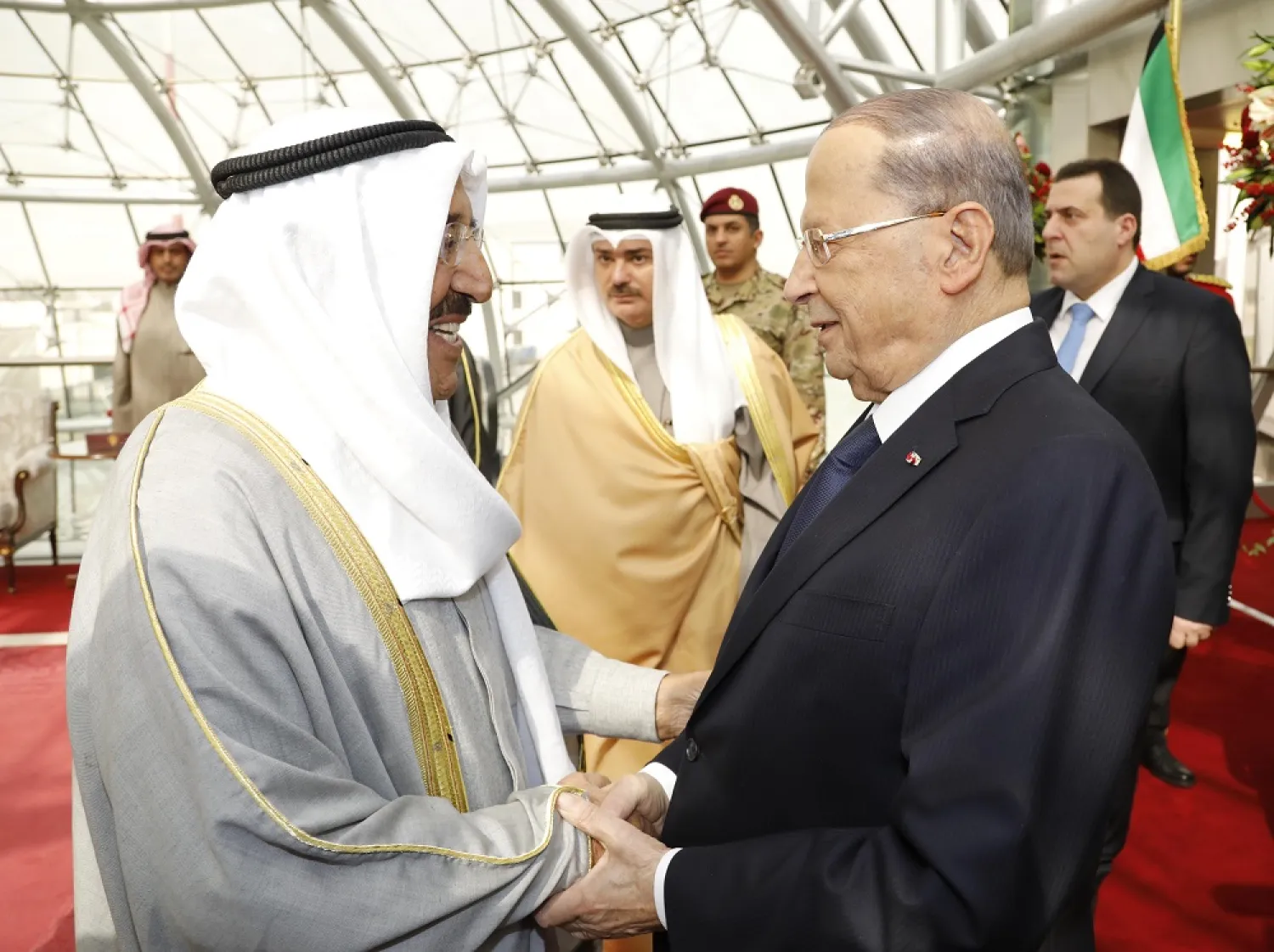
Kuwaiti Emir Sheikh Sabah Al-Ahmad Al-Jaber Al Sabah welcomes Lebanese President Michel Aoun in Kuwait City (Dalati & Nohra)
TT

Kuwait to Resume Assistance to Lebanon

Kuwaiti Emir Sheikh Sabah Al-Ahmad Al-Jaber Al Sabah welcomes Lebanese President Michel Aoun in Kuwait City (Dalati & Nohra)

Kuwait announced on Tuesday it would resume its economic aid to Lebanon and restore warm relations, which have been strained by Kuwait's accusation of Lebanese parties linked to Hezbollah of being involved in the Abdali cell conspiracy.

This came following a meeting between Kuwaiti Emir Sheikh Sabah Al-Ahmad Al-Jaber Al Sabah and Lebanese President Michel Aoun in Kuwait City.

Lebanese sources said that Sheikh Sabah Al-Ahmad Al Sabah gave his directives to the Kuwait Fund for Arab Economic Development to resume economic aid to Lebanon and respond to its needs.

He was also quoted as saying that his country was ready to provide assistance to Lebanon directly and through international conferences.

Relations between the two countries were shaken as a result of accusations by the Kuwaiti authorities to Hezbollah of transferring weapons to the Abdali cell and training its members, which threatens security and stability in the country.

On July 22, 2017, Kuwait handed over an official protest note to the Lebanese government, calling on it to “assume its responsibilities” for “irresponsible practices” by Hezbollah. The Lebanese government sought to contain the crisis, while Hezbollah denied its involvement in the conspiracy that targeted Kuwait.

Observers believe that the Kuwaiti initiative to resume aid to Lebanon was an indication that disagreement between the two countries has been brought to an end.

Lebanon’s National News Agency (NNA) reported that Kuwait’s Emir informed Aoun that he had given the necessary instructions to the Kuwait Fund for Arab Economic Development to respond to Lebanon’s needs.

“We will not hesitate to provide any assistance for Lebanon, whether directly or through international conferences," Sheikh al-Sabah said.

Aoun, for his part, Aoun expressed gratitude for Kuwait’s continuous support.

The NNA reported that he has also asked for Kuwait’s participation in the three conferences to be held in support for Lebanon, in Rome, Paris, and Brussels.

“The stability Lebanon is enjoying encourages investment and contribution to the economic development,” Aoun told his host, according to the NNA.

The two leaders agreed on the need for a unified Arab stance “in the face of Arab and regional developments”.

They also discussed the Syrian refugee crisis and condemned the US decision to consider Jerusalem as the capital of Israel.


Crown Prince of Kuwait Meets with GCC Secretary-General

Secretary General of the Gulf Cooperation Council Jasem Mohamed Albudaiwi. GCC
TT

Crown Prince of Kuwait Meets with GCC Secretary-General

Secretary General of the Gulf Cooperation Council Jasem Mohamed Albudaiwi. GCC

Kuwaiti Crown Prince Sheikh Sabah Khaled Al-Hamad Al-Sabah met with Secretary-General of the Gulf Cooperation Council (GCC) Jasem Albudaiwi on Monday at the Bayan Palace in Kuwait.

Albudaiwi presented a comprehensive report to Sheikh Sabah regarding Kuwait’s presidency of the 45th session of the GCC Supreme Council, and expressed his appreciation for the generous support and steadfast commitment Kuwait provides to the GCC's journey, SPA reported.

He underscored that such support serves as a powerful catalyst for continued efforts toward achieving greater integration and cooperation, ultimately fostering prosperity and well-being for the GCC member states and their peoples.


Botanical Facility Inaugurated at Saudi King Salman Royal Reserve to Boost Ecosystem Sustainability

Saudi  Minister of Interior and Chairman of the Board of Directors of the King Salman bin Abdulaziz Royal Reserve Development Authority Prince Abdulaziz bin Saud bin Naif bin Abdulaziz (R) is seen at the inauguration. (SPA)
TT

Botanical Facility Inaugurated at Saudi King Salman Royal Reserve to Boost Ecosystem Sustainability

Saudi  Minister of Interior and Chairman of the Board of Directors of the King Salman bin Abdulaziz Royal Reserve Development Authority Prince Abdulaziz bin Saud bin Naif bin Abdulaziz (R) is seen at the inauguration. (SPA)

Saudi Minister of Interior and Chairman of the Board of Directors of the King Salman bin Abdulaziz Royal Reserve Development Authority Prince Abdulaziz bin Saud bin Naif bin Abdulaziz inaugurated a central nursery and wild seed research and production station in Al-Jouf, reported the Saudi Press Agency on Monday.

The project aims to boost vegetation cover and sustainability within the reserve. Spanning 1,600 hectares, the project includes advanced botanical facilities, including parent seed fields, seed storage, nurseries, and a wild plant garden, to support local seed and seedling production.

The parent seed fields consist of 14 areas with over 400,000 trees and shrubs from more than 30 local species.

The central nursery covers 60,000 square meters and contains 30 greenhouses, with an annual production capacity of 1.5 million seedlings across 15 plant species. The project boasts a botanical garden spanning 12,000 square meters, featuring over 280 species of trees, shrubs, and perennial grasses.

The central nursery and seed station have contributed to planting over four million seedlings and dispersing more than 8,000 kilograms of seeds across 10 locations within the reserve, resulting in five million wild plants. This reflects the reserve’s commitment to restoring ecosystems and expanding vegetation cover.


Saudi-Tunisian Joint Committee Kicks Off 12th Session in Riyadh

Alkhorayef stressed that the convening of the 12th session comes at an important time that requires intensified coordination in growth-driving sectors - SPA
TT

Saudi-Tunisian Joint Committee Kicks Off 12th Session in Riyadh

Alkhorayef stressed that the convening of the 12th session comes at an important time that requires intensified coordination in growth-driving sectors - SPA

The 12th session of the Saudi-Tunisian Joint Committee kicked off Sunday in Riyadh, organized by the Ministry of Industry and Mineral Resources and bringing together representatives from government entities of both countries to discuss opportunities for expanding cooperation and developing strategic partnerships across various economic and development sectors.

The committee session was co-chaired by Minister of Industry and Mineral Resources Bandar Alkhorayef and Tunisian Minister of Economy and Planning Dr. Samir Abdelhafidh, attended by official delegations and government sector representatives from both countries, SPA reported.

In his opening remarks, Alkhorayef emphasized the strength of Saudi-Tunisian relations and the brotherly and economic ties between the two countries, which span more than 70 years. He noted that these ties are reflected today in shared visions and ambitious work programs that align with the aspirations of both countries’ leaderships and peoples, as well as their mutual interests.

He pointed out that the Saudi-Tunisian Joint Committee, launched in 1998, represents an institutional framework aimed at translating cooperation into executable programs and initiatives. He expressed his hope that this session would serve as a new starting point for joint strategic projects and more impactful agreements that contribute to the economic development of both countries.

Alkhorayef stressed that the convening of the 12th session comes at an important time that requires intensified coordination in growth-driving sectors. The minister called on companies in both countries to build practical partnerships in promising industries and value chains. He also highlighted the outcomes of the third meeting, held in Tunisia in July 2025, namely the agreements on mutual recognition of product conformity certificates, which positively contributed to a 38% growth in trade exchange through September 2025 compared with the same period last year.

The committee’s current session focused on boosting cooperation mechanisms, discussing investment opportunities, and exchanging expertise in key sectors, including industry, mining, tourism, transport and logistics, and the judiciary and justice sectors. These efforts aim to enhance trade efficiency, support the access of Saudi products to international markets, and strengthen economic and investment cooperation.