
The Enduring Power, Magic of Football On The Radio

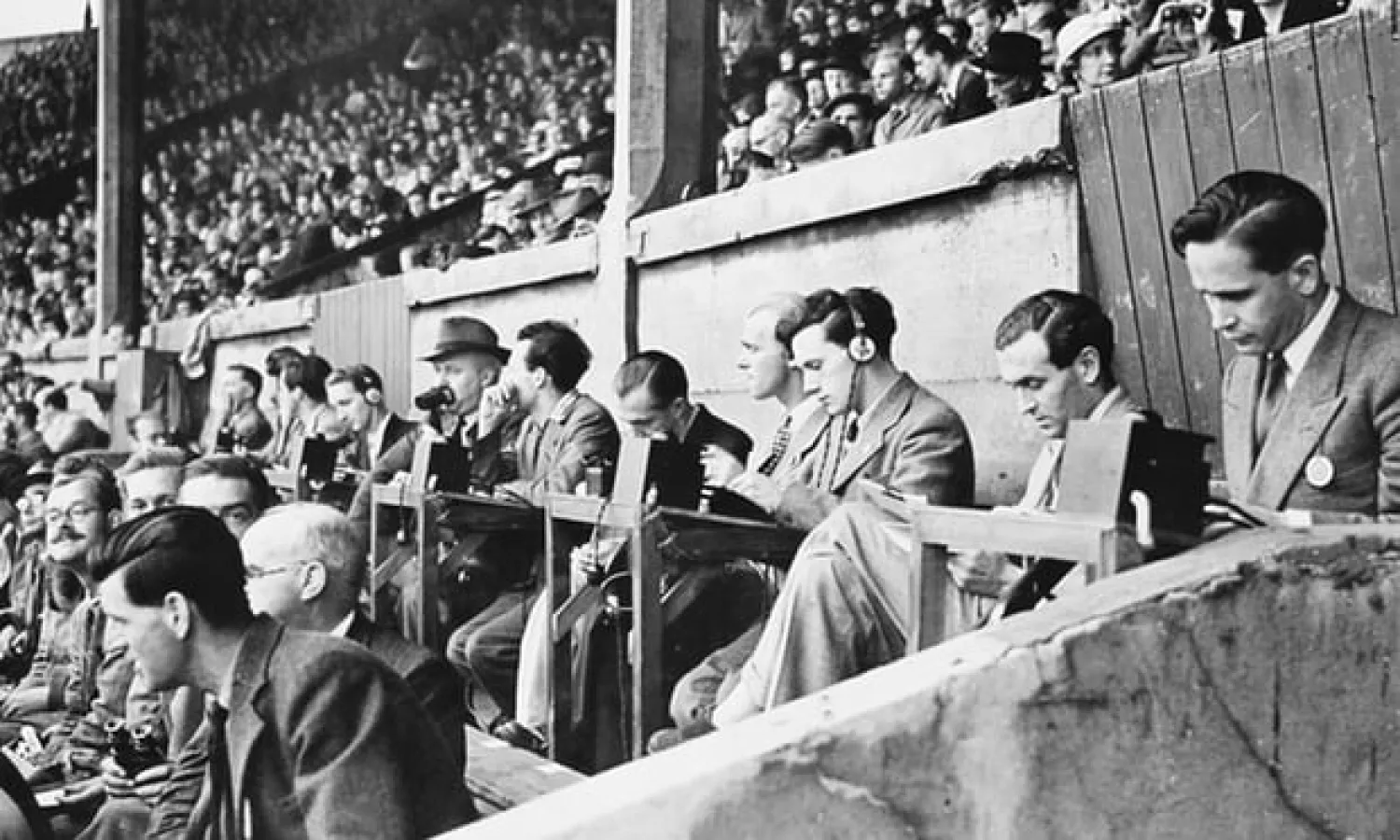
 Radio commentators in the stands at Wembley in 1948. Photograph: Topical Press Agency/Getty Images
Radio commentators in the stands at Wembley in 1948. Photograph: Topical Press Agency/Getty Images
TT

The Enduring Power, Magic of Football On The Radio

 Radio commentators in the stands at Wembley in 1948. Photograph: Topical Press Agency/Getty Images
Radio commentators in the stands at Wembley in 1948. Photograph: Topical Press Agency/Getty Images

It was the sound that the goal made that was particularly stirring. As Mohamed Salah’s impudent chip against Manchester City arced into the net the noise it made was noticeably different to the goals that had preceded it. The crackle from the crowd had added gasps of astonishment to mark the spectacular, plus the dizzying wow-factor to signal a flurry in quick succession, mixed in with standard goal jubilation.

For those of us who somehow managed not to be watching the game of the season live on telly (or even luckier in the flesh at Anfield), it still managed to be an extraordinary radio experience. The emotional soundscape made it obvious this was no ordinary match.

“It’s the old line that the pictures are better on radio,” smiles Rob Nothman, former producer and now a broadcasting coach. “If you have a quality commentator who can take you to the ground, describe what’s going on, give you all the information, but can also paint pictures, it’s evocative, it can grip you.”

Deciphering the nuances of live football from what you can hear over the radio was a much more useful skill a generation or so ago when there was significantly less action on television. Childhood memories of having a little speaker or headphone glued to your ear as the only means to follow a crucial match remain vivid. Radio played a huge part in how we consumed the game, a major source of information on goals, formations, news, opinion, atmosphere, you name it.

It feels particularly poignant to reflect on the power of football on the radio to honour the memory of Jimmy Armfield, whose voice, warmth and experience made him a master of this art. “He had knowledge, authority and clarity,” reflects Nothman. “When he opened his jacket he had a variety of medals – great player, great manager and he was able to bring that across as a broadcaster but in a sympathetic way. Such a lovely man, we will all miss him terribly.”

In this modern media age it’s realistic to wonder what the future holds for football on the radio. The younger fan is brought up on a diet of goals broadcast in a flash over a mobile phone, instant Twitter opinions, fan TV channels and so on. With attention spans changing to suit current social media trends, watching a full game without any distraction is more of a challenge. Kids tend to prefer highlights, shorter bursts, more action and less analysis.

Mark Chapman, the broadcaster who works across various media, is a staunch defender of the special qualities of radio. It remains, he explains, a significant way to absorb football even in this quick-refresh world. “I still maintain it is the fastest way of getting the goals,” he says. “TV is on a slight delay, and we will certainly get it before an app is updated. In this fast-moving world, radio is still the most immediate way of getting your information.

“If there is a massive news story, if you think what needs to be mobilised from a TV point of view to start covering it, that takes a fair amount of time compared to radio who can have someone on the phone within 10 seconds and straight through to a presenter. Just because radio has been around for the longest time compared to the other mediums it still to me feels very modern.

“There is an immediacy of wanting to see the goal and Twitter and so on but there is still a place for live commentary on the game, for debate. The point is listening to a piece of radio might not be the same as watching it but in some ways it can be better. This commentary might be amazing! If you get the right team radio is a much better way to consume a dreadful game.

“I will give you an example: I was driving back from the FA Cup draw in Coventry a couple of weeks ago and that Monday night game was Brighton v Crystal Palace. The 5 Live commentary team was Jonathan Pearce and Steve Claridge and it was hilarious. I couldn’t tell you much about what happened in the first half but as a listen on the radio it was great.”

This week is the anniversary of the first live broadcast of a football match over the airwaves. On 22 January 1927, from a wooden hut that resembled a garden shed erected at Highbury, the top-flight clash between Arsenal and Sheffield United was broadcast over the BBC’s radio service.

A notable detail is that debate to get permission for the radio experience at sports grounds had gone on for some time as the authorities were concerned that live broadcasts would have an impact on attendances and affect ticket sales. The very first commentator was the splendidly named Henry Blyth Thornhill Wakelam – a former rugby player.

Chapman’s love for the magic of football on the radio endures. “There is still nothing better in any of the jobs that I do than saying: ‘It’s 5 o’clock, you are listening to 5 Live and this is Sports Report. You know there are two million people in cars coming back from sport ready to listen to the headlines.” Cue that music …

The Guardian Sport


Real-Life Horror to TV Drama: Feared Syria Sites Become Sets for Series 

Syrian director Mohamad Abdul Aziz poses for a photograph at his office in Damascus on November 24, 2025. (AFP)
TT

Real-Life Horror to TV Drama: Feared Syria Sites Become Sets for Series 

Syrian director Mohamad Abdul Aziz poses for a photograph at his office in Damascus on November 24, 2025. (AFP)

At a Damascus air base once off-limits under Bashar al-Assad, a crew now films a TV series about the final months of the ousted leader's rule as seen through the eyes of a Syrian family.

"It's hard to believe we're filming here," director Mohamad Abdul Aziz said from the Mazzeh base, which was once also a detention center run by Assad's air force intelligence branch, known for its cruelty.

The site in the capital's southwestern suburbs "used to be a symbol of military power. Now we are making a show about the fall of that power," he told AFP.

Assad fled to Russia as an opposition offensive closed in on Damascus, taking it without a fight on December 8 last year after nearly 14 years of civil war and half a century of Assad dynasty rule.

The scene at the Mazzeh base depicts the escape of a figure close to Assad and is set to feature in "The King's Family" filmed in high-security locations once feared by regular Syrians.

The series is to be aired in February during the Muslim holy month of Ramadan, prime-time viewing in the Arab world, when channels and outlets vie for the attention of eager audiences.

Dozens of actors, directors and other show-business figures who were opposed to Assad have returned to Syria since his ouster, giving the local industry a major boost, while other series have also chosen to film at former military or security sites.

- 'Impossible before' -

"It's a strange feeling... The places where Syria used to be ruled from have been transformed" into creative spaces, Abdul Aziz said.

Elsewhere in Damascus, his cameras and crew now fill offices at the former military intelligence facility known as Palestine Branch, where detainees once underwent interrogation so brutal that some never came out alive.

"Palestine Branch was one of the pillars of the security apparatus -- just mentioning its name caused terror," Abdul Aziz said of the facility, known for torture and abuse.

Outside among charred vehicles, explosions and other special effects, the team was recreating a scene depicting "the release of detainees when the security services collapsed," he said.

Thousands of detainees were freed when jails were thrown open as Assad fell last year, and desperate Syrians converged on the facilities in search of loved ones who disappeared into the prison system, thousands of whom are still missing.

Assad's luxurious, high-security residence, which was stormed and looted after he fled to Russia, is also part of the new series.

Abdul Aziz said he filmed a fight scene involving more than 150 people and gunfire in front of the residence in Damascus's upscale Malki district.

"This was impossible to do before," he said.

- 'Fear' -

The series' scriptwriter Maan Sakbani, 35, expressed cautious relief that the days of full-blown censorship under Assad were over.

The new authorities' information ministry still reviews scripts, but the censor's comments on "The King's Family" were very minor, he said from a traditional Damascene house where the team was discussing the order of scenes.

Sakbani said he was uncertain how long the relative freedom would last, and was waiting to see the reaction to the Ramadan productions once they were aired.

Several other series inspired by the Assad era are also planned for release at that time, including "Enemy Syrians", which depicts citizens living under the eyes of the security services.

Another, "Going Out to the Well", directed by Mohammed Lutfi and featuring several prominent Syrian actors, is about deadly prison riots in the infamous Saydnaya facility in 2008.

Rights group Amnesty International had called the facility a "human slaughterhouse".

"The show was written more than two years ago and we intended to film it before Assad's fall," Lutfi said.

But several actors feared the former authorities' reaction and they were unable to find a suitable location since filming in Syria was impossible.

Now, they plan to film on site.

"The new authorities welcomed the project and provided extensive logistical support and facilities for filming inside Saydnaya prison," Lutfi said.

As a result, it will be possible "to convey the prisoners' suffering and the regime's practices -- from the inside the actual location," he said.


Swiss Haenni Takes over RB Leipzig as First Female CEO of a Bundesliga Club 

Tatjana Haenni, FIFA deputy director of the competitions division and head of women's football, listens during the opening news conference for the FIFA Women's World Cup in Vancouver, British Columbia, on Thursday, June 4, 2015. (AP)
TT

Swiss Haenni Takes over RB Leipzig as First Female CEO of a Bundesliga Club 

Tatjana Haenni, FIFA deputy director of the competitions division and head of women's football, listens during the opening news conference for the FIFA Women's World Cup in Vancouver, British Columbia, on Thursday, June 4, 2015. (AP)

Former Switzerland international and experienced football administrator, Tatjana Haenni, became the first female CEO of a Bundesliga club after she was appointed to the post at RB Leipzig on Wednesday.

Haenni has decades of experience following her playing career, having held various posts in women's football at global governing body FIFA for more than a decade.

She was also in charge of women's football at the Swiss football association and sports director at the National Women's Soccer League (NWSL) in the United States among others until her departure earlier this year.

"In our discussions, she impressed us and the committees with her expertise, as well as her combination of specialist knowledge, leadership strength and strategic thinking," said Oliver Mintzlaff, chair of RB Leipzig's supervisory board in a club statement.

The 59-year-old will take up her role on January 1, 2026.

Leipzig, owned by energy drinks maker Red Bull, are currently in second place in the Bundesliga, eight points behind leaders Bayern Munich. The Bundesliga will go into a winter break between December 21 and January 9.

"I am very much looking forward to this new role. I am convinced that with strong teamwork and a focus on RB Leipzig’s strengths, we can tap into significant potential," Haenni said.

"I can’t wait to get started in January and to get to know the club on a deeper level," Haenni said. "Together, we want to continue on what is already a successful path, and achieve our ambitious goals."


Italian Cooking and Its Rituals Get UN Designation as World Heritage 

A waiter carries pizzas at L'antica Pizzeria da Michele as Italian cuisine awaits a crucial UNESCO decision that could recognize it as an Intangible Cultural Heritage of Humanity in Naples, Italy, December 5, 2025. (Reuters)
TT

Italian Cooking and Its Rituals Get UN Designation as World Heritage 

A waiter carries pizzas at L'antica Pizzeria da Michele as Italian cuisine awaits a crucial UNESCO decision that could recognize it as an Intangible Cultural Heritage of Humanity in Naples, Italy, December 5, 2025. (Reuters)

Italian food is known and loved around the world for its fresh ingredients and palate-pleasing tastes. On Wednesday, the UN's cultural agency gave foodies another reason to celebrate their pizza, pasta and tiramisu by listing Italian cooking as part of the world’s “intangible” cultural heritage.

UNESCO added the rituals surrounding Italian food preparation and consumption to its list of the world’s traditional practices and expressions. It's a designation celebrated alongside the more well-known UNESCO list of world heritage sites, on which Italy is well represented with locations like the Rome's Colosseum and the ancient city of Pompeii.

The citation didn’t mention specific dishes, recipes or regional specialties, but highlighted the cultural importance Italians place on the rituals of cooking and eating: the Sunday family lunch, the tradition of grandmothers teaching grandchildren how to fold tortellini dough just so, even the act of coming together to share a meal.

“Cooking is a gesture of love, a way in which we tell something about ourselves to others and how we take care of others,” said Pier Luigi Petrillo, a member of the Italian UNESCO campaign and professor of comparative law at Rome’s La Sapienza University.

“This tradition of being at the table, of stopping for a while at lunch, a bit longer at dinner, and even longer for big occasions, it’s not very common around the world,” he said.

Premier Giorgia Meloni celebrated the designation, which she said honored Italians and their national identity.

“Because for us Italians, cuisine is not just food or a collection of recipes. It is much more: it is culture, tradition, work, wealth,” she said in a statement.

Many gastronomic cultures get recognition It’s by no means the first time a country’s cuisine has been recognized as a cultural expression: In 2010, UNESCO listed the “gastronomic meal of the French” as part of the world’s intangible heritage, highlighting the French custom of celebrating important moments with food.

Other national cuisines and cultural practices surrounding them have also been added in recent years: the “cider culture” of Spain’s Asturian region, the Ceebu Jen culinary tradition of Senegal, the traditional way of making cheese in Minas Gerais, Brazil.

UNESCO meets every year to consider adding new cultural practices or expressions onto its lists of so-called “intangible heritage.” There are three types: One is a representative list, another is a list of practices that are in “urgent” need of safeguarding and the third is a list of good safeguarding practices.

This year, the committee meeting in New Delhi considered 53 nominations for the representative list, which already had 788 items. Other nominees included the Swiss yodelling, the handloom weaving technique used to make Bangladesh’s Tangail sarees, and Chile’s family circuses.

In its submission, Italy emphasized the “sustainability and biocultural diversity” of its food. Its campaign noted how Italy’s simple cuisine valued seasonality, fresh produce and limiting waste, while its variety highlighted its regional culinary differences and influences from migrants and others.

“For me, Italian cuisine is the best, top of the range. Number one. Nothing comes close,” said Francesco Lenzi, a pasta maker at Rome’s Osteria da Fortunata restaurant, near the Piazza Navona. “There are people who say ‘No, spaghetti comes from China.’ Okay, fine, but here we have turned noodles into a global phenomenon. Today, wherever you go in the world, everyone knows the word spaghetti. Everyone knows pizza.”

Lenzi credited his passion to his grandmother, the “queen of this big house by the sea” in Camogli, a small village on the Ligurian coast where he grew up. “I remember that on Sundays she would make ravioli with a rolling pin.”

“This stayed with me for many years,” he said in the restaurant's kitchen.

Mirella Pozzoli, a tourist visiting Rome’s Pantheon from the Lombardy region in northern Italy, said the mere act of dining together was special to Italians:

“Sitting at the table with family or friends is something that we Italians cherish and care about deeply. It’s a tradition of conviviality that you won’t find anywhere else in the world.”

Italy already well-represented on list Italy already has 13 other cultural items on the UNESCO intangible list, including Sicilian puppet theater, Cremona’s violin craftsmanship and the practice moving of livestock along seasonal migratory routes known as transhumance.

Italy appeared in two previous food-related listings: a 2013 citation for the “Mediterranean diet” that included Italy and half a dozen other countries, and the 2017 recognition of Naples’ pizza makers.

Petrillo, the Italian campaign member, said after 2017, the number of accredited schools to train Neapolitan pizza makers increased by more than 400%.

“After the UNESCO recognition, there were significant economic effects, both on tourism and the sales of products and on education and training,” he said.