

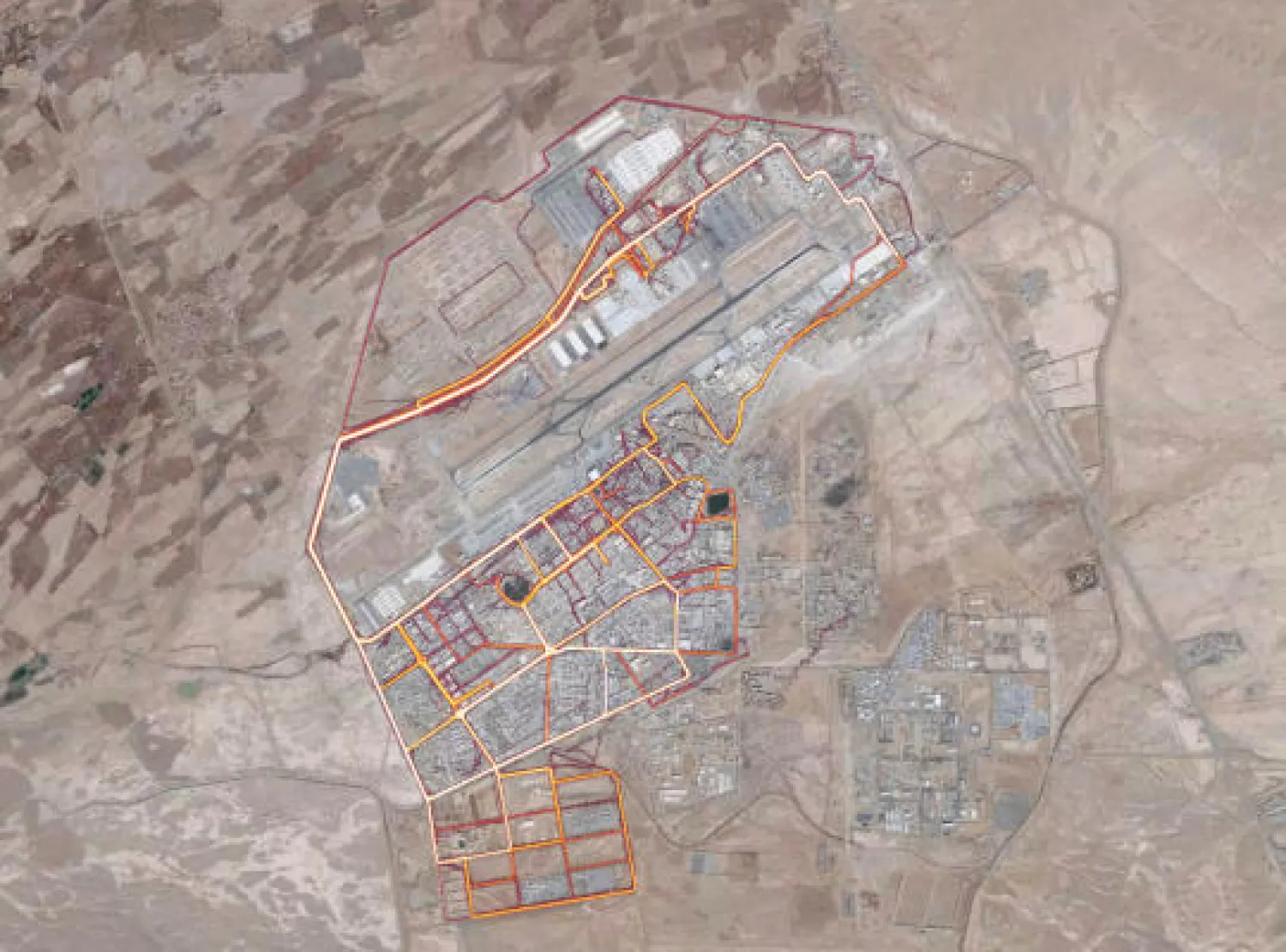

Fitness Devices Can Reveal Locations of US Soldiers

A portion of the Strava Labs heat map from Kandahar Airfield in Afghanistan, made by tracking activities. (Screenshot from Strava Labs)
TT

Fitness Devices Can Reveal Locations of US Soldiers

A portion of the Strava Labs heat map from Kandahar Airfield in Afghanistan, made by tracking activities. (Screenshot from Strava Labs)

Fitness devices, such as Fitbit, can reveal the location and activities of their users, sparking concerns that the security of US soldiers using them can be compromised.

The revelation was made though an interactive map found online that can show the locations and activities of the users of such devices.

The Global Heat Map, published by the GPS tracking company Strava, uses satellite information to map the locations and movements of subscribers to the company's fitness service over a two-year period, by illuminating areas of activity, The Washington Post reported Sunday.

Strava said it has 27 million users around the world, including people who own widely available fitness devices, as well as people who directly subscribe to its mobile app. The map is not live, but shows a pattern of accumulated activity between 2015 and September 2017.

The map shows a great deal of activity in the US and Europe. But in war zones and deserts in countries such as Iraq and Syria, the heat map becomes almost entirely dark — except for scattered evidence of activity.

A closer look at those areas brings into focus the locations and outlines of well-known US military bases, as well as other lesser-known and potentially sensitive sites — possibly because American soldiers and other personnel are using fitness trackers as they move around.

The Global Heat Map was posted online in November 2017, but the information it contains was only publicized recently.

The data could provide information to someone who wants to attack or ambush troops, the Post reported.

Military officials are looking into the situation to determine how to respond.

"DoD takes matters like these very seriously and is reviewing the situation to determine if any additional training or guidance is required, and if any additional policy must be developed to ensure the continued safety of DoD personnel at home and abroad," Maj. Audricia Harris, a Defense Department spokeswoman, told The Associated Press.



Paris Metro Stabbing Suspect is French, Says Ministry

The attacks happened on a central line of Paris's metro, seen here in a file picture © JULIEN DE ROSA / AFP/File
TT

Paris Metro Stabbing Suspect is French, Says Ministry

The attacks happened on a central line of Paris's metro, seen here in a file picture © JULIEN DE ROSA / AFP/File

The suspect in the stabbing of three women in the Paris metro last week is French, the interior ministry said Monday, after previously saying he was an undocumented Malian ordered to leave the country.

A source with knowledge of the case, requesting anonymity because not allowed to speak to the press, said he had held a French passport since 2018, AFP reported.

The 25-year-old man was arrested on suspicion of having stabbed and injured three women along the Paris metro's Line 3 on Friday, then admitted to a psychiatric hospital the next day.

"The investigation uncovered a French passport belonging to the suspect," the ministry said, adding that he had not once mentioned his French nationality during previous run-ins with police.

The ministry said on Friday the man was a Malian citizen imprisoned in January last year for aggravated theft and sexual assault, and required to leave France after being released in July.

The man had been placed in an administrative detention centre, but failure to obtain a consular travel document required for his deportation meant he was released after 90 days as required by law, it said.

Interior Minister Laurent Nunez last week called for "maximum vigilance" during the festive season in France.


China Stages Military Drills around Taiwan to Warn 'External Forces' after US, Japan Tensions

 In this photo released by Xinhua News Agency, Chinese President Xi Jinping, also chairman of the Central Military Commission (CMC), front row second from left, poses with other military officers after promoting to generals, back row, from left, Yang Zhibin of the Eastern Theater Command and Han Shengyan commander of Central Theater Command in Beijing on Monday, Dec. 22, 2025. (Li Gang/Xinhua via AP)
In this photo released by Xinhua News Agency, Chinese President Xi Jinping, also chairman of the Central Military Commission (CMC), front row second from left, poses with other military officers after promoting to generals, back row, from left, Yang Zhibin of the Eastern Theater Command and Han Shengyan commander of Central Theater Command in Beijing on Monday, Dec. 22, 2025. (Li Gang/Xinhua via AP)
TT

China Stages Military Drills around Taiwan to Warn 'External Forces' after US, Japan Tensions

 In this photo released by Xinhua News Agency, Chinese President Xi Jinping, also chairman of the Central Military Commission (CMC), front row second from left, poses with other military officers after promoting to generals, back row, from left, Yang Zhibin of the Eastern Theater Command and Han Shengyan commander of Central Theater Command in Beijing on Monday, Dec. 22, 2025. (Li Gang/Xinhua via AP)
In this photo released by Xinhua News Agency, Chinese President Xi Jinping, also chairman of the Central Military Commission (CMC), front row second from left, poses with other military officers after promoting to generals, back row, from left, Yang Zhibin of the Eastern Theater Command and Han Shengyan commander of Central Theater Command in Beijing on Monday, Dec. 22, 2025. (Li Gang/Xinhua via AP)

China's military on Monday dispatched air, navy and missile units to conduct joint live-fire drills around the island of Taiwan, which Beijing called a “stern warning” against separatist and “external interference” forces. Taiwan said it was placing its forces on alert and called the Chinese government “the biggest destroyer of peace.”

Taiwan’s aviation authority said more than 100,000 international air travelers would be affected by flight cancellations or diversions.

The drills came after Beijing expressed anger at what could be the largest-ever US arms sale to the self-ruled territory and at a statement by Japan’s prime minister, Sanae Takaichi, saying its military could get involved if China were to take action against Taiwan. China says Taiwan must come under its rule, The AP news reported.

The Chinese military did not mention the United States and Japan in its statement on Monday, but Beijing's foreign ministry accused the Taiwanese ruling party of trying to seek independence through requesting US support.

Taiwan’s Defense Ministry said rapid response exercises were underway, with forces on high alert. “The Chinese Communist Party’s targeted military exercises further confirm its nature as an aggressor and the biggest destroyer of peace,” it said.

Beijing sends warplanes and navy vessels toward the island on a near-daily basis, and in recent years it has stepped up the scope and scale of these exercises.

Senior Col. Shi Yi, spokesperson of China's People's Liberation Army's Eastern Theater Command, said the drills would be conducted in the Taiwan Strait and areas to the north, southwest, southeast and east of the island.

Shi said the activities would focus on sea-air combat readiness patrol, “joint seizure of comprehensive superiority” and blockades on key ports. It was also the first large-scale military drill where the command publicly mentioned one goal was “all-dimensional deterrence outside the island chain."

“It is a stern warning against ‘Taiwan independence’ separatist forces and external interference forces, and it is a legitimate and necessary action to safeguard China’s sovereignty and national unity,” Shi said.

China and Taiwan have been governed separately since 1949, when a civil war brought the Communist Party to power in Beijing. Defeated Nationalist Party forces fled to Taiwan. The island has operated since then with its own government, though the mainland’s government claims it as sovereign territory.

Drills will continue on Tuesday The command on Monday deployed destroyers, frigates, fighters, bombers and unmanned aerial vehicles, alongside long-range rockets, to the north and southwest of the Taiwan Strait. It carried out live-fire exercises against targets in the waters as well. Among other training, drills to test the capabilities of sea-air coordination and precise target hunting were conducted in the waters and airspace to the east of the strait.

Hsieh Jih-sheng, deputy chief of the general staff for intelligence of the Taiwanese Defense Ministry, said that as of 3 p.m. Monday, 89 aircraft and drones were operating around the strait, with 67 of them entering the “response zone" — airspace under the force's monitoring and response. In the sea, the ministry detected 14 navy ships around the strait and four other warships in the Western Pacific, in addition to 14 coast guard vessels.

“Conducting live-fire exercises around the Taiwan Strait ... does not only mean military pressure on us. It may bring more complex impact and challenges to the international community and neighboring countries,” Hsieh told reporters.

Military drills are set to continue Tuesday. Taiwan's Civil Aviation Administration said Chinese authorities had issued a notice saying seven temporary dangerous zones would be set up around the strait to carry out rocket-firing exercises from 8 a.m. to 6 p.m. on Tuesday, barring aircraft from entering them.

The Taiwanese aviation authority said more than 850 international flights were initially scheduled during that period and the drills would affect over 100,000 travelers. Over 80 domestic flights, involving around 6,000 passengers, were also canceled, it added.

The Chinese command released themed posters about the drills online accompanied by provocative wording. One poster depicted two shields with the Great Wall alongside three military aircraft and two ships. Its social media post said the drills were about the “Shield of Justice, Smashing Illusion," adding that any foreign interlopers or separatists touching the shields would be eliminated.

Last week, Beijing imposed sanctions against 20 US defense-related companies and 10 executives, a week after Washington announced large-scale arms sales to Taiwan valued at more than $10 billion. It still requires approval by the US Congress.

Under US federal law in place for many years, Washington is obligated to assist Taipei with its defense, a point that has become increasingly contentious with China. The US and Taiwan had formal diplomatic relations until 1979, when President Jimmy Carter’s administration recognized and established relations with Beijing.

Asked about the drills, Chinese foreign ministry spokesperson Lin Jian said Taiwan's Democratic Progressive Party has attempted "to seek independence by soliciting US support and even risk turning Taiwan into a powder keg and ammunition depot.”

“External forces’ attempts to use Taiwan to contain China and to arm Taiwan will only embolden the Taiwan independence forces and push the Taiwan Strait toward a dangerous situation of military confrontation and war,” he said.

There was no immediate US statement on the drills.

Taiwanese army on high alert Karen Kuo, spokesperson for the Taiwanese president's office, said the drills were undermining the stability and security of the Taiwan Strait and Indo-Pacific region and openly challenging international law and order.

“Our country strongly condemns the Chinese authorities for disregarding international norms and using military intimidation to threaten neighboring countries.” she said.

Taiwan's Defense Ministry released a video that featured its weapons and forces in a show of resilience. Multiple French Mirage-2000 aircraft conducted landings at an air force base.

In October, the Taiwanese government said it would accelerate the building of a “Taiwan Shield” or “T-Dome” air defense system in the face of the military threat from China.

The military tensions came a day after Taipei Mayor Chiang Wan-an said he hoped the Taiwan Strait would be associated with peace and prosperity, instead of “crashing waves and howling winds," during a trip to Shanghai.


Iranian Traders and Shopkeepers Protest as Currency Hits Record Low

 People shop at Tajrish Bazaar in the Iranian capital Tehran on December 29, 2025. (AFP)
People shop at Tajrish Bazaar in the Iranian capital Tehran on December 29, 2025. (AFP)
TT

Iranian Traders and Shopkeepers Protest as Currency Hits Record Low

 People shop at Tajrish Bazaar in the Iranian capital Tehran on December 29, 2025. (AFP)
People shop at Tajrish Bazaar in the Iranian capital Tehran on December 29, 2025. (AFP)

Iranian traders and shopkeepers staged a second day of protests Monday after the country’s currency plummeted to a new record low against the US dollar.

Videos on social media showed hundreds taking part in rallies in Saadi Street in downtown Tehran, as well as in the Shush neighborhood near Tehran's main Grand Bazaar, which played a crucial role in the 1979 revolution that ousted the monarchy and brought clerics to power.

Witnesses told The Associated Press that traders shut their shops and asked others to do the same. The semiofficial ILNA news agency said many businesses and merchants stopped trading even though some kept their shops open.

There was no reports of police raids though security was tight at the protests, according to witnesses.

On Sunday, protest gatherings were limited to two major mobile market in downtown Tehran, where the demonstrators chanted anti-government slogans.

Iran's rial on Sunday plunged to 1.42 million to the dollar. On Monday, it traded at 1.38 million rials to the dollar.

The rapid depreciation is compounding inflationary pressure, pushing up prices of food and other daily necessities and further straining household budgets, a trend that could worsen by a gasoline price change introduced in recent days.

According to the state statistics center, inflation rate in December rose to 42.2% from the same period last year, and is 1.8% higher than in November. Foodstuff prices rose 72% and health and medical items were up 50% from December last year, according to the statistics center. Many critics see the rate a sign of an approaching hyperinflation.

Reports in official Iranian media said that the government plans to increase taxes in the Iranian new year that begins March 21 have caused more concern.

Iran’s currency was trading at 32,000 rials to the dollar at the time of the 2015 nuclear accord that lifted international sanctions in exchange for tight controls on Iran’s nuclear program. That deal unraveled after US President Donald Trump unilaterally withdrew the United States from it in 2018.

There is also uncertainty over the risk of renewed conflict following June’s 12-day war involving Iran and Israel. Many Iranians also fear the possibility of a broader confrontation that could draw in the United States, adding to market anxiety.

In September, the United Nations reimposed nuclear-related sanctions on Iran through what diplomats described as the “snapback” mechanism. Those measures once again froze Iranian assets abroad, halted arms transactions with Tehran and imposed penalties tied to Iran’s ballistic missile program.