




There are always moments in this job that you remember more than others. The trips abroad, the sweet-scented nights at all those fabulous old grounds where, even subconsciously, you find yourself quickening your step on the walk in. Or the occasions with the great football men from years gone by, when you know how lucky you are to be in their company, listening to their stories with the shackles off, and it feels like an education.
One of those times, in particular, will always stay with me. I remember how well turned out they all were, in their polished shoes and their smart blazers, and that first moment when Sir Bobby Charlton came up the stairs and brought the room to a respectful silence. He smiled politely but you could see, up-close, that it was going to be an ordeal.
On the next table, Bill Foulkes shook our hands, a generation of football writers who maybe didn’t know the story as well as we should have done, and started going through his own memories, half a century on, of that seminal, awful night on the runway of Munich‑Riem airport. Foulkes was one of the survivors who had pulled others from the wreckage but there was absolutely no way he was willing to portray himself as a hero. We were only a few minutes in before this formidable old centre‑half – “tough as teak”, Charlton remembered him – was struggling with his emotions and reaching for a glass of water.
Of all the memories of covering Manchester United, all the matches and trophies and air miles, it was certainly quite something to sit opposite these men at the club’s training ground 10 years ago, building up to the 50th anniversary of the Munich tragedy, and listen to their accounts of the day that changed their lives.
Harry Gregg, another of the heroes, had flown in from Belfast, where the walls of his house are adorned with pictures of Matt Busby’s team. Albert Scanlon, who escaped with a fractured skull and a broken leg, talked about the profound psychological scars that had stayed with him and Kenny Morgans, the youngest player involved in the crash, explained he did not usually like to talk too much about it.Morgans was the last survivor to be rescued from the burnt-out BEA Elizabethan after being found under the wheels five hours after the official search was called off. He spoke beautifully about the team‑mates who had been lost. All five of the men in our company did. We sat with them, listened and felt a little bit more connected with the club’s history.
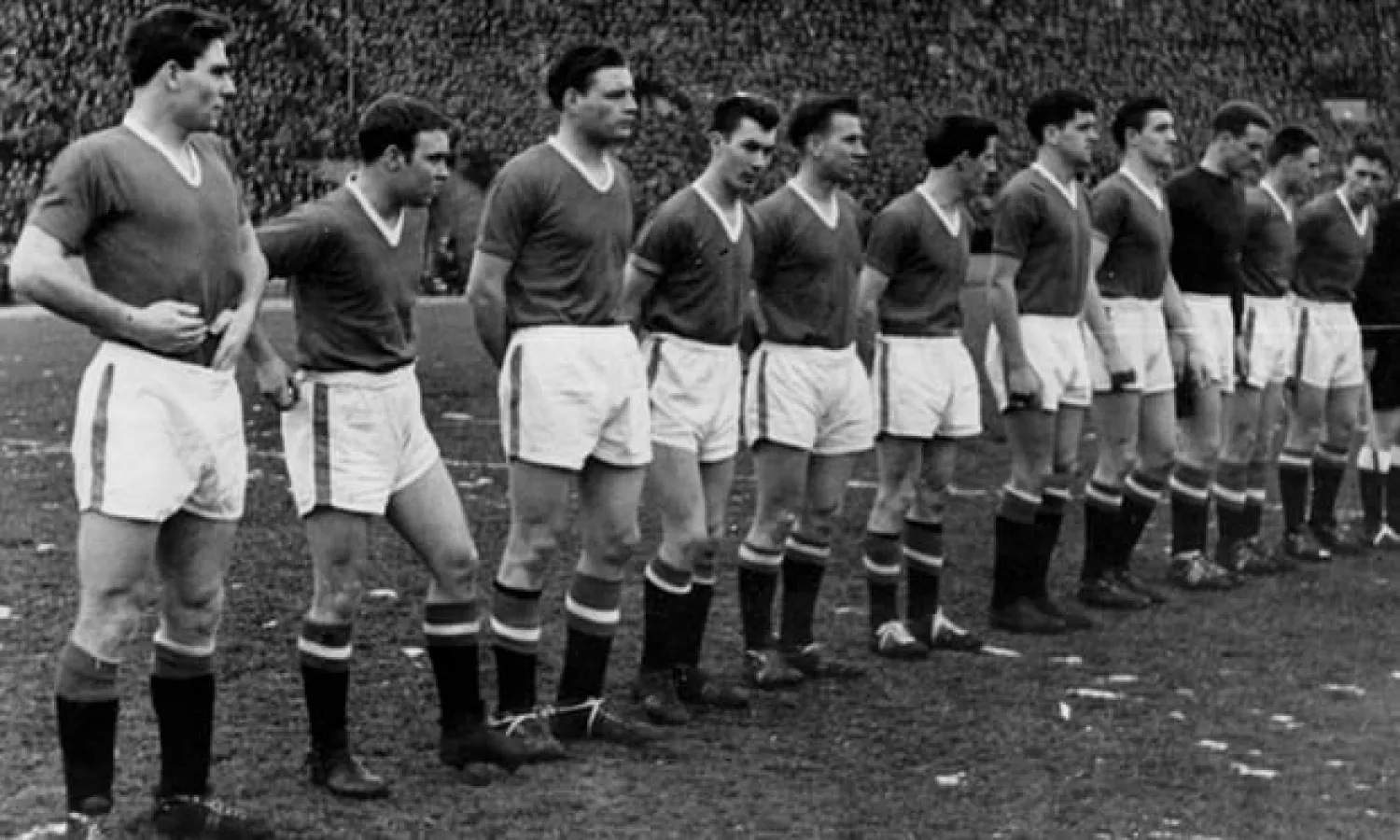
Next weekend, a crowd will gather outside Old Trafford, as it always does before the home match nearest the anniversary, to remember the 23 people who died, 60 years since that European Cup tie against Red Star Belgrade. Eight of the dead belonged to the thrilling, youthful team that had won the league championship under Busby’s expert guidance the previous two seasons. Other victims included two members of the air crew (though the pilot, James Thain, survived), three club officials and eight journalists including one of my own predecessors, Donny Davies, of what was then the Manchester Guardian, writing with a pseudonym, as many football correspondents did in those days, of “An Old International”.
We live in an era when football seems obsessed with finding new ways to hold a minute’s silence, often when it has nothing whatsoever to do with the sport. But this one always resonates. Before José Mourinho’s team play Huddersfield there will be a rendition of Flowers of Manchester beneath the Munich plaque. Supporters will be given a commemorative pack, including a book, Remembering the Busby Babes, that has been written specially for the occasion by Ivan Ponting, a prolific author of United’s history.
A service will be held at Old Trafford the following Tuesday while, 80 miles south in Dudley, other events are taking place to remember the town’s most famous football son. An exhibition about the life of Duncan Edwards, the original boy wonder, opened two weeks ago and on 21 February the great and good will gather for a tribute dinner on the anniversary of his death.
Edwards, an England international by the age of 18, was so catastrophically damaged when the plane skidded off the runway the initial casualty list described him as “mortally injured”. Instead, it was another 15 days before his final breath, though not before he asked Jimmy Murphy, Busby’s assistant, what time kick-off would be against Wolves the following Saturday, and whether he was playing. “It was as though a young Colossus had been taken from our midst,” Frank Taylor wrote in The Day a Team Died.
Of the players who made it out of flight 609, only Charlton and Gregg are with us now and neither will ever lose sight of the fact that the miracle of life came at a terrible price. Everyone was affected in different ways but the people who know Charlton best, including his brother, Jack, say that was the day he “stopped smiling”. More than once, I have heard him described as a little stern, or difficult to approach, but what you have to remember is that Charlton was always “one of the boys” before the quarter-final in Belgrade and the stop, for refuelling, in the snow and ice of Munich. If he lost his sparkle on that runway, at the age of 20, who could ever be surprised?
His life since, he told us during that audience 10 years ago, had been accompanied by one unanswerable question: why me? Why, he wanted to know, was he able to run his hands over his body and realise he had nothing more serious than a bang on the head and a small cut? When he closed his eyes, he could still recall the awful noise of metal on metal, the smoke and carnage and the blare of sirens. He could recall coming to his senses, outside the wrecked plane but still strapped into his seat, and seeing so many stricken team-mates lying around him, some already beyond help.
Charlton found Busby lying on the runway and, in those catastrophic seconds, took off his overcoat to lay it across him. Then it was the following morning, in his bed at Rechts der Isar hospital, when the names of the dead were read out to him. “The names of all my pals. Friends I would go to the dance with at the weekend. Friends who would invite me to dinner at Christmas. It felt like my life was being taken away from me, piece by piece.”
He is 80 now, no longer so visible in everyday life at Old Trafford, but still feels it is his duty to educate the current squad. Ten years ago, Charlton requested Sir Alex Ferguson’s permission to speak to the players. His talk lasted an hour and each player was given a DVD about the Busby Babes. This time, he has written a letter that will be given to all the players. I hope they read it, take it in and realise, for all their riches, that Old Trafford is not just the giant fruit machine that is sometimes portrayed.
By pure coincidence, United’s under-19s will be in Belgrade to play in a Uefa Youth League tie. A reception will be held at the Majestic hotel, where Busby’s travelling party had stayed before that fateful game in 1958, and at least one surviving member of the Red Star Belgrade team is expected to be there.
A minute’s silence will be held at the old Stadion JNA and hopefully the latest products from United’s youth system will reflect what happened to their predecessors and understand a little better, perhaps, why there is the “Munich Tunnel” running beneath the stand at Old Trafford that is named after Charlton.
Our own audience with those men, as the football writers who cling to United’s coat-tails and lost some of our own on that flight, was certainly time to cherish. “We were the best team in the country,” Charlton wanted us to know before we left. “People don’t believe me sometimes when I tell them how good Duncan Edwards was. Tommy Taylor. David Pegg. Eddie Colman. Billy Whelan. All of them. You look at the old black-and-white footage and you think everything is slow and ponderous but, I tell you, they all had unbelievable talent – and I would hate for anyone to forget that.”
The Guardian Sport


