


British Report: Robots to Take One in Five Jobs in 12 Years

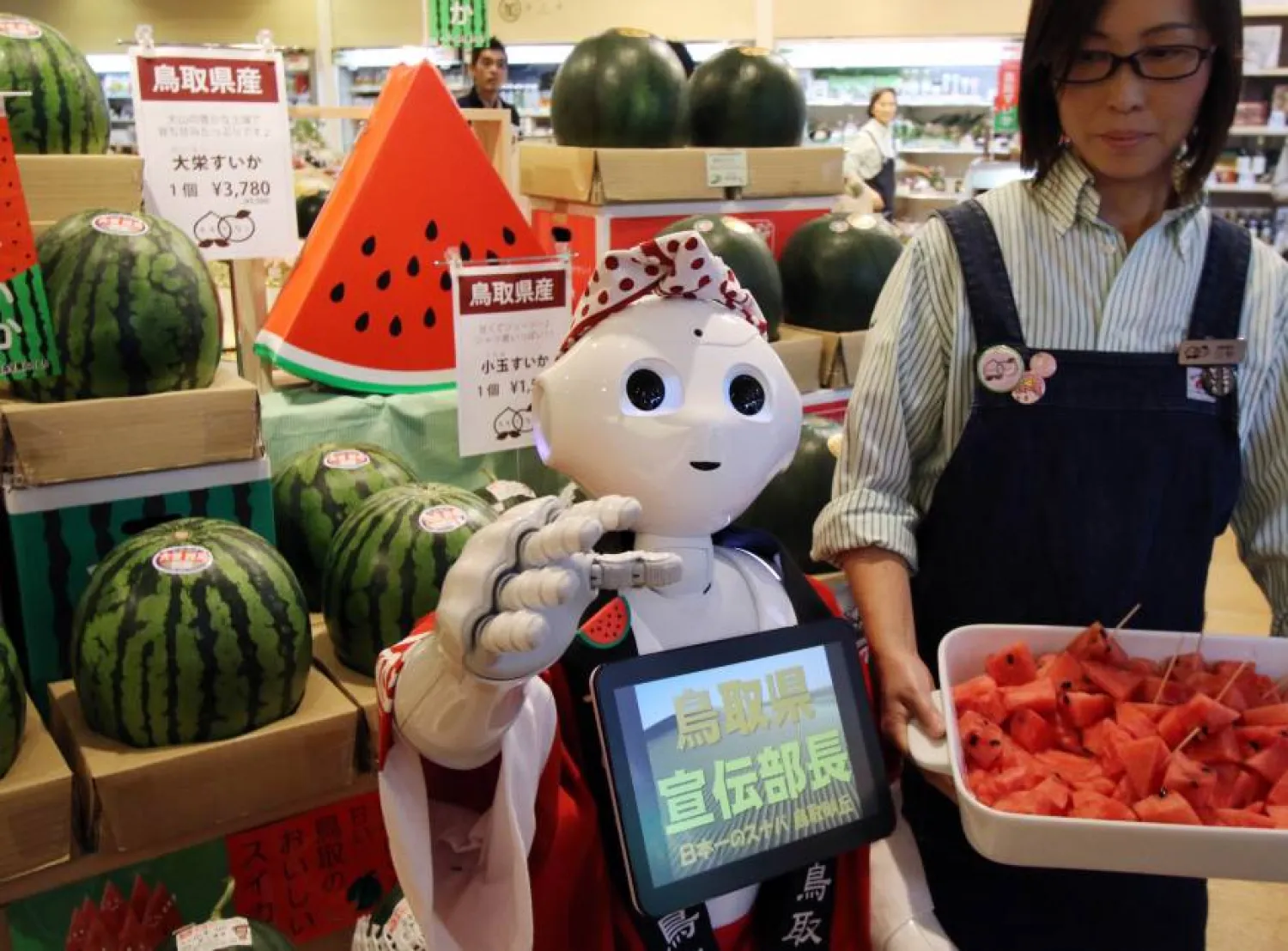
SoftBank's humanoid robot Pepper helps promote watermelons from Tottori Prefecture, at a shop offering local produce in Tokyo. AFP file photo
TT

British Report: Robots to Take One in Five Jobs in 12 Years

SoftBank's humanoid robot Pepper helps promote watermelons from Tottori Prefecture, at a shop offering local produce in Tokyo. AFP file photo

A British report showed that robots could take over one in five jobs in British cities by 2030. Retail, customer service and warehouse jobs are most at threat from automation. According to the Daily Mail Newspaper, struggling cities in the North and Midlands were more exposed to job losses than wealthier cities in the South, which will widen the gap between the North and the South.

Cities including Mansfield, Sunderland and Wakefield could see two out of five jobs lost, while Oxford and Cambridge face losing 13 percent. The report found that the changes would lead to jobs being created as well as lost, but in Northern and Midlands' cities they would largely be in low-skilled occupations.

It also said that up to one in 10 jobs are in occupations predicted to grow, while new industries would bring positions which do not currently exist.

Andrew Carter, chief executive of Center for Cities, said: “Automation and globalization will bring huge opportunities to increase prosperity and jobs, but there is also a real risk that many people and places will lose out.

National and local leaders need to ensure that people in cities across the North and Midlands can share in the benefits these changes could offer. That means reforming the education system to give young people the cognitive and interpersonal skills they need to thrive in the future, and improving school standards, especially in places where jobs are most at risk.”

Carter added: “We also need greater investment in lifelong learning and technical education to help adults adapt to the changing labor market, and better retraining for people who lose their jobs because of these changes.

The challenges and opportunities ahead for Blackburn are very different to those for Brighton, and therefore, the Government needs to give cities more powers and resources to tackle the issues that automation and globalization will present, and to make the most of the benefits they will bring.”

A report by the World Economic Forum has revealed that more than five million jobs will fade, disappear, and evaporate by 2020, due to the huge technological development in the world.

The forum says robotics will replace humans in these five million jobs in just three years from now, which will lead to a rise in unemployment rates and the number of unemployed people. The jobs threatened by robots are only low-skilled jobs that don’t require much intelligence, creativity, and innovation, and that can be commissioned to robots.

According to estimates, the world's technology revolution and the phenomenal evolution of artificial intelligence have made it possible to give a robot many complex tasks that it could never have done before.

A previous report by the United Nations Conference on Trade and Development (UNCTAD) warned from the impact of the "robot" recovery on high-skilled jobs in developing countries, and the need of cheap labor. The report said it’s possible to replace the third of all jobs in the developing world by relying on automated systems that have become more widespread in automobile and electronics manufacturing.”

With the remarkable advances in artificial intelligence, there is growing concern that robots may expose humans to threats or risks. According to Professor Stuart Russell, professor of Computer Science University of California, Berkeley, “the solution to avoid this potential risk is to turn human values ​​into a programmable code.”

During an interview with the California Report News, Russell said: “The moral philosophy will form an important industrial sector in the near future. Today, robots are doing complex tasks that we could not imagine anyone else doing. Therefore, we have to think seriously about translating our values ​​and ethics into an artificial intelligence language that we can teach to those smart machines."

In this regard, experts at the "McKinsey" agency for market research say that between 400 and 800 million employees around the world may be forced to look for an alternative job, due to the reliance on robots in the productive, industrial and commercial sectors.

Furthermore, 2015 saw a 15 percent rise in the sales of industrial robots over the previous year. The biggest share of sales went to China accounting for 27 percent, followed by EU countries with about 20 percent. Overall, we notice that 75 percent of the total sales of industrial robots in 2015 went to five countries: China, South Korea, Japan, the United States and Germany, according to the latest International Federation of Robotics’ report of 2016.

This raises many questions on the future of labor markets and jobs, and how to counteract the implications of the proliferation of robots and smart automation, and its consequences on the technological unemployment, which results from the intensive use of technology in communities.




China Approves First Two Level-3 Autonomous Driving Cars from State-owned Automakers

People pass by the entrance to Volkswagen (China) Technology Company, a 3 billion euros ($3.5 billion) R&D center in Hefei in eastern China's Anhui province, on Feb. 25, 2025. (AP Photo/Ken Moritsugu)
TT

China Approves First Two Level-3 Autonomous Driving Cars from State-owned Automakers

People pass by the entrance to Volkswagen (China) Technology Company, a 3 billion euros ($3.5 billion) R&D center in Hefei in eastern China's Anhui province, on Feb. 25, 2025. (AP Photo/Ken Moritsugu)

China's industry regulator on Monday approved two Chinese cars with level-3 autonomous driving capabilities, marking the first time such vehicles have been cleared by the national regulator as legitimate products ready for mass adoption.

The Ministry of Industry and Information Technology approved the two electric sedans from state-owned automakers Changan Auto and BAIC Motor in its latest automobile product entry category, said Reuters.

The two models are allowed to activate conditional autonomous driving in designated areas of Chongqing and Beijing with speed limits of 50km/h and 80km/h, respectively, the ministry said in a statement. The automakers will conduct trial operation with the cars on the specific roads via their ride-hailing units, it added.

The auto industry has defined five levels of autonomous driving, from cruise control at level one to fully self-driving cars at level five, and level three allows drivers to take their eyes and hands off the road in certain situations.

The move underscored China's ambition to lead the development and adoption of autonomous driving, a technology poised to disrupt the auto industry globally. Last year, China lined up nine automakers for public tests to advance the adoption of self-driving cars.

Chinese regulators earlier this year had sharpened scrutiny of the assisted driving technologies following an accident involving a Xiaomi SU7 sedan in March. That incident killed three occupants when their car crashed seconds after the driver took control from the assisted-driving system.

But government officials are pressing Chinese automakers to rapidly deploy even more advanced systems. In their level-3 push, Chinese regulators also are upping the regulatory ante by holding automakers and parts suppliers liable if their systems fail and cause an accident.

Autonomous driving developers such as Pony AI and WeRide have been testing their level-4 cars with licenses granted by local governments across China.

Tesla's Full Self-Driving, a level-2 driver assistance system, has been partially approved in China since February and falls short of its capabilities in the United States.


Elm Company Named Strategic Partner for International Data and AI Conference

Elm Company Named Strategic Partner for International Data and AI Conference
TT

Elm Company Named Strategic Partner for International Data and AI Conference

Elm Company Named Strategic Partner for International Data and AI Conference

The Saudi Data and Artificial Intelligence Authority (SDAIA) announced a strategic partnership with Elm Company for the International Conference on Data and AI Capacity Building (ICAN 2026), enhancing collaboration to empower the data and artificial intelligence ecosystem and promote innovation in education and human capacity development.

This partnership comes as part of preparations for ICAN 2026, organized by SDAIA from January 28 to 29 at King Saud University in Riyadh, with the participation of a select group of specialists and experts from around the world, SPA reported.

The step represents a qualitative addition that contributes to enriching the conference’s knowledge content and expanding partnerships with leading national entities.

Elm Company brings extensive experience in designing digital solutions and building technical capabilities, reinforcing its role as a strategic partner in supporting the conference. It contributes by developing training tracks and digital empowerment programs, participating in the technology exhibition, and presenting qualitative initiatives that help empower national competencies in the fields of data and artificial intelligence.


Foxconn to Invest $510 Million in Kaohsiung Headquarters in Taiwan

Construction is scheduled to start in 2027, with completion targeted for 2033. Reuters
TT

Foxconn to Invest $510 Million in Kaohsiung Headquarters in Taiwan

Construction is scheduled to start in 2027, with completion targeted for 2033. Reuters

Foxconn, the world’s largest contract electronics maker, said on Friday it will invest T$15.9 billion ($509.94 million) to build its Kaohsiung headquarters in southern Taiwan.

That would include a mixed-use commercial and office building and a residential tower, it said. Construction is scheduled to start in 2027, with completion targeted for 2033.

Foxconn said the headquarters will serve as an important hub linking its operations across southern Taiwan, and once completed will house its smart-city team, software R&D teams, battery-cell R&D teams, EV technology development center and AI application software teams.

The Kaohsiung city government said Foxconn’s investments in the city have totaled T$25 billion ($801.8 million) over the past three years.