


Egypt: Politicians Call for Boycott of Presidential Elections

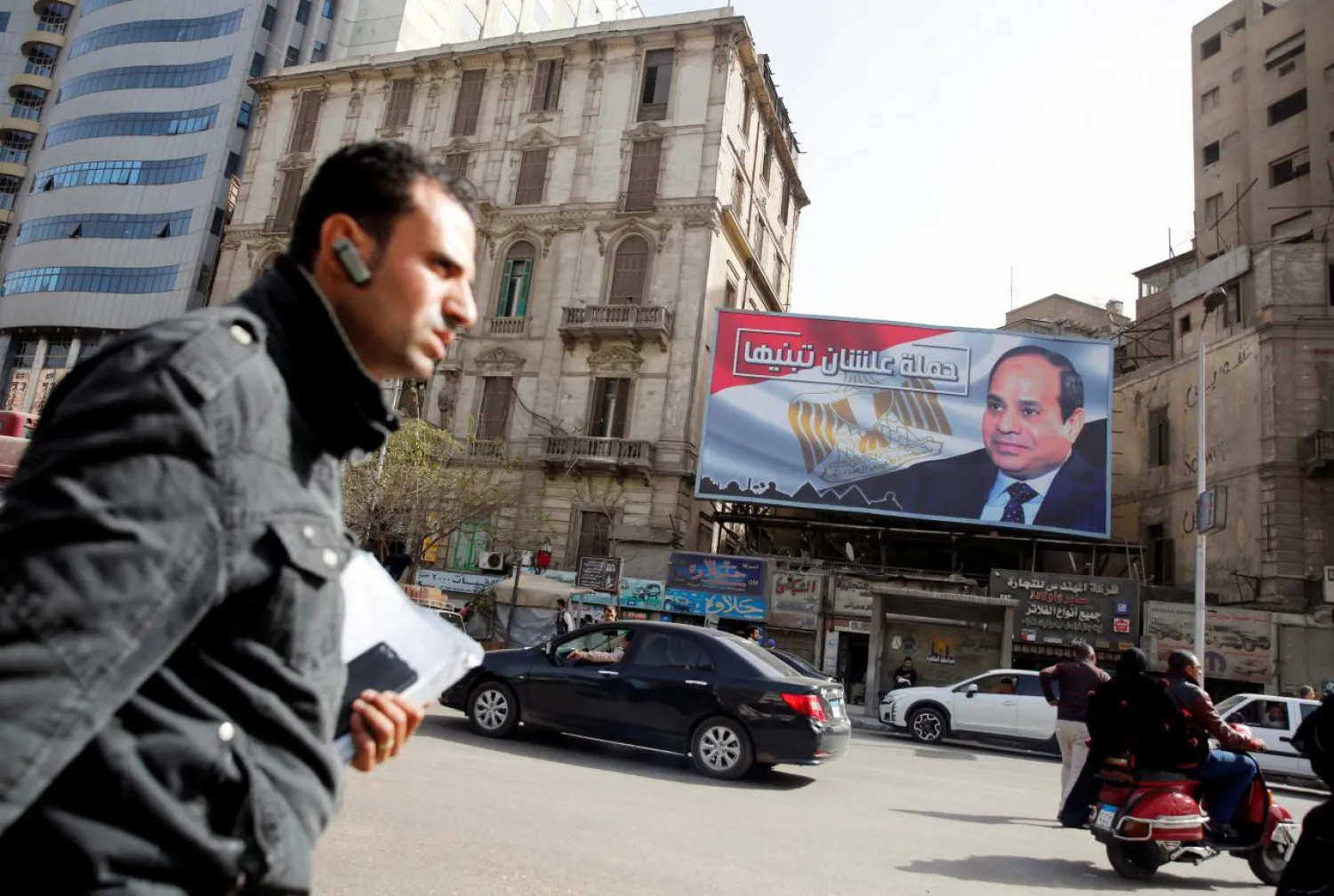
People walk by a poster of Egypt's President Abdel Fattah al-Sisi from the campaign titled “Alashan Tabneeha” (So You Can Build It) for the upcoming presidential election in Cairo, Egypt, January 22, 2018. Picture taken January 22, 2018. REUTERS/Amr Abdallah Dalsh
TT

Egypt: Politicians Call for Boycott of Presidential Elections

People walk by a poster of Egypt's President Abdel Fattah al-Sisi from the campaign titled “Alashan Tabneeha” (So You Can Build It) for the upcoming presidential election in Cairo, Egypt, January 22, 2018. Picture taken January 22, 2018. REUTERS/Amr Abdallah Dalsh

Egypt's National Electoral Authority announced on Tuesday the preliminary list of candidates for the presidential elections scheduled for the end of March, including current president Abdul Fattah el-Sisi and the head of Ghad Party Musa Mustafa Musa.

Meanwhile, seven political parties and a number of figures including the presidential candidate Hamdeen Sabahi called to boycott the presidential elections because of what he considered as "a lack of guarantees of competition."

In return, Sisi campaign denied that it was responsible for the lack of candidates and their withdrawal from the race.

During a press conference, Civilian Democratic Movement, a coalition of several movements and parties, announced they will not vote during the elections and called on voters to stay away from ballot boxes and on Egyptians not to recognize the vote's outcome.

The parties came up with the slogan “stay home” for the boycotting campaign.

Sabahi called on other pro-democracy groups to join the coalition: "Come and let us stand together. This is a moment when the people will make their say known and, God willing, the say of the people will prevail."

Seven parties participated in the announcement of the boycott: Reform and Development, Popular Alliance Party, al-Dastour Party, Justice Party, Egyptian Social Democratic Party, al-Karama Movement, and Freedom Egypt Party.

This is not the first call to boycott the presidential elections. Former presidential candidate Abdul Moneim Aboul-Fotouh, former MP Anwar Sadat, and team members of former presidential candidate Sami Anan: Hisham Geneina and Hazem Hosni called for canceling the elections that have lost all credibility.

In a joint statement, the signatories called for boycotting the elections expressing their concern of a possible change of the constitution by opening presidential terms and eliminating any opportunity for a peaceful rotation of power.

“We urge our glorious people to boycott the vote and not to recognize whatever result it would produce,” said the statement.

Legal adviser and spokesperson for the electoral campaign of Sisi, Mohammed Abu Shoka, said Monday that his candidate should not be asked about the lack of other candidates in the upcoming election.

Speaking at a press conference, Abu Shoka indicated that Sisi is not responsible for politicians’ "reluctance to engage in political life, the blame should be directed towards those who did not succeed [in meeting candidacy requirements]."

Abu Shoka indicated that Sisi’s campaign submitted 173,000 endorsement forms from citizens to the National Electoral Authority, although more than 900,000 forms were received by the campaign.

Several politicians had announced their intentions presidential election, but withdrew later, including: former prime minister of Egypt, Ahmed Shafiq, former MP Anwar Sadat, lawyer Khalid Ali, and head of Wafd Party al-Sayyid Badawi, whose party refused his candidacy and announced its support to Sisi.

In addition, Former Chief of Staff Sami Annan removed his name from the database of voters after he was accused by the "armed forces" of forging the required documents and "inciting against the Egyptian army with the aim of driving a wedge between the armed forces and the Egyptian people."

The Egyptian Trade Union Federation (ETUF) organised an indoor rally on Tuesday for its members to back Sisi in the upcoming presidential elections in March.

The NEA announced on Monday the end of the ten-day deadline set for receiving presidential election applications.

The Authority had received applications from Sisi and Mostafa Musa, the leader of al-Ghad Party, to run for the coming presidential elections due to be held in March.

The NEA said it will examine the papers presented from the would-be candidates ahead of announcing the candidacy list on Wednesday.

Spokesman of the Authority Advisor Mahmoud El-Sherif, announced that 48 local organizations, 9 international organizations, National Human Rights Council, National Council for Women and the National Council for Disability have all been approved to monitor the upcoming elections.

Spokesman for the Presidency Bassam Radhi stated that President Sisi held a meeting with the Prime Minister Sharif Ismail and a number of minister. During the meeting, the officials reviewed the government's efforts to provide basic food commodities in the markets with appropriate quantities and prices, and the procedures for monitoring the markets.

The spokesman added that the steps were taken to activate the National Academy for Training and Rehabilitation of Youth and activate its training programs aimed at achieving the human development requirements of the youth in all sectors and upgrading their abilities and skills to achieve comprehensive human, economic and social development.



Iran Mobilizes Remnants of Fourth Division to Stoke Syria Unrest

 Circulating images of Syria’s Fourth Division
Circulating images of Syria’s Fourth Division
TT

Iran Mobilizes Remnants of Fourth Division to Stoke Syria Unrest

 Circulating images of Syria’s Fourth Division
Circulating images of Syria’s Fourth Division

The Syria TV website said Iran has been working since early December to mobilize remnants of the Fourth Division, which was linked to Iran and previously overseen by Maher al-Assad, the brother of fugitive President Bashar al-Assad, to inflame the situation in Syria.

Citing regional security sources, the website reported that Iran is utilizing Ghiyath Dalla, the former commander of the Fourth Division, along with Maj. Gen. Kamal Hassan, a former head of military intelligence, and Maj. Gen. Ghassan Bilal, who previously served in the Fourth Division’s command.

According to the sources, Iran’s Islamic Revolutionary Guard Corps, which has over recent months kept dozens of officers from the Fourth Division and military intelligence in camps it controls along the Iraqi border, in Lebanon’s Hermel area, and in areas under the control of formations linked to the Kurdistan Workers Party in eastern Syria, is pushing for their return to Syrian territory and the mobilization of former Assad regime elements for a new wave of security operations.

The New York Times recently published a report based on interviews with participants in those moves and a review of correspondence between them, showing that the former leadership figures are determined to reassert their influence in Syria, which remains gripped by tensions more than 13 years after the outbreak of civil war.

The newspaper said it had received credible information that some former figures in the Assad regime are working to build an armed insurgent movement from exile.

One of them is backing a lobbying campaign in Washington, estimated to cost millions of dollars, in the hope of securing control over Syria’s coastal region, the stronghold of the Alawite sect to which Assad and many of his senior military and security commanders belong.

Returning to the information cited by Syria TV, Iran has several objectives in fueling tensions in Syria. Chief among them is easing US pressure on Iran in the Iraqi arena along the Iranian border, where the US envoy to Baghdad is pressing Iraqi factions to disband.

Escalation in Syria would serve as a distraction and diversion from those efforts.

The report said pressure is also expected to intensify on Lebanon’s Hezbollah to complete the process of disarming, with the possibility that it could face new military operations, alongside a potential new Israeli attack on Iran.

Mobilizing remnants of the Assad regime and extending their presence in Syria would give Tehran and Hezbollah greater room to maneuver, rather than remaining confined to a defensive posture.

They could also be used in intelligence operations to track future Israeli movements preemptively.


Somali President to Visit Türkiye After Israeli Recognition of Somaliland

 Somalia's President Hassan Sheikh Mohamud delivers a joint press conference with the German Chancellor after talks at the Chancellery in Berlin, on November 5, 2024. (AFP)
Somalia's President Hassan Sheikh Mohamud delivers a joint press conference with the German Chancellor after talks at the Chancellery in Berlin, on November 5, 2024. (AFP)
TT

Somali President to Visit Türkiye After Israeli Recognition of Somaliland

 Somalia's President Hassan Sheikh Mohamud delivers a joint press conference with the German Chancellor after talks at the Chancellery in Berlin, on November 5, 2024. (AFP)
Somalia's President Hassan Sheikh Mohamud delivers a joint press conference with the German Chancellor after talks at the Chancellery in Berlin, on November 5, 2024. (AFP)

Somalia's president is to visit Türkiye on Tuesday following Israel's recognition of the breakaway territory of Somaliland, Türkiye’s presidency said.

Somali President Hassan Sheikh Mohamud will hold talks "on the current situation in Somalia in the fight against terrorism, measures taken by the federal Somali government towards national unity and regional developments", Burhanettin Duran, head of the Turkish presidency's communications directorate, said on X.

Türkiye on Friday denounced Israel's recognition of Somaliland, a self-proclaimed republic, calling it "overt interference in Somalia's domestic affairs".

Somaliland declared independence in 1991.

The region has operated autonomously since then and possesses its own currency, army and police force.

It has generally experienced greater stability than Somalia, where Al-Shabaab militants periodically mount attacks in the capital Mogadishu.

Diplomatic isolation has been the norm -- until Israel's move to recognize it as a sovereign nation, which has been criticized by the African Union, Egypt, the six-nation Gulf Cooperation Council and the Saudi-based Organization of Islamic Cooperation.

The European Union has insisted Somalia's sovereignty should be respected.

The recognition is the latest move by Israel that has angered Türkiye, with relations souring between the two countries in recent years.

Ankara has strongly condemned Israel's offensive in the Gaza Strip, and Israel has opposed Türkiye’s participation in a future stabilization force in the Palestinian territory.


Iraq's Parliament Elects Al-Halbousi as Its New Speaker

 The new speaker of parliament Haibet Al-Halbousi, center, looks on before the start of their first legislative session in Baghdad, Iraq, Monday, Dec. 29, 2025. (AP Photo/Hadi Mizban)
The new speaker of parliament Haibet Al-Halbousi, center, looks on before the start of their first legislative session in Baghdad, Iraq, Monday, Dec. 29, 2025. (AP Photo/Hadi Mizban)
TT

Iraq's Parliament Elects Al-Halbousi as Its New Speaker

 The new speaker of parliament Haibet Al-Halbousi, center, looks on before the start of their first legislative session in Baghdad, Iraq, Monday, Dec. 29, 2025. (AP Photo/Hadi Mizban)
The new speaker of parliament Haibet Al-Halbousi, center, looks on before the start of their first legislative session in Baghdad, Iraq, Monday, Dec. 29, 2025. (AP Photo/Hadi Mizban)

Iraq's parliament on Monday elected a new speaker following overnight talks to break a political deadlock.

Haibet Al-Halbousi received 208 votes from the 309 legislators who attended, according to The AP news. He is a member of the Takadum, or Progress, party led by ousted speaker and relative Mohammed al-Halbousi. Twenty legislators did not attend the session.

Iraq held parliamentary elections in November but didn’t produce a bloc with a decisive majority. By convention, Iraq’s president is always Kurdish, while the more powerful prime minister is Shiite and the parliamentary speaker is Sunni.

The new speaker must address a much-debated bill that would have the Hashd al-Shaabi, or Popular Mobilization Units become a formal security institution under the state. Iran-backed armed groups have growing political influence.

Al-Halbousi also must tackle Iraq’s mounting public debt of tens of billions of dollars as well as widespread corruption.

Babel Governor Adnan Feyhan was elected first deputy speaker with 177 votes, a development that might concern Washington. Feyhan is a member of the Asaib Ahl al-Haq, or League of the Righteous, a US-sanctioned, Iran-backed group with an armed wing led by Qais al-Khazali, also sanctioned by Washington.