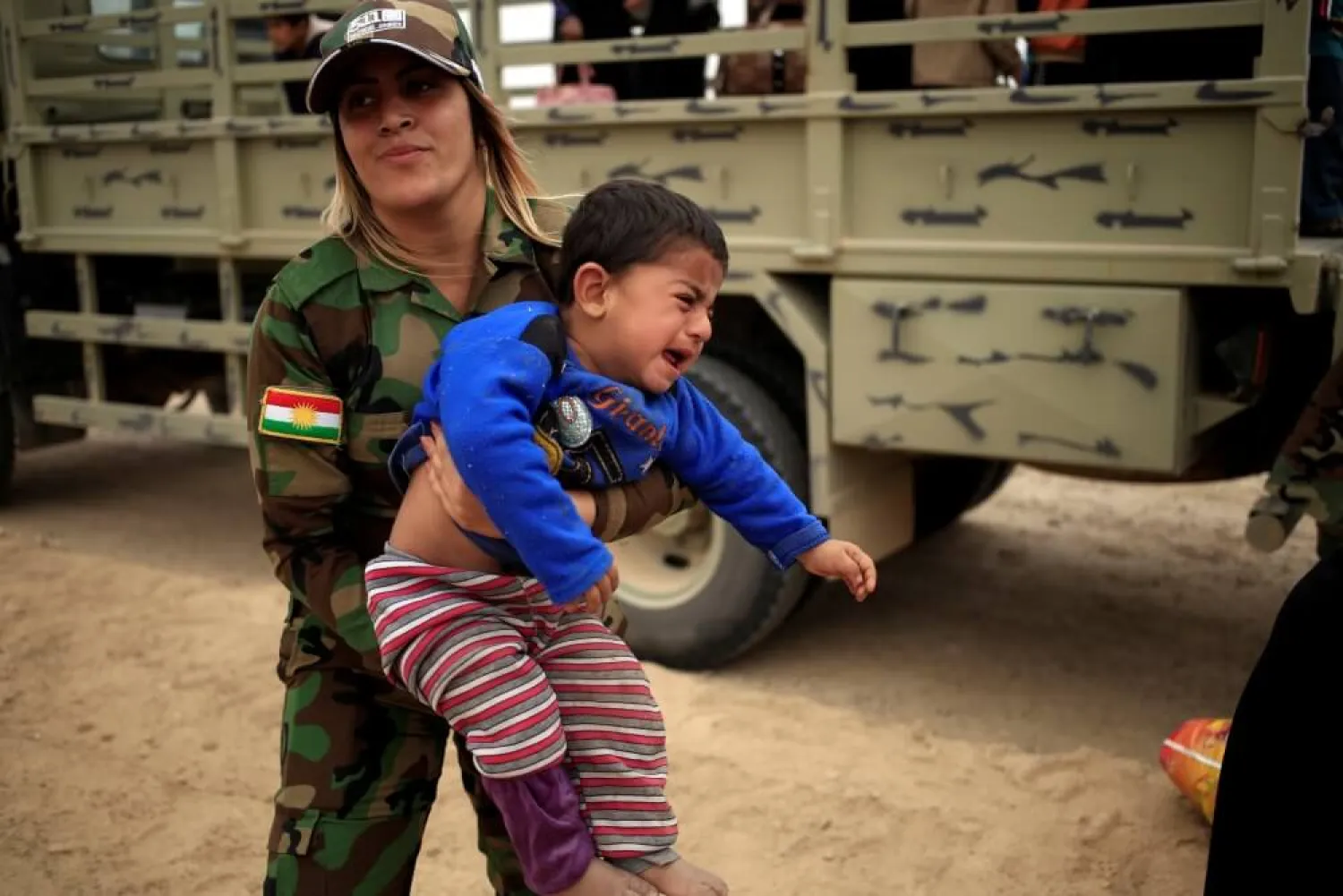
A Kurdish female Peshmerga soldier carries a newly internally displaced boy as he cries upon his arrival at Al Khazar camp near Hassan Sham, east of Mosul, October 25, 2016. (Photo: Reuters/Zohra Bensemra)
A Kurdish female Peshmerga soldier carries a newly internally displaced boy as he cries upon his arrival at Al Khazar camp near Hassan Sham, east of Mosul, October 25, 2016. (Photo: Reuters/Zohra Bensemra)
German Foreign Ministry efforts have succeeded in allowing a 14-month-old child to return to Germany from Iraq, accompanied by his grandfather.
The toddler is the son of German mother Zaibal. H, 30, and her second husband Denes. B who worked as a paramedic for ISIS.
He was born in Tal Afar and has lived with his parents in an Iraqi prison since the liberation of Mosul from ISIS. The mother joined the group twice in Syria and Iraq and was detained along with dozens of other women in a basement in Mosul. As for the father, he surrendered to the Peshmerga Forces during the Mosul siege.
The couple, who had joined ISIS in 2015, will soon appear before an Iraqi court on charges of membership with a terrorist group.
German security sources revealed that German investigators found in the mother’s mobile a video of her first husband who was killed in battles.
The government justified its intervention to secure the release of the child as part of its duty to defend German citizens. The German Foreign Ministry believes that the children should not be held responsible for their parents’ actions.
The child’s grandfather said the parents lived for years with ISIS as if they were in a prison.
He added that he paid the fees for the German Embassy in addition to a USD400 fine because according to Iraqi law, the child had entered the country illegally although he was born in Tal Afar.
The German government is preparing for the arrival of over 100 infants and children of people who left the country to fight for ISIS in Iraq and Syria.
Hans-Georg Maassen, head of the BfV agency, told Reuters earlier in the week that minors returning from war zones in the two countries could grow into a new generation of recruits in Germany for ISIS.
“We see that children who grew up with ISIS were brainwashed in the schools and the kindergartens" of the terrorist group, he said. “They were confronted early with the ISIS ideology ... learned to fight, and were in some cases forced to participate in the abuse of prisoners, or even the killing of prisoners.”
He said security officials believed such children could later carry out violent attacks in Germany.
Nearly 1,000 people are believed to have left Germany to join up with the militants.
WHO Chief Reports 5 Ebola Recoveries, New Treatment Center Opens in Eastern Congohttps://english.aawsat.com/world/5279034-who-chief-reports-5-ebola-recoveries-new-treatment-center-opens-eastern-congo
Director-General of the World Health Organisation (WHO) Tedros Adhanom Ghebreyesus has his temperature checked as he tours the Evangelical Medical Center (CEM), in Bunia, Ituri province, Democratic Republic of Congo, May 31, 2026. REUTERS/Gradel Muyisa Mumbere
WHO Chief Reports 5 Ebola Recoveries, New Treatment Center Opens in Eastern Congo
Director-General of the World Health Organisation (WHO) Tedros Adhanom Ghebreyesus has his temperature checked as he tours the Evangelical Medical Center (CEM), in Bunia, Ituri province, Democratic Republic of Congo, May 31, 2026. REUTERS/Gradel Muyisa Mumbere
Five patients have recovered from a rare type of Ebola virus, the head of the World Health Organization said Sunday during a visit to Bunia in eastern Congo, a city at the heart of an outbreak.
“Four people will be discharged today and there was one that was discharged the day before yesterday,” WHO Director-General Tedros Adhanom Ghebreyesus said during the opening of a new Ebola treatment center in Bunia, the capital of Ituri province.
“Of course, we’re still working on vaccines and treatments but that doesn’t mean that people cannot recover from Ebola,” he added.
The WHO said Friday a patient had recovered from the Bundibugyo virus, the current species of Ebola, which has no approved treatment or vaccine. It was the first documented recovery of a confirmed Bundibugyo patient during the current outbreak.
The health organization said authorities have reported 134 confirmed cases in Congo and neighboring Uganda, including 18 confirmed deaths as of May 29.
Recovered patients describe their experience Baraka Bulambulu, one of those who recovered, told The Associated Press on Sunday that community members feared contracting an unknown illness from them, keeping their distance while delivering food and medicine.
He said the uncertainty was overwhelming, as he and other patients believed they might die without knowing what disease they had, though testing eventually confirmed Ebola.
“Being able to come out of this alive is an immense source of happiness,” Bulambulu said. ”Many people who were in the same situation died.”
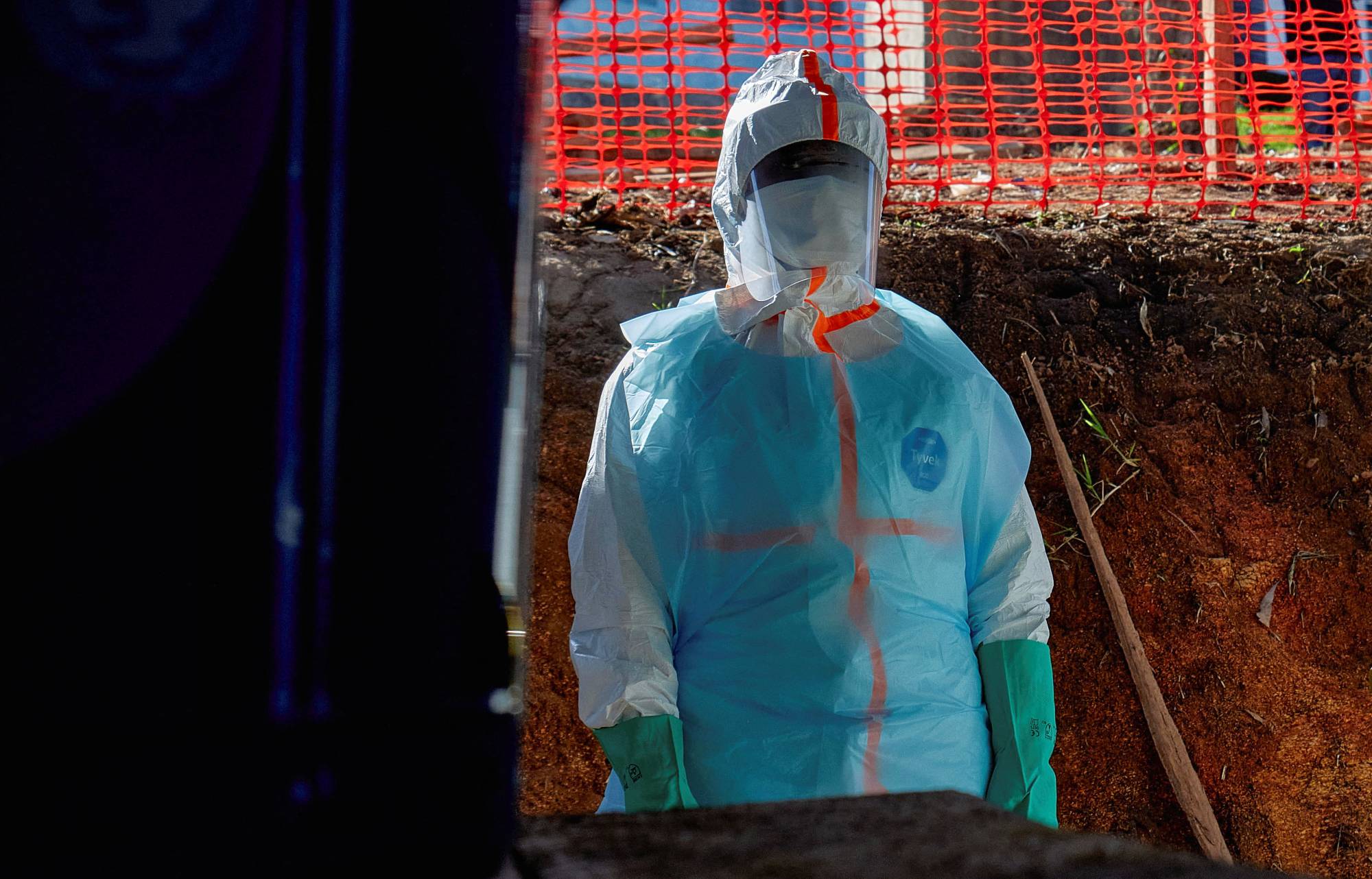
A health worker dresses up in personal protective equipment (PPE) at the Evangelical Medical Center, one of the facilities at the forefront of the response to the Ebola outbreak, as agencies intensify efforts to contain a new Ebola outbreak caused by the Bundibugyo virus strain, in Bunia, Ituri province, Democratic Republic of Congo, May 31, 2026. REUTERS/Gradel Muyisa Mumbere
Ezo Étienne, a nurse, said his symptoms began during ward rounds when he suddenly felt dizzy, then rapidly deteriorated into vomiting, intense itching, severe diarrhea and extreme weakness. He was tested seven times before Ebola was confirmed.
His treatment remained purely to treat the symptoms: medications to control vomiting, fluids to prevent dehydration and pain relievers. “That was all they could provide,” he said.
He urged the public and healthcare workers not to dismiss early symptoms such as vomiting and headaches, warning that misinformation leads many people to believe they have been poisoned rather than seeking hospital care.
Doctors Without Borders, or MSF, said Saturday the virus continues to spread faster than the response despite better-organized health facilities and new aid arrivals. It called for the immediate expansion of testing, faster deployment of aid workers and sustained access for medical supplies.
The dangers faced by health workers have been heightened by anger among residents over the stringent medical protocols for handling the victims’ bodies, which clash with local burial rites. Residents have launched at least three attacks against health centers.
Tedros stressed the importance of involving the community in the outbreak response during the opening of the new treatment center on Sunday.
“If you come to health facilities when you have symptoms, you can get the support and recover, so the key is to come forward as early as possible and to get the necessary support," the WHO chief said.
“We can stop this Ebola and anyone who has it can also recover. But the rule ... is this thing is everybody’s business and every citizen should be involved,” he added.
Attacks in the region by the Allied Democratic Forces, a rebel group allied with ISIS, and a coalition of ethnic militias have also hindered the response.
ADF fighters killed seven people Saturday in Beni, North Kivu province, an area also affected by the outbreak, the Congolese army and civil society groups said.
The illness also has been reported in both North Kivu and South Kivu, south of Ituri, where the Rwanda-backed M23 rebel group controls many key cities, including Goma and Bukavu.
“The final message we would like to share with the Ituri community is that there is hope,” Pierre Akilimali, incident manager at Congo's National Institute of Public Health, said during the inauguration on Sunday.
“With the symptomatic treatment that we are currently providing, we are seeing patients recover,” Akilimali added.
“We truly have hope. The virus here is not as complicated as those we have dealt with in the past, and with the support of all our partners, we believe we will be able to bring this outbreak under control as quickly as possible,” said Davin Ambitapio, another doctor at the treatment center.
Bus Crashes and Catches Fire in Western Türkiye, Killing 8 People, Including an Infanthttps://english.aawsat.com/world/5279000-bus-crashes-and-catches-fire-western-t%C3%BCrkiye-killing-8-people-including-infant
Bus Crashes and Catches Fire in Western Türkiye, Killing 8 People, Including an Infant
A Turkish flag is pictured on a boat in Istanbul, Türkiye, June 25, 2018. (Reuters)
A bus crashed and caught fire in western Türkiye early Sunday, leaving eight people dead, including a 9-month-old baby boy, local media reported.
The bus, owned by Pamukkale Tourism, crashed into highway barriers in Denizli province at 1:40 a.m. local time while carrying 38 passengers and three staff from Izmir to the Mediterranean city of Antalya, the Demiroren News Agency said, The AP news reported.
Some 33 people were injured in the incident. Among the dead were the 50-year-old driver and the father of the infant boy.
Images of the aftermath of the crash showed the burned out frame of the bus by the roadside.
Saturday was the final day of Eid al-Adha. The religious festival usually sees a spike in traffic accidents across Türkiye as people travel to visit family and take vacations.
Rescuers Say a Blast at a Building Storing Explosives in Myanmar Has Killed more than 45 Peoplehttps://english.aawsat.com/world/5278992-rescuers-say-blast-building-storing-explosives-myanmar-has-killed-more-45-people
Rescuers Say a Blast at a Building Storing Explosives in Myanmar Has Killed more than 45 People
Police stand guard as they wait for protests against coup in Yangon, Myanmar February 4, 2021. REUTERS/Stringer
A blast on Sunday at a building in northeastern Myanmar said to have been storing explosives for mining has killed more than 45 people, according to rescue workers and independent media reports.
About 70 other people were injured in the explosion that took place around noon in the village of Kaungtup, in Namhkam township.
The area, located about 3 kilometers (2 miles) south of the Chinese border, is under the control of the Ta’ang National Liberation Army, an ethnic armed group fighting Myanmar’s central government.
A rescue worker who rushed to the site of the blast told The Associated Press that 46 bodies, including six children, had been recovered by Sunday evening and taken for cremation.
The rescuer, who spoke on condition of anonymity for security reasons, said 74 wounded people had been transported to the township hospital and rescue operations were continuing.
Another rescuer in Namhkam, who also spoke on condition of anonymity, said about 40 people were killed and more than 100 houses near the blast site were damaged.
لم تشترك بعد
انشئ حساباً خاصاً بك لتحصل على أخبار مخصصة لك ولتتمتع بخاصية حفظ المقالات وتتلقى نشراتنا البريدية المتنوعة