


Why Italian Football Does Not Make Sense In The English Language

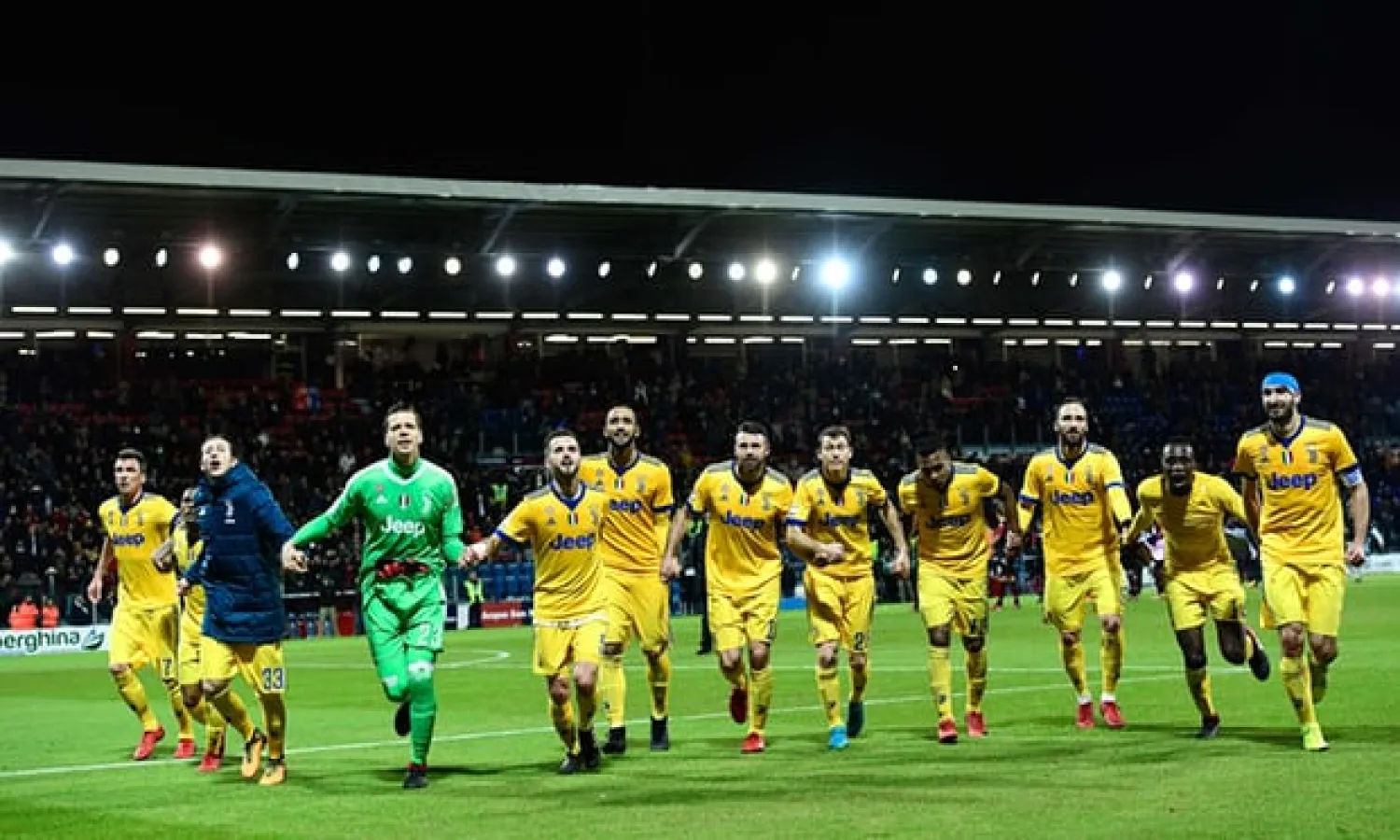
 Juventus players celebrate after beating Cagliari at the Sardegna Arena. Photograph: Miguel Medina/AFP/Getty Images
Juventus players celebrate after beating Cagliari at the Sardegna Arena. Photograph: Miguel Medina/AFP/Getty Images
TT

Why Italian Football Does Not Make Sense In The English Language

 Juventus players celebrate after beating Cagliari at the Sardegna Arena. Photograph: Miguel Medina/AFP/Getty Images
Juventus players celebrate after beating Cagliari at the Sardegna Arena. Photograph: Miguel Medina/AFP/Getty Images

As a football fan living in the US, I’m amazed at how many games are available on TV these days. On any Saturday or Sunday, I can choose from at least 10 games on my basic cable package. Football fans in the US tend to focus their attentions on the Premier League, which has as much to do with the crispness of its presentation as the action on the pitch. The periphery is perfect: the stadiums are beautiful, modernised and full, and the the fans are present and loud. But, more than anything, the games are so watchable because of the commentary.

NBC, who show all 380 Premier League matches live in the US, do not put out the exact same broadcast as the one shown in the UK, but they do employ commentators with British presenters, which lends everything immediacy and authenticity. This is what sets the Premier League apart from the rest of the big European leagues. When we watch games from Spain, Germany, France or Italy, we are watching something in translation.

I have followed Italian football intently for more than half of my life – especially during the three years I spent living there – but I increasingly find myself watching Serie A games without the sound as it almost feels like a contaminant. It’s not that the quality of the commentary in English is that bad – it is pretty bad, though – it’s more that the words used just don’t fit the game the way Italian commentary does. Rather than watching a Serie A game, I feel as if I’m listening to somebody else watching the game, with an added layer of detachment.

It’s not just that the observations are more astute and the passion is more intense, but the Italian language manages to mesh perfectly with the action it describes. Italians even have their own name for the game: calcio, literally “kick”, preferring not to Latinise the word “football” as the Spanish (fútbol), French (le foot) and Portuguese (futebol) all do. In my very first Italian class, a student asked the teacher why Italians do not just use a simple variation, like in Spain, and the teacher replied, without even the hint of a smile: “Because we are much better at soccer than the Spanish.”

Italian football is often criticised for being overly dramatic, with players spending too much time feigning injury, encircling the referee or dropping to the grass with their faces in their hands after they have missed opportunities. These criticisms carry weight but, given the language of the game in Italy, it is hard to see how the game could be any other way. An Italian match is more than just that; it is a performance in which the players are fighting not just to win but to win over the audience.

In Italian a player does not play a position (posizione), but rather their role (ruolo). Managers often speak in post-match interviews about how a player has “interpreted their role” or how the team has “interpreted the match” as a whole. The playmaker is called a regista, or “director”, while players who exchange passes are said to dialogare, literally “to dialogue”.

A goal is not scored, but rather “authored” (l’autore del gol). A player who is often at the centre of the action becomes the game’s protagonista, with the potential to risolvere la partita, or “resolve the match”. A particularly creative player may also be praised for his fantasia, while a true legend of the game, such as Roberto Baggio, is a maestro.

A team’s passing or possession may be referred to as its fraseggio, which means literally its “phrasing”, a term used to describe musical expression. A player’s individual move is a numero, his error or lapse in judgment is a pasticcio, or “pastiche”, while his shot on goal is a conclusione, which, should he miss, is considered fallita, or “failed”, the same word Italians use to describe bankruptcy.

A ball is not won from the opposing team, but conquistato, or “conquered”, and is not trapped but addomesticato, “domesticated”. A challenge from an opposing player is a contrasto, or “conflict”; a match-up is a duello; and a penalty-kick is a rigore, or “rigour”. All this drama plays out in front of the pubblico whose cori, or “choruses”, are as likely to be jeering the victorious team as celebrating them depending on the performance itself.

It’s hard to know whether the style of play adapted to suit the language of the stage or the lexicon was developed in response to the style of the action. Either way, this colourful commentary certainly lends Serie A matches gravitas. Suddenly the level of drama on the pitch makes sense. The highest praise a commentator can bestow upon a match is that of spettacolo, the word for both “spectacle” and a “play”. When an opposing coach lost to Napoli at the end of last year, he praised his opponents in wonder as una sinfonia, “a symphony”.

When looking to describe new trends in the game, Italian commentators often look abroad, incorporating many English terms such as pressing, tap-in, assist, cross, dribbling and stretching, which are appallingly pronounced and sometimes even carry a reimagined meaning. Dribbling, for instance, becomes a noun in Italian rather than a verb; so instead of a player beating an opponent with a dribble, he is said to have executed a “dribbling”. Similarly, an assist does not have to lead to a goal, just a goalscoring opportunity. Whether misunderstandings or not, these neologisms only add to the charm and idiosyncrasy of the calcio lexicon.

Serie A has other problems when presented on TV – including empty stands and outdated stadiums – but the language barrier is the biggest issue for me. Fans of the Bundesliga, Ligue 1 and La Liga probably have similar complaints and this may explain why English speakers flock to the Premier League. Having all these games on TV is amazing but, in the same way that the coffee from my Italian espresso maker never quite tastes as good at home, these football matches are lost in translation. Something is missing, so I watch and sip in silence.

The Guardian Sport


Late Guirassy Goal Seals Win as Dortmund Cuts Bayern’s Bundesliga Lead to 3 Points

07 February 2026, Lower Saxony, Wolfsburg: Borussia Dortmund's Serhou Guirassy celebrates scoring his side's second goal during the German Bundesliga soccer match between VfL Wolfsburg and Borussia Dortmund at Volkswagen Arena. (dpa)
TT

Late Guirassy Goal Seals Win as Dortmund Cuts Bayern’s Bundesliga Lead to 3 Points

07 February 2026, Lower Saxony, Wolfsburg: Borussia Dortmund's Serhou Guirassy celebrates scoring his side's second goal during the German Bundesliga soccer match between VfL Wolfsburg and Borussia Dortmund at Volkswagen Arena. (dpa)

Serhou Guirassy scored late for Borussia Dortmund to cut Bayern Munich’s Bundesliga lead to three points on Saturday with a 2-1 win at Wolfsburg.

Wolfsburg dominated the second half with Mohamed Amoura missing several good chances and Maximilian Arnold striking the crossbar.

Dortmund’s Maximilian Beier hit the underside of the bar with a deflected shot in the first half, when Julian Brandt opened the scoring with a header from Julian Ryerson’s corner in the 38th for the visitors.

Konstantinos Koulierakis replied in similar fashion after the break with a header from Arnold’s free kick, but Wolfsburg was to rue not taking its chances to score more.

Guirassy pounced for the winner in the 87th after good play between Fábio Silva and Felix Nmecha.

“That’s part of football,” Dortmund coach Niko Kovač said of his team’s scrappy win. “But then to decide it with one action is also a quality.”

Eighteen-year-old Italian defender Luca Reggiani went on late for Dortmund for his Bundesliga debut.

American winger Kevin Paredes made his first Wolfsburg start since April 25 after recovering from two operations on his right foot.

Bayern, which failed to win its last two games, can restore its six-point lead with a win over high-flying Hoffenheim on Sunday.

Borussia Mönchengladbach was hosting Bayer Leverkusen later.

Bremen loses on coach's debut

Werder Bremen’s coaching change did little to alter its fortunes as the team lost 1-0 in Freiburg on Daniel Thioune’s debut.

Jan-Niklas Beste let fly and found the top far corner in the 13th for Freiburg, which had Johan Manzambi sent off early in the second half for a foul on Bremen’s Olivier Deman.

Thioune’s team was unable to capitalize on the extra player and is now 11 league games without a win. Bremen faces a visit from Bayern next weekend.

Welcome win for St. Pauli

St. Pauli boosted its survival hopes with a hard-fought 2-1 win over Stuttgart.

The Hamburg-based team remained second-from-bottom, but it opened a four-point gap on bottom side Heidenheim, which lost 2-0 at home to Hamburger SV. Bremen's defeat means St. Pauli is just two points from the relegation playoff place.

Mainz keeps winning

Nadiem Amiri scored two penalties, one in each half, for Mainz to beat Augsburg 2-0 for its third straight win.

Amiri ripped off his distinctive carnival-inspired jersey as he celebrated the second one to seal the win. The thoughtful Lee Jae-sung picked it up so he could resume when the celebrations died down.

Mainz next visits Dortmund.


Man United Wins Again to Make It Four in a Row for New Coach Michael Carrick

Bruno Fernandes of Manchester United scores the 2-0 goal during the English Premier League match between Manchester United and Tottenham Hotspur, in Manchester, Britain, 07 February 2026. (EPA)
TT

Man United Wins Again to Make It Four in a Row for New Coach Michael Carrick

Bruno Fernandes of Manchester United scores the 2-0 goal during the English Premier League match between Manchester United and Tottenham Hotspur, in Manchester, Britain, 07 February 2026. (EPA)

It's four Premier League wins in a row for Manchester United under Michael Carrick and a season that was unraveling just weeks ago now looks full of promise.

A 2-0 victory against Tottenham on Saturday extended Carrick's 100% start as head coach and will further strengthen his case to be given the job on a long-term basis.

“Michael has won everything here and he knows what it means for these fans, what it means for the club to win and how much is needed to win in this football. I think that adds something special to the team,” United captain Bruno Fernandes told TNT Sports.

It was the first time in two years that United has won four straight league games and boosted its hopes of a return to the lucrative Champions League after missing out for the last two years.

Bryan Mbeumo and Fernandes scored in each half at Old Trafford in a game that saw Spurs reduced to 10 men after captain Cristian Romero was sent off in the 29th minute.

Carrick has transformed United's fortunes since he was parachuted in to replace the fired Ruben Amorim last month. Initially given a contract until the end of the season — having previously had a three-game interim spell in 2021 — his impressive impact will likely put him in serious contention to keep the job as the club's hierarchy consider its long-term plans.

“I think Michael came in with the right ideas of giving the players the responsibility, but some freedom to take the responsibility on the pitch, doing the decisions that were needed,” said Fernandes. “He's very good with the words.

“I think he still remembers what I told him the last time he was our manager for our last game. I was sure that Michael could be a great manager, and he’s just showing it.”

United is fourth and after moving up to 44 points, the 20-time English champion has already exceeded last season's total of 42 points for the entire campaign.

Fernandes’ goal, with a controlled finish off his shin in the 81st, was his 200th goal involvement since joining United in 2020.

It sealed victory after Mbeumo had given United the lead in the 38th when firing low from a corner to score his 10th goal of his debut season at the club.

While United's captain was inspirational, Tottenham's Romero did his team no favors with his sending off in the first half.

Having described as “disgraceful” the fact that Spurs were reduced to 11 fit players for the draw with Manchester City last weekend, Romero hardly helped his team’s cause with his red card for a dangerous tackle on Casemiro.

The league's stats partner Opta said it was Romero's sixth sending off since joining the club in 2021 — more than any other Premier League player in that time.


Protesters in Milan Denounce Impact of Games on Environment

 A protester sets off fireworks during a protest against the environmental, economic and social impact of the Milano-Cortina 2026 Winter Olympics, near the Olympic Village in Milan, Italy, February 7, 2026. (Reuters)
A protester sets off fireworks during a protest against the environmental, economic and social impact of the Milano-Cortina 2026 Winter Olympics, near the Olympic Village in Milan, Italy, February 7, 2026. (Reuters)
TT

Protesters in Milan Denounce Impact of Games on Environment

 A protester sets off fireworks during a protest against the environmental, economic and social impact of the Milano-Cortina 2026 Winter Olympics, near the Olympic Village in Milan, Italy, February 7, 2026. (Reuters)
A protester sets off fireworks during a protest against the environmental, economic and social impact of the Milano-Cortina 2026 Winter Olympics, near the Olympic Village in Milan, Italy, February 7, 2026. (Reuters)

Thousands of people took to the streets of Milan on Saturday in a protest over housing costs and environmental concerns on the first full day of the Milano Cortina Winter Olympics.

The march, organized by grassroots unions, housing-rights groups and social center community activists, is seeking to highlight what activists call an increasingly unsustainable city model marked by soaring rents and deepening inequality.

The Olympics cap a decade in which Milan has seen a property boom following the 2015 World Expo, with locals ‌squeezed by soaring ‌living costs as an Italian tax scheme for ‌wealthy ⁠new residents, ‌alongside Brexit, draws professionals to the financial capital.

Some groups also argue that the Olympics are a waste of public money and resources pointing to infrastructure projects they say have damaged the environment in mountain communities.

A banner stretched across the street read: "Let's take back the cities, let's free the mountains."

CARDBOARD TREES SYMBOLIZE DESTRUCTION

"I’m here because these Olympics are unsustainable — economically, socially, and environmentally," said 71-year-old Stefano Nutini, standing beneath a Communist ⁠Refoundation Party flag.

He argued that Olympic infrastructure had placed a heavy burden on mountain towns hosting events ‌in the first widely dispersed edition of the Winter ‍Games.

The International Olympic Committee (IOC) points out ‍that the Games are largely using existing facilities, making them more sustainable.

At ‍the head of the procession, about 50 people carried stylized cardboard trees to represent the larches they said were felled to build a new bobsleigh track in Cortina d'Ampezzo.

"Century-old trees, survivors of two wars...sacrificed for 90 seconds of competition on a bobsleigh track costing 124 million (euros)," read another banner.

MARCH TAKES PLACE UNDER TIGHT SECURITY

According to police estimates, more than 5,000 people were taking part in the ⁠march.

Protesters set off from the Medaglie d'Oro central square to cover nearly four kilometers (2.5 miles) to end in Milan's south-eastern quadrant of Corvetto, a historically working-class district.

A rally last weekend by the hard-left in the city of Turin turned violent, with more than 100 police officers injured and nearly 30 protesters arrested, according to an interior ministry tally.

Saturday's protest follows a series of actions in the run-up to the Games, including rallies on the eve of the opening ceremony that denounced the presence in Italy of US ICE agents and what activists describe as the social and economic burdens of the Olympic project.

The march is taking place under tight security ‌as Milan hosts world leaders, athletes and thousands of visitors for the global sport event, including US Vice President JD Vance.
