


Poland Celebrates History of Fluorescent Ads in Neon Museum

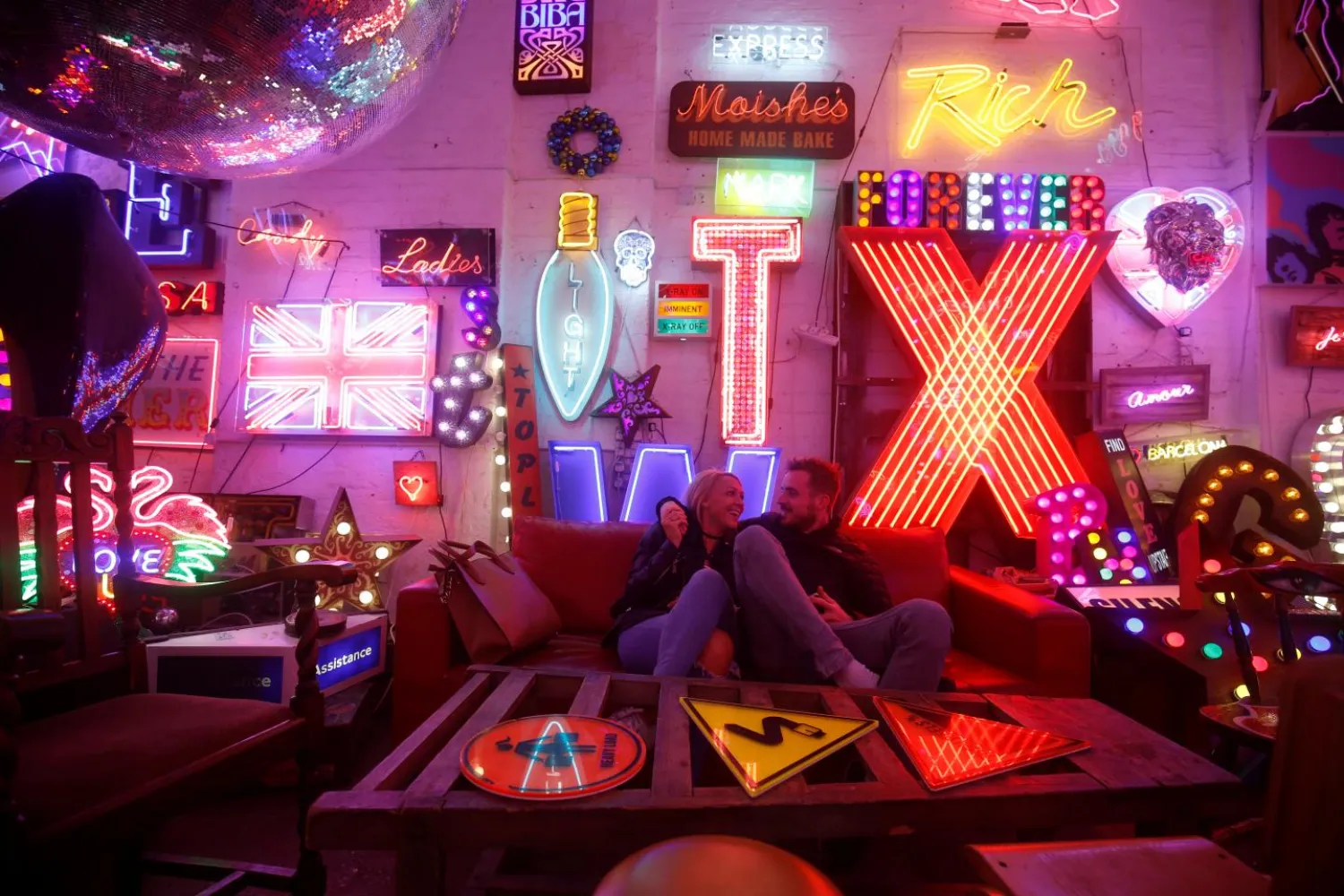
A couple laugh as they cuddle on a sofa looking at the neon signs and artworks in God's Own Junkyard gallery and cafe in London. REUTERS/RUSSELL BOYCE
TT

Poland Celebrates History of Fluorescent Ads in Neon Museum

A couple laugh as they cuddle on a sofa looking at the neon signs and artworks in God's Own Junkyard gallery and cafe in London. REUTERS/RUSSELL BOYCE

Ilona Karwinska found the communist-era neon advertising board in a Warsaw shop that used to sell Western clothing.

The sign, with its curling tubes full of bright red gas, was the first of hundreds she has salvaged. It now hangs between other ads from the 1950s to 1970s in Europe’s only neon museum, opened in 2005 and located in the capital’s Praga district, reported the German News Agency.

At the beginning, Karwinska used her balcony to store the bulky signs from train stations, restaurants and businesses, replete with artful scripts and even animal motifs, says her colleague Izabela Michalska.

Today, the museum in the Soho Factory, a former industrial site that now serves as a giant workshop for the city's creatives, is bursting at the seams.

Attracting some 400 visitors a day, the museum still has 200 signs in storage. About 50 prime examples glow on the old factory's dark walls. The favorite piece among visitors is a neon incarnation of the Warsaw coat of arms, which was used in the middle of the 14th century. While visually enticing, the exhibits also offer a fascinating snapshot of Polish history. Illuminated advertising came into fashion after the 1953 death of Soviet dictator Joseph Stalin. Poland's next communist government was less repressive and chose to take on the West at its own game: With hefty state funding channeled to artists and manufacturers, Western neon advertising was co-opted to beautify dark communist buildings.

Michalska says: “It was supposed to be better than capitalist advertising in the West. This was intended to produce works of art.”

Hundreds of neon advertisements lit up Warsaw's main streets, (Aleje Jerozolimskie and Ulica Pulawska). Some originals, like the sign of an instrument shop, still shine there today.

Other Polish cities also boasted their own distinctive neon culture. Katowice in southern Poland was a riot of color, earning the nickname "little Vegas." Even small villages had their own neon ads, so far did the fad grow. Neon was popular in other Soviet Bloc countries too, but it peaked in Poland, reaching staggering production volumes.

Michalska notes: “About 380 million kilometers of fluorescent tubes were made from 1950 to 1960. About the distance from the earth to the moon.”

An interesting subplot of the story behind Poland's neon romance is that the medium was actively promoted by the state, offering more artistic freedom than even literature, which was strictly censored. To illustrate the point, Michalska points to a Warsaw restaurant sign that used to stand near the US Embassy. The inscription "ambassador" is in the style of a western saloon and would have been banned in other Soviet Bloc states, she notes.

The neon boom fell into decline after the 1970s. Damaged signs were thrown in the trash, while others simply consumed too much electricity for their owners to keep them.

In Poland, the medium was also eventually replaced by advertising from the West after the fall of the Iron Curtain in 1989.

Today, the neon ad is a testimony to Polish art, say the museum staff, who run a flourishing nationwide rescue service for endangered illuminated signs.

Using the museum's takings and some external funding, the Warsaw neon sign devotees can restore almost any old signs to life, but at a cost of thousands of euros each. In Katowice and Wroclaw, there are also some private initiatives to save old neon tube ads.

Only the Warsaw museum completely reconstructs broken signs. In doing so, it must often refer to the old design sketches kept at the Warsaw Museum of Modern Art.

In an ironic twist in the neon sign story, the industry is in fact growing again. Demand for old Polish designs is rising, especially among local firms looking to tap the retro market, and tourists seeking unique souvenirs with stylish lettering and motifs of the past.




US Astronaut to Take her 3-year-old's Cuddly Rabbit Into Space

FILE PHOTO: An evening launch of a SpaceX Falcon 9 rocket carrying 20 Starlink V2 Mini satellites, from Space Launch Complex at Vandenberg Space Force Base is seen over the Pacific Ocean from Encinitas, California, US, June 23, 2024. REUTERS/Mike Blake/File Photo
TT

US Astronaut to Take her 3-year-old's Cuddly Rabbit Into Space

FILE PHOTO: An evening launch of a SpaceX Falcon 9 rocket carrying 20 Starlink V2 Mini satellites, from Space Launch Complex at Vandenberg Space Force Base is seen over the Pacific Ocean from Encinitas, California, US, June 23, 2024. REUTERS/Mike Blake/File Photo

When the next mission to the International Space Station blasts off from Florida next week, a special keepsake will be hitching a ride: a small stuffed rabbit.

American astronaut and mother, Jessica Meir, one of the four-member crew, revealed Sunday that she'll take with her the cuddly toy that belongs to her three-year-old daughter.

It's customary for astronauts to go to the ISS, which orbits 250 miles (400 kilometers) above Earth, to take small personal items to keep close during their months-long stint in space.

"I do have a small stuffed rabbit that belongs to my three-year-old daughter, and she actually has two of these because one was given as a gift," Meir, 48, told an online news conference.

"So one will stay down here with her, and one will be there with us, having adventures all the time, so that we'll keep sending those photos back and forth to my family," AFP quoted her as saying.

US space agency NASA says SpaceX Crew-12 will lift off on a SpaceX Falcon 9 rocket from Cape Canaveral in Florida to the orbiting scientific laboratory early Wednesday.

The mission will be replacing Crew-11, which returned to Earth in January, a month earlier than planned, during the first medical evacuation in the space station's history.

Meir, a marine biologist and physiologist, served as flight engineer on a 2019-2020 expedition to the space station and participated in the first all-female spacewalks.

Since then, she's given birth to her daughter. She reflected Sunday on the challenges of being a parent and what is due to be an eight-month separation from her child.

"It does make it a lot difficult in preparing to leave and thinking about being away from her for that long, especially when she's so young, it's really a large chunk of her life," Meir said.

"But I hope that one day, she will really realize that this absence was a meaningful one, because it was an adventure that she got to share into and that she'll have memories about, and hopefully it will inspire her and other people around the world," Meir added.

When the astronauts finally get on board the ISS, they will be one of the last crews to live on board the football field-sized space station.

Continuously inhabited for the last quarter century, the aging ISS is scheduled to be pushed into Earth's orbit before crashing into an isolated spot in the Pacific Ocean in 2030.

The other Crew-12 astronauts are Jack Hathaway of NASA, European Space Agency astronaut Sophie Adenot, and Russian cosmonaut Andrey Fedyaev.


iRead Marathon Records over 6.5 Million Pages Read

Participants agreed that the number of pages read was not merely a numerical milestone - SPA
TT

iRead Marathon Records over 6.5 Million Pages Read

Participants agreed that the number of pages read was not merely a numerical milestone - SPA

The fifth edition of the iRead Marathon achieved a remarkable milestone, surpassing 6.5 million pages read over three consecutive days, in a cultural setting that reaffirmed reading as a collective practice with impact beyond the moment.

Hosted at the Library of the King Abdulaziz Center for World Culture (Ithra) and held in parallel with 52 libraries across 13 Arab countries, including digital libraries participating for the first time, the marathon reflected the transformation of libraries into open, inclusive spaces that transcend physical boundaries and accommodate diverse readers and formats.

Participants agreed that the number of pages read was not merely a numerical milestone, but a reflection of growing engagement and a deepening belief in reading as a daily, shared activity accessible to all, free from elitism or narrow specialization.

Pages were read in multiple languages and formats, united by a common conviction that reading remains a powerful way to build genuine connections and foster knowledge-based bonds across geographically distant yet intellectually aligned communities, SPA reported.

The marathon also underscored its humanitarian and environmental dimension, as every 100 pages read is linked to the planting of one tree, translating this edition’s outcome into a pledge of more than 65,000 trees. This simple equation connects knowledge with sustainability, turning reading into a tangible, real-world contribution.

The involvement of digital libraries marked a notable development, expanding access, strengthening engagement, and reinforcing the library’s ability to adapt to technological change without compromising its cultural role. Integrating print and digital reading added a contemporary dimension to the marathon while preserving its core spirit of gathering around the book.

With the conclusion of the iRead Marathon, the experience proved to be more than a temporary event, becoming a cultural moment that raised fundamental questions about reading’s role in shaping awareness and the capacity of cultural initiatives to create lasting impact. Three days confirmed that reading, when practiced collectively, can serve as a meeting point and the start of a longer cultural journey.


Imam Turki bin Abdullah Royal Reserve Launches Fifth Beekeeping Season

Jazan’s Annual Honey Festival - File Photo/SPA
TT

Imam Turki bin Abdullah Royal Reserve Launches Fifth Beekeeping Season

Jazan’s Annual Honey Festival - File Photo/SPA

The Imam Turki bin Abdullah Royal Nature Reserve Development Authority launched the fifth annual beekeeping season for 2026 as part of its programs to empower the local community and regulate beekeeping activities within the reserve.

The launch aligns with the authority's objectives of biodiversity conservation, the promotion of sustainable environmental practices, and the generation of economic returns for beekeepers, SPA reported.

The authority explained that this year’s beekeeping season comprises three main periods associated with spring flowers, acacia, and Sidr, with the start date of each period serving as the official deadline for submitting participation applications.

The authority encouraged all interested beekeepers to review the season details and attend the scheduled virtual meetings to ensure organized participation in accordance with the approved regulations and the specified dates for each season.