


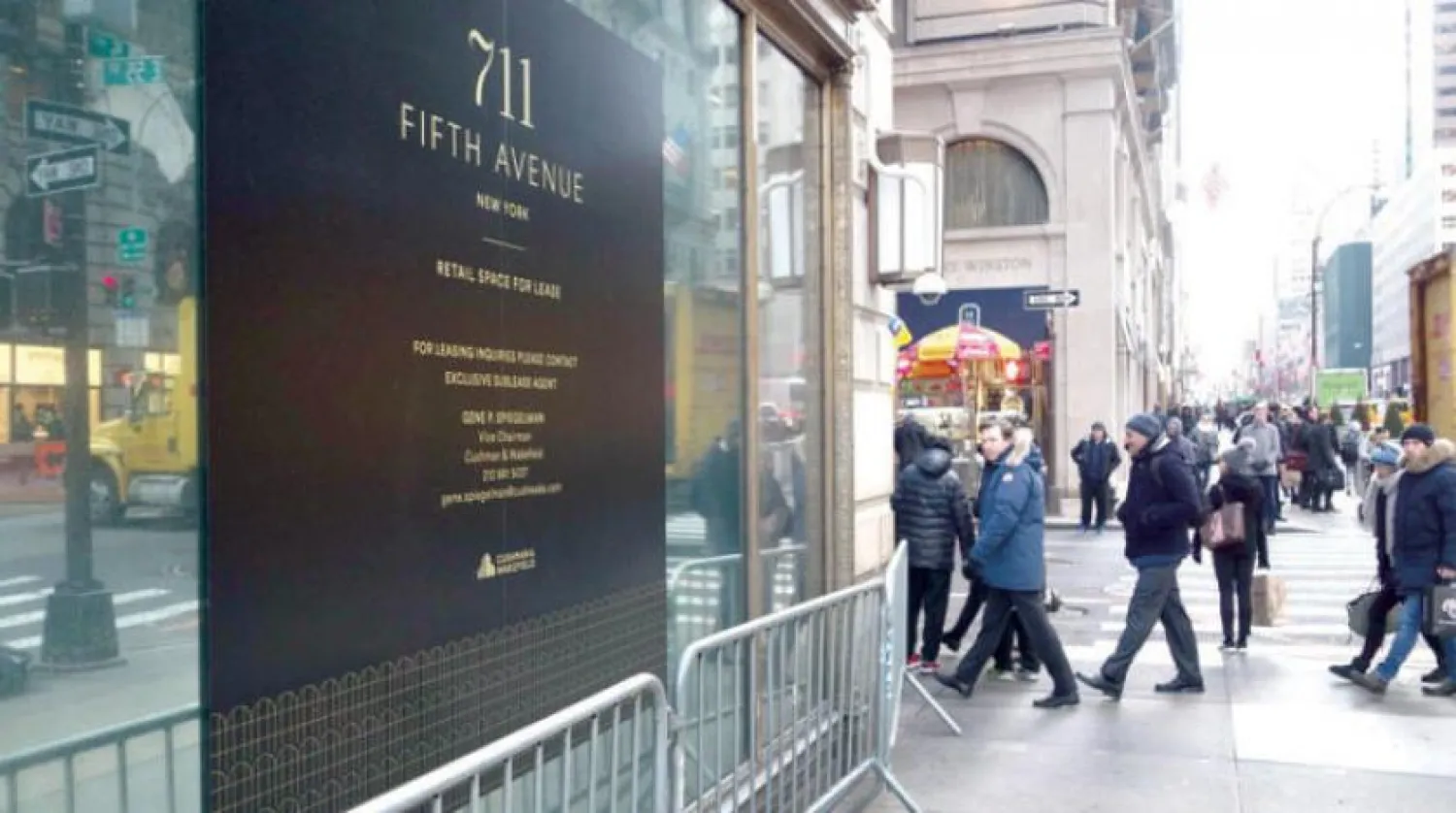

The New York borough of Manhattan is richer and more populated than ever, but a growing number of businesses are closing their doors under the pressure of exorbitant rents and online commerce. In a phenomenon welcomed by some, while considered by others as an indicator of a real crisis.
On Valentine's day, Steven Telvi closed down his Upper East Side drugstore, The Source, after nearly 37 years, due to slower business and high rent, Telvi said.
From Soho to the Upper West Side, passing Fifth Avenue or the Meatpacking District, it is no longer rare to see two or three deserted storefronts on the same block in New York, according to a report by AFP.
Nearly all the economic indicators of America's largest city look positive: historically low unemployment; per capita income 34 percent above the national average; more than 61 million tourists last year.
Business people and property agents interviewed by AFP all cite skyrocketing rents as the primary cause of the business closures.
Rents rose 68 percent between 2009 and 2016 in Soho, 70 percent in parts of the Upper West Side, and 175 percent in places on Fifth Avenue, according to the Real Estate Board of New York (REBNY).
"This is a classic example of pricing outstripping demand and fundamentals in a market," said Brian Klimas, REBNY's vice president in charge of research.
Prices have finally started to fall over the past few months in numerous parts of Manhattan.
But the proportion of vacant businesses is still rising, to nearly a quarter of spaces in Soho at the end of 2017, according to property firm Cushman & Wakefield.
"Landlords have been slow to change the price point of their retail offering," said Kenneth Hochhauser, executive vice president of Winick Realty Group.
For the shopkeepers who remain, sometimes in tenuous financial circumstances, "it's not helping" to see neighbors disappear, says Clara, a salesperson at ready-to-wear clothes retailer Variazioni on the Upper West Side.
There's no (foot) traffic" because there aren't enough businesses, said Jennifer Sun, who opened the Magical Kids store for children's clothing on the Upper East Side in May 2016.
After an "OK" first year, Sun says many surrounding stores have closed "over the last five or six months" -- and activity slowed.
"I don't even have a salary," she said.
Steven Soutendijk, executive director of retail sales at Cushman & Wakefield, said, "it's going to take some time" before the market adjusts.
He talks of "two or three years before it really swings back," but isn't worried, according to AFP.
"In the financial crisis, you had all activity dry up entirely for a period of four or five months," he said, referring to the global economic collapse that struck in 2008 and peaked the following year.
"It does not feel as negative as 2009. Not even close."
But at that time, online commerce represented only 3.6 percent of retail sales, against 9.1 percent today, according to the latest government figures. Since then, his activity has dropped five percent annually.
The opening of new subway stations on Second Avenue at the end of 2016 reduced the foot traffic past his store a little more, cutting by a quarter his turnover and pushing him towards the exit.
Some New York City Council members say authorities have to act.
At the end of November, Mayor Bill de Blasio made an initial move, doubling the threshold for which retailers are exempt from municipal tax.
The shopkeepers are fighting with their own weapons.


