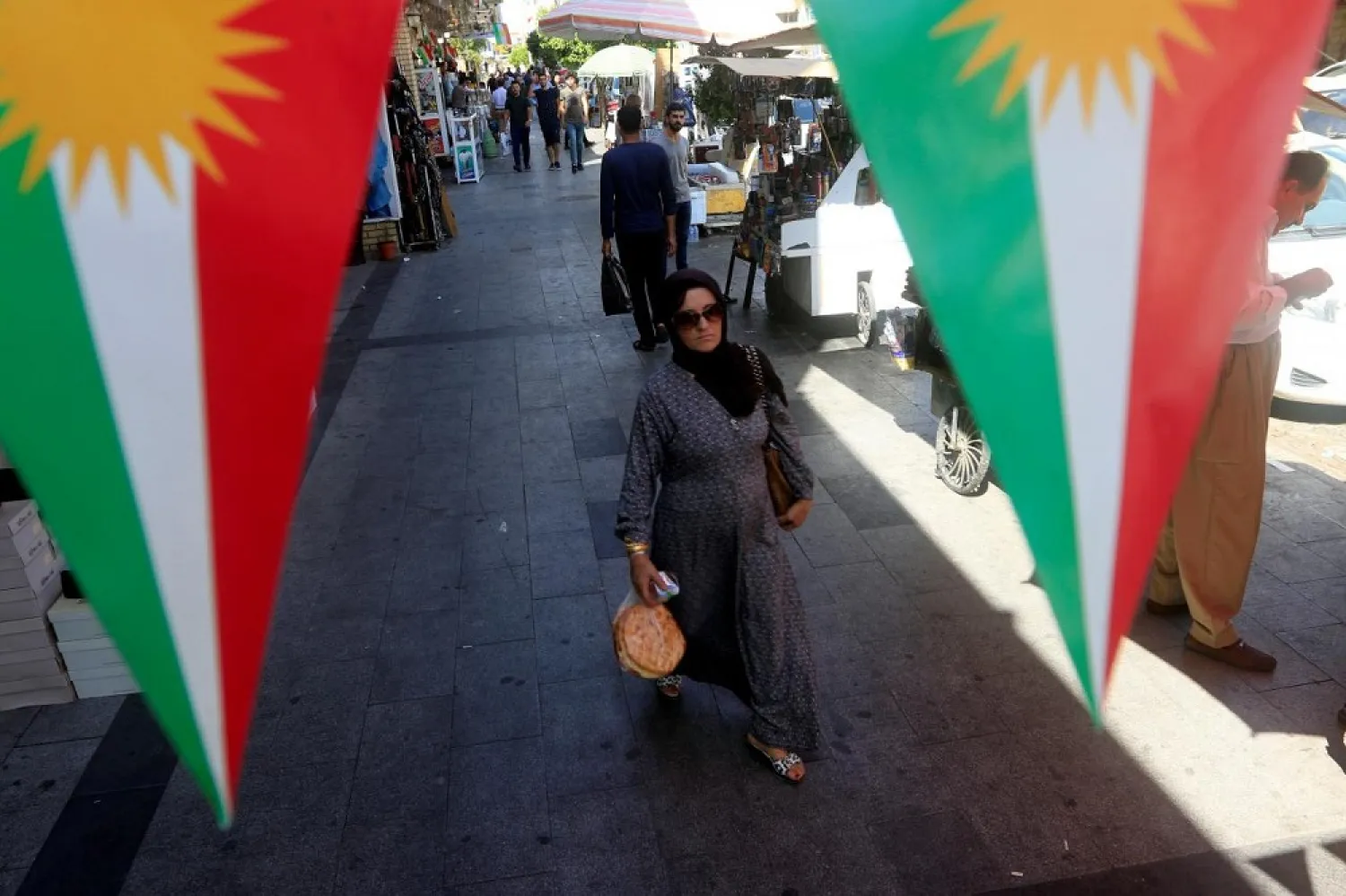

Baghdad Holds Solution to Ending Economic Paralysis in Iraqi Kurdistan

The economy in Iraqi Kurdistan has suffered due to ongoing political disputes with Baghdad. (Reuters)
TT

Baghdad Holds Solution to Ending Economic Paralysis in Iraqi Kurdistan

The economy in Iraqi Kurdistan has suffered due to ongoing political disputes with Baghdad. (Reuters)

The Iraqi Kurdistan region witnessed during the past decade remarkable economic development in wake of the 2003 collapse of the former regime in Baghdad.

That period witnessed a period of prosperous trade with Iraq to reach tens of billions of dollars annually. The real estate sector in the region’s three provinces, most notably Irbil, witnessed a sharp rise in real estate prices, even exceeding those in the world’s most famous capitals.

Experts said that the economic boon could be attributed to the dozens of foreign and Arab investments that were attracted to the Kurdish market. They benefited from facilitations provided by the regional government, which included tax exemptions and property ownership rights.

This positive investment atmosphere helped boost the economy at the time and improve living conditions in the region by creating thousands of job opportunities, reviving the private sector and attracting foreign capital.

This consequently led private sector companies to limit their dependence on foreign labor.

This general revival in Iraqi Kurdistan however was followed with a gradual decline with mounting political disputes with Baghdad starting mid 2013.

This culminated with the Iraqi federal government’s decision in 2014 to completely cut Kurdistan’s share of the annual budget, said the regional government.

This was followed with Kurdistan’s war against the ISIS terrorist organization and the flow of refugees from Iraq and Syria that topped 2 million. This dealt a strong blow to the already fragile economy in the region.

This forced dozens of investment companies to quit the region within only two years. Hundreds of local firms also filed for bankruptcy amid a sharp rise in foreign debt that reached nearly 22 billion dollars, said parliamentary and semi-official sources from the region.

This was all coupled with the local government’s inability to pay pubic employee salaries, which it was forced to cut back by 75 percent since 2015. This weakened the individual’s purchasing power, especially since several citizens ran out of their savings.

As the economic crisis enters its fifth year, economy professor at the Catholic University in Irbil Dr. Salahaddin Kako told Asharq Al-Awsat that the primary cause for this poor situation is the government’s inability, for more than three years, to pay employee salaries.

In addition, he said that the purchasing power is determined by the level of a person’s income and the prices of goods in the market. The purchasing power will naturally decrease with the drop in salaries. He noted however that the prices of goods have remained stable and at times even dropped.

Kako explained that Kurdistan’s economy could be revived if the Iraqi federal government agreed to dispense public employee salaries, which will in turn improve living conditions.

Foreign debt, he said, can be paid through various means, such as proposing attractive investment opportunities.

An oil sector employee said that prior to the economic crisis in Kurdistan, he used to earn $1,200 a month, which allowed him and the five members of his family to live comfortably.

When the company he was working for decided to quit Kurdistan, he was left with a monthly salary of barely $200.

“I was no longer able to buy a kilogram of meat per month,” he lamented.

Many locals believe that key to ending the crisis lies in Baghdad’s hands and in resolving its pending disputes with Irbil.
Guantanamo Detention Camp: The 'Exception' that Became the Rule

General view of Camp X-Ray, where security was tight (AFP)
TT

Guantanamo Detention Camp: The 'Exception' that Became the Rule

General view of Camp X-Ray, where security was tight (AFP)

On the 25th anniversary of the September 11 attacks, the Guantanamo detention camp appears less like a prison that remained open by mistake and more like an entrenched institution that has learned how to withstand the passage of time.

The detention camp, which opened at the US naval base at Guantanamo Bay in January 2002, was supposed to be a temporary solution to an exceptional situation: detaining captured fighters in the “war on terror” far from the US mainland and, according to the logic of the US administration at the time, outside the legal rules governing conventional prisons or prisoners of war.

But the temporary became prolonged.

After a quarter century, the question is no longer simply: Why was Guantanamo never closed? It is also: What happened to the idea that gave rise to it? And how could a legal and political exception, born in a moment of “collective trauma” following the September 11 terrorist attacks, become an institution capable of enduring and continuing even after administrations in the White House changed, wars on the ground shifted, the nature of the threats evolved, and the names of those behind them changed?

After the attacks, the United States entered a new war that it called the “war on terror.” Within the framework of that war, a broad system of detention outside the ordinary legal framework emerged, relying on secrecy and indefinite detention, as well as an attempt to separate the military “war” from the legislative framework that would normally govern it.

Guantanamo became the clearest example of a contradiction that gradually came to light. While several secret detention sites operated by the Central Intelligence Agency emerged in multiple countries, relying on coercive and inhumane interrogation programs that later became part of one of the most controversial chapters of America’s war on terror, Guantanamo remained different. It had an additional advantage.

It was a living place. It grew, evolved and expanded across a larger geographic area over the years, from the moment it opened in early January 2002 to the present. As it adapted to successive US administrations, Republican and Democratic alike, and developed its methods and practices, it never strayed an inch from the idea on which it was founded and from the vast sphere of political power that underpinned it: that under exceptional circumstances, the US government could create an exceptional space; that a detainee could be an “enemy combatant” without being a prisoner of war in the traditional sense and without being charged before a criminal court; and that a war could last long enough for detention itself to have no defined end. That remains the reality for some Guantanamo prisoners today, nearly a quarter century later.

Guantanamo as an Archive

Perhaps in the first days after September 11, the logic of the exception was easy to understand. America was still reeling from the attacks, and the US administration viewed Al Qaeda as a threat that transcended the boundaries of states and conventional armies.

But the dilemma lies in the exception itself, not merely in the moment when it was created. The problem is its ability to survive after the moment that gave rise to it has passed.

This is where the entire story of Guantanamo lies.

The men initially sent there were considered part of the new war and its new tools. But over the years, it became clear that many of the detainees were not senior Al Qaeda leaders, and that some had been sent there on the basis of false information, marginal connections or financial rewards, only to find themselves trapped in a system that was difficult to escape.

Over the years, roughly 800 men passed through the detention camp. Only a small number remain today. At the beginning of 2025, the official number was 15 detainees, including some awaiting transfer to other countries, others facing proceedings before military commissions, and three who remained in detention without criminal charges or approval for their transfer.

But the decline in numbers did not mean the end of the problem.

On the contrary, the fewer detainees there were, the less Guantanamo resembled a mass prison detached from the broader context and the more it came to resemble a living archive of the war on terror: unresolved legal cases, confessions obtained under coercive conditions, military trials delayed for years, and people with whom the US government still struggles to determine how to deal and how to bring their detention to an end.

A Valuable Catch in a Dark Hole

It may be unfair to reduce the story of a detention camp as significant as Guantanamo to a single individual. But Khalid Sheikh Mohammed is a stark example of the enormous contradictions surrounding this case.

The man accused of being the mastermind of the September 11 attacks did not arrive at Guantanamo immediately. Years of pursuit and secret detention preceded it, including detention by the Central Intelligence Agency and harsh interrogations, before he was transferred to Guantanamo in 2006 along with a number of “high-value detainees,” as they were known at the time, who had been held at the previously mentioned secret sites known as the “black sites.”

Here, the man’s story intersects with the story of the place: Where does war end and justice begin? And can a case involving a crime on the scale of September 11 be built on evidence that was, in part, developed within a secret system that used torture and coercion?

More than two decades after the attacks, the case is still searching for its conclusion. Finally, in August, a military judge set a tentative date of June 5, 2028, for the trial of Khalid Sheikh Mohammed and three other defendants before a military commission at Guantanamo, following years of legal setbacks.

But then came the surprise. After the rules governing the trials changed, prosecutors decided to proceed with the case without using a key confession made by Khalid Sheikh Mohammed in 2007, in which he admitted responsibility for the attacks, after it was deemed involuntary and obtained through coercion.

Ironically, prosecutors did not appeal the decision, fearing that it would delay the trial even further.

The detention camp had thus become part of the very problem it was supposed to solve. After having condemned hundreds of innocent people, it may now end up acquitting a guilty man.

Washington now faces an even greater dilemma. On the one hand, it wants to put those responsible for the largest terrorist attack ever carried out on US soil on trial and close this chapter. On the other, it is forced to confront the predicament of its own making: What happens to evidence when the process that produced it is itself subject to legal challenge?

For this reason, the Khalid Sheikh Mohammed case is no longer simply the case of a man accused of terrorism. It is also the case of a state that sought to deliver justice without paying its full legal price.

Khalid Sheikh Mohammed, the “mastermind” of the September 11 attacks, shortly after the CIA captured him in Pakistan in 2003 (AP)

A Countdown... to No End

In 2009, when the newly elected Obama administration announced its intention to close the detention camp, which had been one of his campaign promises, with a target date of January 22, 2010, I traveled to Guantanamo on a journalistic assignment. It was eight years old at the time, and during those years it had undergone one expansion after another, along with numerous “improvements” to its services. Trials had also begun there, in courtrooms with wooden arches, seating for spectators and all the elements of a courtroom designed to project the appearance of justice.

At the time, the camp administration brought journalists in to show them its conditions. It had come to resemble federal prisons, with kitchens serving halal meat, sports fields, various activities and prayer times, in the hope of making up, however slightly, for the images of rows of cages standing in the heat of a tropical island.

At the same time, the political leadership in Washington was negotiating with various countries to transfer detainees there. The practical question was simple: How could those held there be moved out and the facility closed?

But the place, its inhabitants and the volunteer lawyers defending them there in New York... they all said otherwise.

During those tightly organized and closely monitored visits, it was possible to see many parts of the detention camp and its updated and improved facilities, but other parts remained beyond view. And there was a phrase that military personnel repeatedly told visitors, carrying a promise that exceeded the place’s ability to fulfill it: “Here, you will see the truth naked,” they said.

But can the truth really be seen naked from behind a curtain?

For example, there was “Camp 7,” the most secretive section, designated for the “high-value detainees” among Al Qaeda’s senior leaders. Its existence was known, and its building overlooked the other facilities from a nearby hill. But its details were shrouded in absolute secrecy.

In “Camp 6,” for example, detainees would look out, or try to look out, through narrow openings in the windows, and their voices reached us from a distance before we could make out their faces. “Liars! Liars!” was the cry that repeatedly came from behind those walls. It was not possible to see the faces clearly, as looking up at the prisoners was prohibited, but the accusation could be heard loud and clear.

That, in itself, was a small lesson in the nature of the facility: its doors could be open enough for you to see it, and closed enough to keep you from knowing everything inside it.

At the time, Rear Adm. Tom Copeman, commander of the joint forces at the base, also described closing the detention camp as a difficult task, “but not an impossible one.”

A logical statement in the context of 2009.

At the time, the difficulty of closing it was not technical. It did not require ending a war or dismantling a state. What was required was to transfer hundreds of men and make political and legal decisions about who would be tried, who would be released and who would be transferred to a third country, and then close a facility like any other. Each decision led to another.

Would a detainee return to his home country? Would a third country accept him? Would he appear before a civilian or military court? Could he be released if there was insufficient evidence to prosecute him? And what about intelligence agencies that considered him a threat? What does a state do with someone it cannot convict but does not trust itself to release?

In this sense, Guantanamo became less about the number of detainees and their “improved” detention conditions than about the decision-making structure within the US administration and the complex chain of command that had developed around them.

Welcome sign at the entrance to the Guantanamo detention camp base following renovations (file, AFP)

What Did Guantanamo Do to America?

Perhaps the mistake was to view Guantanamo solely as an external human rights problem.

In an important sense, it was an American domestic experiment in the limits of power.

After September 11, the executive branch acquired enormous power in the name of national security. The judiciary then imposed limits on that power through a series of landmark cases, from Rasul v. Bush to Hamdan v. Rumsfeld and then Boumediene v. Bush. Each time, the same question returned in a different form: Can war create a zone outside the law?

The answer is undoubtedly complicated.

Congress passed laws, administrations changed their policies, the courts intervened, the military revised its detention rules, and the United States transferred or released a large number of detainees. But the institution that emerged in a moment of exception remained, and remains, and could be repurposed to continue indefinitely with new missions.

That is why the latest developments at the base carry significance beyond that of a passing news story.

In January 2025, the administration of President Donald Trump directed the Departments of Defense and Homeland Security to expand the Migrant Operations Center at the Guantanamo naval base to its full capacity, with the aim of providing additional space for detaining migrants. Since then, ICE documents have confirmed special procedures for detaining migrants at the base, including at “Camp 6” and the Migrant Operations Center.

Two US soldiers enter Camp Delta 1, a high-security facility (Getty)

Accordingly, Adam Abdullah, a 31-year-old Somali man detained by immigration authorities in Minnesota, was transferred to Guantanamo without clear charges. He has lawful status and is subject to periodic reviews with immigration authorities. US media reported that he had been held in “Camp 6” for about two weeks and was one of eight Somali nationals detained there.

This does not mean that the “war on terror” detention camp and migrant detention centers are the same legal institution, nor that the people held in them are subject to the same system. But reusing the same facility to carry out detentions outside the legal framework and far from the US mainland raises a question that cannot be ignored:

Are the tools of the “war on terror” being revived to wage a “war on migrants”? And is the notorious detention camp being repurposed again and again depending on who occupies the White House?

The two wars do not need to be identical for the question to be worth asking.

Guantanamo is no longer simply a product of what happened on September 11. It has become a daily test of what can happen to the tools states create in moments of fear, only to discover later that they are easier to invent than to abolish.

It is simply the story of an exception that became the rule.


Doomsday Tech: Could AI Really Kill Us All?

A banner shows message reading "AI" during the London Tech Week at Olympia, in London, Britain, June 8, 2026. (Reuters)
TT

Doomsday Tech: Could AI Really Kill Us All?

A banner shows message reading "AI" during the London Tech Week at Olympia, in London, Britain, June 8, 2026. (Reuters)

Stark warnings from artificial intelligence researchers that advanced forms of the technology could wipe out humanity have raised questions over whether governments are moving fast enough to regulate it.

What are the potential dangers of "superintelligent" computer systems, and should we be worried?

- What's the worst-case scenario? -

AI experts have long described the threat as critical.

In 2023, hundreds of AI scientists and industry figures, including the heads of top US labs, signed a "statement on AI extinction risk" calling for the issue to be treated as seriously as pandemics or nuclear war.

If an out-of-control future AI deems that humans are obstructing its goals, it could use robots to "synthesize and spread novel pathogens", said Stuart Russell, computer science professor at the University of California, Berkeley.

Or it could "convince people to initiate nuclear war, including by hacking into early warning systems", Russell, a prominent voice on AI safety, told AFP.

Such existential fears do not concern current AI systems, he stressed. But as the technology improves it could take lethal action beyond our understanding, such as by removing oxygen from the atmosphere.

"We are less intelligent than superintelligent AI. If you ask chimpanzees how humans could wipe them out, they probably wouldn't be able to give you all the right answers."

In the meantime, "in the next year or two I think the risk is higher from human misuse," Russell added -- such as an AI-enabled terror attack.

- Why don't AI labs stop? -

"The stakes are well-understood," Jacob Coxon, a 27-year-old researcher, wrote on X this week, announcing his resignation from US AI startup Anthropic.

"But they are locked in a race to get there first," he added, saying that Anthropic "believe no one else will act responsibly, so they must do it themselves".

Anthropic this year removed a pledge from its safety charter to halt development of its models if it failed to control their risks.

It argued that if it unilaterally paused its work, its less cautious rivals would dominate the industry, making it less safe overall.

"The people building AI earnestly believe that it could kill us all by the end of the decade," said Coxon, who previously worked at ChatGPT maker OpenAI.

He accused both companies of "gambling with our lives" as they strive to develop AI models capable of self-improvement.

Fears are heightened over rogue AI after OpenAI technology operating outside human supervision hacked into Hugging Face, a repository of AI models.

"We really do earnestly believe AI could kill all humans!" Anthropic safety executive Evan Hubinger chimed in on X, estimating the risk at more than 10 percent over the next decade.

- What's the hype factor? -

It's important to remember that doom-laden percentage predictions are "absolutely unscientific", said Hussein Abbass, a computing professor at UNSW Canberra.

"The situation is still controllable, and it can be managed," Abbass told AFP.

But governments should not sit on their hands when it comes to regulating AI, he added, urging an "agile" approach as AI development accelerates.

Both Anthropic and OpenAI are expected to go public soon, and some skeptics say scary warnings make AI appear powerful and worthy of large investments.

Others argue that focusing on the risk of extinction distracts from more pressing problems caused by AI, from job losses to machines discriminating against minorities.

In July, more than 1,000 tech employees, including Anthropic's CEO, called on Washington to support a coordinated slowdown in the development of the most advanced AI systems.

OpenAI halted training of its latest models for two weeks in August before resuming it under tighter controls.

- What will it take to regulate? -

So far, the United States has been firmly against global regulation of the sector that could stifle innovation.

But the unprecedented hacking capabilities of the most cutting-edge models have given Washington pause, with recent Anthropic and OpenAI releases delayed over national security concerns.

Even then, "we don't want to restrict them where all of a sudden we come in second to China", President Donald Trump has said.

"Maybe it will take a massive, Chernobyl-scale disaster to get governments to act," Russell said, urging them to establish a licensing regime for AI, as exists with aviation, medicine or water supply.

"Perhaps at some point governments will remember that their voters prefer not to be dead," he added.


Why Do ‘Temporary’ Weapons Depots Keep Exploding in Northwestern Syria?

Syrian White Helmets rescuers inspect the site of an explosion at a temporary depot for weapons and explosive remnants of war in Sarmada, Idlib province (AFP)
TT

Why Do ‘Temporary’ Weapons Depots Keep Exploding in Northwestern Syria?

Syrian White Helmets rescuers inspect the site of an explosion at a temporary depot for weapons and explosive remnants of war in Sarmada, Idlib province (AFP)

The latest explosion in the city of Sarmada in northern Idlib province has renewed attention on the threat posed by weapons depots and explosive remnants of war across northwestern Syria.

Such explosions have increasingly endangered civilians and undermined stability, prompting growing calls from residents and local groups to dismantle the depots that have long caused anxiety and move them away from populated areas.

Fourteen people were killed and 11 others wounded in Wednesday’s explosion in Sarmada, near the Syrian-Turkish border north of Idlib, according to the Idlib Media Directorate.

The toll remained preliminary as civil defense teams continued searching the site and dealing with the aftermath of the blast, the directorate said.

Civil defense teams from the Emergency and Disaster Management Directorate headed to the site after the explosion, which preliminary information suggested was linked to munitions stored in the Burj al-Nimra area near Sarmada.

The teams began assessing and securing the site, searching for casualties and taking measures to address any potential repercussions, the civil defense said.

Syria’s Defense Ministry said the incident was caused by an explosion at a temporary depot used to collect weapons and explosive remnants of war before their removal.

“The explosion injured a number of ministry personnel, and our units are working in coordination with the relevant authorities to secure the site,” the ministry said.

Investigation and penalties

Sources at the Defense Ministry said the facility was a temporary depot used to collect unexploded ordnance, mines and other remnants of war recovered from areas of northern Idlib province before they were transferred to designated sites for detonation or disposal.

The ministry launched an investigation immediately to rule out external involvement or the presence of anyone implicated in the incident, the sources said.

Legal action against those responsible for the storage site, including possible disciplinary measures and penalties, would be determined by the investigation’s findings, they added.

The ministry sources nevertheless said the blast was most likely caused by a mine or munition stored inside the depot, particularly as some of the remnants had lain undisturbed for years.

The ministry’s explanations and subsequent measures do not absolve it of responsibility or criticism, military experts contacted by Asharq Al-Awsat said. They cited inadequate safety and storage standards, delays in relocating the stockpiles and a failure to move weapons and ammunition depots away from civilian areas.

Idlib province in northwestern Syria has become a frequent site of explosions involving weapons depots and the transportation of munitions.

Earlier in September, five people were killed when a vehicle loaded with ammunition exploded in the center of the city of Binnish.

That incident was preceded by an explosion at a depot containing rockets and ammunition north of the town of Kafr Takharim in rural Idlib. Five people were killed and several civilians wounded in the blast, which was also linked to work being carried out by a crew near the site.

A series of similar incidents was recorded last year. The most notable occurred near the western entrance to Idlib city on Aug. 14, 2025, when an arms depot exploded, triggering successive blasts involving rocket and shell remnants. Four people were killed and several civilians were wounded, according to the civil defense.

Other explosions in the town of Maarat Misrin killed 11 civilians and wounded dozens, as well as causing extensive property damage. The town of al-Foua also witnessed a series of blasts that deepened civilians’ fears over the continued presence of depots established near residential areas during the war against the government of Bashar al-Assad.

Military expert Diaa Qaddour attributed the recurring explosions to the large quantities of weapons, ammunition and explosive remnants left scattered across the country after 14 years of war and the fall of Assad’s government in late 2024.

Some came from depots belonging to the former government, while others were left by former armed factions and foreign groups or seized as spoils of war, he said.

Qaddour said the Syrian government and the Defense Ministry had sought to address the issue and secure the weapons, but the process remained slow and complex because of the vast size of the stockpiles, the need for a comprehensive survey and the presence of temporary storage sites near residential areas.

He attributed delays in removing the stockpiles from civilian areas to a shortage of specialized personnel and equipment.

“The lack of adequate safety measures plays a major role in the recurrence of these explosions,” Qaddour said.

Weapons and ammunition were often stored in unsecured facilities or near populated areas without sufficient protection from heat or ignition sources, he said. Other contributing factors included inadequate equipment, the handling of munitions by unqualified personnel and high summer temperatures.

Qaddour also pointed to locally manufactured weapons and munitions that were not designed for long-term storage and could not withstand changing conditions, transportation or poor storage.

“They are less stable, their quality varies, and heat and humidity accelerate their deterioration, making them increasingly prone to problems over time,” he said.

Possible Israeli role

Brigadier General Imad Shehoud, a military expert, did not rule out possible Israeli involvement in the latest explosion in Sarmada, despite the lack of evidence and the absence of any Israeli claim of responsibility.

“Although there is no evidence, the possibility remains that an Israeli aircraft squadron entered Syrian airspace in stealth mode and carried out the operation,” Shehoud said.

“The Israeli government has not issued any statement so far, but the reported presence of Israeli aircraft over southern Syria means the possibility cannot be excluded.”

Shehoud said the explosion coincided with an “intelligence report” indicating extensive reconnaissance activity by Israel’s 122nd Squadron, involving Nachshon Shavit, Nachshon Oron and Gulfstream G550 aircraft over Syrian and Lebanese territory in the hours before the blast.