


Exclusive - UN Documents Reveal 'Chemical' Cooperation between Syria, North Korea

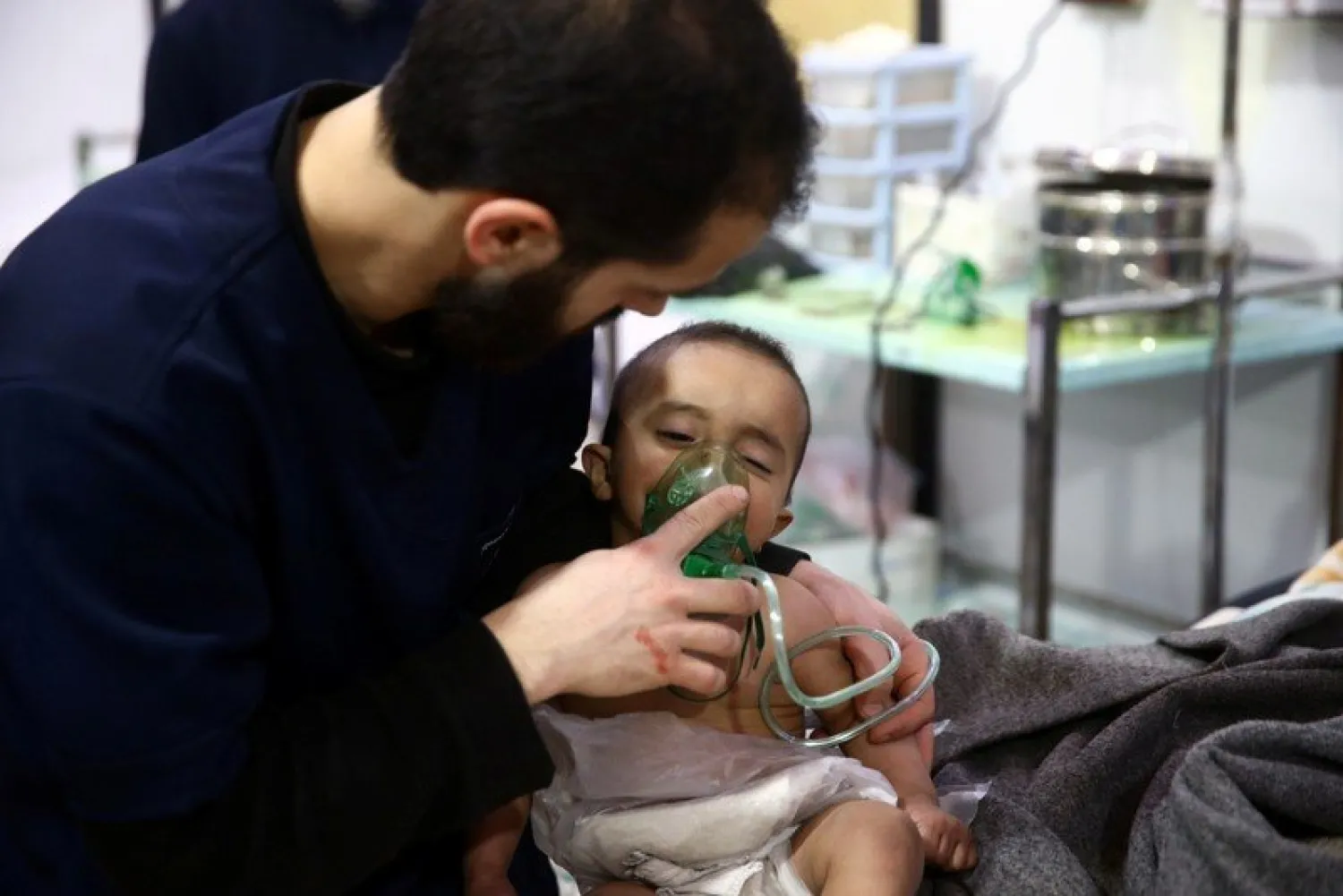
Man with a child are seen in hospital in the besieged town of Douma, Eastern Ghouta, Damascus. Thomson Reuters
TT

Exclusive - UN Documents Reveal 'Chemical' Cooperation between Syria, North Korea

Man with a child are seen in hospital in the besieged town of Douma, Eastern Ghouta, Damascus. Thomson Reuters

North Korean authorities provided the Syrian regime with equipment that could be used to manufacture chemical weapons, according to secret UN documents obtained by Asharq Al-Awsat.

The report, prepared by UN experts and consisting of hundreds of pages, dedicated more than 15 paragraphs to transactions prohibited by international resolutions between Pyongyang and Damascus.

It noted that the United Nations Panel of Experts, which is working under Security Council Resolution 1718, has conducted numerous investigations into North Korean transfers to Syria of ballistic missiles, materials related to conventional weapons and dual-use goods.

The report pointed to the activities of several groups of North Korean ballistic missile technicians, as well as entities that are subject to sanctions in Syria.

It also said that there were more than 40 North Korea unreported shipments between 2012 and 2017 to the Council of Scientific Research in Syria, in the region of Jamraya.

The report revealed that some member-states seized goods that are believed to be part of a contract between the North Korean company KOMID and the interfaces of the Syrian Scientific Research Council.

These investigations highlighted important new evidence on North Korea’s ongoing sanctioned activities, as well as innovative evasion techniques, through the use of a dual system to validate the documents of the shipments and mask illegal activities.

The report details “substantial new evidence” about North Korea’s dealings with Syria, dating back to 2008. That year, North Korea’s Ryonhap-2 corporation was reportedly in a Syrian ballistic missile program.

Moreover, the over-200-page document recounted a visit to Syria by a technical delegation from North Korea in August 2016 “involved the transfer to Syria of special resistance valves and thermometers known for use in chemical weapons programs.”

Another visit by North Korean ballistic missile experts was conducted in November 2016. The delegation passed through Beijing and Dubai airports on its way to Damascus on a Syrian Arab Airlines flight, according to the report.

A member state was quoted in the UN report as saying that North Korean technicians “continue to operate at chemical weapons and missile facilities at Barzeh, Adra and Hama”.

The report included Syria’s reply to the panel about the information: “There are no [North Korean] technical companies in Syria and the only presence of some [North Korean] individuals are confined in the field of sports under private individual contracts for training athletics and gymnastics.”

Investigations by the UN panel showed that in many cases of unreported arms shipments and cooperation with front companies of entities placed under sanctions between 2010 and 2017, there is further evidence of violations of the arms embargo and other breaches, through the transfer of products used in the manufacture of ballistic missiles and weapons and in chemical programs.

The eight experts forming the UN panel come from different countries and have specific expertise in areas such as weapons of mass destruction, maritime transport and customs controls.

The report includes copies of contracts between North Korean and Syrian companies as well as bills of lading indicating the types of materials shipped.

Although experts, who read the report, said that the evidence it cited did not prove conclusively that there was ongoing and continuous cooperation between North Korea and Syria on chemical weapons, they said it did deliver the most detailed account to date of the two countries’ efforts to evade sanctions intended to restrain their military expansion.



Israeli Strikes Kill Three Palestinians, Including a Child, in Gaza, Medics Say

 Palestinians inspect the site of an Israeli strike that targeted a police post, in Gaza City, May 5, 2026. (Reuters)
Palestinians inspect the site of an Israeli strike that targeted a police post, in Gaza City, May 5, 2026. (Reuters)
TT

Israeli Strikes Kill Three Palestinians, Including a Child, in Gaza, Medics Say

 Palestinians inspect the site of an Israeli strike that targeted a police post, in Gaza City, May 5, 2026. (Reuters)
Palestinians inspect the site of an Israeli strike that targeted a police post, in Gaza City, May 5, 2026. (Reuters)

Israeli strikes killed at least three Palestinians, including a child, and wounded several others in the Gaza Strip on Tuesday, health officials said.

Medics said a Palestinian was killed and two others were wounded by an Israeli airstrike near the Sheikh Radwan neighborhood in Gaza City, while another was killed and several others were wounded by Israeli tank shelling near the central area of the enclave.

Later on Tuesday, an Israeli strike targeted a police station in northern Gaza, killing a 15-year-old child, medics said. The Hamas-run interior ministry said ‌some policemen ‌were also wounded in the attack.

Reuters has previously reported ‌that ⁠Israel has intensified its ⁠attacks on Gaza's Hamas-run police force, which the group has used to reinforce its hold in the areas it controls in the strip.

There was no immediate Israeli comment on any of the incidents.

Violence in Gaza has persisted despite an October 2025 ceasefire, with Israel conducting almost daily attacks on Palestinians. Israel and Hamas have blamed each ⁠other for ceasefire violations.

At Al Shifa Hospital, the largest ‌medical facility still partially functional in the ‌enclave, relatives and friends arrived to bid farewell to one of those ‌killed on Tuesday, Mohammed Al-Ghandour. Two girls were crying and being ‌comforted by a woman outside the hospital's morgue.

"The Zionist enemy doesn't know anything called truce and does not commit to international treaties or laws or humanitarian laws," said the victim's uncle, Abu Omar Al-Naffar.

At least 830 Palestinians ‌have been killed since the ceasefire deal took effect, according to local medics, while Israel says fighters have ⁠killed four ⁠of its soldiers over the same period.

Israel says its strikes are aimed at thwarting attempts by Hamas and other Palestinian fighters to stage attacks against its forces.

More than 72,500 Palestinians have been killed since the Gaza war started in October 2023, most of them civilians, according to Gaza health authorities.

Since the truce last October, Israel still occupies more than half of Gaza, where it has ordered residents out and demolished almost all remaining structures. Nearly the entire population of more than 2 million Palestinians now lives in a narrow strip along the coast, mainly in tents and damaged buildings, under the de facto control of Hamas.


Israel Court Extends Gaza Flotilla Activists’ Detention Until Sunday

 Brazil's activist Thiago Avila is escorted into court in the Israeli coastal city of Ashkelon on May 5, 2026. (AFP)
Brazil's activist Thiago Avila is escorted into court in the Israeli coastal city of Ashkelon on May 5, 2026. (AFP)
TT

Israel Court Extends Gaza Flotilla Activists’ Detention Until Sunday

 Brazil's activist Thiago Avila is escorted into court in the Israeli coastal city of Ashkelon on May 5, 2026. (AFP)
Brazil's activist Thiago Avila is escorted into court in the Israeli coastal city of Ashkelon on May 5, 2026. (AFP)

An Israeli court has extended the detention of two foreign activists from a Gaza-bound flotilla until Sunday, a rights group representing them said, as authorities continue to question the pair.

Spanish national Saif Abu Keshek and Brazilian national Thiago Avila appeared before a court in the city of Ashkelon for their second hearing on Tuesday, after they were brought to Israel for questioning last week.

The two, held in a prison in the southern Israeli city, were among dozens of activists aboard a Gaza-bound flotilla intercepted by Israeli forces off the coast of Greece early on Thursday.

At their first hearing on Sunday, the court extended their detention by two days. A second hearing was held on Tuesday, where both appeared with their legs shackled.

"The court approved their detention until Sunday morning" at Tuesday's hearing, Miriam Azem, international advocacy coordinator at the Israeli rights group Adalah told AFP.

An AFP journalist saw the two activists brought to the courtroom.

Adalah said the two activists were on hunger strike, with Tuesday their sixth day of protest.

On Monday, the rights group alleged the pair had been subjected to physical and psychological abuse in detention.

- Abuse claims -

Both Abu Keshek and Avila are being held in isolation, with "high-intensity lighting" on at all times in their cells, Adalah said, adding that Avila was being held in "extremely cold temperatures".

"They are kept blindfolded at all times whenever they are moved outside their cells, including during medical examinations," it said.

Israeli authorities have rejected the abuse claims.

At Sunday's hearing, Adalah said the state attorney had presented a list of offences the pair were accused of, including "assisting the enemy during wartime" and "membership in and providing services to a terrorist organization".

But Adalah's lawyers challenged the state's jurisdiction, arguing there had been an "unlawful abduction" of the two activists in international waters.

Israel's foreign ministry said both individuals were affiliated with the Popular Conference for Palestinians Abroad (PCPA), a group accused by Washington of "clandestinely acting on behalf of" Palestinian group Hamas.

The ministry said Abu Keshek was a leading PCPA member, and that Avila was also linked to the group and "suspected of illegal activity".

The flotilla's vessels had set sail from France, Spain and Italy with the aim of breaking Israel's blockade of Gaza and bringing humanitarian supplies to the devastated Palestinian territory.

But they were intercepted by Israeli forces off the coast of Greece.

The Global Sumud Flotilla's first voyage last year was also intercepted by Israeli forces off the coasts of Egypt and Gaza.

Israel controls all entry points into Gaza, which has been under an Israeli blockade since 2007.

Throughout the Gaza war that started in October 2023, there have been shortages of critical supplies in the territory, with Israel at times cutting off aid entirely.


With Wood Scarce, Gaza Carpenters Make Simple Beds from Pallets

 Palestinian carpenter Mohammed Wafi builds furniture from recycled wooden pallets in his workshop amid shortages of materials in Khan Younis, in the southern Gaza Strip, May 2, 2026. (Reuters)
Palestinian carpenter Mohammed Wafi builds furniture from recycled wooden pallets in his workshop amid shortages of materials in Khan Younis, in the southern Gaza Strip, May 2, 2026. (Reuters)
TT

With Wood Scarce, Gaza Carpenters Make Simple Beds from Pallets

 Palestinian carpenter Mohammed Wafi builds furniture from recycled wooden pallets in his workshop amid shortages of materials in Khan Younis, in the southern Gaza Strip, May 2, 2026. (Reuters)
Palestinian carpenter Mohammed Wafi builds furniture from recycled wooden pallets in his workshop amid shortages of materials in Khan Younis, in the southern Gaza Strip, May 2, 2026. (Reuters)

As Israeli restrictions continue to curb the entry of goods into Gaza, local carpenters are turning to scrap wood and shipping pallets to make much-needed basic beds and tables in a strip battered by two years of war between Hamas and Israel.

In a workshop in southern Gaza, carpenters dismantle used pallets to make beds, cupboards, and shelves for families displaced by fighting, after regular construction materials became scarce or prohibitively expensive.

Mohammed Wafi, 34, a carpenter in Khan Younis, said pallets became one of the few available sources of wood when limited ‌aid trucks began entering ‌Gaza.

Demand for his handiwork has grown as people living ‌in ⁠tents seek basic furniture ⁠to get by, Wafi said. Even recycled furniture has become more costly as prices for basic components soar.

"Today people say, 'I just need something to get by, something to get my clothes off the floor'... especially those (living) in tents," said Wafi, who has worked in carpentry for 16 years.

"Due to the rats and cockroaches, they need a tent or a bed to be lifted off the ground," he said.

Rats and parasites are spreading ⁠through Gaza's tent camps, biting people as they sleep, gnawing through ‌possessions, and spreading disease.

COGAT, the Israeli military agency ‌that coordinates aid into Gaza, didn't respond to a request for comment. Wood is a construction material ‌that Israel bans from entry to Gaza because it is considered a dual-use ‌item - items for civilian but also potential military use.

"We used to get a kilo of nails for 5 shekels ($1.70). Today, a kilo of nails costs around 100 or 130 shekels," Wafi said. Hinges and other fittings have also multiplied in price.

Still, furniture made from pallets remains far ‌cheaper than conventional bedroom sets, consisting of a bed, closet and dresser, he said. A pallet set sells for 4,000 to ⁠5,000 shekels compared ⁠to 18,000 for a traditional set.

Shortages of electricity and wood have slowed production, he added, leaving carpenters unable to guarantee delivery times.

The ceasefire in Gaza has been repeatedly violated, with over 830 Palestinians and four Israeli soldiers reported killed since it began in October, according to Palestinian and Israeli tallies.

Israel cites security concerns for curbs on Gaza, and COGAT has previously said it invests considerable efforts to ensure aid reaches Gaza and has denied restricting supplies.

In tent encampments near Khan Younis, Mohammed Tayseer, who has lived in a tent for two years, said he slept on the ground until recently.

"The ground is sandy and dirty, and as you can see, you find the clothes full of sand. There are rats and mice," he said.

"One's back hurts and is stiff from sleeping on the floor... now (we) have a bed," he said.