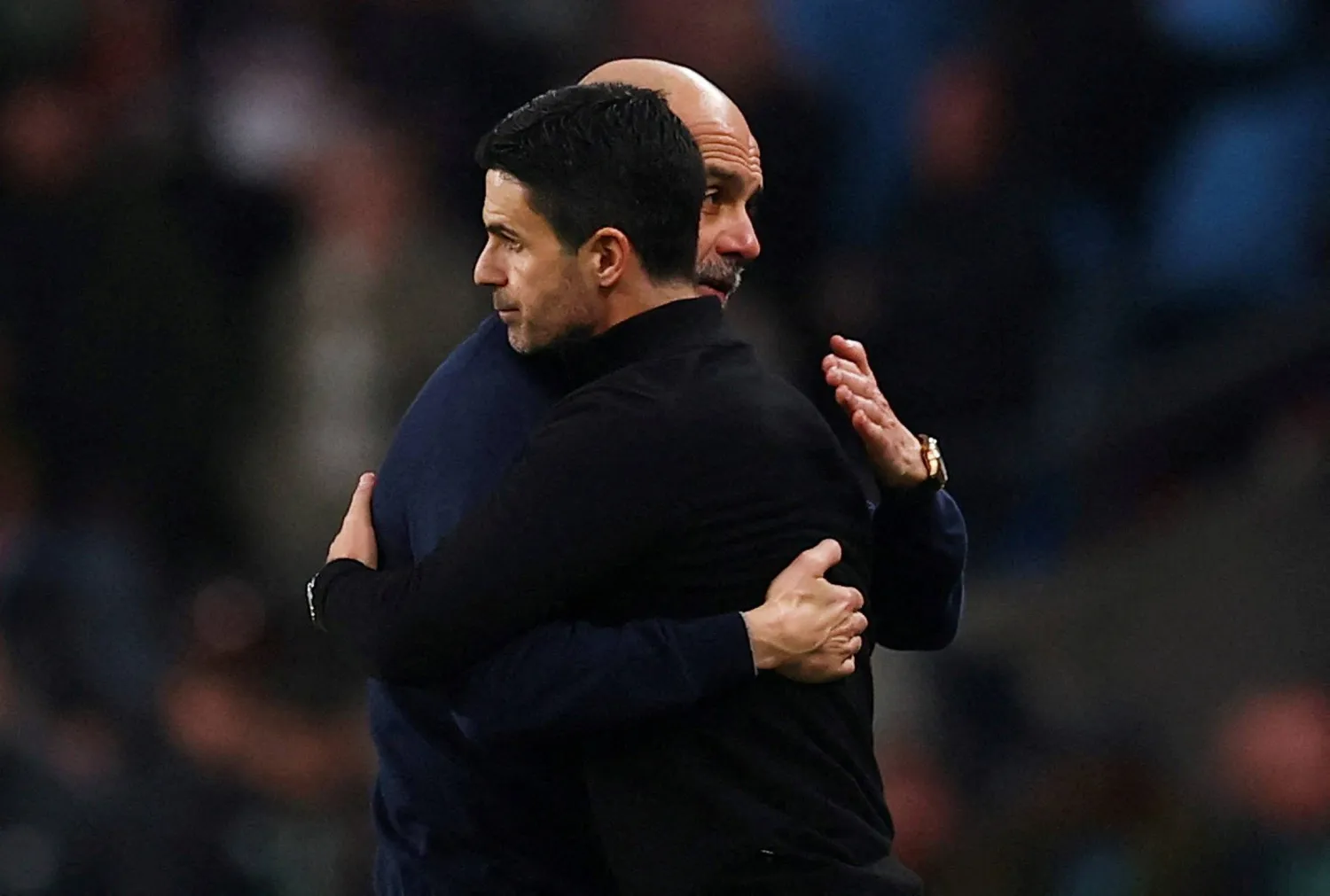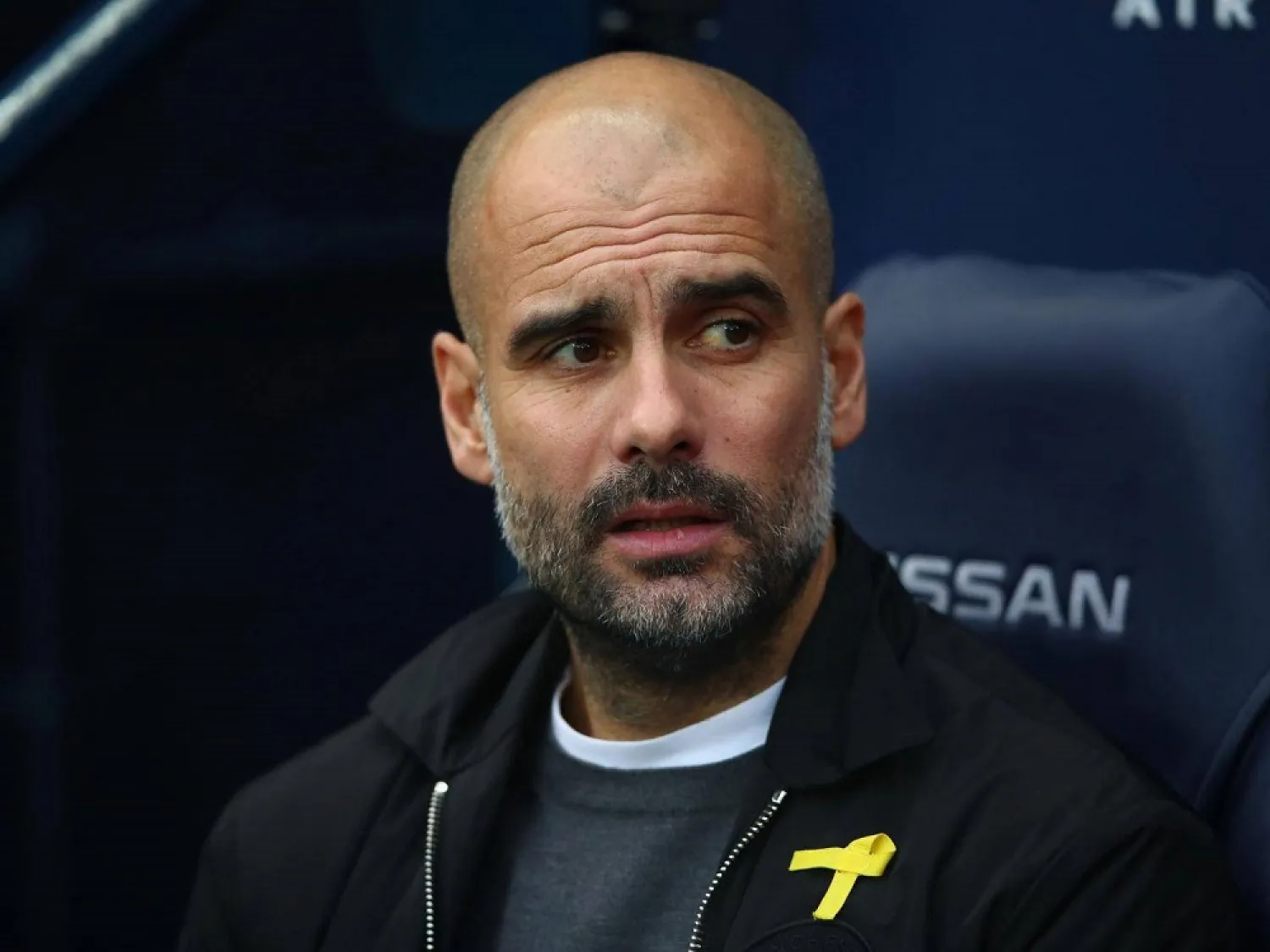

Pep Guardiola: Mixing Sports with Politics

Manchester City manager Pep Guardiola. (Getty Images)
TT

Pep Guardiola: Mixing Sports with Politics

Manchester City manager Pep Guardiola. (Getty Images)

As they consider the case of Pep Guardiola, who won his first medal in English football at Wembley on Sunday while semi-surreptitiously sporting a yellow ribbon in support of the jailed members of the Catalan independence movement, the leaders of the Football Association might look back at the record of their own predecessors, and in particular at the events of 1938, when they ordered the England football team to perform the Nazi salute in Berlin’s Olympic stadium.

History tells they did so under instruction from the British ambassador to Germany, Sir Nevile Henderson, who was having a difficult year. On the morning of the match, Henderson had called a meeting with two senior FA figures: the 71-year-old Charles Wreford-Brown, chairman of the international selection committee, and Stanley Rous, the association’s secretary.

“When I go to see Herr Hitler,” the ambassador told them, “I give him the Nazi salute because that it is the normal courtesy expected. It carries no hint of approval of anything Hitler and his regime may do. And if I do it, why should you or your team object?”

After Rous and Wreford-Brown had transmitted the request to their captain, Eddie Hapgood, and his team‑mates, it seems some certainly did object. According to Stanley Matthews, a scorer in England’s 6-3 victory: “All the players were livid and totally opposed to this, myself included.” They backed Hapgood when he said they would simply stand to attention during their opponents’ national anthem, as was their normal practice.

Rous responded by turning the instruction into an order, backed by the ambassador. And so it was that 11 footballers representing England stood in line abreast in the Olympic stadium on 14 May 1938, under the eyes of Hermann Göring, Joseph Goebbels and 110,000 German fans, raising their right arms in unison with their opponents while Deutschland über alles was sung.

It is hard to look at the photographs of the Berlin salute now without wincing. Nobody, with the benefit of hindsight, would defend that instruction. History has a way of making fools of us all. But whereas the FA’s decision 80 years ago was made for reasons of political expediency, at least Guardiola’s gesture of protest is the result of personal conviction.

Such is the way of football that there is probably a cell of the Catalan independence movement being set up in east Manchester right now. Anything Guardiola supports, City’s fans must support too – or at least they must reject any argument against his insistence on defending a gesture that has already brought him into conflict with the governing body.

Guardiola was a player of outstanding intelligence whose gifts of vision and motivation have made him the world’s most coveted coach, a status bringing with it a reported annual salary of £15.3m. His presence in the Premier League has been notable for his eloquence and for a level of courtesy only a couple of notches below that shown by Sven‑Goran Eriksson and Claudio Ranieri during their time in England. But no one could play so many games and win so many trophies in central midfield for Barcelona and Spain without developing a resistance, when confronted, to backing down.

With the world in its current state, we might all have our opinions on the general advisability of splitting more or less harmonious national federations into smaller units. Guardiola is certainly entitled to his views, and to freedom of speech, and he has a point when he tells his English critics it is only three and a half years since Britain gave the Scots the right to determine their destiny in a referendum. But that does not make him necessarily right about wearing his ribbon at Wembley, just as the FA’s lamentable record of decision-making does not make them necessarily wrong.

The only way to resolve the dispute is for both sides to share a conversation in which each is willing to listen respectfully to the other’s point of view. We know Guardiola will defend himself with conviction. The question is whether the FA, historically so lacking in sound judgment and the ability to take decisive action, possesses a voice capable of outlining the counterarguments. Who can tell the proud Catalan, with the wisdom and subtlety to which he might respond, there is a time and a place for everything, and the technical area might not be the right place for a display of loyalty that has nothing to do with the occasion?

Most important, someone should be able to make him see that displays of political affiliation are banned for the very good reason that once a blind eye is turned on a single occasion, the gates are open to everyone. That was why Robbie Fowler’s support of 500 sacked Liverpool dockers, proclaimed on a T-shirt during a Cup Winners’ Cup tie, and Nicolas Anelka’s quenelle, an arm gesture associated with antisemitism, were punished in 1997 and 2014 respectively, the first by a Uefa fine of 2,000 Swiss francs and the second with a five-match ban by the FA.

Someone could also point out to Guardiola that 10 years ago he was acting as a paid ambassador for Qatar’s World Cup. How does he feel about that now, following revelations about the Gulf state’s use of its controversial labor laws to restrict the rights of the immigrant laborers building its new stadiums, and the apparent indifference to dozens of deaths on the project? In the eye of history, his readiness to front for the Qataris might look barely more defensible than the FA’s capitulation in Berlin.

The Guardian Sport


Chelsea Injuries up 44% After Club World Cup but Report Says Event Has Had ‘Minimal’ Impact

Chelsea's Reece James, center, lifts the trophy following the Club World Cup final soccer match between Chelsea and PSG at MetLife Stadium in East Rutherford, N.J., Sunday, July 13, 2025. (AP)
TT

Chelsea Injuries up 44% After Club World Cup but Report Says Event Has Had ‘Minimal’ Impact

Chelsea's Reece James, center, lifts the trophy following the Club World Cup final soccer match between Chelsea and PSG at MetLife Stadium in East Rutherford, N.J., Sunday, July 13, 2025. (AP)

Chelsea suffered a 44% spike in injuries after competing in the supersized Club World Cup this year, according to findings published on Tuesday.

But the newly expanded tournament has so far had a “minimal impact” on injuries overall, the latest edition of the Men’s European Football Injury Index found.

There was fierce opposition to FIFA's new flagship club event when it was confirmed in 2023 that it would increase from seven to 32 teams, with players' unions warning of physical and mental burnout of players due to an ever expanding match schedule. But FIFA pressed ahead and staged the tournament in the United States in June-July.

Chelsea went on to win the inaugural competition, receiving the trophy from US President Donald Trump at MetLife Stadium and taking home prize money of around $125 million. But, according to the Index, from June-October, Chelsea picked up more injuries — 23 — than any of the nine clubs from Europe's top leagues that participated in the Club World Cup.

They included star player Cole Palmer, and was a 44% increase on the same period last year.

While Chelsea, which played 64 games over the entire 2024-25 season, saw an increase in injuries, the Index, produced by global insurance firm Howden, found that overall there was a decrease.

“In principle you would expect this increased workload to lead to an increase in the number of injuries sustained, as a possible rise in overall injury severity,” the Index report said, but added: “The data would suggest a minimal impact on overall injury figures.”

Despite the figures, the authors of the report accept it was too early to assess the full impact of the Club World Cup, with the findings only going up to October.

“We would expect to see the impact to spike in that sort of November to February period,” said James Burrows, Head of Sport at Howden. “What we’ve seen previously is that’s where the impact is seen from summer tournaments."

Manchester City has sustained 22 since the tournament, which is the highest among the nine teams from Europe's top leagues — England, Spain, Italy, Germany and France.

Those teams have recorded 146 injuries from June-October, which is down on the previous year's figure of 174.

From August-October that number is 121, the lowest for that three-month period in the previous six years of the Index.


Sunderland Worst Hit by Losing Players to African Cup of Nations 

14 December 2025, United Kingdom, London: Sunderland's Habib Diarra (L) and Leeds United's Gabriel Gudmundsson battle for the ball during the English Premier League soccer match between Brentford and Leeds United at the Gtech Community Stadium. (dpa)
TT

Sunderland Worst Hit by Losing Players to African Cup of Nations 

14 December 2025, United Kingdom, London: Sunderland's Habib Diarra (L) and Leeds United's Gabriel Gudmundsson battle for the ball during the English Premier League soccer match between Brentford and Leeds United at the Gtech Community Stadium. (dpa)

Premier League Sunderland will have to do without six players over the next few weeks and are the club worst hit as the Africa Cup of Nations takes its toll on European clubs competing over the holiday season.

Sunderland, eighth in the standings, had four of their African internationals in action when they beat Newcastle United on Sunday, but like 14 other English top-flight clubs will now lose those players to international duty.

The timing of the African championship, kicking off in Morocco on Sunday and running through to January 18, has long been an irritant for coaches, with leagues in Belgium, France, Germany, Italy, Netherlands, Portugal, and Spain also affected.

Hosting the tournament in the middle of the season impacts around 58% of the players at the Cup of Nations, though the Confederation of African Football did try to mitigate the impact by moving the start to before Christmas, so it is completed before the next round of Champions League matches.

The impact on European clubs was also lessened by allowing them to release players seven days, rather than the mandatory 14 days, before the tournament, meaning they could play for their clubs last weekend.

Sunderland's Congolese Arthur Masuaku and Noah Sadiki, plus full back Reinildo (Mozambique), midfielder Habib Diarra (Mali), and attackers Chemsdine Talbi (Morocco) and Bertrand Traore (Burkina Faso) have now departed for Morocco.

Ironically, Mohamed Salah’s absence from Liverpool to play for Egypt should lower the temperature at the club after his recent outburst against manager Arne Slot, but Manchester United will lose three players in Noussair Mazraoui, Bryan Mbeumo and Amad Diallo, who scored in Monday’s 4-4 draw with Bournemouth.

France is again the country with the most players heading to the Cup of Nations, and with 51 from Ligue 1 clubs. But their absence is much less impactful than previously as Ligue 1 broke after the weekend’s fixtures and does not resume until January 2, by which time the Cup of Nations will be into its knockout stage.

There are 21 players from Serie A clubs, 18 from the Bundesliga, and 15 from LaLiga teams among the 24 squads at the tournament in Morocco.


Rodgers Takes Charge of Saudi Team Al-Qadsiah After Departure from Celtic 

Then-Celtic head coach Brendan Rodgers greets supporters after a Europa League soccer match between Red Star and Celtic at Rajko Mitic Stadium in Belgrade, Serbia, Sept. 24, 2025. (AP)
TT

Rodgers Takes Charge of Saudi Team Al-Qadsiah After Departure from Celtic 

Then-Celtic head coach Brendan Rodgers greets supporters after a Europa League soccer match between Red Star and Celtic at Rajko Mitic Stadium in Belgrade, Serbia, Sept. 24, 2025. (AP)

Brendan Rodgers has returned to football as the coach of Saudi Arabian club Al-Qadsiah, six weeks after resigning from Scottish champion Celtic.

Al-Qadsiah, whose squad includes Italian striker Mateo Retegui and former Real Madrid defender Fernandez Nacho, is in fifth place in the Saudi Pro League in its first season after promotion.

Rodgers departed Celtic on Oct. 27 and has opted to continue his managerial career outside Britain for the first time, having previously coached Liverpool, Leicester and Swansea.

In its statement announcing the hiring of Rodgers on Tuesday, Al-Qadsiah described him as a “world-renowned coach” and said his arrival “reflects the club’s ambitious vision and its rapidly growing sporting project.”

Aramco, the state-owned Saudi oil giant, bought Al-Qadsiah in 2023 in a move that has helped to transform the club’s status.

“This is a landmark moment for the club,” Al-Qadsiah chief executive James Bisgrove said. “The caliber of his experience and track record of winning reflects our ambition and long-term vision to establish Al-Qadsiah as one of Asia’s leading clubs.”

Rodgers is coming off winning back-to-back Scottish league titles with Celtic, where he won 11 major trophies across his two spells. He also won the FA Cup with Leicester.

Al-Qadsiah's last two coaches were former Liverpool striker Robbie Fowler and former Spain midfielder Michel.