


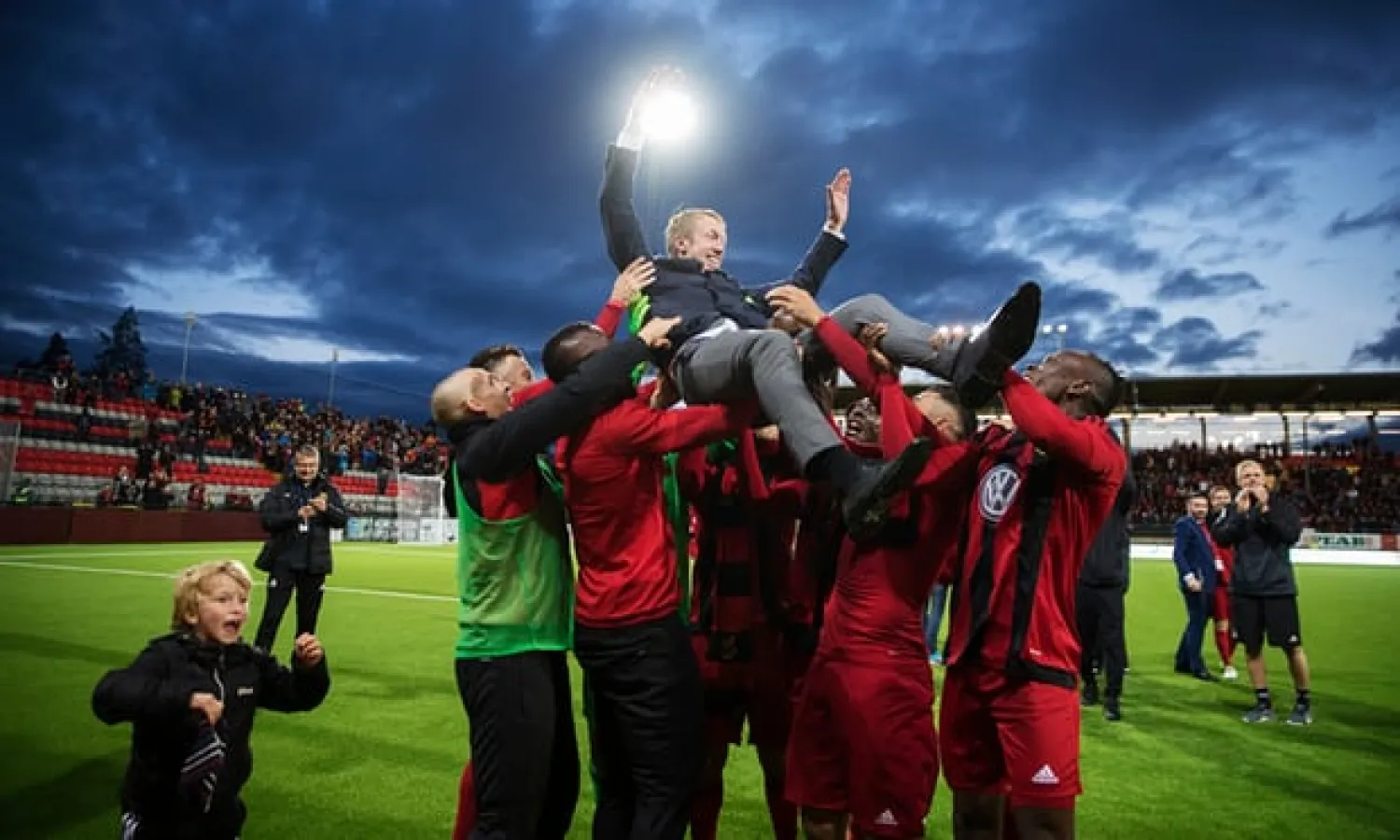

“It’s a different kind of cold,” Graham Potter says as darkness spreads across Östersund and the temperature plummets to -20C. The inspirational manager of Östersund, who will reach the next stage of an incredible story when they host Arsenal in the first leg of their Europa League tie on Thursday, laughs when I say it’s hard to believe. I’ve felt colder on a wet February afternoon in Birmingham, not far from his old home in Solihull, than I do in this small town in remote northern Sweden.
“I know what you mean,” Potter agrees in his West Midlands accent. “This is a dry cold and it’s not too bad, is it?”
Arsenal still face a very different experience against Östersund, at a snowy ground which holds only 9,000, and featuring a squad which Potter has galvanised through a variety of methods – from his players putting on a ballet production of Swan Lake for the town, singing on stage and writing a book together.
We take a bracing walk to his office where, over the past seven years, Potter has led the rise of this new club from the fourth tier of Swedish football to the European stage. This season Östersund have knocked out Galatasaray, beaten Hertha Berlin and drawn with Athletic Bilbao, on their way to the last 32 of the Europa League.
Potter is now the only Englishman still managing a club in European competition and he has achieved the feat with a squad of Swedish players mixed with footballers rejected or lost in countries stretching from Iraq to England to Ghana. Östersund, both as a town and a club, is agog at the prospect of facing Arsenal.
Potter takes off his jacket and grins. “I thought it was either going to be AC Milan or Arsenal. I remember sitting here as the draw happened and smiling. It felt like an amazing reward for what we’d done in 2017. We finished fifth [their highest-ever position in the top division] and won the Swedish Cup. The result of all that is we’ve got Arsenal in the Europa League. It’s incredible, Wenger has been at Arsenal longer than we have been in existence as a club.”
Östersund were formed on 31 October 1996 – five weeks after Arsène Wenger had been announced as Arsenal’s manager. “Arsenal are a wonderful club, an institution, and to go to the Emirates for the second leg is fantastic and crazy – because they have more people [60,000] in their stadium than we have in our whole town. We’re going to take 5,000 fans, which is mind‑blowing when only 50,000 people live in Östersund. So hopefully I’ve shown there’s another path for English managers.”
Potter played 10 first-team games in the top flight for Southampton and, as well as assorted loans, he was also at Birmingham, Stoke, West Bromwich Albion, York, Boston and Macclesfield. He was often frustrated by the English game. “When I first started English football was coming from the dark ages, after the European ban. I played football because I loved the game – but I didn’t enjoy the focus on not making mistakes and the culture being essentially one of blame and a little fear.”
Higher education reshaped Potter. He began his first social sciences degree while playing for Southampton and eventually completed his masters. Luck then played its part. Graham Jones, Roberto Martínez’s assistant coach, had played with Potter at Boston and they were old friends. When Jones and Martínez were at Swansea they often played pre-season friendlies in Östersund. Jones forged a bond with Daniel Kindberg, their ambitious chairman. He convinced Kindberg that Potter should be offered the job as manager when the club were watched by just 500 fans and languishing in the bottom division.
When he arrived in Sweden in 2011, Potter immersed himself in his new role but his wife, Rachel, struggled. “That’s the biggest thing when I look back,” Potter says, “and why I’m proud of what we’ve achieved. I had the football opportunity but she had to give up her business she’d built up for 10 years. We had an 11‑month old baby and were away from the grandparents. Rachel told me afterwards she cried every day for six months. She wouldn’t show me when I came home as she was trying to be positive. But she missed her family, her home. It was not straightforward.”
Potter’s conviction, however, was clear. Even before one promotion followed another, and the rise to the top division was sealed in 2015, Potter was convinced he would succeed. “You have to believe that. When you make this sort of move, with these sacrifices, you’ve got to make it work. But it was consuming. The first two years there was no video so I’d drive nine hours to scout a player. Rachel thought I was insane. There were moments of doubt when you think we’ve got no chance because we haven’t got the finances, the history, anything. But it was just fleeting. I believed.”
Östersund apparently plan to build a statue of Potter. “There were rumours,” he says, “but I tried to pooh‑pooh that idea. I was used to football supporters hammering me and I thought my name was Graham Potter-Boo at one point. So it’s been different, and I remember the fans holding up a banner thanking Rachel. I’d done an interview describing the big sacrifices she’d made. The supporters recognised that and it was a really nice gesture.”
Success on the pitch has been accompanied by an embrace of culture as a way of developing players as people first. “It was a combination of many conversations between myself and Daniel,” Potter says. “We’d speak about holistic development and it was his idea to come up with the culture academy. I thought it was a great idea to develop the depth of a person.”
Whether singing or dancing in public, Potter ensured that every staff member performed alongside the players. “It’s so powerful to develop that trust and empathy. Our first theatre production was sold out to 500 people and we were uncomfortable and vulnerable. But dealing with it is a great way of developing self-awareness and responsibility.”One of their more recent productions celebrated the indigenous Sápmi tribe, also known as Laplanders, with a local hip-hop artist. “The first part is to get to know the culture and we had to learn about reindeer husbandry. Part of it was lassoing the reindeer so she said: ‘Who wants to have a go?’ She had a pair of antlers and said: ‘Put them on your head.’ I did while they got the lasso out. Only in Sweden.”
Potter laughs but he is soon serious again when asked which cultural event was the most meaningful. “Two stand out. Swan Lake – because the crowd was so proud of the team and we got such a great reception. It was a real challenge collectively. And then the following year we did a gala of solidarity with refugees. To hear the stories and see the response, singing in front of 1,600 people, was powerful. I had to open it by singing the Lapland national anthem in a local dialect. It was incredibly nerve‑racking singing in front of the players sober. You really work with your vulnerabilities but I managed to get through it. This year we’re working with a nice music group and a few of them have cognitive disabilities. It’s fascinating.”
Potter’s success means that he has begun to be linked with jobs in England – most recently at Stoke before Paul Lambert succeeded Mark Hughes. Would such techniques work in English football? “You have to respect and understand the environment. So I don’t think it’s a case of taking anything from Östersund and transferring it to somewhere else. But concepts around how a team functions, the importance of the relationship between football and the person, how you develop both, are always valid.”
Before the Swedish Cup final last year, Potter thought it would be nice for the lads to get letters from their families expressing how proud they are. “Each player got two letters on the morning of the game. One was from me about them as people and the second was this wonderful letter from their family. It helped them understand this game was a special opportunity. That game stands out with the PAOK Thessaloniki qualification home match. We were 3-1 down from the first leg and won 2-0. The implications of getting into the Europa League for a small club were huge.”
Östersund had won two earlier ties – and defeated a giant in Galatasaray seven months ago. “They’re a club with huge tradition and importance within world football. To have them visit us was an event. It was really intense and we beat them 2-0 at home, so of course their supporters made it very hostile in Turkey. We had enough about us to be organised and scored the first goal. We were good with the ball, we attacked well, created some good chances – but then you have to defend and be resilient. Afterwards we were worried because season tickets were getting thrown. But we went over to our supporters and all the Galatasary fans started to clap us. It was wonderful, a goosebumps moment.”
Arsenal will present a more complex challenge at the end of Östersund’s winter break. “We understand where we are in the hierarchy and we need to play really well and they need to play really badly,” Potter says as we walk back out into the dark and the cold. The snow glistens under the small stadium’s floodlights and Potter sounds full of hope. “In football you can dream and we’ll do our best. It’s a once-in-a-lifetime opportunity. We’ll approach it as a gift, as a chance for us to find out more about ourselves and to grow and improve.”
The Guardian Sport


