
Delusions of Stadium Grandeur Haunt West Ham, Club’s owners

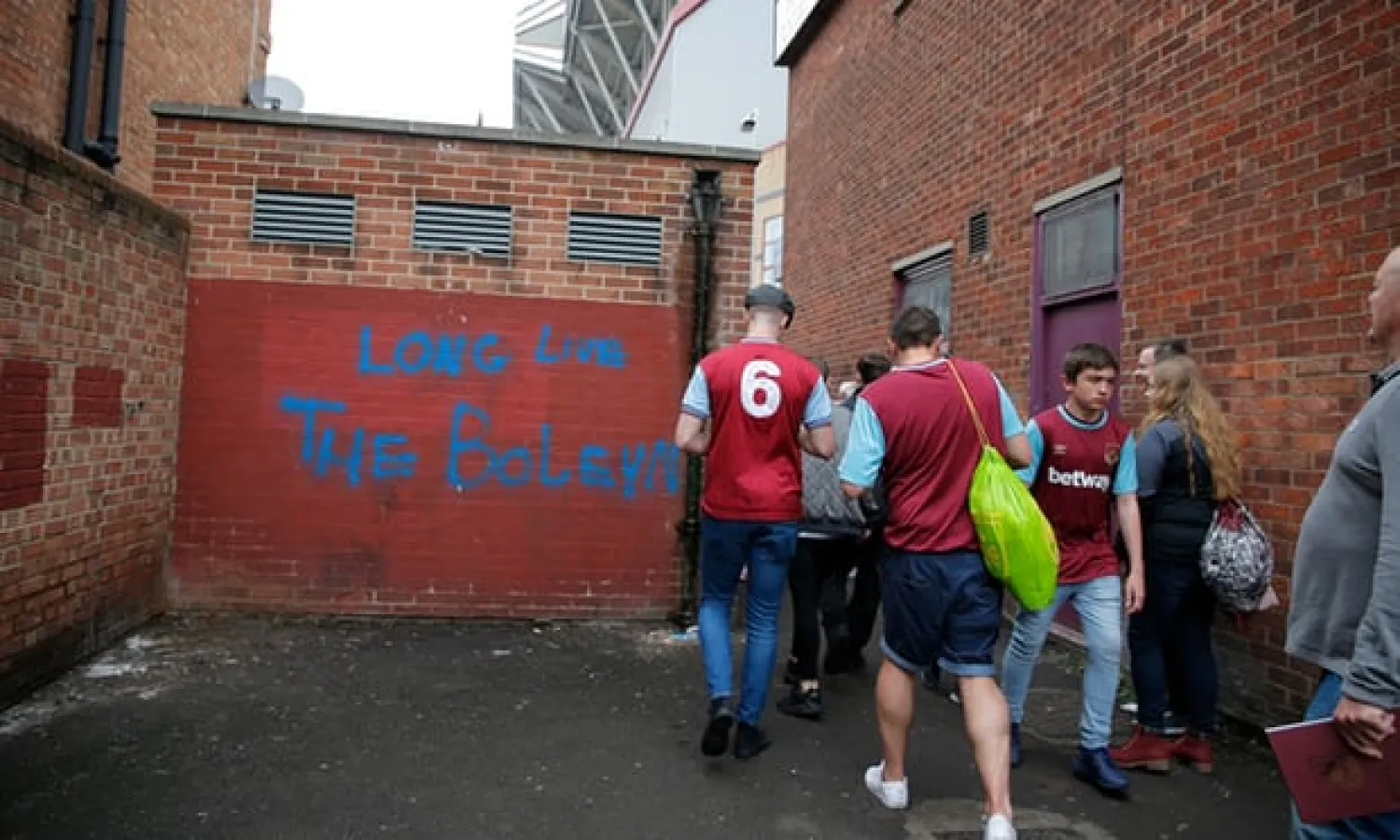
 West Ham United fans at Upton Park before the final match at the old Boleyn Ground in May 2016, when Manchester United were beaten 3-2. Photograph: Tom Jenkins for the Guardian
West Ham United fans at Upton Park before the final match at the old Boleyn Ground in May 2016, when Manchester United were beaten 3-2. Photograph: Tom Jenkins for the Guardian
TT

Delusions of Stadium Grandeur Haunt West Ham, Club’s owners

 West Ham United fans at Upton Park before the final match at the old Boleyn Ground in May 2016, when Manchester United were beaten 3-2. Photograph: Tom Jenkins for the Guardian
West Ham United fans at Upton Park before the final match at the old Boleyn Ground in May 2016, when Manchester United were beaten 3-2. Photograph: Tom Jenkins for the Guardian

The fate of the little memorial garden on Green Street, next to where the Boleyn ground’s main entrance once stood, is just one of the problems facing West Ham United. Full of bedraggled scarves and wilting flowers and plaques dedicated to long-gone fans – should it be taken from its present location, where the roar of the crowd will never be heard again, and reinstalled in the club’s widely detested new home?

Another is the much loved statue 50 yards away, on the crossroads at the junction with Barking Road. It depicts Bobby Moore, the embodiment of the club’s self‑image, in his moment of greatest triumph, holding aloft the World Cup while borne on the shoulders of his club mate Geoff Hurst and Everton’s Ray Wilson, while a third Hammer, Martin Peters, looks on.

Across the road, posters in the windows of the Boleyn pub invite fans to join an online petition urging the mayor of Newham to stop the statue’s proposed move to the former Olympic Stadium in Stratford, four miles down road but a continent away in emotional distance. “The way I look at it,” the lady behind the bar says as she pulls a pint, “I mean, Bobby Moore and them never played at Stratford, did they?”

The football club has gone, leaving only echoes of the matchday crowds strolling along Green Street towards an institution that once gave life to this part of east London. The social centre of the West Ham United Supporters Club is shuttered and padlocked, a stained and crumbling hulk awaiting the outcome of a meeting at the pub later this month.

The Boleyn, Nathan’s Pie & Mash restaurant and the Newham Bookshop, celebrating its 40th anniversary this spring, are among the few visible survivals in a district whose demographics and culture have changed almost beyond recognition in the decades since Moore, Hurst and Peters returned in triumph to a tightly knit community.

On a wall at the back of the old supporters’ club centre, someone has spray-painted LONG LIVE THE BOLEYN in blue on a claret background. But the Boleyn is dead and gone, swiftly razed once the sale of the ground to developers for around £40m was completed. Whatever the football club’s destiny, it will not be played out in E13. The pre-match pie and mash delivered by Nathan’s to a new fans’ rendezvous on the edge of the Olympic Park is as close to the old authenticity as the Hammers’ more nostalgic fans can come in the club’s new age.

West Ham’s true legacy in this part of east London is the building site from which apartment blocks are rising, fronted by a landscaped sales suite where eager representatives give their spiel to prospective buyers of a range of 842 living units. Although attractive enough in the glossy brochure, these are not the kind of palaces in the sky currently rising in more prosperous parts of London. It’s hard to imagine members of the McMafia wanting to park their families or their funny money in this unpretentious location.

By every yardstick except that of profit for the club’s owners, the new development seems an unfair swap for what was once a football ground with a character built up through 112 years of joy and disappointment. With a final capacity of 35,000, Upton Park always seemed to be the right size for a club of West Ham’s proportions and aspirations: big enough to stage top-tier matches but not an embarrassment in harder times.

Football fans, however, are easily persuaded by dreams of glory, and West Ham’s faithful were no different when they listened to the promises of their owners, the former porn barons David Gold and David Sullivan. Had the team built on the promise of the last season at Upton Park, when Slaven Bilic guided them to seventh place in the Premier League, there would have been no scenes like those witnessed last Saturday.

Success on the pitch would have silenced internal reservations about the former Olympic Stadium’s inadequacies and probably external complaints about the £300m of public money spent on the rebuilding, too. But failure, unsurprisingly, has turned the cocktail of incompetence, expediency and greed created by the deal into something explosive.

Before trouble broke out at the weekend, forcing the owners and their families to retreat from a furious mob, the club had managed to stop a planned protest march from Upton Park to Stratford. In meetings attended by Karren Brady, the club’s vice-chairman, they negotiated with various supporters’ groups, including one that includes members of the old Inter City Firm, West Ham’s representatives in the hooligan wars of the 1970s and 80s.

By appearing to favour one fan organisation over others, making offers to reimburse travel costs and provide complimentary match tickets, Brady and her colleagues appear to be copying the modus operandi of Argentina’s barras bravas and Italy’s ultras, some of whom have historically used the threat of violence and disruption as a means to gain favoured status and a measure of power within their clubs. This is a dangerous game and one to which, amid the present volatile mood, it is hard to foresee a happy ending.

At least West Ham’s owners still make their way from their Essex and Surrey mansions to show their faces on matchday. But what they are watching is the sight of their policies turning the threat of relegation from something to be absorbed with a bit of grumbling and a few economies into a potential catastrophe for a club whose strong heart they have ripped out and left bleeding in Green Street, amid the scarves and flowers.

The Guardian Sport


Chelsea Injuries up 44% After Club World Cup but Report Says Event Has Had ‘Minimal’ Impact

Chelsea's Reece James, center, lifts the trophy following the Club World Cup final soccer match between Chelsea and PSG at MetLife Stadium in East Rutherford, N.J., Sunday, July 13, 2025. (AP)
TT

Chelsea Injuries up 44% After Club World Cup but Report Says Event Has Had ‘Minimal’ Impact

Chelsea's Reece James, center, lifts the trophy following the Club World Cup final soccer match between Chelsea and PSG at MetLife Stadium in East Rutherford, N.J., Sunday, July 13, 2025. (AP)

Chelsea suffered a 44% spike in injuries after competing in the supersized Club World Cup this year, according to findings published on Tuesday.

But the newly expanded tournament has so far had a “minimal impact” on injuries overall, the latest edition of the Men’s European Football Injury Index found.

There was fierce opposition to FIFA's new flagship club event when it was confirmed in 2023 that it would increase from seven to 32 teams, with players' unions warning of physical and mental burnout of players due to an ever expanding match schedule. But FIFA pressed ahead and staged the tournament in the United States in June-July.

Chelsea went on to win the inaugural competition, receiving the trophy from US President Donald Trump at MetLife Stadium and taking home prize money of around $125 million. But, according to the Index, from June-October, Chelsea picked up more injuries — 23 — than any of the nine clubs from Europe's top leagues that participated in the Club World Cup.

They included star player Cole Palmer, and was a 44% increase on the same period last year.

While Chelsea, which played 64 games over the entire 2024-25 season, saw an increase in injuries, the Index, produced by global insurance firm Howden, found that overall there was a decrease.

“In principle you would expect this increased workload to lead to an increase in the number of injuries sustained, as a possible rise in overall injury severity,” the Index report said, but added: “The data would suggest a minimal impact on overall injury figures.”

Despite the figures, the authors of the report accept it was too early to assess the full impact of the Club World Cup, with the findings only going up to October.

“We would expect to see the impact to spike in that sort of November to February period,” said James Burrows, Head of Sport at Howden. “What we’ve seen previously is that’s where the impact is seen from summer tournaments."

Manchester City has sustained 22 since the tournament, which is the highest among the nine teams from Europe's top leagues — England, Spain, Italy, Germany and France.

Those teams have recorded 146 injuries from June-October, which is down on the previous year's figure of 174.

From August-October that number is 121, the lowest for that three-month period in the previous six years of the Index.


Sunderland Worst Hit by Losing Players to African Cup of Nations 

14 December 2025, United Kingdom, London: Sunderland's Habib Diarra (L) and Leeds United's Gabriel Gudmundsson battle for the ball during the English Premier League soccer match between Brentford and Leeds United at the Gtech Community Stadium. (dpa)
TT

Sunderland Worst Hit by Losing Players to African Cup of Nations 

14 December 2025, United Kingdom, London: Sunderland's Habib Diarra (L) and Leeds United's Gabriel Gudmundsson battle for the ball during the English Premier League soccer match between Brentford and Leeds United at the Gtech Community Stadium. (dpa)

Premier League Sunderland will have to do without six players over the next few weeks and are the club worst hit as the Africa Cup of Nations takes its toll on European clubs competing over the holiday season.

Sunderland, eighth in the standings, had four of their African internationals in action when they beat Newcastle United on Sunday, but like 14 other English top-flight clubs will now lose those players to international duty.

The timing of the African championship, kicking off in Morocco on Sunday and running through to January 18, has long been an irritant for coaches, with leagues in Belgium, France, Germany, Italy, Netherlands, Portugal, and Spain also affected.

Hosting the tournament in the middle of the season impacts around 58% of the players at the Cup of Nations, though the Confederation of African Football did try to mitigate the impact by moving the start to before Christmas, so it is completed before the next round of Champions League matches.

The impact on European clubs was also lessened by allowing them to release players seven days, rather than the mandatory 14 days, before the tournament, meaning they could play for their clubs last weekend.

Sunderland's Congolese Arthur Masuaku and Noah Sadiki, plus full back Reinildo (Mozambique), midfielder Habib Diarra (Mali), and attackers Chemsdine Talbi (Morocco) and Bertrand Traore (Burkina Faso) have now departed for Morocco.

Ironically, Mohamed Salah’s absence from Liverpool to play for Egypt should lower the temperature at the club after his recent outburst against manager Arne Slot, but Manchester United will lose three players in Noussair Mazraoui, Bryan Mbeumo and Amad Diallo, who scored in Monday’s 4-4 draw with Bournemouth.

France is again the country with the most players heading to the Cup of Nations, and with 51 from Ligue 1 clubs. But their absence is much less impactful than previously as Ligue 1 broke after the weekend’s fixtures and does not resume until January 2, by which time the Cup of Nations will be into its knockout stage.

There are 21 players from Serie A clubs, 18 from the Bundesliga, and 15 from LaLiga teams among the 24 squads at the tournament in Morocco.


Rodgers Takes Charge of Saudi Team Al-Qadsiah After Departure from Celtic 

Then-Celtic head coach Brendan Rodgers greets supporters after a Europa League soccer match between Red Star and Celtic at Rajko Mitic Stadium in Belgrade, Serbia, Sept. 24, 2025. (AP)
TT

Rodgers Takes Charge of Saudi Team Al-Qadsiah After Departure from Celtic 

Then-Celtic head coach Brendan Rodgers greets supporters after a Europa League soccer match between Red Star and Celtic at Rajko Mitic Stadium in Belgrade, Serbia, Sept. 24, 2025. (AP)

Brendan Rodgers has returned to football as the coach of Saudi Arabian club Al-Qadsiah, six weeks after resigning from Scottish champion Celtic.

Al-Qadsiah, whose squad includes Italian striker Mateo Retegui and former Real Madrid defender Fernandez Nacho, is in fifth place in the Saudi Pro League in its first season after promotion.

Rodgers departed Celtic on Oct. 27 and has opted to continue his managerial career outside Britain for the first time, having previously coached Liverpool, Leicester and Swansea.

In its statement announcing the hiring of Rodgers on Tuesday, Al-Qadsiah described him as a “world-renowned coach” and said his arrival “reflects the club’s ambitious vision and its rapidly growing sporting project.”

Aramco, the state-owned Saudi oil giant, bought Al-Qadsiah in 2023 in a move that has helped to transform the club’s status.

“This is a landmark moment for the club,” Al-Qadsiah chief executive James Bisgrove said. “The caliber of his experience and track record of winning reflects our ambition and long-term vision to establish Al-Qadsiah as one of Asia’s leading clubs.”

Rodgers is coming off winning back-to-back Scottish league titles with Celtic, where he won 11 major trophies across his two spells. He also won the FA Cup with Leicester.

Al-Qadsiah's last two coaches were former Liverpool striker Robbie Fowler and former Spain midfielder Michel.