


Syria’s Manbij: Dividing Line for External Conflicts

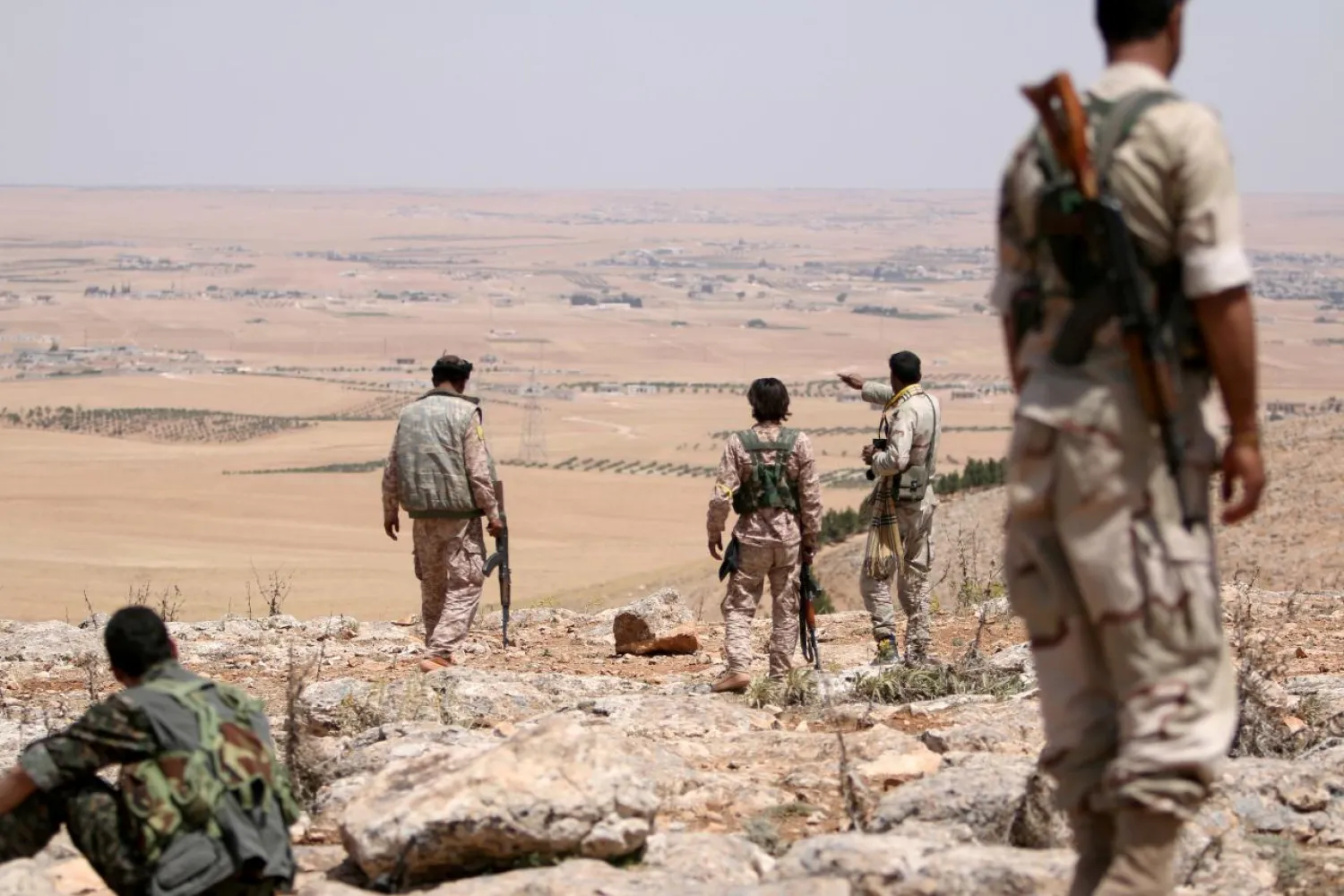
Fighters of the Manbij military council, take an overwatch position in the southern rural area of Manbij, in Aleppo Governorate, Syria. Photo: Reuters
TT

Syria’s Manbij: Dividing Line for External Conflicts

Fighters of the Manbij military council, take an overwatch position in the southern rural area of Manbij, in Aleppo Governorate, Syria. Photo: Reuters

Ismail, 53, didn’t know that his quiet home in the village of Arab Hassan Kabir, on the southern bank of the Sajur River, would one day become a dividing line between two warring sides and that he would sleep every night on the sounds of gunfire and intermittent clashes.

Since mid-2016, the two banks of Sajur River, which is located 15 kilometers north of Manbij in the eastern Aleppo countryside and 30 kilometers south of the Turkish borders, have been transformed into a border strip separating the areas that fall under the control of pro-Turkish Euphrates Shield factions on one hand and the forces of the US-led Manbij Military Council on the other hand.

Manbij is part of Aleppo, 80 km to the north-east and only 40 km from the Turkish borders.

The regime lost control of the city in July 2012, after it was liberated by factions of the Free Syrian Army, and it became under the control of ISIS terrorist organization in the summer of 2014.

However, the "Syrian Democratic Forces" and "Manbij Military Council," with the support of the international coalition, were able to regain control of the city on August 15, 2016 after fierce battles that lasted for more than two months.

“If you turn your face to the west, you will find elements of the Euphrates Shield, accompanied by soldiers and armored vehicles of the Turkish army, and if you look to the east, you will notice the movements of the fighters of Manbij Military Council, accompanied by US soldiers and their military vehicles,” Ismail told Asharq Al-Awsat.

He explained that he lives with his wife and family members in their house, which overlooks Sajur River, and they are accustomed to the new situation that has been created by the divisions of the Syrian war.

“When clashes start between the two parties, we escape and flee from the village to neighboring safe areas, and after these clashes stop, we return back home,” Ismail said.

Yet, he is struggling to continue living his life in light of the fluctuations of the scene in the vicinity of his area, forget the divisions and artificial boundaries, and he hopes that tomorrow will be a better day.

"This situation has been going on for about a year and a half now. God willing, these divisions will end peacefully," he said.

Notably, the 74-kilometer-long Sajur River flows from Turkey and crosses the Syrian border along the Euphrates River in the Ayn Azzah area.

It separates the lands of Aoun al-Daddat, Mahasleni, Arab Hassan, Halawanji and Tukhaz villages, in which they are divided into two parts. Each part falls under the control of a military party that is on a rivalry with the other one, and the river ends by combining with the Euphrates River.



Sudan Paramilitary Strike on Southeastern City Kills 27

RSF fighters. (AFP file photo)
TT

Sudan Paramilitary Strike on Southeastern City Kills 27

RSF fighters. (AFP file photo)

Sudan's paramilitary Rapid Support Forces launched drones at an army base in the southeastern city of Sinja on Monday, killing 27 people, military and health sources told AFP.

Sinja, the capital of Sennar state, lies around 300 kilometers (180 miles) southeast of the capital Khartoum, along a strategic road connecting the national capital to the army-controlled east.

The strike comes a day after the army-aligned government announced its return to Khartoum after close to three years operating from its wartime base in the eastern city of Port Sudan.

Since April 2023, the war between the army and the RSF has killed tens of thousands of people, displaced 11 million internally and across borders, and created the world's largest displacement and hunger crises.

Sinjah had largely been spared the fighting since the army recaptured the area in late 2024 as part of a wider offensive that saw it later retake Khartoum.

The military source, speaking anonymously because they were not authorized to brief the media, said RSF drones "targeted the headquarters of the army's 17th Infantry Division" in Sinja.

Ibrahim al-Awad, the Sennar state health minister, said that the attack carried out by the RSF also wounded 73 people.

A security source told AFP on condition of anonymity that the attack targeted the army headquarters "during a meeting attended by military, security and government officials" from several eastern and central states.

One resident of Sinja told AFP that they "heard explosions and anti-aircraft fire".

The Sennar region had last been targeted by drones in October.

- Fragile return -

In the year following its recapture, more than 200,000 people returned to Sennar state, according to the United Nations' migration agency.

But the agency has warned many such returns across the country remain "fragile", often taking place in areas with damaged infrastructure and ongoing insecurity.

Along with the government, millions of civilians had fled Khartoum early in the war when RSF fighters quickly overran it.

Since the army regained control last year, around 1.2 million have gradually returned, according to the latest UN figures.

Reconstruction efforts are underway, but the RSF, which with its allies now rules around a third of the country, sporadically launches long-range drones deep into army-controlled territory, particularly targeting infrastructure.

The army and its government control Sudan's north, east and center.

The RSF now dominates the vast western region of Darfur and has pushed through the southern region of Kordofan, aiming to capture cities that would bring it closer to Khartoum.

With multiple cities under paramilitary siege, hundreds of thousands face mass starvation in Kordofan.

The UN has called the conflict a "war of atrocities", with both sides accused of targeting civilians.


Drone Strike Kills 3 in Gaza as Hamas Prepares to Transfer Governance to New Committee

 A tent camp for displaced Palestinians stretches across an area in Deir al-Balah, in the central Gaza Strip, Saturday, Jan. 10, 2026. (AP)
A tent camp for displaced Palestinians stretches across an area in Deir al-Balah, in the central Gaza Strip, Saturday, Jan. 10, 2026. (AP)
TT

Drone Strike Kills 3 in Gaza as Hamas Prepares to Transfer Governance to New Committee

 A tent camp for displaced Palestinians stretches across an area in Deir al-Balah, in the central Gaza Strip, Saturday, Jan. 10, 2026. (AP)
A tent camp for displaced Palestinians stretches across an area in Deir al-Balah, in the central Gaza Strip, Saturday, Jan. 10, 2026. (AP)

An Israeli drone strike on Monday killed three Palestinians who had crossed the ceasefire line near central Gaza’s Morag corridor, hospital officials said.

Israel’s military did not immediately respond to questions about the strike, which came as Gaza awaits an expected announcement this week of a “Board of Peace” to oversee its governance.

Hamas said it will dissolve its existing government once the new committee takes over the territory, as mandated under the US-brokered peace plan.

The Gaza Health Ministry reports that more than 440 people have been killed since Israel and Hamas agreed last October to suspend their two-year war. Since then each side has accused the other of violating the ceasefire, which remains in its initial stage as efforts continue to recover the remains of the final Israeli hostage in Gaza.

Israel’s military controls a buffer zone that covers more than half of Gaza, while the Hamas-run government retains authority over the rest.

Throughout the war, Israel has supported anti-Hamas groups, including an armed group in southern Gaza that claimed responsibility on Monday for the killing of a senior Hamas police officer in Khan Younis.

Lt. Col. Mahmoud al-Astal was gunned down in the Muwasi area, the Hamas-run Interior Ministry said in a statement.

Hamas spokesperson Hazem Kassem, in a post on Telegram on Sunday, called for a speeding up of the establishment of the Palestinian technocratic committee set to govern Gaza.

Hamas and the rival Palestinian Authority have not announced the names of who will sit on the committee and it remains unclear if they will be cleared by Israel and the US.

Officials say that Trump will announce his appointments to the Board of Peace in the coming days.

Under Trump’s plan, the board would supervise the new Palestinian government, the disarmament of Hamas, the deployment of an international security force, additional pullbacks of Israeli troops and reconstruction. The US has reported little progress on any of these fronts so far.

According to Turkish officials, Foreign Minister Hakan Fidan participated on Monday in a video conference with the US and others meeting to discuss “preparations for the second stage” of the ceasefire agreement. The talks, held as a continuation of the meeting in Miami at the end of December, also included officials from Egypt and Qatar.

Dozens of Palestinians, including medical workers, held a protest in Gaza City on Monday to demand the release of thousands of Palestinian prisoners still being held in Israeli prisons. The protest was organized by the Palestinian Prisoners Committee outside the building of the International Committee of the Red Cross in Gaza City.

Meanwhile, groups that advocate for Palestinian prisoners said that Israeli authorities have confirmed the death of a detainee from Gaza.

In a statement Sunday, the Prisoners’ Affairs Commission and the Palestinian Prisoner Society said that Hamza Abdullah Abdelhadi Adwan died in prison on Sept. 9, based on information the family received from the Israeli military.

Adwan, 67, a father of nine with serious health problems, had been detained at a checkpoint on Nov. 12, 2024. Two of his children were killed in the Gaza war.

Since the start of the war, 87 Palestinian detainees have died in Israeli prisons — including 51 from Gaza — according to the Palestinian Prisoners’ Affairs Commission. They said that more than 100 detainees — some not yet identified — had died of torture, starvation, medical neglect, and abuse.


Israeli-Backed Group Kills a Senior Hamas Police Officer in Gaza, Threatens More Attacks

Palestinians walk along a road amid destroyed buildings in Jabalia, in the northern Gaza Strip, on January 10, 2026. (AFP)
TT

Israeli-Backed Group Kills a Senior Hamas Police Officer in Gaza, Threatens More Attacks

Palestinians walk along a road amid destroyed buildings in Jabalia, in the northern Gaza Strip, on January 10, 2026. (AFP)

An Israeli-backed Palestinian group said on Monday it had killed a senior Hamas police officer in the southern Gaza Strip, an incident which Hamas blamed on "Israeli collaborators".

A statement from the Hamas-run interior ministry said gunmen opened fire from a passing car, ​killing Mahmoud Al-Astal, head of the criminal police unit in Khan Younis, in the south of the enclave. It described the attackers as "collaborators with the occupation".

Hussam Al-Astal, leader of an anti-Hamas group based in an area under Israeli control east of Khan Younis, claimed responsibility for the killing in a video he posted on his Facebook page. The surname he shares with the dead man, Al-Astal, is common in that part of Gaza.

"To those who work with Hamas, your destiny is to be killed. Death is coming to you," he ‌said, dressed in ‌a black military-style uniform and clutching an assault rifle.

Reuters could ‌not ⁠independently ​verify ‌the circumstances of the attack. An Israeli military official said the army was not aware of any operations in the area.

The emergence of armed anti-Hamas groups, though still small and localized, has added pressure on the movement and could complicate efforts to stabilize and unify a divided Gaza, shattered by two years of war.

These groups remain unpopular among the local population as they operate in areas under Israeli control, although they publicly deny they take Israeli orders. Hamas has held public executions ⁠of people it accuses of collaboration.

Under a ceasefire in place since October, Israel has withdrawn from nearly half of ‌the Gaza Strip, but its troops remain in control of ‍the other half, largely a wasteland ‍where virtually all buildings have been levelled.

Nearly all of the territory's two million people ‍now live in Hamas-held areas, mostly in makeshift tents or damaged buildings, where the group has been reasserting its grip. Four Hamas sources said it continues to command thousands of fighters despite suffering heavy losses during the war.

Israel has been allowing rivals of Hamas to operate in areas it controls. In ​later phases, US President Donald Trump's plan for Gaza calls for Israel to withdraw further and for Hamas to yield power to an internationally backed administration, ⁠but there has so far been no progress towards those steps.

Prime Minister Benjamin Netanyahu acknowledged Israeli backing for anti-Hamas groups in June, saying Israel had "activated" clans, but has given few details since then.

The ceasefire has ended major combat in Gaza over the past three months, but both sides have accused the other of regular violations. More than 440 Palestinians and three Israeli soldiers have been killed since the truce took effect.

Gaza health authorities said on Monday Israeli drone fire killed at least three people near the center of Khan Younis.

The Israeli military did not have an immediate comment on the drone incident.

The war erupted on October 7, 2023 when Gazan fighters invaded Israel, killing about 1,200 people and taking some 250 hostages, according to ‌Israeli tallies.

Israel’s subsequent military assault on Gaza has killed more than 71,000 Palestinians, according to the enclave’s health ministry, and led to accusations of genocide and war crimes, which Israel denies.