The Russia World Cup Has to Save International Football from Crisis

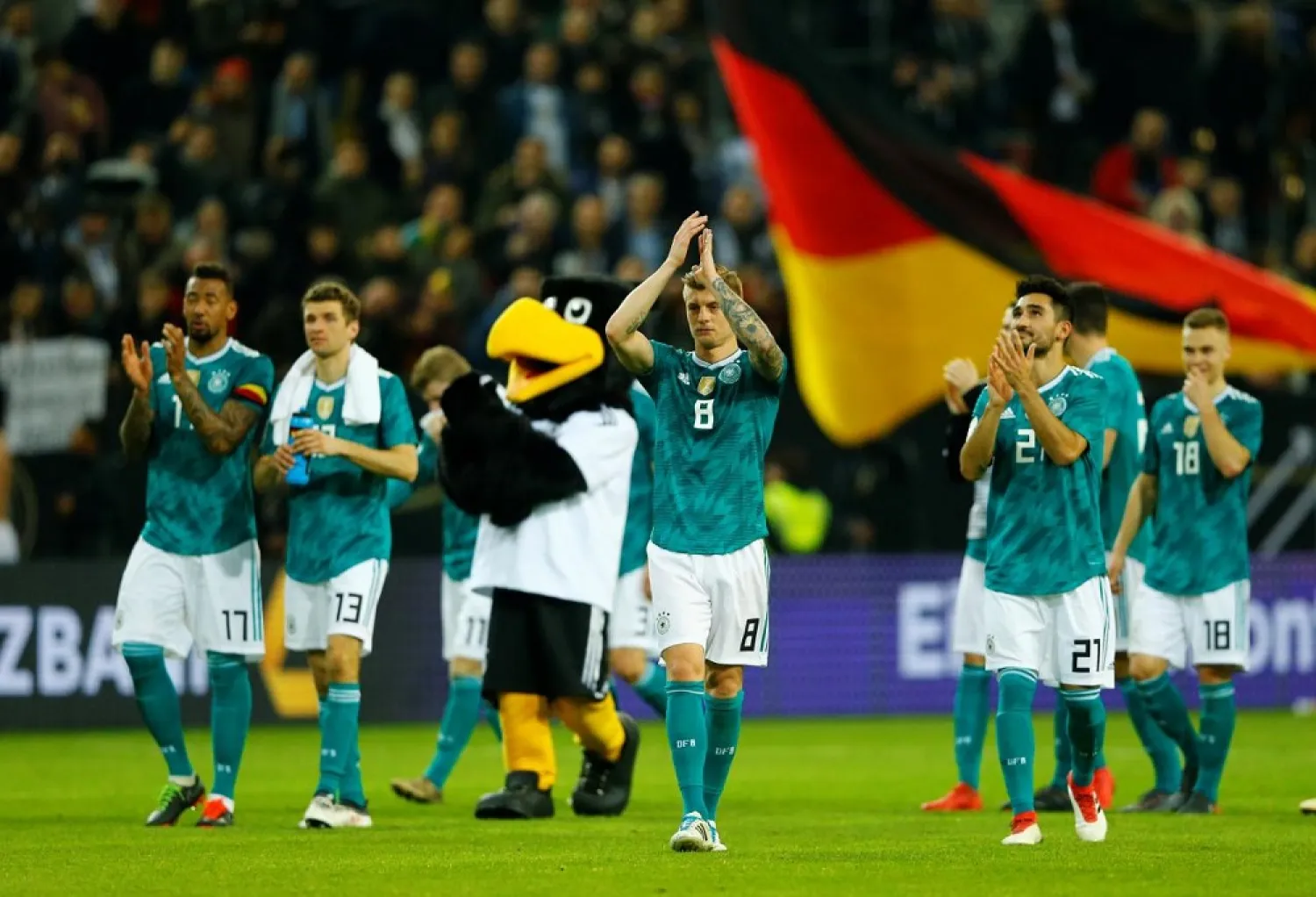
German national team players applaud the fans after their draw with Spain in Dusseldorf on Friday. (Reuters)
TT

The Russia World Cup Has to Save International Football from Crisis

German national team players applaud the fans after their draw with Spain in Dusseldorf on Friday. (Reuters)

As the friendly international spring break descended upon the season like a dose of Sunday afternoon blues, it has become a reflex response among those watching to sigh a little, to count the days, to see this severance from the teat of club football excitement as a draught of cold water, another unwelcome interruption from the dying hand of international football.

In many ways this sense of deflation is a credit to the way the Premier League is sold and packaged. If not quite a reflection of its enduring tensions. It is worth being clear on this point. When the current round of 82 mixed and varied international friendlies has been played, Manchester City will still be miles clear of the field, the Premier League season still reduced to a wrangle to avoid 19th and 18th place. Serie A will still be the only major European league with anything resembling a title race.

In the meantime international football, so often dismissed – with some justification – as a drowned world of by-rote mediocrity, is entering one of its periods of sharpened interest. Many of these games may look enjoyably obscure – Gibraltar vs. Latvia anyone? – or a selection of carefully staged geopolitical oddities (I bring you: Madagascar vs. Kosovo at the Stade Jean Rolland). But there is also something more tangible in train, the first real spark of the World Cup fuse, a kind of base camp for Russia 2018.

This will be the last round of friendlies before the club seasons end, a place where squads are trimmed and sharpened, tactical plans junked or fleshed out. And where we might get a sense of the look and feel of Russia 2018, European football’s last sensible international tournament before the inanities of the multi-nation Euros and Qatar’s winter-sun break.

History suggests there are three key on-field components to a genuinely memorable World Cup. The first is a high-functioning top tier of teams: a pedigree winner and at least one other side touched with a little greatness to chase them across the line.

This often turns on circumstance. The most vivid teams define themselves in fine tournament details. The good news for Russia 2018’s prospects is the likely winners look both impressively stocked and genuinely hard to separate.

Hence, Friday’s round of fixtures and next week’s will produce moments of A-list gold. Argentina played Italy and will meet Spain on Tuesday. Germany played Spain and then face Brazil. Chuck in France, who played Colombia, and history, and indeed most predictions of the future, suggest the winner will come from this bunch.

Germany are deserved favorites, with a method that seems beautifully grooved and some genuine depth in the player pool. Toni Kroos has matured into the real heart of this late-Löw team, all grizzled serial winners and fearless young talent. Germany do not exactly look irresistible. But they seem like a standard to beat, a default winner, supremely well-equipped to retain the title unless someone, somewhere can come up with a reason why not.

Brazil are better under Tite, with less in the way of Neymar-dependence and plenty of elite club football faces. Not to mention a hard core who have played club football in Russia or Ukraine.

Spain’s blend of aging lions and sparky young guns is the usual seductive mix. Watching a midfield containing Isco, Thiago Alcântara and Andrés Iniesta might be an absorbing game within a game in its own right. France could probably pick a last-16 team from players who will not make their squad. Argentina have the greatest club footballer of all time and a rag-bag of talent and scufflers in support. There is enough here for the gears to click, the sense of destiny to take over, for at least one of the obvious A-listers to find its best rhythms.

The second necessity for a functioning tournament is interest elsewhere, a generational moment from one or two of the nearly-theres: think Poland ’82, Holland through the 90s, Romania at USA 94, Colombia last time out. Again next week’s fixtures could offer some hope. Portugal are behind England in the UK betting, laughably, but they have a very decent chance of winning the World Cup.

And throughout the week there are games that look like convincingly drool-worthy World Cup last-16 knockout ties. Poland, currently joint sixth in the Fifa rankings, played Nigeria. Nigeria then play Serbia. Belgium’s blend of muscular defense, attacking brilliance and Roberto Martínez has a one-off against Saudi Arabia.

In the middle of which there is a genuine seam of talent, candidates for breakout success, a run to the semis, haunting penalty shootout agony.

Similarly the final ingredient – the breakout-team, the Cameroon 1990 – also looks intriguingly poised. There will surely be hints this week. South Korea face Poland, Iceland play Peru, Denmark took on Panama. Even England, defiantly touting around their assortment of bafflement and inflated expectation, could surprise everyone by failing to collapse under Gareth Southgate’s cautiously dogged hand.

So far, so familiar. But there is an added urgency too. Whatever your views on international football – and many younger fans, drawn more to individual players, do seem nonplussed by the spectacle of energetic mediocrity wrapped in a flag – it is undoubtedly entering a point of dramatic crisis.

Fifa is desperate for a successful World Cup. The club game continues to soar away into the stratosphere, sucking up coaching talent, setting an unmatchable bar of intensity.

Meanwhile, the World Cup continues to struggle under its self-imposed yoke of corruption and tailing interest, the political difficulties of Russia, even the disaster-in-waiting of badly applied VAR. There is a genuine sense of jeopardy. International football desperately needs this to work out. And it all starts here.

The Guardian Sport


Irish Boxer Lee Reeves Dies at Age 31, Three Months after Dublin Title Fight Injury

Irish boxer Lee Reeves. Reuters
TT

Irish Boxer Lee Reeves Dies at Age 31, Three Months after Dublin Title Fight Injury

Irish boxer Lee Reeves. Reuters

Irish boxer Lee Reeves has died more than three months after being injured during a fight in Dublin, promoter Queensberry said Tuesday. He was 31.

"Everyone at Queensberry is devastated to learn of the passing of Lee Reeves," Queensberry Promotions said in a statement.

Reeves was hospitalized after being knocked out by compatriot Gary Cully in the 10th and final round of their Boxing Union of Ireland Celtic super-lightweight title fight on Aug. 1.

Reeves was carried from the ring on a stretcher after receiving initial treatment.

Queensberry had said after the fight that his condition was critical but stable.

“Lee was an immensely talented boxer, as well as a true role model and inspiration to his community,” the statement added Tuesday, according to The Associated Press. “Our deepest condolences go to Lee’s family, friends and all those who loved him. We ask that their privacy be respected at this incredibly difficult time. Rest in peace, Lee.”


Alonso to Enter Dakar Rally with Loeb and Aston Martin Team

November 5, 2026 Aston Martin's Fernando Alonso during a press conference ahead of the F1 Sao Paulo Grand Prix. (Reuters)
TT

Alonso to Enter Dakar Rally with Loeb and Aston Martin Team

November 5, 2026 Aston Martin's Fernando Alonso during a press conference ahead of the F1 Sao Paulo Grand Prix. (Reuters)

Double Formula One champion Fernando Alonso will compete in next January's Dakar Rally in an Aston Martin Dreadnought entry run by engineering partner Prodrive.

The 45-year-old Spaniard, a 32-time Grand Prix winner and two-time Le Mans 24 Hours winner, will be racing in the annual event for the second time after competing with Toyota in 2020, finishing 13th.

France's nine-time world rally champion Sebastien Loeb and Brazil's reigning world rally-raid champion Lucas Moraes will be his teammates in a three-car entry.

The 49th edition of the Dakar Rally will ‌be held in ‌Morocco from January 9 to 23, with a prologue and first ‌stage ⁠in Portugal, after ⁠being moved from Saudi Arabia due to security concerns.

The 24-round Formula One season is due to start in Bahrain in March after testing in late February.

Alonso, who will again have compatriot and five-time motorcycle Dakar winner Marc Coma as co-driver, is racing in the Las Vegas Grand Prix this weekend. He said he had turned his thoughts to Dakar after deciding to continue in Formula One with Aston Martin.

“In the end, the decision became simple. I wanted to embrace ⁠the challenge completely and take on both Formula One and the ‌Dakar Rally in the same year," he explained in ‌a statement.

"In 2020, Dakar was one of the most challenging and enjoyable experiences of my career. ‌I have enormous respect for this race and the specialists who have mastered it.

"Formula One ‌remains my priority. But I am a racing driver, and challenges like this are why I love competing. I’m looking forward to seeing what we can achieve."

LOEB CHASES FIRST DAKAR WIN

In October, Alonso told reporters at the Singapore Grand Prix that he felt the desert endurance race would be physically ‌incompatible with his Formula One commitments.

Loeb, 52, will also be chasing a first Dakar win after 10 previous attempts that have brought ⁠him 28 stage ⁠wins to date.

“Winning the Dakar is very important to me,” said the Frenchman, who will be partnered by Belgian Fabian Lurquin. “We have come close several times, and the motivation is there to keep working until we achieve it."

The Dreadnought is a digital-only tactical SUV created exclusively for gamers playing "Call of Duty: Modern Warfare 4" that will now be brought into the real world by Prodrive, Aston Martin's partners in endurance GT racing.

The Dakar will be Aston Martin Racing’s debut in the world rally-raid championship.

"Aston Martin's ambition for this program has been clear from the outset: to create a car capable of competing at the front of the world's toughest motorsport event," said Prodrive Chairman David Richards.

"By combining Aston Martin's vision with Prodrive's experience in rallying, endurance racing and Dakar competition, we have built a strong foundation. With an exceptional driver line-up and a highly capable engineering team, we look forward to seeing Dreadnought take on this remarkable challenge."


Owono Does Not Deserve 12-Match Ban Over De Miguel Death, Says Andorra Owner Pique

Equatorial Guinea's goalkeeper #01 Jesus Owono leaves the pitch at half time during the Africa Cup of Nations (CAN) Group E football match between Equatorial Guinea and Algeria at Moulay Hassan Stadium in Rabat on December 31, 2025. (AFP)
TT

Owono Does Not Deserve 12-Match Ban Over De Miguel Death, Says Andorra Owner Pique

Equatorial Guinea's goalkeeper #01 Jesus Owono leaves the pitch at half time during the Africa Cup of Nations (CAN) Group E football match between Equatorial Guinea and Algeria at Moulay Hassan Stadium in Rabat on December 31, 2025. (AFP)

FC Andorra owner Gerard ‌Pique said goalkeeper Jesus Owono did not deserve the 12-match suspension he received following the challenge that led to the death of Tenerife forward Jesus de Miguel.

Owono and De Miguel collided during a Spanish second-tier match on November 2. De Miguel was taken to intensive care and died the following day.

The disciplinary committee of the Spanish football federation (RFEF) banned Owono for violent conduct which resulted in serious ‌injury last week.

"Players, ‌former players, coaches, goalkeepers, everyone has ‌called ⁠it an accident," ⁠Pique said in a video posted on social media late on Monday.

"I truly believe that imposing the maximum sanction on Jesus for this action puts him in a situation he does not deserve, because he is not to blame for all of ⁠this having happened."

Former Barcelona player Pique ‌pointed to the three-match ‌ban handed to Albacete's Jose Corpas for accidentally kicking Sabadell ‌player Quadri Liameed in the head during a ‌recent match in Spain.

"Fortunately Quadri is fine, the consequences in this case were not fatal, and the committee decided to sanction Corpas with three matches," Pique added.

"With ‌all this, my reflection is: what is being sanctioned, the action or the ⁠consequences?"

The RFEF ⁠did not immediately respond to a request for comment outside regular business hours in Spain.

Owono, 25, has withdrawn from Equatorial Guinea's squad for Africa Cup of Nations qualifiers against Zimbabwe this month and Pique said it was unlikely the goalkeeper would return to action as soon as his suspension is up.

"Jesus is going to need far more than 12 matches before he is available and able to compete," he added. "No sanction is going to bring Demi (De Miguel) back to us."