


Palestine Mourns Land Day Victims

Sixteen people were killed during clashes with Israeli forces on Friday. (Reuters)
TT

Palestine Mourns Land Day Victims

Sixteen people were killed during clashes with Israeli forces on Friday. (Reuters)

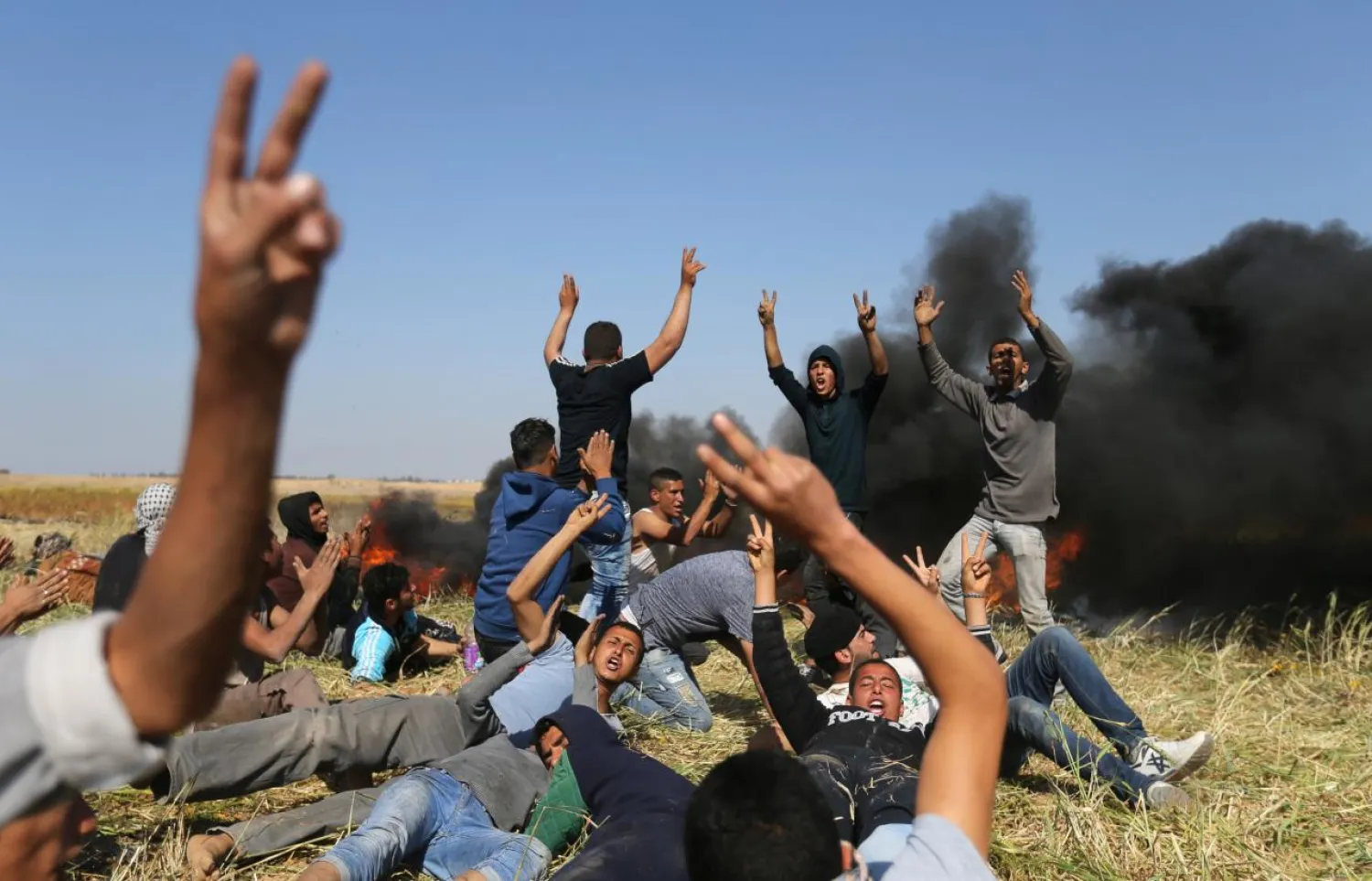
Palestinians in the Gaza Strip buried their dead on Saturday a day after a major demonstration led to clashes with Israeli forces that left 16 dead.

Friday marked the bloodiest day in the coastal strip since the 2015 Israeli offensive against it.

Calls have been made to avenge the dead from Friday’s protests, but only a few hundred demonstrators returned to tents erected at different sites near the Gaza Strip's border with Israel to resume rallies planned to last six weeks in the blockaded enclave.

Gaza's health ministry said 15 people suffered wounds that were not life-threatening in low-level clashes along the border on Saturday.

Thousands attended funerals for 14 of those killed -- two were buried on Friday -- with mourners holding Palestinian flags and some chanting "revenge" and firing into the air.

The armed wing of Hamas said five of those killed were its members who were participating "in popular events side-by-side with their people."

A general strike was being held in both the Gaza Strip and the occupied West Bank.

Minor clashes broke out between Israeli forces and Palestinians in Hebron, while a small protest was held in Nablus, both in the West Bank.

In addition to the 16 Palestinians killed, more than 1,400 were also wounded Friday, 758 of them by live fire, with the remainder hurt by rubber bullets and tear gas inhalation, according to the Gazan health ministry.

Israel defended its soldiers' actions, when troops opened fire on Palestinians who strayed from the main protest camp attended by tens of thousands and approached the heavily fortified fence cutting off the Gaza Strip.

The Israeli military says it opened fire only when necessary against those throwing stones and firebombs or rolling tires at soldiers.

It said there were attempts to damage the fence and infiltrate Israel, while alleging there was also an attempted gun attack against soldiers along the border. No casualties were reported among Israelis.

Palestinians accused Israel of using disproportionate force, saying its soldiers opened fire on protesters who did not pose a threat, while human rights groups questioned Israel's use of live fire.

UN chief Antonio Guterres called for an "independent and transparent investigation" and European Union diplomatic chief Federica Mogherini followed suit, calling in a statement for a probe into Israel's use of live ammunition.

Israeli Defense Minister Avigdor Lieberman issued a scornful rejection of the demands.

"I do not understand the chorus of hypocrites who want a commission of inquiry," he posted in Hebrew on his Twitter account.

Palestinian President Mahmoud Abbas declared Saturday a day of national mourning and in a speech said he held Israel fully responsible for the deaths.

His spokesman on Saturday called on the United States at the UN Security Council to not provide "cover for Israel to continue its aggression against the Palestinian people."

Human Rights Watch criticized Israel's actions.

"Israeli allegations of violence by some protesters do not change the fact that using lethal force is banned by international law except to meet an imminent threat to life," the New York-based group said, calling the number of killed and wounded "shocking."

An Israeli military spokesman said Friday's events were "not a protest demonstration" but "organized terrorist activity" by Hamas, which has fought three wars with Israel since 2008.

The six-week protest is in support of Palestinian refugees and the timetable holds significance for a range of reasons that have added to tensions.

It began on Land Day, when Palestinians commemorate the killing of six unarmed Arab protesters in Israel in 1976, and as Jewish Israelis readied to observe the Passover holiday, which started at sundown on Friday.

Protests will continue until the United States opens its new Jerusalem embassy around May 14, a move that has provoked deep anger among the Palestinians, who see the city's annexed eastern sector as the capital of their future state.

May 14 will also mark 70 years since the creation of Israel, while Palestinians will mark what they call the Nakba, or "catastrophe," the following day.

The Nakba commemorates the more than 700,000 Palestinians who either fled or were expelled from their homes in the war surrounding Israel's creation in 1948.

Israel had deployed troop reinforcements along the border, including more than 100 special forces snipers, saying it would prevent attempts to break through the fence.

Protests along the border are common, often culminating in young Palestinian men throwing stones at Israeli soldiers who respond with tear gas along with rubber and live bullets.

But the "March of Return" protest that began on Friday is on a larger scale and intended to involve families with women and children camping in tent cities near the border for weeks.

Asmaa al-Katari said she participated in the march despite the risks and would join upcoming protests because "life is difficult here in Gaza and we have nothing to lose."

The history student said she is a descendant of refugees from what is now Israel's southern Negev Desert. She said her grandfathers had lived in tents as refugees.

"I want to tell the world that the cause of our grandfathers is not dead," she added.

Gaza resident Ghanem Abdelal, 50, said he hopes the protest "will bring a breakthrough, an improvement, to our life in Gaza."

He had brought his family to a protest tent camp near Gaza City — one of five set up several hundred meters from the border fence — where he distributed water bottles to women and children sitting on a mat.


Rescue Teams Search for Survivors in Building Collapse that Killed at Least 2 in Northern Lebanon

A Lebanese flag is pictured, in the aftermath of a massive explosion, in Beirut's damaged port area, Lebanon August 17, 2020. REUTERS/Hannah McKay
TT

Rescue Teams Search for Survivors in Building Collapse that Killed at Least 2 in Northern Lebanon

A Lebanese flag is pictured, in the aftermath of a massive explosion, in Beirut's damaged port area, Lebanon August 17, 2020. REUTERS/Hannah McKay

At least two people were killed and four rescued from the rubble of a multistory apartment building that collapsed Sunday in the city of Tripoli in northern Lebanon, state media reported.

Rescue teams were continuing to dig through the rubble. It was not immediately clear how many people were in the building when it fell.

The bodies pulled out were of a child and a woman, the state-run National News Agency reported.

Dozens of people crowded around the site of the crater left by the collapsed building, with some shooting in the air.

The building was in the neighborhood of Bab Tabbaneh, one of the poorest areas in Lebanon’s second largest city, where residents have long complained of government neglect and shoddy infrastructure. Building collapses are not uncommon in Tripoli due to poor building standards, according to The AP news.

Lebanon’s Health Ministry announced that those injured in the collapse would receive treatment at the state’s expense.

The national syndicate for property owners in a statement called the collapse the result of “blatant negligence and shortcomings of the Lebanese state toward the safety of citizens and their housing security,” and said it is “not an isolated incident.”

The syndicate called for the government to launch a comprehensive national survey of buildings at risk of collapse.


Israel to Take More West Bank Powers and Relax Settler Land Buys

A view of Israeli settlement of Maale Adumim, in the West Bank, Sunday, June 18, 2023. (AP)
TT

Israel to Take More West Bank Powers and Relax Settler Land Buys

A view of Israeli settlement of Maale Adumim, in the West Bank, Sunday, June 18, 2023. (AP)

Israel's security cabinet approved a series of steps on Sunday that would make it easier for settlers in the occupied West Bank to buy land while granting Israeli authorities more enforcement powers over Palestinians, Israeli media reported.

The West Bank is among the territories that the Palestinians seek for a future independent state. Much of it is under Israeli military control, with limited Palestinian self-rule in some areas run by the Western-backed Palestinian Authority (PA).

Citing statements by Finance Minister Bezalel Smotrich and Defense Minister Israel Katz, Israeli news sites Ynet and Haaretz said the measures included scrapping decades-old regulations that prevent Jewish private citizens buying land in the West Bank, The AP news reported.

They were also reported to include allowing Israeli authorities to administer some religious sites, and expand supervision and enforcement in areas under PA administration in matters of environmental hazards, water offences and damage to archaeological sites.

Palestinian President Mahmoud Abbas said the new measures were dangerous, illegal and tantamount to de-facto annexation.

The Israeli ministers did not immediately respond to requests for comment.

The new measures come three days before Prime Minister Benjamin Netanyahu is scheduled to meet in Washington with US President Donald Trump.

Trump has ruled out Israeli annexation of the West Bank but his administration has not sought to curb Israel's accelerated settlement building, which the Palestinians say denies them a potential state by eating away at its territory.

Netanyahu, who is facing an election later this year, deems the establishment of any Palestinian state a security threat.

His ruling coalition includes many pro-settler members who want Israel to annex the West Bank, land captured in the 1967 Middle East war to which Israel cites biblical and historical ties.

The United Nations' highest court said in a non-binding advisory opinion in 2024 that Israel's occupation of Palestinian territories and settlements there is illegal and should be ended as soon as possible. Israel disputes this view.


Arab League Condemns Attack on Aid Convoys in Sudan

A general view shows the opening session of the meeting of Arab foreign ministers at the Arab League Headquarters (Reuters)
TT

Arab League Condemns Attack on Aid Convoys in Sudan

A general view shows the opening session of the meeting of Arab foreign ministers at the Arab League Headquarters (Reuters)

Arab League Secretary-General Ahmed Aboul Gheit strongly condemned the attack by the Rapid Support Forces on humanitarian aid convoys and relief workers in North Kordofan State, Sudan.

In a statement reported by SPA, secretary-general's spokesperson Jamal Rushdi quoted Aboul Gheit as saying the attack constitutes a war crime under international humanitarian law, which prohibits the deliberate targeting of civilians and depriving them of their means of survival.

Aboul Gheit stressed the need to hold those responsible accountable, end impunity, and ensure the full protection of civilians, humanitarian workers, and relief facilities in Sudan.