

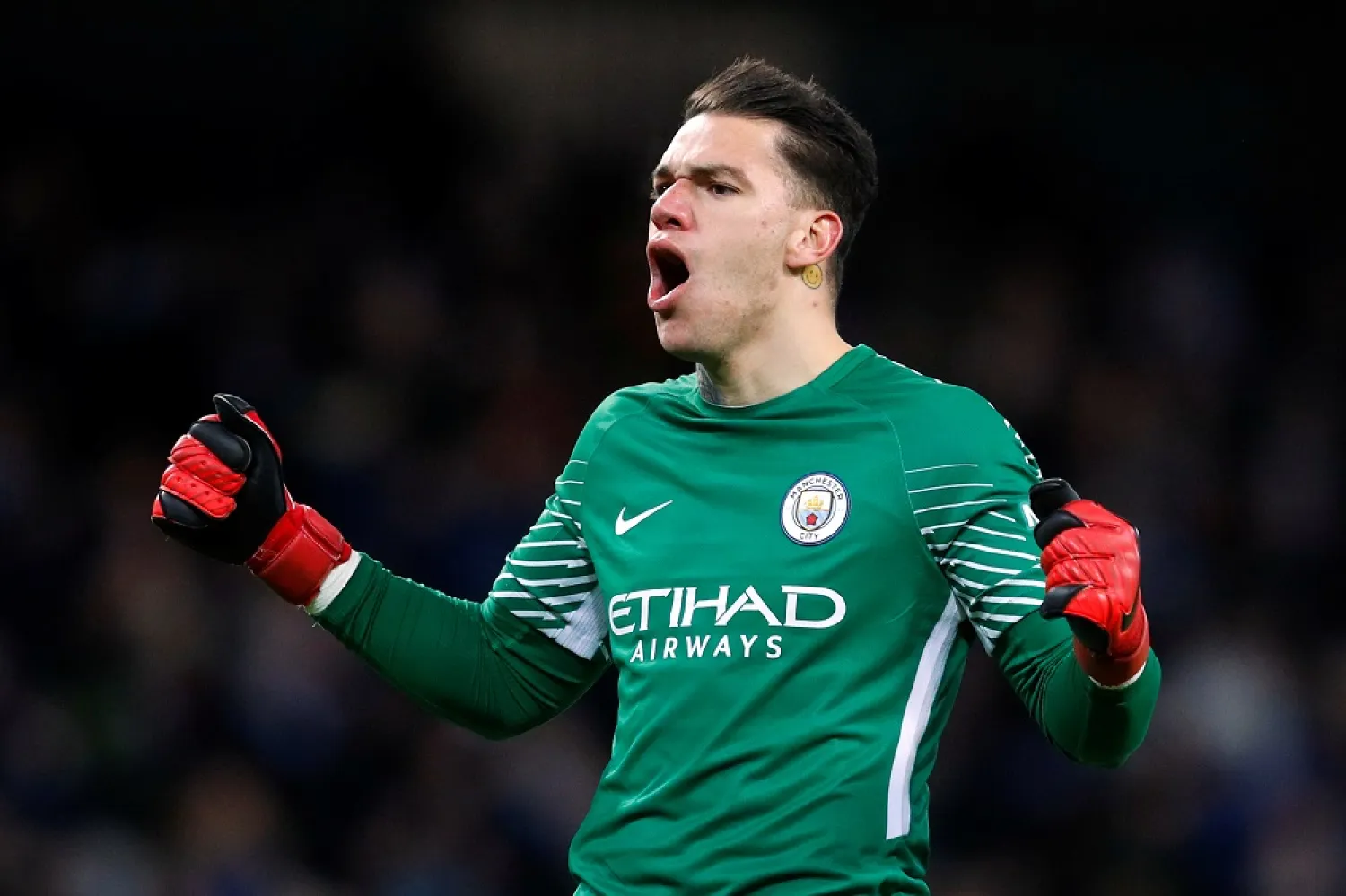

The Making of Ederson: A Goalkeeper with Twinkling Feet and Cold Blood

Manchester City's Ederson. (Reuters)
TT

The Making of Ederson: A Goalkeeper with Twinkling Feet and Cold Blood

Manchester City's Ederson. (Reuters)

Pep Guardiola was a few months into his Manchester City adventure when his team lost 4-0 at the Camp Nou. City had done OK until the 52nd minute when the goalkeeper, Claudio Bravo, tried to play the ball out of defense. It backfired terribly as possession went straight to Luis Suárez and Bravo made matters even worse by handling the Uruguayan’s attempted lob outside his area to get sent off.

It was not Bravo’s first mistake, nor his last. But Guardiola made clear that night he would never abandon his strategy of playing from the back. “I’m sorry but until the last day of my career as a coach I will try to play from our goalkeeper,” he said.

It may not have worked in 2016-17 when the Catalan played Bravo and then Willy Caballero, ending the season trophyless, but in the summer he spent £34.9m on Ederson from Benfica and City have not looked back. They have won their first trophy of the season, are one victory from securing the Premier League and go to Liverpool on Wednesday for the first leg of their Champions League quarter-final. Finally they have a goalkeeper good enough for a club with aspirations to be among the world’s best.

Perhaps it is no wonder that Ederson, who has conceded 26 goals in 38 City appearances, ended up playing for Guardiola. The Brazilian grew up idolizing Rogério Ceni, the former Brazil international who is the top-scoring goalkeeper of all time with 131 goals in his 25-year career at São Paulo. “He is my only idol and will always be my main inspiration,” Ederson said. “I still watch many of his videos making amazing saves and showing his quality to start his team’s play from the back. His quality was extraordinary.”

As a boy Ederson spent hours watching Ceni on TV from the family home in Osasco, a rough area in Greater São Paulo, but he started as a left-back at a football school called Champions Ebenézer FC.

“He came because his older brother was playing with us,” says Gilberto Lopes, better known as Giba, who created the charity team to help youngsters growing up in one of the most violent parts of the suburbs. “As Osasco is a very dangerous town, we have to give a lot of attention to the children. Football is weapon that I use until this day to get the boys off the street.

“As he is left-footed, I started playing Ederson at left-back. He already had a powerful shot but he did not carry ginga [the rhythm] for dribbling, so I pulled him back to be a keeper. With the first shot he caught the ball without dropping it, and that was the beginning.”

Giba was impressed with the progress of this thin (5ft 9in and 123.4lb aged 13) but promising pupil, whose nickname still is, ironically, “Gordo” (Fat boy), and recommended him to a friend at São Paulo’s academy. “I was told that Ederson was already standing out as a goalkeeper,” says Antonio Rodrigues, Ederson’s first coach in the under-13 team, who has been at the club for 18 years. “I was impressed with the precision he had with the ball at his feet and his quickness and agility in goal.”

Ederson’s talent with his feet had been shaped in futsal. “That helped him a lot,” says Victor Severo, a childhood friend from Osasco who also played for São Paulo’s academy and lives with the Ederson family in Cheshire. “He used to play as a goleiro-linha [the so-called ‘fifth man’, a goalkeeper who joins the outfield players] to take advantage of his powerful shot. Due to that, our main tactic was to clear space so he could come from his box to shoot. He was so good with his feet he was challenging to become the top scorer.”

At São Paulo, Ederson was initially well regarded. “São Paulo had a plan to produce Rogerio Ceni’s successor, so our training sessions with the boys had a big focus on footwork,” says Luiz Batista da Silva Junior, then youth goalkeeping coach. “Although he was very shy, Ederson paid attention to all the exercises and learned everything quickly.”

But then Ederson’s dream turned into a nightmare. The phone rang, his mother, Joelma, answered and she was told by a member of São Paulo’s staff that the young goalkeeper was no longer needed.

“It was very sad,” says Severo. “It is terrible to receive this kind of news face to face; imagine how it was for him to find out that way, without a convincing justification. Obviously he will never forget the moments he had at the club but the way he was pushed out is also hurtful. He cried a lot.”

Ederson was encouraged by Giba, his mentor, to resume training in Osasco and it was then that another call changed his life. Someone linked to Jorge Mendes, the super-agent, asked Antonio Rodrigues, Ederson’s former coach, whether he could recommend a promising goalkeeper. “The first name that sprang to my mind was Ederson’s,” recalls Rodrigues. “I kept him in mind because of his huge dedication in training. When the person asked me about Ederson’s best qualities, I clearly remember saying about his distribution, dynamism and agility. Also I said: ‘I am sure that, if he goes to Europe, he will not come back.’”

So Ederson joined Benfica’s academy aged 16. In Portugal, he moved to the second-tier side Ribeirão and then Rio Ave before returning to the Stadium of Light, where he supplanted his compatriot Júlio César and grabbed Guardiola’s attention.

The next call he expects is from the Brazil coach, Tite, to go to Russia 2018. Claudio Taffarel, the 1994 World Cup winner and current Brazil goalkeeping coach, says: “When I started working with Ederson I wondered what his unemotional behavior was all about. I suspected that it could be excessive fear, as he was quite introverted and barely spoke. But over time, after we developed a good relationship, he began to open himself more, both in training and off the pitch, and I noticed that calmness is a very positive part of his personality.”

Ederson, since joining City for a British record fee for a goalkeeper, has proved the doubters wrong not only with his efficiency as a shot-stopper but also – and mainly – with that composure in possession whatever the pressure. “Pretty cold-blooded” is the description used by Taffarel, though he emphasizes that Ederson is not the finished article: “He still has room to improve his decision-making.”

Ederson’s form has established him as Brazil’s No 2, behind Roma’s Alisson. Although the 24-year-old has only one cap, it would be a shock if he were left out of the World Cup squad. “In spite of his young age he is impressively secure and this security is naturally transferred to the team in a very productive way,” Taffarel adds, aware that Brazil have unearthed a talent who should be with them for the long term.

The Guardian Sport


Hospital: Vonn Had Surgery on Broken Leg from Olympics Crash

This handout video grab from IOC/OBS shows US Lindsey Vonn crashing during the women's downhill event at the Milano Cortina 2026 Winter Olympic Games on February 8, 2026. (Photo by Handout / various sources / AFP)
TT

Hospital: Vonn Had Surgery on Broken Leg from Olympics Crash

This handout video grab from IOC/OBS shows US Lindsey Vonn crashing during the women's downhill event at the Milano Cortina 2026 Winter Olympic Games on February 8, 2026. (Photo by Handout / various sources / AFP)

Lindsey Vonn had surgery on a fracture of her left leg following the American's heavy fall in the Winter Olympics downhill, the hospital said in a statement given to Italian media on Sunday.

"In the afternoon, (Vonn) underwent orthopedic surgery to stabilize a fracture of the left leg," the Ca' Foncello hospital in Treviso said.

Vonn, 41, was flown to Treviso after she was strapped into a medical stretcher and winched off the sunlit Olimpia delle Tofane piste in Cortina d'Ampezzo.

Vonn, whose battle to reach the start line despite the serious injury to her left knee dominated the opening days of the Milano Cortina Olympics, saw her unlikely quest halted in screaming agony on the snow.

Wearing bib number 13 and with a brace on the left knee she ⁠injured in a crash at Crans Montana on January 30, Vonn looked pumped up at the start gate.

She tapped her ski poles before setting off in typically aggressive fashion down one of her favorite pistes on a mountain that has rewarded her in the past.

The 2010 gold medalist, the second most successful female World Cup skier of all time with 84 wins, appeared to clip the fourth gate with her shoulder, losing control and being launched into the air.

She then barreled off the course at high speed before coming to rest in a crumpled heap.

Vonn could be heard screaming on television coverage as fans and teammates gasped in horror before a shocked hush fell on the packed finish area.

She was quickly surrounded by several medics and officials before a yellow Falco 2 ⁠Alpine rescue helicopter arrived and winched her away on an orange stretcher.


Meloni Condemns 'Enemies of Italy' after Clashes in Olympics Host City Milan

Demonstrators hold smoke flares during a protest against the environmental, economic and social impact of the Milano-Cortina 2026 Winter Olympics in Milan, Italy, February 7, 2026. REUTERS/Kevin Coombs
TT

Meloni Condemns 'Enemies of Italy' after Clashes in Olympics Host City Milan

Demonstrators hold smoke flares during a protest against the environmental, economic and social impact of the Milano-Cortina 2026 Winter Olympics in Milan, Italy, February 7, 2026. REUTERS/Kevin Coombs

Italian Prime Minister Giorgia Meloni has condemned anti-Olympics protesters as "enemies of Italy" after violence on the fringes of a demonstration in Milan on Saturday night and sabotage attacks on the national rail network.

The incidents happened on the first full day of competition in the Winter Games that Milan, Italy's financial capital, is hosting with the Alpine town of Cortina d'Ampezzo.

Meloni praised the thousands of Italians who she said were working to make the Games run smoothly and present a positive face of Italy.

"Then ⁠there are those who are enemies of Italy and Italians, demonstrating 'against the Olympics' and ensuring that these images are broadcast on television screens around the world. After others cut the railway cables to prevent trains from departing," she wrote on Instagram on Sunday.

A group of around 100 protesters ⁠threw firecrackers, smoke bombs and bottles at police after breaking away from the main body of a demonstration in Milan.

An estimated 10,000 people had taken to the city's streets in a protest over housing costs and environmental concerns linked to the Games.

Police used water cannon to restore order and detained six people.

Also on Saturday, authorities said saboteurs had damaged rail infrastructure near the northern Italian city of Bologna, disrupting train journeys.

Police reported three separate ⁠incidents at different locations, which caused delays of up to 2-1/2 hours for high-speed, Intercity and regional services.

No one has claimed responsibility for the damage.

"Once again, solidarity with the police, the city of Milan, and all those who will see their work undermined by these gangs of criminals," added Meloni, who heads a right-wing coalition.

The Italian police have been given new arrest powers after violence last weekend at a protest by the hard-left in the city of Turin, in which more than 100 police officers were injured.


Liverpool New Signing Jacquet Suffers 'Serious' Injury

Soccer Football - Ligue 1 - RC Lens v Stade Rennes - Stade Bollaert-Delelis, Lens, France - February 7, 2026  Stade Rennes' Jeremy Jacquet in action REUTERS/Benoit Tessier
Soccer Football - Ligue 1 - RC Lens v Stade Rennes - Stade Bollaert-Delelis, Lens, France - February 7, 2026 Stade Rennes' Jeremy Jacquet in action REUTERS/Benoit Tessier
TT

Liverpool New Signing Jacquet Suffers 'Serious' Injury

Soccer Football - Ligue 1 - RC Lens v Stade Rennes - Stade Bollaert-Delelis, Lens, France - February 7, 2026  Stade Rennes' Jeremy Jacquet in action REUTERS/Benoit Tessier
Soccer Football - Ligue 1 - RC Lens v Stade Rennes - Stade Bollaert-Delelis, Lens, France - February 7, 2026 Stade Rennes' Jeremy Jacquet in action REUTERS/Benoit Tessier

Liverpool's new signing Jeremy Jacquet suffered a "serious" shoulder injury while playing for Rennes in their 3-1 Ligue 1 defeat at RC Lens on Saturday, casting doubt over the defender’s availability ahead of his summer move to Anfield.

Jacquet fell awkwardly in the second half of the ⁠French league match and appeared in agony as he left the pitch.

"For Jeremy, it's his shoulder, and for Abdelhamid (Ait Boudlal, another Rennes player injured in the ⁠same match) it's muscular," Rennes head coach Habib Beye told reporters after the match.

"We'll have time to see, but it's definitely quite serious for both of them."
Liverpool agreed a 60-million-pound ($80-million) deal for Jacquet on Monday, but the 20-year-old defender will stay with ⁠the French club until the end of the season.

Liverpool, provisionally sixth in the Premier League table, will face Manchester City on Sunday with four defenders - Giovanni Leoni, Joe Gomez, Jeremie Frimpong and Conor Bradley - sidelined due to injuries.
