
The Real and Remarkable Ray Wilkins Was Always a Joy to Watch

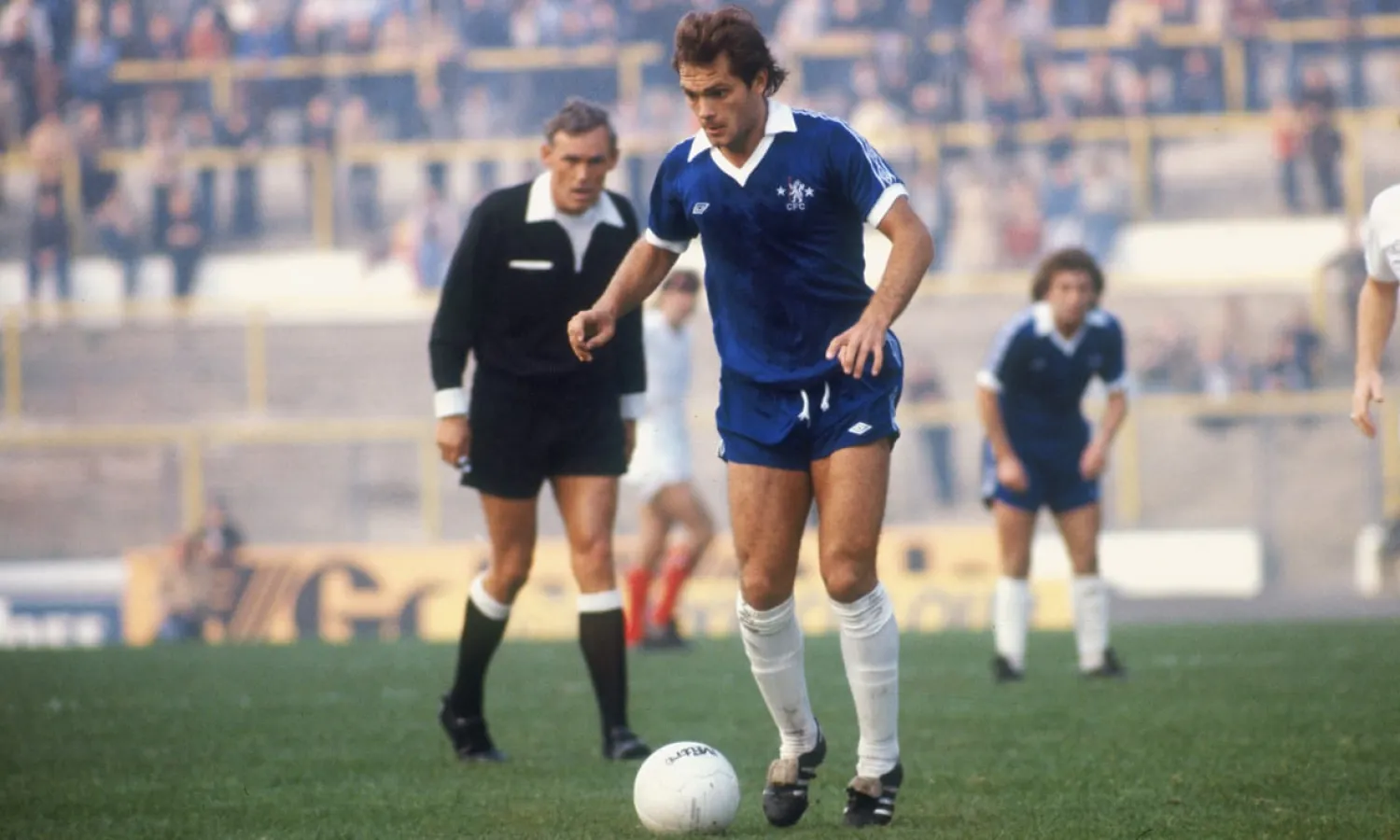
Ray Wilkins in action for Chelsea in the 1970s. Photograph: Getty Images
TT

The Real and Remarkable Ray Wilkins Was Always a Joy to Watch

Ray Wilkins in action for Chelsea in the 1970s. Photograph: Getty Images

In the eyes of all who watched him captaining Chelsea at the age of 18, Ray Wilkins was a golden boy of English football. To an instinctive vision of the game and a superlative range of skills he was already bringing elegance, composure and, most of all, a precocious sense of responsibility that enabled him to instill a sense of purpose into a team who had just been relegated to the old Second Division.

As a classical inside-forward, Wilkins was always a joy to watch. He led Chelsea back into the top tier in his second season as the captain of a team assembled by Eddie McCreadie, a manager willing to put his faith in youth, before taking his qualities to Manchester United, Milan, Paris Saint-Germain and Rangers. He was respected everywhere he went in those years, from the mid-1970s to the end of the 80s.

He left Old Trafford in 1984 as the supporters’ player of the season in a team who also included Bryan Robson and Arnold Muhren, and is warmly remembered at San Siro, where he spent three years during a difficult era for the Rossoneri and made his exit only when a new owner, Silvio Berlusconi, reshaped the squad around a group of Dutch masters at a time when only two foreign players were allowed. His stay with PSG was brief but at Ibrox he won the Scottish league title and wept with the fans when saying his farewell.

His 84 caps for England – 10 of them as captain – came under Don Revie, Ron Greenwood and Bobby Robson. In a midfield where players such as Bryan Robson, Glenn Hoddle and Peter Reid were also vying for places, he was often the victim of that innate sense of responsibility. He would frequently sit deep, holding position, playing a simple ball and encouraging others to take on the creative role to which he was better suited.

In that way he allowed some observers to persuade themselves that he was an unimaginative player, when the opposite was the truth. The delusion was cemented when Ron Atkinson nicknamed him “The Crab”, for his supposed habit of passing sideways. It would not be the last time that Atkinson’s mouth did more damage than he intended.

Wilkins was not a prolific scorer but his goals could be memorable. United’s fans remember an exquisite left-footed curler in the 1983 FA Cup final against Brighton, while Rangers’ supporters cherish another memorable strike, a sweetly timed right-footed volley from outside the area, for Graeme Souness’s side in an Old Firm match in 1988.

His 10-year England career was spoiled near its end by a moment of hot-headedness that was wholly uncharacteristic but had its origins in his better qualities. Bryan Robson, his former United team-mate, and he started the 1986 World Cup finals in Mexico as the twin pivots of England’s midfield, respectively captain and vice-captain.

Robson, however, had been suffering from a dislocated shoulder before the tournament and should not have been included in the squad. When the injury recurred and Robson had to leave the field during the second group match against Morocco, his tournament clearly over, Wilkins’s frustration led him to throw the ball at the referee while disputing a decision. It was the first time an England player had been sent off during a World Cup finals.

Wilkins came from a west London football family – his father had played for Brentford and Nottingham Forest, and his three brothers all played professionally – and he was reluctant to let his playing career go. After touching the heights he was happy to slide gently down the scale, from Queens Park Rangers and Hibernian to fleeting spells at Wycombe Wanderers, Millwall and Leyton Orient, where he hung up his boots after three games in 1997, aged 40. He had made just under 700 league appearances for his 11 clubs in England, Italy, France and Scotland, scoring 49 goals.

By that time he had already spent two years as player-manager at QPR, taking them to eighth in the Premier League in his first season but to relegation in his second. He spent a year as Fulham’s head coach, taking them to the play-offs in the Second Division (as the third tier was then known) before being removed by Mohamed Al Fayed, the owner, who installed Kevin Keegan, previously the club’s chief operating officer, as manager.

Then came three further spells at Stamford Bridge as assistant first to Gianluca Vialli, then to Luiz Felipe Scolari and finally to Carlo Ancelotti. It was a role and an environment that suited Wilkins perfectly, particularly after the arrival of his friend Carletto, a fellow ex-Milanista. Together in 2009-10 they won the first league and Cup double in the club’s history and Wilkins’s first trophies in his long and intimate association with the club.

“Ray is one of those select few, always present, noble in spirit, a real blue-blood,” Ancelotti wrote in his autobiography. “Chelsea flows in his veins.” But one day at the training centre at Cobham, a few weeks into the following season, he was told that his services were no longer required. The reason was never made public, although it was suspected that he may have said something out of turn in the presence of the owner, Roman Abramovich.

That would have been strangely untypical, since Wilkins was the most well-mannered and courteous of football men. In his later years he provided generous-spirited if often anodyne contributions to Sky Sports and Talksport and after receiving a four-year driving ban, admitted to problems with alcohol. He also suffered from ulcerative colitis and underwent a double heart bypass operation last year.

On TV he was talking to an audience who mostly had little knowledge of his prime as a player. Like Abramovich, they had not been present at Stamford Bridge in the mid-70s to see the young captain return an opposition goalkeeper’s clearance straight back into the net from the halfway line, or to witness him play a pass from the edge of his own area and race up the field to meet the return, scoring with a full-length diving header. Nor had they seen the teenager putting a hand on the shoulder of Peter Bonetti to console Chelsea’s veteran keeper for some disastrous error. That was the real and very remarkable Ray Wilkins.

(The Guardian)


Sunderland Worst Hit by Losing Players to African Cup of Nations 

14 December 2025, United Kingdom, London: Sunderland's Habib Diarra (L) and Leeds United's Gabriel Gudmundsson battle for the ball during the English Premier League soccer match between Brentford and Leeds United at the Gtech Community Stadium. (dpa)
TT

Sunderland Worst Hit by Losing Players to African Cup of Nations 

14 December 2025, United Kingdom, London: Sunderland's Habib Diarra (L) and Leeds United's Gabriel Gudmundsson battle for the ball during the English Premier League soccer match between Brentford and Leeds United at the Gtech Community Stadium. (dpa)

Premier League Sunderland will have to do without six players over the next few weeks and are the club worst hit as the Africa Cup of Nations takes its toll on European clubs competing over the holiday season.

Sunderland, eighth in the standings, had four of their African internationals in action when they beat Newcastle United on Sunday, but like 14 other English top-flight clubs will now lose those players to international duty.

The timing of the African championship, kicking off in Morocco on Sunday and running through to January 18, has long been an irritant for coaches, with leagues in Belgium, France, Germany, Italy, Netherlands, Portugal, and Spain also affected.

Hosting the tournament in the middle of the season impacts around 58% of the players at the Cup of Nations, though the Confederation of African Football did try to mitigate the impact by moving the start to before Christmas, so it is completed before the next round of Champions League matches.

The impact on European clubs was also lessened by allowing them to release players seven days, rather than the mandatory 14 days, before the tournament, meaning they could play for their clubs last weekend.

Sunderland's Congolese Arthur Masuaku and Noah Sadiki, plus full back Reinildo (Mozambique), midfielder Habib Diarra (Mali), and attackers Chemsdine Talbi (Morocco) and Bertrand Traore (Burkina Faso) have now departed for Morocco.

Ironically, Mohamed Salah’s absence from Liverpool to play for Egypt should lower the temperature at the club after his recent outburst against manager Arne Slot, but Manchester United will lose three players in Noussair Mazraoui, Bryan Mbeumo and Amad Diallo, who scored in Monday’s 4-4 draw with Bournemouth.

France is again the country with the most players heading to the Cup of Nations, and with 51 from Ligue 1 clubs. But their absence is much less impactful than previously as Ligue 1 broke after the weekend’s fixtures and does not resume until January 2, by which time the Cup of Nations will be into its knockout stage.

There are 21 players from Serie A clubs, 18 from the Bundesliga, and 15 from LaLiga teams among the 24 squads at the tournament in Morocco.


Rodgers Takes Charge of Saudi Team Al-Qadsiah After Departure from Celtic 

Then-Celtic head coach Brendan Rodgers greets supporters after a Europa League soccer match between Red Star and Celtic at Rajko Mitic Stadium in Belgrade, Serbia, Sept. 24, 2025. (AP)
TT

Rodgers Takes Charge of Saudi Team Al-Qadsiah After Departure from Celtic 

Then-Celtic head coach Brendan Rodgers greets supporters after a Europa League soccer match between Red Star and Celtic at Rajko Mitic Stadium in Belgrade, Serbia, Sept. 24, 2025. (AP)

Brendan Rodgers has returned to football as the coach of Saudi Arabian club Al-Qadsiah, six weeks after resigning from Scottish champion Celtic.

Al-Qadsiah, whose squad includes Italian striker Mateo Retegui and former Real Madrid defender Fernandez Nacho, is in fifth place in the Saudi Pro League in its first season after promotion.

Rodgers departed Celtic on Oct. 27 and has opted to continue his managerial career outside Britain for the first time, having previously coached Liverpool, Leicester and Swansea.

In its statement announcing the hiring of Rodgers on Tuesday, Al-Qadsiah described him as a “world-renowned coach” and said his arrival “reflects the club’s ambitious vision and its rapidly growing sporting project.”

Aramco, the state-owned Saudi oil giant, bought Al-Qadsiah in 2023 in a move that has helped to transform the club’s status.

“This is a landmark moment for the club,” Al-Qadsiah chief executive James Bisgrove said. “The caliber of his experience and track record of winning reflects our ambition and long-term vision to establish Al-Qadsiah as one of Asia’s leading clubs.”

Rodgers is coming off winning back-to-back Scottish league titles with Celtic, where he won 11 major trophies across his two spells. He also won the FA Cup with Leicester.

Al-Qadsiah's last two coaches were former Liverpool striker Robbie Fowler and former Spain midfielder Michel.


Portugal to Return to F1 Calendar in 2027 and 2028 

12 July 2025, United Arab Emirates, Abu Dhabi: Red Bull driver Max Verstappen leads into turn one during the Abu Dhabi Grand Prix at the Yas Marina Circuit, Abu Dhabi. (dpa)
TT

Portugal to Return to F1 Calendar in 2027 and 2028 

12 July 2025, United Arab Emirates, Abu Dhabi: Red Bull driver Max Verstappen leads into turn one during the Abu Dhabi Grand Prix at the Yas Marina Circuit, Abu Dhabi. (dpa)

Formula One will return to Portugal's Portimao circuit in 2027 and 2028 after the Dutch Grand Prix at Zandvoort drops off the calendar.

Formula One announced a two-year deal in a statement on Tuesday.

The 4.6-km Algarve International circuit in the country's south last hosted the Portuguese Grand Prix in 2020 and 2021, both seasons impacted by the COVID-19 pandemic with stand-in venues.

In 2020, seven-times world champion Lewis Hamilton took his 92nd career win at Portimao, breaking the record previously held by Michael Schumacher. Hamilton also won in 2021.

"The interest and demand to host a Formula One Grand Prix is the highest that it has ever been," said Formula One chief executive Stefano Domenicali, thanking the Portuguese government and local authorities.

The financial terms of the deal were not announced.

"Hosting the Grand Prix in the Algarve reinforces our regional development strategy, enhancing the value of the territories and creating opportunities for local economies," said Economy Minister Manuel Castro Almeida.

Portugal first hosted a grand prix in Porto in 1958, with subsequent races at Monsanto and Estoril near Lisbon. The late Brazilian great Ayrton Senna took his first grand prix pole and win at the latter circuit in 1985.

Formula One announced last year that Zandvoort, a home race for four-times world champion Max Verstappen, would drop off the calendar after 2026.

The championship already features a record 24 races and Domenicali has spoken of European rounds alternating to allow others to come in.

Belgium's race at Spa-Francorchamps is due to be dropped in 2028 and 2030 as part of a contract extension to 2031 announced last January.