

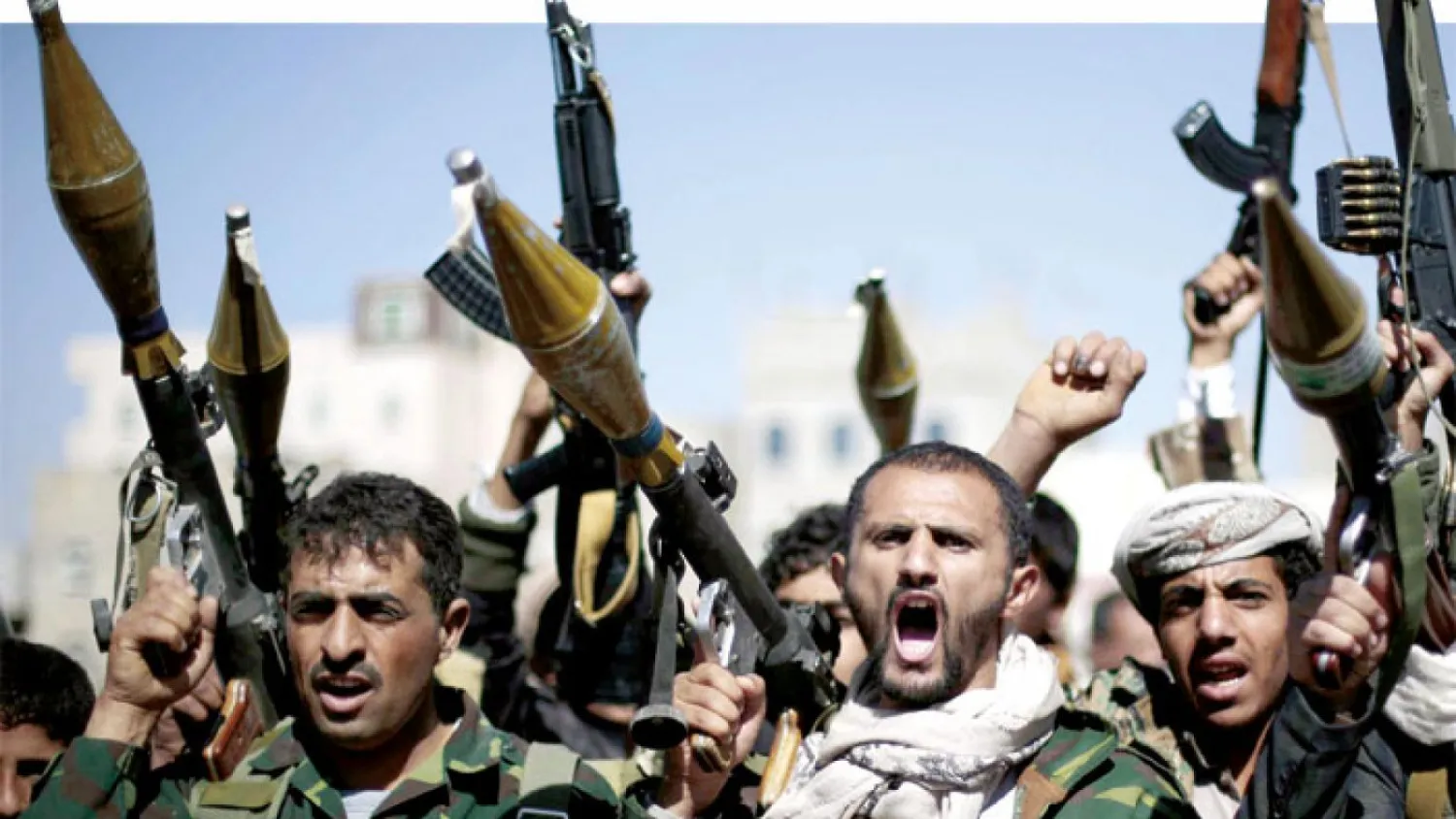

Panic among Houthis as Yemeni Army Advances

Tribesmen loyal to Houthi rebels hold their weapons in Sana’a. (AFP)
TT

Panic among Houthis as Yemeni Army Advances

Tribesmen loyal to Houthi rebels hold their weapons in Sana’a. (AFP)

Leader of Houthi militia is worried of the recent field advancements of Coalition-backed Yemeni army in Saada. This, as tribal and military sources confirmed to Asharq Al-Awsat, led him to call upon a number of leaders descending from Houthis to develop plans to defend the group’s stronghold and warn them of tribesmen’s treachery.

Sources indicated that the leader of the group loyal to Iran, Abdul-Malik al-Houthi, summoned dozens of group’s commanders descendants from Saada to a video meeting, where he spoke to them about the imminent fall of the group's stronghold and his birthplace in the hands of the Yemeni army forces following the collapse among militia ranks.

Houthi's warnings and his new orders have stirred anger among fighters prompting several to retreat from the fighting fronts over the past days, according to tribal sources in Sanaa.

A few days ago, the gunmen of Anas tribe, west Dhamar, held a meeting in which they threatened to retaliate against the group, which they suspect to be behind the mysterious assassination of dozens of tribesmen.

Backed by the coalition, Yemeni army forces raided the coup by opening a new front in Dhaher, west of Saada, and took control over the Camp in al-Malahiz district, following heavy artillery and missile shelling to clear the surrounding mountains, including nearby Marran mountains.

This comes weeks after legitimate forces achieved several advancements on the northern front of Razih governnorate. The forces took control of large areas in Zuhoor mountains near the center of the governnorate, less than 40 kilometers north of Malahiz district.

Sources revealed that the group’s officials called by Houthi for the urgent meeting, included his brother Abdul Khaliq al-Houthi, and his uncle Abdul Karim al-Houthi, and field leader and head of intelligence of the coup government Abu Ali al-Hakim.

Houthi’s leader warned his followers of "treachery of the tribesmen loyal to the group," according to the sources, and ordered them to assign direct Houthi descendants as leaders of fronts and combat groups. He also asked them to inform field commanders to kill any fighter who tries to escape or surrender.

Houthi ordered his commanders to start a mobilization campaign in Sanaa, Amran and Hajjah governorates to recruit members and push them to Marran mountains.

Houthis want to stop government's forces from advancing and compensate hundreds of those killed in the fighting or during air strikes that targeted them as they attempted to advance on fronts around Saada.

Houthis' leader exact whereabouts is not known, however tribal and local sources in Saada, indicated that it is likely that he is still in Saada, without excluding the possibility that he recently might have moved to Sanaa to hide in the group’s safe houses.

In related news, Houthi commanders began on Sunday in Sanaa and Amran a new campaign to mobilize fighters among tribes and former military personnel, given a recent armed gathering in al-Ashah district called by the members of the group in the attempt to attract more recruits to Saada fronts.

In Sanaa, the group tasked its sectarian leader Taha al-Mutawakil with overseeing a campaign to summon ex-servicemen and retirees to force them to go to the fronts.

Official Houthi sources indicated that Mutawakil attended a meeting for the same purpose at the presence of Houthi-appointed governor of Sanaa, Hamoud Abbad, among other officials to develop an alternative plan to call on soldiers and new recruits.

Houthi’s Saba news agency, stated that Abbad ordered local officials in the capital to provide all the necessary resources for the success of the mobilization committee and subcommittees in the directorates, adding that directorates managers should allocate part of their time to work with the committees and help them overcome difficulties.

There is an underlying conflict between different wings of the militia on several levels, according to sources close to the group in Sanaa. Several Houthis from different districts outside Saada are complaining from injustice and most tribesmen complain their orders were not obeyed out by Houthi descendants.



Lebanese PM Says Premature to Talk of Any High-Level Meeting with Israel

Smoke rises as a result of an Israeli strike in the south of Lebanon, as seen from the Upper Galilee in northern Israel, 06 May 2026, amid a ceasefire between Israel and Lebanon. (EPA)
TT

Lebanese PM Says Premature to Talk of Any High-Level Meeting with Israel

Smoke rises as a result of an Israeli strike in the south of Lebanon, as seen from the Upper Galilee in northern Israel, 06 May 2026, amid a ceasefire between Israel and Lebanon. (EPA)

Lebanese Prime Minister Nawaf Salam said it is premature to talk of any high-level meeting between Lebanon and Israel, comments underlining the dim chances of one being held soon as hoped for by US President Donald Trump.

Salam, in comments reported by Lebanon's National News Agency (NNA) on Wednesday, said shoring up a ceasefire would be the basis for any new round of negotiations that might be held by Lebanese and Israeli government envoys in Washington.

Hostilities between Israel and Iran-backed Hezbollah have continued to rage in southern Lebanon despite a US-mediated ceasefire between Lebanon and Israel announced on April 16.

Since ‌Hezbollah triggered the ‌war by opening fire in support of Iran on March ‌2, ⁠the Lebanese administration ⁠led by Salam and President Joseph Aoun has initiated Beirut's highest-level contacts with Israel in decades, reflecting deep divisions between the Shiite group and its Lebanese opponents.

Washington last month hosted two meetings between the Israeli and Lebanese ambassadors to the United States. Hezbollah strongly objects to the contacts.

Announcing a three-week extension of the ceasefire on April 23, Trump said he looked forward to hosting Israeli Prime Minister Benjamin Netanyahu and Aoun in the near future, and that he ⁠saw "a great chance" the countries would reach a peace deal ‌this year.

Salam said Lebanon was not seeking "normalization with Israel, but ‌rather achieving peace".

The current circumstances "are not ripe to talk about high-level meetings," he added, according to NNA.

"Our ‌minimum demand is a timetable for Israel’s withdrawal," he said, adding that the government ‌would develop its plan to restrict weapons to state control - an effort aimed at securing Hezbollah's disarmament.

Aoun said this week the timing was not right for a meeting with Netanyahu. Lebanon "must first reach a security agreement and a halt to the Israeli attacks, before we raise the issue of a meeting ‌between us," he said.

TRADING BLOWS

Israel has occupied a so-called security zone extending as deep as 10 km (6 miles) into southern ⁠Lebanon, saying it aims ⁠to protect northern Israel from Hezbollah militants embedded in civilian areas.

Hezbollah and Israel have continued to trade blows.

Lebanon's Health Ministry said on Wednesday an Israeli airstrike killed four people including two women and an elderly man in the town of Zelaya in southern Lebanon.

The Israeli military said Hezbollah had launched explosive drones and rockets towards Israeli soldiers in southern Lebanon, injuring two Israeli soldiers.

It also said the Israeli air force intercepted a hostile aircraft before it crossed into Israel, and announced strikes on Hezbollah infrastructure in several areas in Lebanon.

More than 2,700 people have been killed in the war in Lebanon since March 2, the Health Ministry says.

The Israeli military says Hezbollah has fired hundreds of rockets and drones at Israel since March 2. Israel has announced 17 soldiers have been killed in southern Lebanon, along with two civilians in northern Israel.


EU Urged to 'Act Now' on West Bank Settlement Project

The Palestinian village of Turmus Ayya (foreground) and the Israeli settlement of Shilo (background), north of Ramallah in the Israeli-occupied West Bank, are pictured on May 6, 2026. (Photo by Zain JAAFAR / AFP)
TT

EU Urged to 'Act Now' on West Bank Settlement Project

The Palestinian village of Turmus Ayya (foreground) and the Israeli settlement of Shilo (background), north of Ramallah in the Israeli-occupied West Bank, are pictured on May 6, 2026. (Photo by Zain JAAFAR / AFP)

More than 400 former diplomats, ministers, and senior officials on Wednesday urged the European Union to "act now" against Israel's "illegal" settlements in the occupied West Bank.

The open letter comes as Israel intends to move forward with E1, a new construction project covering around 12 square kilometers (4.6 square miles) with some 3,400 housing units in the occupied West Bank.

The move would further separate east Jerusalem, occupied and annexed by Israel and predominantly inhabited by Palestinians, from the West Bank.

"The EU and its member states, together with partners, must take immediate action to deter Israel from further advancing its illegal annexation of Palestinian land in the West Bank," said the letter signed by more than 440 figures, including former EU foreign policy chief Josep Borrell and former Belgian prime minister Guy Verhofstadt.

The signatories called for targeted sanctions, such as visa bans and business restrictions, on "all those engaged in illegal settlement activity", calling for measures against those promoting or implementing the E1 scheme.

The Israeli government plans to publish an initial tender on June 1 for the construction of housing for up to 15,000 "illegal settlers", AFP quoted the letter as saying, urging the EU and its member states to "act now".

The plan has been condemned by international leaders, with UN Secretary General Antonio Guterres's spokesman saying it would pose an "existential threat" to a contiguous Palestinian state.

Excluding east Jerusalem, more than 500,000 Israelis live in the occupied West Bank in settlements that are illegal under international law, among some three million Palestinians.

In 2025, the expansion of Israeli settlements reached its highest level since at least 2017, when the United Nations began tracking data, according to a UN report.

There has been a spike in deadly attacks by Israeli settlers in the occupied West Bank since the start of the Iran war on February 28, Palestinian officials and the United Nations have said.

Israel has occupied the West Bank since 1967.


Israel Army Says Striking Hezbollah Targets across Lebanon

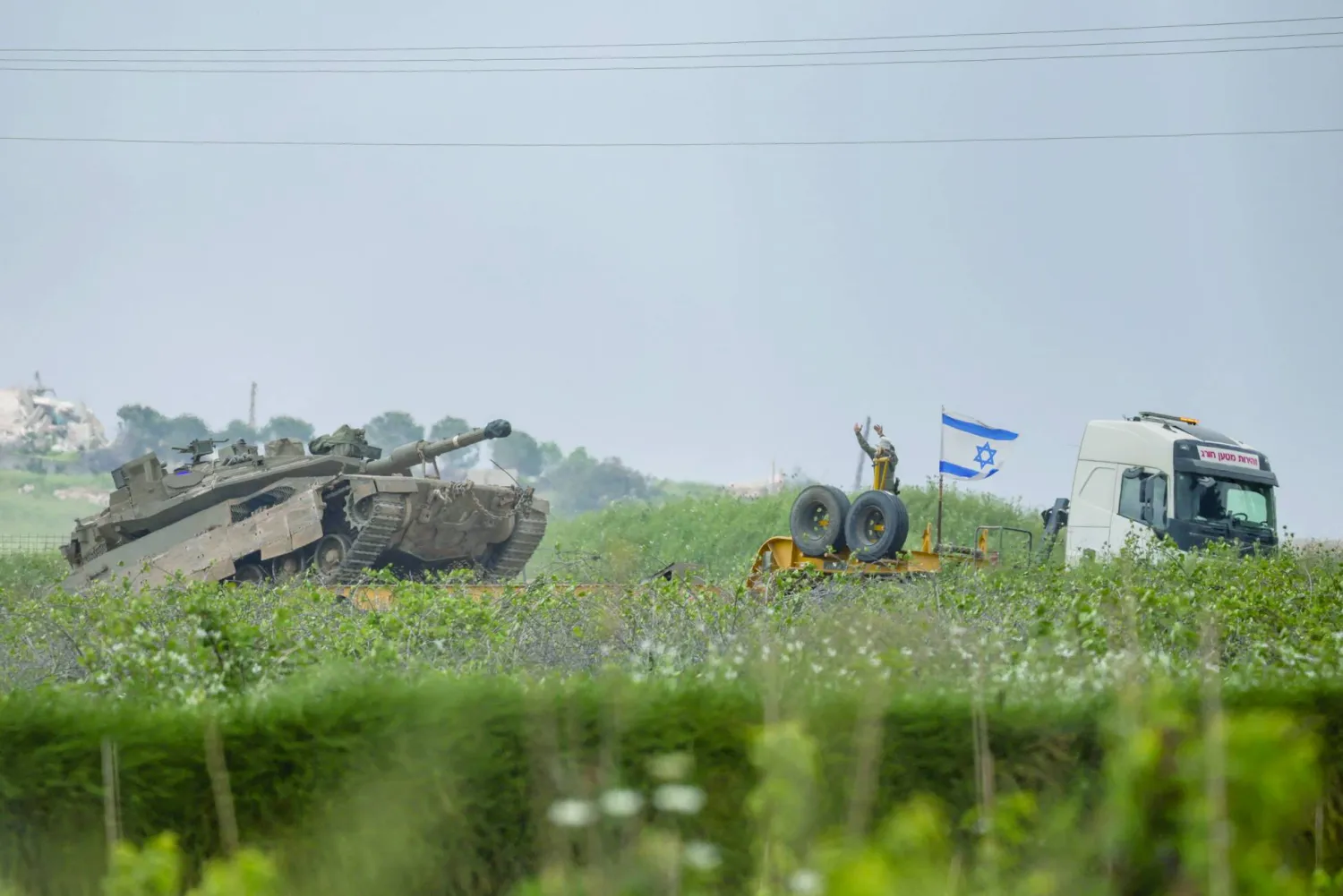
An Israeli soldier gestures next to a tank, on the Israeli side of the border with Lebanon, May 3, 2026. REUTERS/Shir Torem
TT

Israel Army Says Striking Hezbollah Targets across Lebanon

An Israeli soldier gestures next to a tank, on the Israeli side of the border with Lebanon, May 3, 2026. REUTERS/Shir Torem

Israel's army said Wednesday it had begun striking Hezbollah infrastructure in several areas of Lebanon, despite a truce with the neighboring country intended to halt fighting with the Iran-backed militant group. 

"The IDF has begun striking Hezbollah terror infrastructure sites in several areas in Lebanon," a military statement said. 

It came shortly after the army reported "several incidents" during which drones exploded near Israeli soldiers operating in Lebanon's south.  

Lebanon's health ministry said an Israeli strike in Lebanon's eastern Bekaa valley killed four people, with local media reporting the attack took place before the Israeli army issued a warning to evacuate the area along with 11 other towns. 

"An Israeli enemy raid on the town of Zellaya in West Bekaa resulted in four martyrs, including two women and an elderly man," the ministry said. 

Lebanese state media said the attack struck the house of the town's mayor, killing him and three members of his family.