

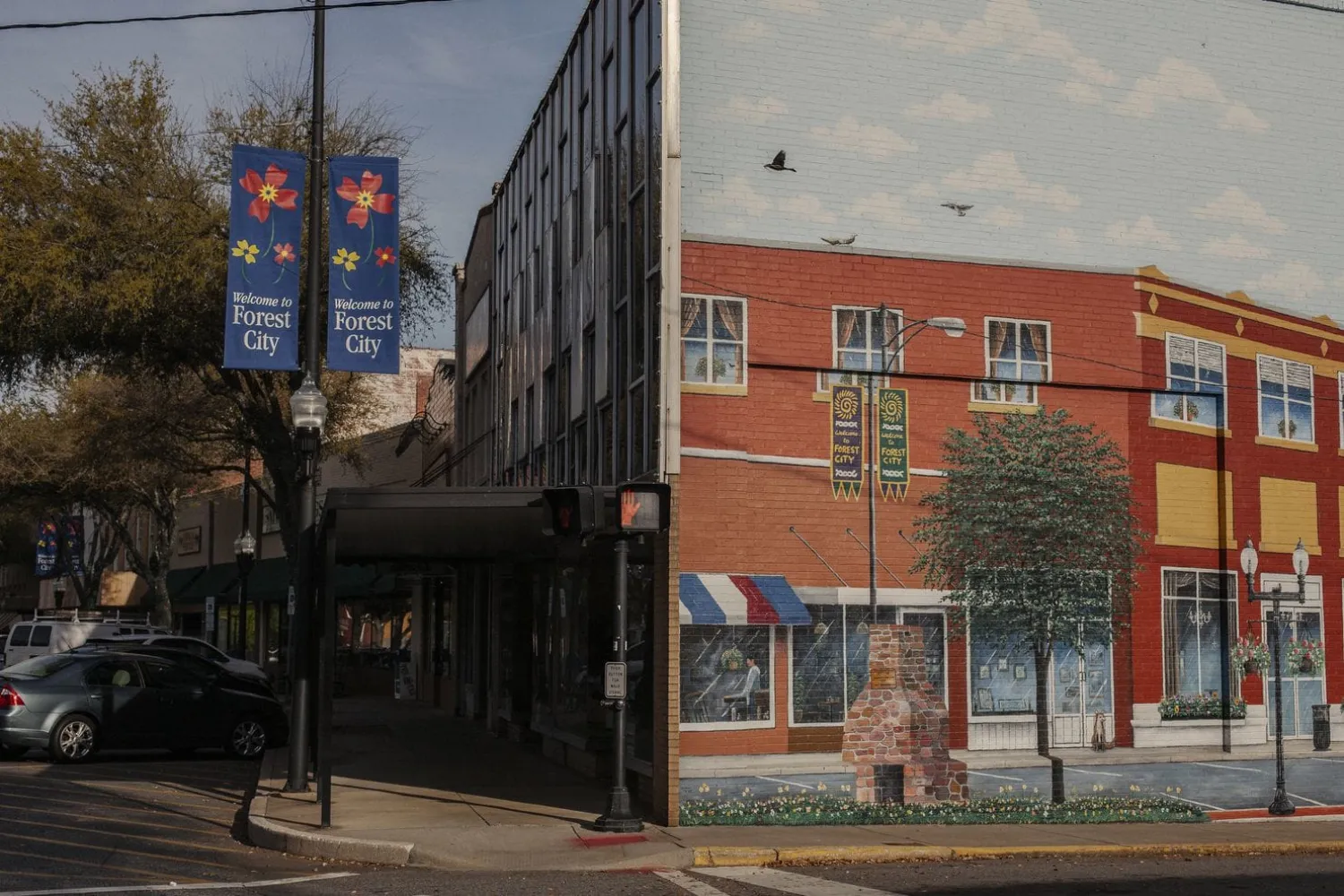

Facebook Stores its Data in this Rural Town, Where the Privacy Debate is Just Beginning to Catch On

Signs and a mural welcome visitors to downtown Forest City. (Jacob Biba/For The Washington Post)
TT

Facebook Stores its Data in this Rural Town, Where the Privacy Debate is Just Beginning to Catch On

Signs and a mural welcome visitors to downtown Forest City. (Jacob Biba/For The Washington Post)

It was slow at the thrift shop, and manager Stephanie Henderson, 38, was looking at her laptop, trying to discover all that Facebook had collected on her: the posts, the memes, the photos, the messages to her family.

She had been meaning to do this for weeks, ever since outrage over Facebook’s handling of user privacy first burst into her timeline. Now, she clicked a button. Her request for her Facebook data was sent. As she waited, Henderson tried to imagine what a decade’s worth of personal details might look like.

“I’m afraid to see what Facebook has on me,” she said. “This is just so embarrassing.”

Facebook has been on the defensive about user privacy since last month’s revelation that political-data firm Cambridge Analytica improperly harvested the profiles of 87 million Facebook users. The social media giant pledged reforms while also divulging that “malicious actors” could have collected the personal data of most of its 2 billion users worldwide. Facing intense criticism, chief executive Mark Zuckerberg testified before Congress on Tuesday, repeatedly offering apologies and attempting to explain the social network’s business model. He planned to continue testifying Wednesday.

The privacy debate raging in policy and corporate circles can feel distant in rural western North Carolina, but Forest City plays an unusual role: It is home to a massive Facebook data center, one of just four in the United States, digital attics where the company stores the information at the center of the current controversy. The Facebook user data obtained by Cambridge Analytica and others has probably spread far out of reach, experts say, to other databases and the dark Web. But it is also here — in bytes stored on tens of thousands of computer servers tucked inside three well-guarded and ever-expanding buildings — that the amorphous discussion about privacy is made concrete.

And residents like Henderson are just starting to dig in — both creeped out by what they find and resigned to an online world where the loss of privacy is taken for granted.

“It surprises me that they have all this stuff,” Henderson said, scrolling through her personal Facebook archive.

Henderson’s data is probably stored just on the other side of town, at the Facebook complex next to U.S. Route 74. It’s in the middle of a construction boom, part of a rapid expansion that includes plans to beef up existing Facebook data centers and build five new ones across the country. The gray warehouses are ringed by security cameras and thick steel fences. The data center has its own electrical substation next door. Beyond that are a few houses and rolling pastures for cows and horses.

Facebook choose Forest City in 2010 because the town sits near the slopes of the Blue Ridge Mountains in an isothermal belt that provides unusually consistent weather. The Facebook property is worth about $650 million today, according to municipal records, accounting for nearly half of the entire town’s value. But only about 250 people work there, in a town with a population of 7,400. Forest City has more computer servers than people.

Kenneth Odom often finds himself curious about the data center, which he passes on his way to work each day.

“A lot of my stuff is probably sitting in that building,” said Odom, an information technology specialist with the county library.

He’s cautious online — more of a Facebook “lurker” than an active “poster.” But he and the rest of the library staff have long wanted to teach the public how to protect themselves online. So a couple of months ago they hosted a Facebook privacy class. They hoped for a big draw.

“Maybe one person showed up,” Odom said.

But the topic, especially in the wake of the Cambridge Analytica scandal, has sparked debate — at least among library staffers.

“I don’t feel like a trust has been broken,” said Tamara Edwards, youth services librarian.

April Young, director of county libraries, asked: “But don’t you think that’s because you know how all this works?”

“It seems no different than the information they collect when you swipe your loyalty card at the grocery store,” Edwards said.

Still, Edwards admitted to being “creeped out” by the feeling of being watched online. After she researches teen fiction on her work computer, her Kindle at home sometimes recommends that she read vampire romance novels. Once, library staffers were talking about something in the office, and Edwards later saw ads for it on Facebook, as though the computer were eavesdropping.

Jerred Roberts, who owns Puzzle Creek Outdoor, finds what Facebook is doing with data both “scary” and “interesting.” He uses Facebook as a small-business owner to place ads, and he marvels at its ability to target people who, for example, ride bicycles and live in the county. Otherwise he uses it to keep up with far-flung friends and family.

“It does get a little weird, though, when my data is being shared with various groups in any way they want to use it,” Roberts said, “and that can be in ways that doesn’t line up with my political and religious beliefs.”

A customer overheard Roberts and, after inquiring about a product to clean his bicycle drivetrain, said Facebook’s recent privacy problems led him to finally delete his account.

“That’s what pushed me over the edge,” Scott Griffith said.

It wasn’t easy. He had to research the process, and it took two weeks to complete. He wasn’t even sure it was finalized. He asked Roberts to check. Roberts tried searching for him on Facebook on the store’s computer.

“Nope, I don’t see you,” Roberts said.

“Good,” Griffiths said.

While deleting Facebook is rare, several residents spoke of pulling back from sharing intimate details on their social media pages because of the recent privacy trouble. This is part of a larger worry for Facebook, which recently noted that at the end of 2017 it suffered “a slight decline” in the number of daily active users in the United States and Canada after years of growth.

At the Second Chances thrift shop, which benefits Brother Wolf Animal Rescue, Henderson was clicking through file after file in her Facebook data archive, teasing out bits of what she had assumed was information lost to history. There was an old selfie shot — “Oh, I look so much younger,” she said — and a local news piece on ATM skimmers that she didn’t remember sharing. GIFs she’d sent to friends. Apps she’d downloaded onto her phone. A list of everyone who had “poked” her on Facebook and how many times.

“It doesn’t really bother me if this stays on Facebook,” she said, “but if they share this with other people, that’s scary.”

Then she found lists of books she’d read. It looked as though they came from her Goodreads app. But she didn’t know for sure. It was an unsettling jumble of information, shards that perhaps could be assembled into some kind of useful profile for someone, but not her. This didn’t feel as though it was about her.

It started to feel overwhelming. File after file after file.

There was just one thing left to do. It was a temporary fix, only for the night.

She logged out of Facebook.

The Washington Post


Bill Gates Tells Lawmakers Meeting Epstein Was a ‘Grave Error in Judgment’ in Closed-Door Hearing

 Bill Gates, co-founder of Microsoft, arrives on Capitol Hill for a closed-door interview with the House Oversight Committee investigating convicted sex offender Jeffrey Epstein, in Washington, Wednesday, June 10, 2026. (AP)
Bill Gates, co-founder of Microsoft, arrives on Capitol Hill for a closed-door interview with the House Oversight Committee investigating convicted sex offender Jeffrey Epstein, in Washington, Wednesday, June 10, 2026. (AP)
TT

Bill Gates Tells Lawmakers Meeting Epstein Was a ‘Grave Error in Judgment’ in Closed-Door Hearing

 Bill Gates, co-founder of Microsoft, arrives on Capitol Hill for a closed-door interview with the House Oversight Committee investigating convicted sex offender Jeffrey Epstein, in Washington, Wednesday, June 10, 2026. (AP)
Bill Gates, co-founder of Microsoft, arrives on Capitol Hill for a closed-door interview with the House Oversight Committee investigating convicted sex offender Jeffrey Epstein, in Washington, Wednesday, June 10, 2026. (AP)

Bill Gates said Wednesday that he made a “grave error in judgment" by ever meeting with Jeffrey Epstein as the Microsoft co-founder faced questions behind closed doors from lawmakers about his relationship with the disgraced financier.

In an opening statement provided to The Associated Press, Gates said he “should never have met with Epstein in the first place,” but that he “never witnessed nor had any indication that Epstein was engaged in ongoing criminal conduct.”

The tech billionaire became the latest powerful figure linked to Epstein to testify before the House Oversight Committee. As Gates arrived at the Capitol, he noted that he was there voluntarily and said he hoped his testimony would be useful.

“I hope my testimony is helpful to the work, the important work, of the committee, to find justice for the victims,” he said.

The committee chairman, Republican US Rep. James Comer, formally requested that Gates testify after he appeared multiple times in a trove of documents released by the Justice Department as part of its Epstein probe. Before the interview on Wednesday, Comer told reporters that “no one’s accusing Bill Gates of any wrongdoing.”

“This is about the survivors" of Epstein and his confidant Ghislaine Maxwell. "This is about trying to figure out how the government failed,” Comer said.

Gates said he was introduced to Epstein through people involved in his professional and philanthropic work and was drawn in by Epstein’s claims that he could help raise billions of dollars for global health initiatives. Gates says he ended the relationship in 2014 after concluding Epstein could not deliver on those promises.

Gates added that he never went to Epstein's island or his other infamous properties.

“I have never victimized anyone. While he may have sought to foster a personal relationship, I was never interested in that and never reciprocated,” Gates said.

The remarks come as lawmakers review documents detailing Gates’ interactions with Epstein. Included in the files are calendar entries for meetings between Gates and Epstein, email correspondence between the two about philanthropic projects and photos of Gates at events that Epstein also attended.

Their relationship began in 2011, three years after Epstein pleaded guilty in Florida to soliciting prostitution from a minor, and continued until at least late 2014, according to the documents.

Gates, who chairs the Gates Foundation, has not been accused of wrongdoing in connection with Epstein and has repeatedly denied any knowledge of Epstein’s abuse of girls. He has said the two met only to discuss philanthropy and previously described the relationship as “a huge mistake.”

Both Gates and his ex-wife, Melinda French Gates, have said his association with Epstein created tension in their marriage.

The foundation acknowledged in February that a small number of employees had met with Epstein based on his “claims that he could mobilize significant philanthropic resources for global health.” They never created a charitable fund together, and the foundation made no payments to Epstein.

Epstein was federally indicted in July 2019 on charges of sex trafficking of minors and conspiracy to commit sex trafficking of minors. The Justice Department alleged that Epstein formed a vast network of girls, some as young as 14, for him to sexually abuse between 2002 and 2005. He died by suicide in a New York jail cell in 2019 while awaiting trial.

The files released by the Justice Department read like a who’s who of powerful men across tech, finance, politics and other industries. All have denied involvement in Epstein’s crimes, but some maintained or formed friendships with him even after his history of sexual abuse came to light.

At another closed-door deposition in February, former President Bill Clinton faced more than six hours of questioning from lawmakers about his association with Epstein more than two decades ago. Epstein visited the White House several times during Clinton’s presidency, and Clinton flew occasionally on Epstein's private jet.

The former Democratic president said he saw no signs of Epstein’s sexual abuse and stopped associating with him long before Epstein's 2008 guilty plea. Clinton has not been accused of any wrongdoing in connection with Epstein.


UN Chief Warns of Risk of Return to ‘Full War’ in Middle East

UN Secretary General Antonio Guterres speaks during a United Nations Security Council meeting on the Middle East, at UN Headquarters in New York, on June 10, 2026. (AFP)
TT

UN Chief Warns of Risk of Return to ‘Full War’ in Middle East

UN Secretary General Antonio Guterres speaks during a United Nations Security Council meeting on the Middle East, at UN Headquarters in New York, on June 10, 2026. (AFP)

United Nations chief Antonio Guterres warned Wednesday of the risk of return to "full war" in the Middle East after Iran and the United States traded strikes.

His intervention came after Iran and the United States once again traded fire following the downing of an American helicopter, further straining a ceasefire that took effect in April but has been marked by sporadic flare-ups of violence.

"We should not minimize the risks of a lesser fire becoming full fire, or in another word -- full war," Secretary-General Guterres said at a meeting of the UN Security Council devoted to the situation in the Middle East.

The UN rights chief echoed Guterres, saying he was "horrified by the fact that we see escalation upon escalation."

"We have, I mean, we're always very relieved when ceasefires are announced, but ceasefires need to be respected in full. International law needs to be respected in full," said the UN High Commissioner for Human Rights Volker Turk in Geneva.

The war, which began with US-Israeli strikes on Iran, threw the region into chaos and rattled global markets before the shaky truce began.

Iran said it attacked Jordan and Bahrain on Wednesday after US forces carried out strikes on the country in retaliation for the downing of a helicopter.


Pentagon’s Hegseth Warns Cuba That Arms Procurement Could Invite Confrontation

US Defense Secretary Pete Hegseth delivers a speech at the US cemetery to commemorate the 82nd anniversary of the D-Day landings, in Colleville-sur-Mer, Normandy, France, Saturday, June 6, 2026. (AP)
TT

Pentagon’s Hegseth Warns Cuba That Arms Procurement Could Invite Confrontation

US Defense Secretary Pete Hegseth delivers a speech at the US cemetery to commemorate the 82nd anniversary of the D-Day landings, in Colleville-sur-Mer, Normandy, France, Saturday, June 6, 2026. (AP)

US Defense Secretary Pete Hegseth warned the government of Cuba on Wednesday against seeking weapons that could strike the US homeland or the US naval base at ‌Guantanamo Bay, ‌saying it would invite ‌a ⁠confrontation Havana would ⁠not endure.

Hegseth, speaking to US troops during a visit to the US base, said still he held out hope ⁠for a positive ‌relationship with ‌Cuba.

“It would be unwise of ‌the government of Cuba ‌to try to procure or get access to the types of weapons that ‌could reach this base or the American homeland,” Hegseth ⁠said, ⁠without offering specifics on weaponry.

“They would be inviting the kind of confrontation not only do they not want but they could not stand. No country on Earth can match the capabilities of the United States of America.”
