


‘Football Changes, Real Madrid Remain’ – How Ronaldo and Co Broke Juventus’ Hearts

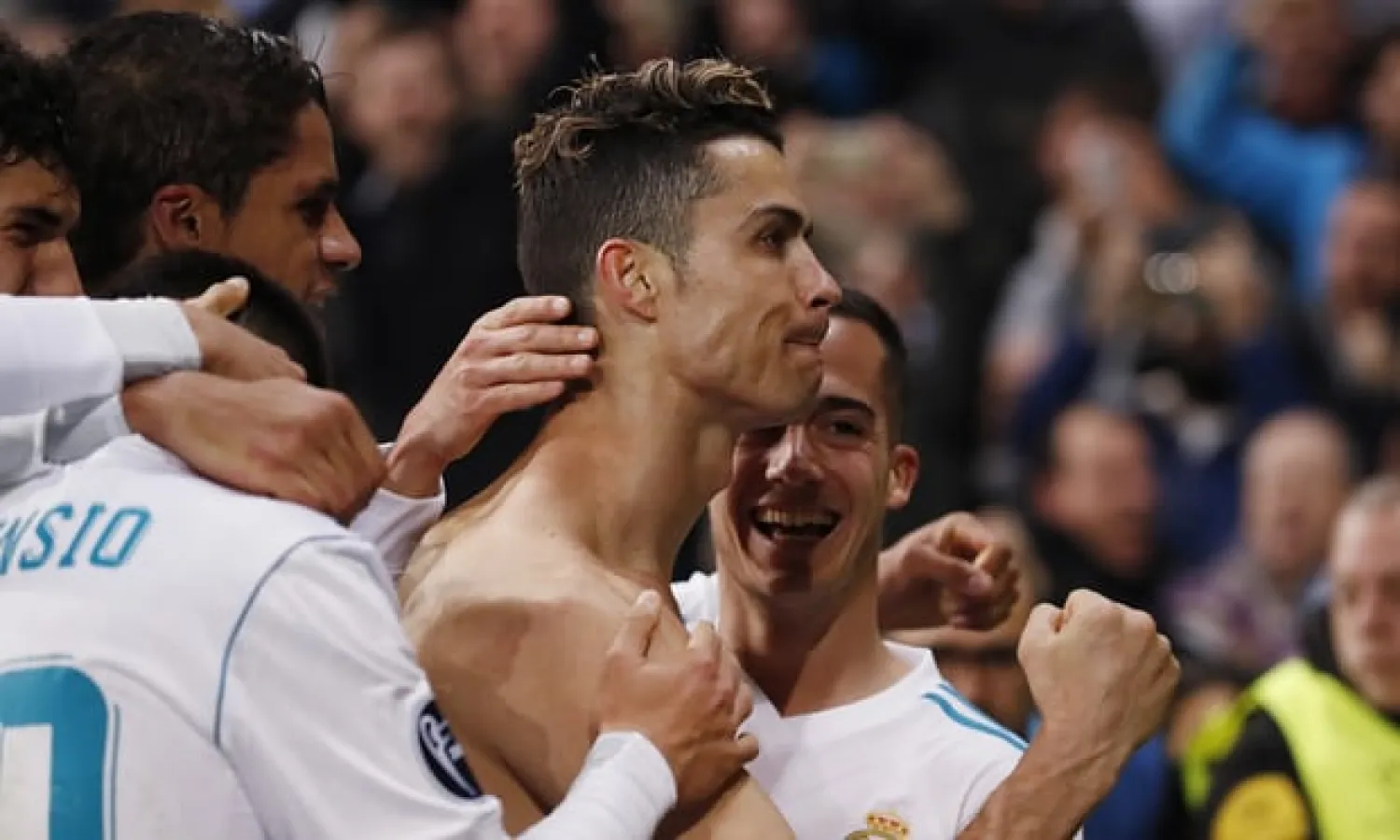
 Cristiano Ronaldo celebrates after scoring the late, decisive penalty. Photograph: Hollandse Hoogte/Rex/Shutterstock
Cristiano Ronaldo celebrates after scoring the late, decisive penalty. Photograph: Hollandse Hoogte/Rex/Shutterstock
TT

‘Football Changes, Real Madrid Remain’ – How Ronaldo and Co Broke Juventus’ Hearts

 Cristiano Ronaldo celebrates after scoring the late, decisive penalty. Photograph: Hollandse Hoogte/Rex/Shutterstock
Cristiano Ronaldo celebrates after scoring the late, decisive penalty. Photograph: Hollandse Hoogte/Rex/Shutterstock

"My heart rate went up a bit but I tried to calm myself down, because I knew it would be decisive," Cristiano Ronaldo said. All that and it came down to this: 180 minutes reduced to a single moment. A 3-0 victory for Real Madrid in Turin, 3-0 to Juventus in Madrid and then, in the 93rd and final minute, with 39 remaining seconds that would soon be considerably more, Lucas Vázquez went down, nudged by Medhi Benatia. So here they were, a semi-final waiting, everyone watching two men standing 12 yards apart at the north end of the Santiago Bernabéu. Well eventually. One shot but a long time to take it. Juventus surrounded the referee and Gigi Buffon was sent off.

“The referee had a rubbish bin where his heart should be,” Buffon said, while Vázquez insisted: “It’s a penalty, the centre-back arrives and bundles me over. But in a situation like that the protests are normal, it’s the last minute after a great game.” Ronaldo thought differently. “I don’t know why they were protesting but football’s like that,” he said. As he left the stadium, he and Buffon embraced. They had not seen each other when the moment came. Buffon walked, Wojciech Szczesny came on to replace him. All the while, Ronaldo waited.

Szczesny had no time to warm up or touch the ball. Ronaldo, who admitted “the minutes before taking the penalty felt eternal”, had it. Szczesny headed on to his line, where he jumped up and down pushing the bar, making it wobble. Ronaldo, still standing there, took a deep breath and then another, as if trying to force both lungs out with the air that had filled them. He was not the only one. Eventually he began his run, Dani Carvajal way behind him, on his knees and unable to look. The clock had said 92min 21sec when Vázquez went down; by the time Ronaldo struck the penalty it was 96.55.

The nerves he admitted to having were not visible, the ball flying into the top corner – his 15th goal in the competition this season, at least one in every match – and the stadium erupting. “Where does the fear go when it escapes your body?” Jorge Bustos asked in El Mundo. There was a lot of it rushing out. It had been there – “somewhere between your intestines and your throat”, Bustos reckoned – from the start to the end.

Comebacks form part of Madrid’s legend, encapsulated in the phrase uttered by the forward Juanito in 1986. Madrid had been beaten 3-1 by Internazionale in the first leg of a Uefa Cup tie but Juanito warned that the second leg would be different, saying in cod Italian: “Noventa minuti en el Bernabéu son molto longo.” Ninety minutes in the Bernabéu are very long. It was supposed to apply to opponents, not Madrid, but here it was reversed. These 90 minutes were molto, molto longo indeed.

When Juventus scored their first, one minute 16 seconds had gone and it was 8.47pm; when Madrid scored their first, finally ending it, it was 10.40pm. An hour and 53 minutes of suffering and then an explosion. Somehow they had found a way through. On the front of the sports daily AS, the headline said: “From panic to the semi-final.” Madrid had escaped thanks to a “miracle”. In El Mundo, Orfeo Suárez saw Madrid still “on course for their Holy Grail, like Christ resurrected. Cristiano, taking his place standing there in the form of a cross, was as implacable in applying punishment as he was suffering in martyrdom”. Suffering was the word. “Journalists are supposed to say things like: ‘How lovely football is,’” Bustos wrote. “Lovely? Bollocks.”

That is football, though. “There’s not much chance,” Max Allegri had said before the match but Zinedine Zidane insisted: “In football any team can mess things up for you in one move.” He said so even before Barcelona had been knocked out in Rome, and that result came as a timely reminder. Sergio Ramos’s brother, René, used a Spanish phrase that roughly translates as: “When you see your neighbour’s beard shaved off, prepare the shaving foam for yours.” In other words, be warned: what happened to them could happen to you. Watching from the tunnel, suspended, the younger Ramos saw how right he had been. Yet no one had expected anything quite like this, the biggest home defeat Madrid had suffered in this competition.

“Did I think we were going to suffer? Yes. What I didn’t expect was for us to concede in the first minute,” Zidane admitted. “I knew they would pressure us, their coach prepared a great plan and they played a great game. But we didn’t expect a goal after one minute; your head goes down and you give them life.” Juventus reached for it, Madrid clung to it. El Mundo made a play on the chant: “That’s how Madrid win” with a headline that read: “That’s how Madrid suffer.”

Vázquez said: “This was a lesson in football. If you relax or you’re not focused every minute, there is no pardon.” But there was, and this is the way Madrid win, too. They always seem to find a way. They have been under pressure in recent years but progressed; they have trailed and come back; they have been bad, as well as good, and won. And despite the warning – perhaps because of the warning? – this will only reinforce the feeling that Zidane’s side are on course for a third Champions League in a row.

“We knew how to suffer and that goal put us in the semi-final,” Vázquez added. “Juventus forgot that in Europe you have to kill Madrid six times,” Marca wrote. “Football changes, Real Madrid remain: the essence of the Champions League,” said Santiago Siguero.

Manuel Jabois wrote in El País: “The Champions League is a competition in which there are not home and away ties but two slaughterhouses in which it’s not always the cleanest man who survives. That’s why Madrid, a terrorised, trembling team, naked and surrendering, waiting for extra-time like a bullet in the head, won. Juventus passed over Madrid; Madrid, as ever, passed through to the next round. Because of a striker in a trance, a mad man who put the ball on the spot and faced a substitute goalkeeper, then sent a missile into the top corner in the last moment, which is the only way to go into a European Cup semi-final. In the end, Madrid is always everything.”

Ronaldo said: “We suffered and we have to learn. Nobody gives you anything and you have to fight to the end.” But when the end came, standing there alone, it was no longer time to fight; it was time to breathe, steady his heart and take the shot.

The Guardian Sport


Tottenham Hotspur Sack Head Coach Thomas Frank

(FILES) Tottenham Hotspur's Danish head coach Thomas Frank gestures on the touchline during the English Premier League football match between Burnley and Tottenham Hotspur at Turf Moor in Burnley, north-west England on January 24, 2026. (Photo by Oli SCARFF / AFP)/
TT

Tottenham Hotspur Sack Head Coach Thomas Frank

(FILES) Tottenham Hotspur's Danish head coach Thomas Frank gestures on the touchline during the English Premier League football match between Burnley and Tottenham Hotspur at Turf Moor in Burnley, north-west England on January 24, 2026. (Photo by Oli SCARFF / AFP)/

Thomas Frank was fired by Tottenham on Wednesday after only eight months in charge and with his team just five points above the relegation zone in the Premier League.

Despite leading Spurs to the round of 16 in the Champions League, Frank has overseen a desperate domestic campaign. A 2-1 loss to Newcastle on Tuesday means Spurs are still to win in the league in 2026.

“The Club has taken the decision to make a change in the Men’s Head Coach position and Thomas Frank will leave today,” Tottenham said in a statement. “Thomas was appointed in June 2025, and we have been determined to give him the time and support needed to build for the future together.

“However, results and performances have led the Board to conclude that a change at this point in the season is necessary.”

Frank’s exit means Spurs are on the lookout for a sixth head coach in less than seven years since Mauricio Pochettino departed in 2019.


Marseille Coach De Zerbi Leaves After Humiliating 5-0 Loss to PSG 

Marseille's Italian coach Roberto De Zerbi looks on from the technical area during the French Cup round of 32 football match between FC Bayeux and Olympique de Marseille (OM) at the Michel-d'Ornano Stadium in Caen on January 13, 2026. (AFP) 
TT

Marseille Coach De Zerbi Leaves After Humiliating 5-0 Loss to PSG 

Marseille's Italian coach Roberto De Zerbi looks on from the technical area during the French Cup round of 32 football match between FC Bayeux and Olympique de Marseille (OM) at the Michel-d'Ornano Stadium in Caen on January 13, 2026. (AFP) 

Marseille coach Roberto De Zerbi is leaving the French league club in the wake of a 5-0 thrashing at the hands of PSG in French soccer biggest game.

The nine-time French champions said on Wednesday that they have ended “their collaboration by mutual agreement.”

The heavy loss Sunday at the Parc des Princes restored defending champion PSG’s two-point lead over Lens after 21 rounds, with Marseille in fourth place after the humiliating defeat.

De Zerbi's exit followed another embarrassing 3-0 loss at Club Brugge two weeks ago that resulted in Marseille exiting the Champions League.

De Zerbi, who had apologized to Marseille fans after the loss against bitter rival PSG, joined Marseille in 2024 after two seasons in charge at Brighton. After tightening things up tactically in Marseille during his first season, his recent choices had left many observers puzzled.

“Following consultations involving all stakeholders in the club’s leadership — the owner, president, director of football and head coach — it was decided to opt for a change at the head of the first team,” Marseille said. “This was a collective and difficult decision, taken after thorough consideration, in the best interests of the club and in order to address the sporting challenges of the end of the season.”

De Zerbi led Marseille to a second-place finish last season. Marseille did not immediately announce a replacement for De Zerbi ahead of Saturday's league match against Strasbourg.

Since American owner Frank McCourt bought Marseille in 2016, the former powerhouse of French soccer has failed to find any form of stability, with a succession of coaches and crises that sometimes turned violent.

Marseille dominated domestic soccer in the late 1980s and early 1990s. It was the only French team to win the Champions League before PSG claimed the trophy last year. It hasn’t won its own league title since 2010.


Olympic Fans Hunt for Plushies of Mascots Milo and Tina as They Fly off Shelves 

Fans take selfies with the Olympic mascot Tina at the finish area of an alpine ski, slalom portion of a women's team combined race, at the 2026 Winter Olympics, in Cortina d'Ampezzo, Italy, Tuesday, Feb. 10, 2026. (AP)
TT

Olympic Fans Hunt for Plushies of Mascots Milo and Tina as They Fly off Shelves 

Fans take selfies with the Olympic mascot Tina at the finish area of an alpine ski, slalom portion of a women's team combined race, at the 2026 Winter Olympics, in Cortina d'Ampezzo, Italy, Tuesday, Feb. 10, 2026. (AP)

For fans of the Milan Cortina Olympic mascots, the eponymous Milo and Tina, it's been nearly impossible to find a plush toy of the stoat siblings in Milan and Cortina d’Ampezzo.

Many of the official Olympics stores in the host cities are already sold out, less than a week into the Winter Games.

“I think the only way to get them is to actually win a medal,” Julia Peeler joked Tuesday in central Milan, where Tina and Milo characters posed for photos with fans.

The 38-year-old from South Carolina is on the hunt for the plushies for her niece. She's already bought some mascot pins, but she won't wear them on her lanyard. Peeler wants to avoid anyone trying to swap for them in a pin trade, a popular Olympic pastime.

Tina, short for Cortina, is the lighter-colored stoat and represents the Olympic Winter Games. Her younger brother Milo, short for Milano, is the face of the Paralympic Winter Games.

Milo was born without one paw but learned to use his tail and turn his difference into a strength, according to the Olympics website. A stoat is a small mustelid, like a weasel or an otter.

The animals adorn merchandise ranging from coffee mugs to T-shirts, but the plush toys are the most popular.

They're priced from 18 to 58 euros (about $21 to $69) and many of the major official stores in Milan, including the largest one at the iconic Duomo Cathedral, and Cortina have been cleaned out. They appeared to be sold out online Tuesday night.

Winning athletes are gifted the plush toys when they receive their gold, silver and bronze medals atop the podium.

Broadcast system engineer Jennifer Suarez got lucky Tuesday at the media center in Milan. She's been collecting mascot toys since the 2010 Vancouver Games and has been asking shops when they would restock.

“We were lucky we were just in time,” she said, clutching a tiny Tina. “They are gone right now.”

Friends Michelle Chen and Brenda Zhang were among the dozens of fans Tuesday who took photos with the characters at the fan zone in central Milan.

“They’re just so lovable and they’re always super excited at the Games, they are cheering on the crowd,” Chen, 29, said after they snapped their shots. “We just are so excited to meet them.”

The San Franciscan women are in Milan for the Olympics and their friend who is “obsessed” with the stoats asked for a plush Tina as a gift.

“They’re just so cute, and stoats are such a unique animal to be the Olympic mascot,” Zhang, 28, said.

Annie-Laurie Atkins, Peeler's friend, loves that Milo is the mascot for Paralympians.

“The Paralympics are really special to me,” she said Tuesday. “I have a lot of friends that are disabled and so having a character that also represents that is just incredible.”
