US Urges IMF to Better Police External Imbalances

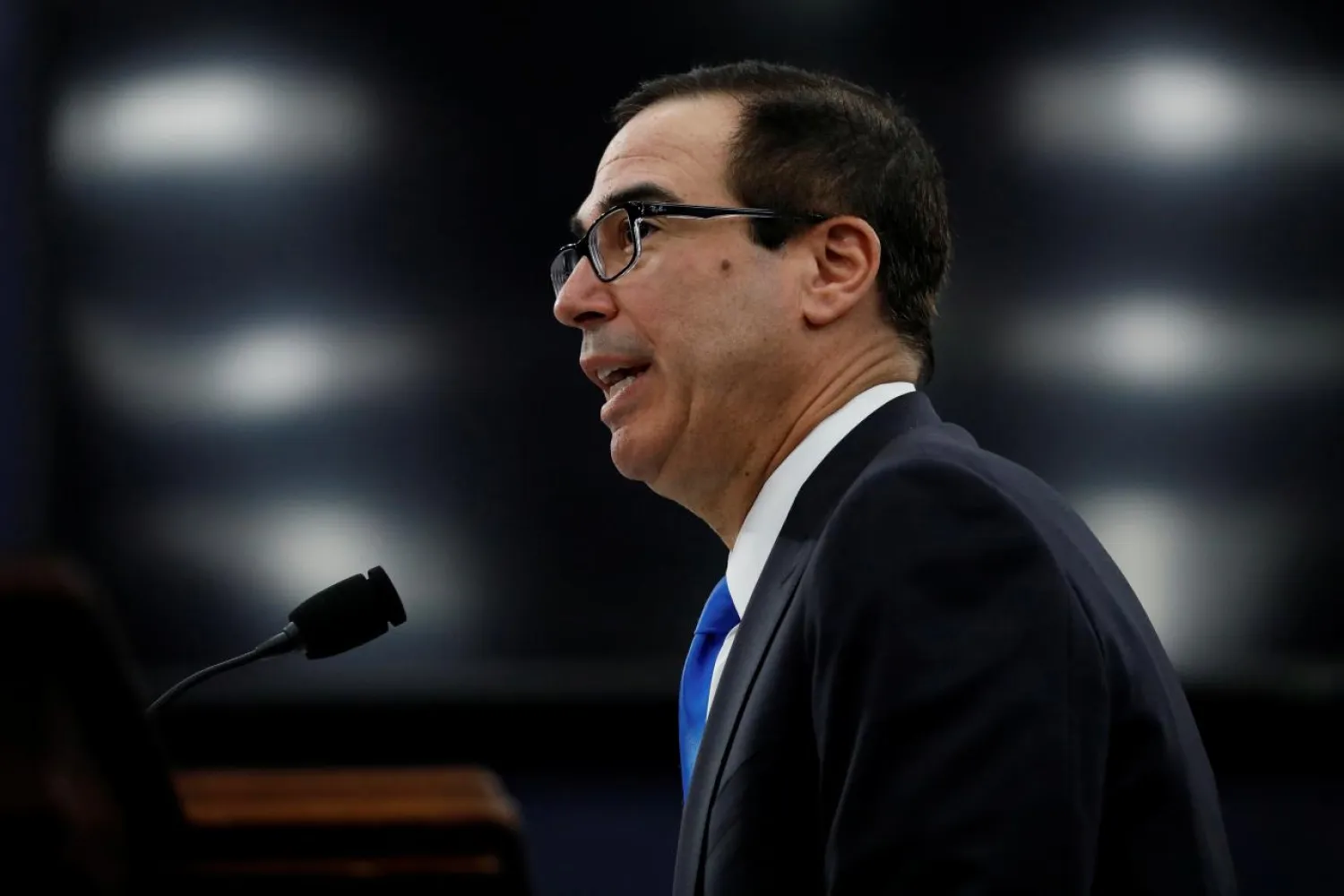
Secretary of the Treasury Steve Mnuchin testifies before the House Committee on Appropriations on Capitol Hill in Washington, US, April 11, 2018. REUTERS/Aaron P. Bernstein
TT

US Urges IMF to Better Police External Imbalances

Secretary of the Treasury Steve Mnuchin testifies before the House Committee on Appropriations on Capitol Hill in Washington, US, April 11, 2018. REUTERS/Aaron P. Bernstein

Trade tensions between the United States and China, which threaten to spill over into the global economy, have dominated the spring meetings of the International Monetary Fund.

Official after official has called for disputes to be resolved through dialogue rather than unilateral tariffs, and warned about the threat to the economic recovery.

French Economy Minister Bruno Le Maire criticized what he called a "vain and pointless" spat with China.

"We run the risk of trade war. We run the risk of multilateral order breaking down that is good for no one, and most definitely not for the world economy and growth," Le Maire told reporters during the spring meetings of the International Monetary Fund.

But US President Donald Trump's top finance official said the fault lies with countries that employ unfair trade policies.

"We strongly believe that unfair global trade practices impede stronger US and global growth, acting as a persistent drag on the global economy," US Treasury Secretary Steven Mnuchin said in a statement to the IMF.

Mnuchin said on Friday that the IMF needed to “step up to the plate” to police large external imbalances, demand the dismantling of trade barriers and protection of intellectual property rights.

In a statement to the IMF’s steering committee, which meets on Saturday, Mnuchin said countries which have large and persistent external surpluses must do more to carry their share of the adjustment.

“The IMF must step up to the plate on this issue, providing a more robust voice and consistently noting when members maintain macroeconomic, foreign exchange, and trade policies that facilitate unfair competitive advantage or lead to imbalanced growth,” Mnuchin said.

The statement reflects the Trump administration’s view that the IMF, through its country surveillance and policy advocacy efforts, can help rein in what are seen as China’s trade abuses.

Mnuchin said the Trump administration welcomes the IMF’s efforts to improve the External Sector Report, the IMF’s assessment of currency valuations.

“At the same time, we urge the IMF to speak out more forcefully on the issue of external imbalances, including by providing clear policy recommendations for countries with large surpluses, in support of more balanced global growth,” Mnuchin added.

“Ensuring that trade is free, fair, and reciprocal will boost global trade and support stronger, more sustainable growth,” he explained.

While IMF chief Christine Lagarde has offered the fund as a forum to resolve differences, Mnuchin instead said the IMF "should be a strong voice" in urging members "to dismantle trade and non-tariff barriers and to protect intellectual property rights."

Le Maire agreed China must respect the rules, but said the country is a key part of the world trading system.

"We must redefine international trade with China, not against China."

- Serious consequences -

Theft of American intellectual property and technology has been a key irritant in the dispute with Beijing, which prompted President Donald Trump to announce steep tariffs on tens of billions of dollars' worth of Chinese goods, on top of last month's punitive duties on steel that were primarily targeted at China as well.

Washington and Beijing have traded tariff threats and also filed complaints against each other at the World Trade Organization.

WTO Director Roberto Azevedo warned that the effects of a major escalation "could be serious," and poor countries would be the collateral damage.

"A breakdown in trade relations among major players could derail the recovery that we have seen in recent years, threatening the ongoing economic expansion and putting many jobs at risk," he said in a statement to the meetings.

The IMF has highlighted the trade tensions as a major downside risk to the otherwise solid global recovery, and Lagarde said the dispute undermines confidence and creates uncertainty that could choke off investment which has been a prime engine of the global recovery.

The WTO projects global merchandise trade will expand by 4.4 percent this year, after increasing by 4.7 percent in 2017.

- G20 avoids trade issue -

Despite the intense focus on the US-China dispute, the Group of 20 finance ministers, from the world's major economies, avoided discussion of the issue Friday, even while acknowledging the potential danger it posed to the global economy.

"We didn't have a discussion on specific measures on trade," Argentine Treasury Minister Nicolas Dujovne told reporters after the meeting. "The G20 is not the place to discuss specific measures. That's the WTO."

It was a surprising omission for the group that was key to shepherding the global economy through the 2008 financial crisis and preventing another depression.

But Dujovne said, "We have to also recognize the limitations that we as a group have... and try to find a consensus even if the consensus is more limited than we want."

The ministers did express concern over the growth of "inward-looking policies," he said, using a frequent euphemism for trade protectionism.

But German central bank chief Jens Weidmann said the G20 officials all agreed trade must benefit all countries.

"Protectionism, not to mention a trade war, is certainly not the solution."

Le Maire repeated his criticism of the US tariffs on steel and aluminum which were aimed at China but only spared the EU and other key trading partners under a temporary exemption that is due to expire May 1.

As close allies in the EU "we expect not only temporary exemption but a full and permanent exemption," he said.

"We cannot live with a kind of sword of Damocles hanging over our heads."

- Treasury chief to China -

As trade tensions simmer between the world’s two largest economies, Mnuchin said on Saturday he may travel to China.

Mnuchin told reporters he was continuing to have discussions with his Chinese counterparts to try to resolve the differences over trade, but said he may go to Beijing.

“A trip is under consideration,” Mnuchin said at a news conference during the International Monetary Fund and World Bank spring meetings in Washington.

“I am not going to make any comment on timing, nor do I have anything confirmed, but a trip is under consideration.”

Mnuchin also declined to say what he wants from a trade deal with China, adding, “If we have a deal, you’ll know what it looks like when we have it.”

Mnuchin said he met China’s new central bank governor, Yi Gang, during the IMF and World Bank meetings and discussed the potential for China to open its markets to more foreign competition.

“I did meet with the Chinese here. The discussions were really more around the governor’s actions at the PBOC (People’s Bank of China) and certain actions they’ve announced in terms of opening some of their markets, which we very much encourage and appreciate.”

In a statement on Saturday to the International Monetary and Financial Committee, Yi said China would “vigorously” push forward the reform and opening of its financial sector, significantly relax market access restrictions, create a more attractive investment environment, strengthen the protection of intellectual properties and actively expand imports.

On Sunday, China’s commerce ministry said it would welcome US officials to discuss trade and economic issues.

“The Chinese side has received information that the US side hopes to come to Beijing to discuss economic and trade issues. China welcomes this,” the ministry said in a statement on its website.


Saudi Real Estate Market Maintains Investment Momentum Despite War Fallout

Residential developments in Saudi Arabia (Ministry of Municipalities and Housing)
TT

Saudi Real Estate Market Maintains Investment Momentum Despite War Fallout

Residential developments in Saudi Arabia (Ministry of Municipalities and Housing)

Saudi Arabia's real estate market continues to attract investment despite geopolitical challenges weighing on economic activity worldwide, supported by new housing developments and efforts to expand residential supply.

The Ministry of Municipalities and Housing announced that more than 15,000 residential land plots had been made available through the Sakani platform across the Kingdom between the beginning of 2026 and the end of October, alongside additional projects launched by private-sector developers.

The developments underscore the sector's continued momentum and its importance to the Saudi economy.

Government initiatives and private-sector projects aim to expand housing supply and meet growing demand, reinforcing real estate's position as a key driver of economic growth and diversification.

Strong domestic demand and ongoing urban development projects continue to underpin the market's appeal, attracting investment from both Saudi and international investors.

Against a backdrop of geopolitical uncertainty and war-related disruptions to trade, supply chains, financing costs and construction expenses, the real estate sector has gained importance as an industry driven largely by domestic demand and capable of sustaining economic activity.

Private-Sector Investment

Despite mounting global economic volatility and geopolitical tensions, Saudi Arabia's real estate market continues to attract international investment, supported by clear economic policies, expanding development opportunities and strong housing demand.

Real estate developer Arada recently announced its entry into the Saudi market through a partnership with local company XTOPIA, backed by a SAR 50 billion ($13.3 billion) portfolio of land and development opportunities.

The partnership's first project is a SAR 14 billion residential development in Riyadh's Al Rimal district.

Riyadh Region Municipality, the Ministry of Municipalities and Housing, and the National Center for Privatization & PPP also recently announced the launch of the expression of interest, prequalification and proposal submission stages for a joint land investment project.

The initiative involves developing a municipal land plot in northern Riyadh through a 50-year partnership with the private sector, marking the municipality's first project under the joint investment model.

Real estate specialists described the initiative as an important step toward enabling private investors to develop property assets into sustainable projects with significant economic value.

They said the extended investment period would encourage developers to improve construction quality and services, strengthen project feasibility, diversify real estate offerings and increase supply in one of the capital's most expensive neighborhoods.

Balancing the Real Estate Market

The importance of releasing more residential land lies in achieving greater balance in the property market, a government objective outlined by Crown Prince and Prime Minister Mohammed bin Salman.

The strategy seeks to increase housing supply by making more land available, broadening the options accessible to Saudi citizens and enabling more households to move from searching for a home to building and owning one.

Increasing the availability of residential land, particularly in cities and governorates experiencing rising demand, could ease pressure on land prices over the medium term, provided that plot locations and sizes correspond to actual market needs.

The release of additional land also creates opportunities for real estate developers, contractors, engineering firms and building materials suppliers to benefit from anticipated demand for construction projects.

As a result, businesses across the real estate and construction supply chain could see stronger activity despite the impact of the geopolitical crisis on other economic sectors in the region.

The initiative also expands housing choices, supports efforts to increase homeownership rates and improve quality of life, and encourages urban development beyond major metropolitan centers.

Lowering Prices

Real estate developer Ahmed Omar Basoudan believes the main challenge facing Saudi Arabia's property market in the coming period will not simply be increasing the number of land plots and housing units available.

Rather, he said, the priority must be ensuring that homes reach buyers at prices they can afford, while providing adequate infrastructure and services and keeping development and construction costs under control.

Speaking to Asharq Al-Awsat, Basoudan explained that genuine balance in the real estate market depends on the availability of housing that meets buyers' needs in terms of price, location and quality, rather than simply increasing overall supply.

He said the release of more than 15,000 residential land plots during the first 10 months of the year, together with recently announced private-sector projects, reflected the government's continued commitment to expanding housing supply and providing more residential options.

Basoudan stressed that the latest real estate developments represent an important step toward addressing one of the market's most pressing challenges: achieving a sustainable balance between supply and demand, particularly amid the Kingdom's population growth and continued urban expansion.


Saudi Stocks Rebound 0.9%, Recouping Previous Session's Losses

An investor monitors stock market data on a screen at the Saudi Exchange (Tadawul) in Riyadh (Reuters)
TT

Saudi Stocks Rebound 0.9%, Recouping Previous Session's Losses

An investor monitors stock market data on a screen at the Saudi Exchange (Tadawul) in Riyadh (Reuters)

Saudi stocks closed higher on Monday, recovering some of the losses sustained in the previous session as heavyweight shares strengthened and the banking sector advanced.

The benchmark Tadawul All Share Index (TASI) rose 0.90% to close at 10,106 points, gaining 90 points. Total trading value reached approximately SAR 3.5 billion ($933 million).

The index had fallen 0.8% on Sunday amid selling pressure on heavyweight stocks.

Anaam International Holding Group, Fitaihi Holding Group and Raoom were among the session's top gainers, rising between 7% and 9% to close at SAR 11.93, SAR 2.11 and SAR 72.30, respectively.

On the losing side, Almunajem Foods led the declines, shedding 9.20% to SAR 49.94, followed by Saudi Paper Manufacturing Co., which fell 6.18% to SAR 48.88, and Alamar Foods, which dropped 4.63% to SAR 44.06.

At the sector level, banks led the gains, advancing 1.60%, supported by a 2.06% rise in Bank AlJazira shares, which closed at SAR 10.89.


Tesla to Refund Many Cybertruck Deposits as Demand Exceeds Production, Musk Says

Tesla Cybertruck electric vehicles sit parked in a storage lot in San Diego, California on April 11, 2025. (AFP)
TT

Tesla to Refund Many Cybertruck Deposits as Demand Exceeds Production, Musk Says

Tesla Cybertruck electric vehicles sit parked in a storage lot in San Diego, California on April 11, 2025. (AFP)

Tesla will have to refund Cybertruck deposits for many customers as orders far exceed production capacity, CEO Elon Musk said, following last week's announcement that the electric vehicle maker is winding down the pickup truck's production at its Texas factory.

"We will try ‌to make ‌as many as ‌possible ⁠before shutting down the ⁠line in about 8 months, but will have to return deposits for a lot of people," the billionaire said in a post on X on Monday.

The comments ⁠come after Musk said ‌Tesla would ‌add an extra production shift to fulfill outstanding ‌Cybertruck orders before dismantling the production ‌line next year to expand output of its Cybercab robotaxi.

The production winddown is slated for mid-2027, Musk announced on ‌Friday, with the resources being redirected to the Cybercab, a vehicle ⁠central ⁠to the automaker's autonomous-driving ambitions.

Tesla began delivering the Cybertruck in late 2023, but demand has fallen far short of Musk's expectations. US sales fell 48% to 20,237 units last year, according to Kelley Blue Book, well below Musk's earlier projection that annual Cybertruck sales could reach 250,000 vehicles.