


When Arsène Wenger and Alex Ferguson Fought Bitterly to Be Top Dog

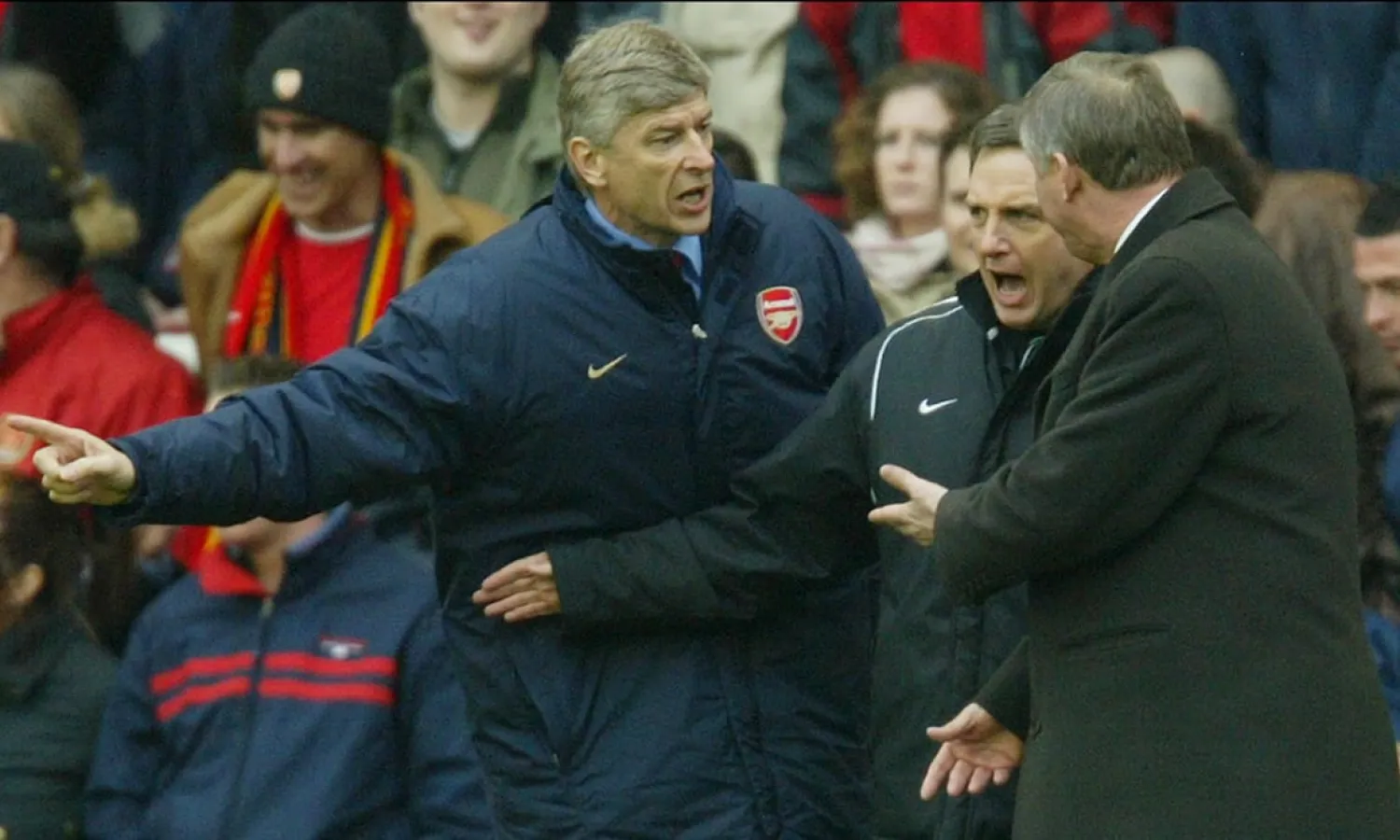
 Arsène Wenger and Sir Alex Ferguson have to be separated by fourth official Alan Wiley during an Arsenal and Manchester United match at Highbury in March 2004. Photograph: Tom Jenkins for the Guardian
Arsène Wenger and Sir Alex Ferguson have to be separated by fourth official Alan Wiley during an Arsenal and Manchester United match at Highbury in March 2004. Photograph: Tom Jenkins for the Guardian
TT

When Arsène Wenger and Alex Ferguson Fought Bitterly to Be Top Dog

 Arsène Wenger and Sir Alex Ferguson have to be separated by fourth official Alan Wiley during an Arsenal and Manchester United match at Highbury in March 2004. Photograph: Tom Jenkins for the Guardian
Arsène Wenger and Sir Alex Ferguson have to be separated by fourth official Alan Wiley during an Arsenal and Manchester United match at Highbury in March 2004. Photograph: Tom Jenkins for the Guardian

The Premier League is the richest league in the world but money cannot buy hate. English football is crying out for an immense, sprawling rivalry between two great teams. There have been some interesting conflicts in recent times but nothing close to the epic nine-year war between Arsenal and Manchester United from 1996 to 2005.

It’s the rift that keeps on giving. Five years after ITV’s memorable Keane & Vieira: Best of Enemies, Channel 5 is to broadcast a documentary on the broader rivalry between the sides, and especially the managers. Fergie v Wenger: The Feud (Monday 10pm) is an exhilarating hour of time travel that includes interviews with more than a dozen players, coaches and journalists – and a series of clips that instantly evoke the nuclear intensity of the time.

The rivalry ached with such importance, from the football field to the school playground, as to make a pacifist throw the first punch. It included everything from allegations of racism by Ian Wright against Peter Schmeichel to a pizza fight. There was also the Battle of Old Trafford, when Arsenal’s players manhandled Ruud van Nistelrooy after the final whistle; Roy Keane literally offering Patrick Vieira outside during a legendary row in the Highbury tunnel; and Jaap Stam being restrained by half of Highbury as he rumbled towards Vieira with extreme prejudice. “It’s funny,” Paul Scholes says. “In team talks against Arsenal, the ball was rarely mentioned.”

That does not mean it was rarely used. The quality of football was through the roof, even if that is sometimes obscured by memories of the rucks and rows. There had never been such technical quality in English football, and the FA Cup semi-final replay of 1999, featured in depth in the programme, has an outstanding case for being the greatest game ever played in England.

There are forgotten classics too, such as a primal 1-1 draw at Old Trafford on a filthy Wednesday night in 1999 and United’s 2-1 win at Highbury later that year, when both teams created an endless stream of chances in a first half that flowed like basketball.

Some of the matches will never be forgotten. Arsenal won the league at Old Trafford in 2002 (and, effectively, in 1998). United beat Arsenal 6-1 in 2001, when Arsène Wenger went postal in the dressing room at half-time, and ended their 49-game unbeaten run in a bitterly controversial match in 2004 – a savage injustice from which Arsenal never truly recovered. “If you don’t feel pain when you’re being conned,” Sol Campbell says, “when are you gonna feel pain?”

Both teams frequently took the moral high ground, often at the same time. With United and Arsenal the only teams to win the league from 1996 to 2004, the rivalry had a chance to develop and intensify. There were some monumental losses of temper from both managers and a set of characters on both sides – winners bursting with personality – any scriptwriter would kill for.

The Feud neatly conveys the mass of contradictions in a rivalry that simultaneously bred hate and respect (when United won that immense FA Cup semi-final in 1999, Lee Dixon and Tony Adams dragged themselves into the tunnel to shake the hand of all their opponents and wish them well in the final).

The players on both sides get on well these days, the experience of sharing punditry studios helping them realize how much they have in common. Yet this documentary dredges up plenty of competitive fire. Scholes, a superb Phil Neville and Martin Keown get in plenty of digs, and Keown is magnificently unrepentant about the incident with Van Nistelrooy.

The extreme masculinity may offend some but those who prefer a bit of needle in their sport will probably love every minute of a superb documentary. The war between Arsenal and United is seen as a symbol of a good old days, yet there is more to it. It was a finite window in a rapidly changing world where the values and intensity of Old Football met the skill and diversity of New Football to produce a biblical struggle. Old Football is gone, so it can never happen again.

In many ways, The Feud is a love letter to two men. Wenger 1.0, the imperturbable outsider who showed English football that the future is also a foreign country; and especially Sir Alex Ferguson, the emphatic genius who outlasted Wenger to win multiple titles after Arsenal started to fade. He had a degree in people and an addiction to competition. “The Gaffer loved a challenge,” says Steve McClaren, who was Ferguson’s assistant from 1999 to 2001. “He had to have somebody to fight. He had to have somebody to complain about. Arsenal. Arsenal. ARSENAL. WENGER!”

Each defined the other for a decade; it was the same with their teams. The signature achievements – United’s Treble and Arsenal’s Invincible season – were only possible because a Dutchman missed a last-minute penalty against them for their greatest rivals: Dennis Bergkamp in 1999 and Van Nistelrooy in 2003. It’s an apt reflection of a rivalry in which every achievement was heightened by the quality and hatred of the opponent. Without each other they would have won so much more – but the triumphs would not have been nearly as sweet.

(The Guardian)


Chelsea Injuries up 44% After Club World Cup but Report Says Event Has Had ‘Minimal’ Impact

Chelsea's Reece James, center, lifts the trophy following the Club World Cup final soccer match between Chelsea and PSG at MetLife Stadium in East Rutherford, N.J., Sunday, July 13, 2025. (AP)
TT

Chelsea Injuries up 44% After Club World Cup but Report Says Event Has Had ‘Minimal’ Impact

Chelsea's Reece James, center, lifts the trophy following the Club World Cup final soccer match between Chelsea and PSG at MetLife Stadium in East Rutherford, N.J., Sunday, July 13, 2025. (AP)

Chelsea suffered a 44% spike in injuries after competing in the supersized Club World Cup this year, according to findings published on Tuesday.

But the newly expanded tournament has so far had a “minimal impact” on injuries overall, the latest edition of the Men’s European Football Injury Index found.

There was fierce opposition to FIFA's new flagship club event when it was confirmed in 2023 that it would increase from seven to 32 teams, with players' unions warning of physical and mental burnout of players due to an ever expanding match schedule. But FIFA pressed ahead and staged the tournament in the United States in June-July.

Chelsea went on to win the inaugural competition, receiving the trophy from US President Donald Trump at MetLife Stadium and taking home prize money of around $125 million. But, according to the Index, from June-October, Chelsea picked up more injuries — 23 — than any of the nine clubs from Europe's top leagues that participated in the Club World Cup.

They included star player Cole Palmer, and was a 44% increase on the same period last year.

While Chelsea, which played 64 games over the entire 2024-25 season, saw an increase in injuries, the Index, produced by global insurance firm Howden, found that overall there was a decrease.

“In principle you would expect this increased workload to lead to an increase in the number of injuries sustained, as a possible rise in overall injury severity,” the Index report said, but added: “The data would suggest a minimal impact on overall injury figures.”

Despite the figures, the authors of the report accept it was too early to assess the full impact of the Club World Cup, with the findings only going up to October.

“We would expect to see the impact to spike in that sort of November to February period,” said James Burrows, Head of Sport at Howden. “What we’ve seen previously is that’s where the impact is seen from summer tournaments."

Manchester City has sustained 22 since the tournament, which is the highest among the nine teams from Europe's top leagues — England, Spain, Italy, Germany and France.

Those teams have recorded 146 injuries from June-October, which is down on the previous year's figure of 174.

From August-October that number is 121, the lowest for that three-month period in the previous six years of the Index.


Sunderland Worst Hit by Losing Players to African Cup of Nations 

14 December 2025, United Kingdom, London: Sunderland's Habib Diarra (L) and Leeds United's Gabriel Gudmundsson battle for the ball during the English Premier League soccer match between Brentford and Leeds United at the Gtech Community Stadium. (dpa)
TT

Sunderland Worst Hit by Losing Players to African Cup of Nations 

14 December 2025, United Kingdom, London: Sunderland's Habib Diarra (L) and Leeds United's Gabriel Gudmundsson battle for the ball during the English Premier League soccer match between Brentford and Leeds United at the Gtech Community Stadium. (dpa)

Premier League Sunderland will have to do without six players over the next few weeks and are the club worst hit as the Africa Cup of Nations takes its toll on European clubs competing over the holiday season.

Sunderland, eighth in the standings, had four of their African internationals in action when they beat Newcastle United on Sunday, but like 14 other English top-flight clubs will now lose those players to international duty.

The timing of the African championship, kicking off in Morocco on Sunday and running through to January 18, has long been an irritant for coaches, with leagues in Belgium, France, Germany, Italy, Netherlands, Portugal, and Spain also affected.

Hosting the tournament in the middle of the season impacts around 58% of the players at the Cup of Nations, though the Confederation of African Football did try to mitigate the impact by moving the start to before Christmas, so it is completed before the next round of Champions League matches.

The impact on European clubs was also lessened by allowing them to release players seven days, rather than the mandatory 14 days, before the tournament, meaning they could play for their clubs last weekend.

Sunderland's Congolese Arthur Masuaku and Noah Sadiki, plus full back Reinildo (Mozambique), midfielder Habib Diarra (Mali), and attackers Chemsdine Talbi (Morocco) and Bertrand Traore (Burkina Faso) have now departed for Morocco.

Ironically, Mohamed Salah’s absence from Liverpool to play for Egypt should lower the temperature at the club after his recent outburst against manager Arne Slot, but Manchester United will lose three players in Noussair Mazraoui, Bryan Mbeumo and Amad Diallo, who scored in Monday’s 4-4 draw with Bournemouth.

France is again the country with the most players heading to the Cup of Nations, and with 51 from Ligue 1 clubs. But their absence is much less impactful than previously as Ligue 1 broke after the weekend’s fixtures and does not resume until January 2, by which time the Cup of Nations will be into its knockout stage.

There are 21 players from Serie A clubs, 18 from the Bundesliga, and 15 from LaLiga teams among the 24 squads at the tournament in Morocco.


Rodgers Takes Charge of Saudi Team Al-Qadsiah After Departure from Celtic 

Then-Celtic head coach Brendan Rodgers greets supporters after a Europa League soccer match between Red Star and Celtic at Rajko Mitic Stadium in Belgrade, Serbia, Sept. 24, 2025. (AP)
TT

Rodgers Takes Charge of Saudi Team Al-Qadsiah After Departure from Celtic 

Then-Celtic head coach Brendan Rodgers greets supporters after a Europa League soccer match between Red Star and Celtic at Rajko Mitic Stadium in Belgrade, Serbia, Sept. 24, 2025. (AP)

Brendan Rodgers has returned to football as the coach of Saudi Arabian club Al-Qadsiah, six weeks after resigning from Scottish champion Celtic.

Al-Qadsiah, whose squad includes Italian striker Mateo Retegui and former Real Madrid defender Fernandez Nacho, is in fifth place in the Saudi Pro League in its first season after promotion.

Rodgers departed Celtic on Oct. 27 and has opted to continue his managerial career outside Britain for the first time, having previously coached Liverpool, Leicester and Swansea.

In its statement announcing the hiring of Rodgers on Tuesday, Al-Qadsiah described him as a “world-renowned coach” and said his arrival “reflects the club’s ambitious vision and its rapidly growing sporting project.”

Aramco, the state-owned Saudi oil giant, bought Al-Qadsiah in 2023 in a move that has helped to transform the club’s status.

“This is a landmark moment for the club,” Al-Qadsiah chief executive James Bisgrove said. “The caliber of his experience and track record of winning reflects our ambition and long-term vision to establish Al-Qadsiah as one of Asia’s leading clubs.”

Rodgers is coming off winning back-to-back Scottish league titles with Celtic, where he won 11 major trophies across his two spells. He also won the FA Cup with Leicester.

Al-Qadsiah's last two coaches were former Liverpool striker Robbie Fowler and former Spain midfielder Michel.
