Arsène Wenger Stirred Arsenal Exasperation But was a Martyr to His Values

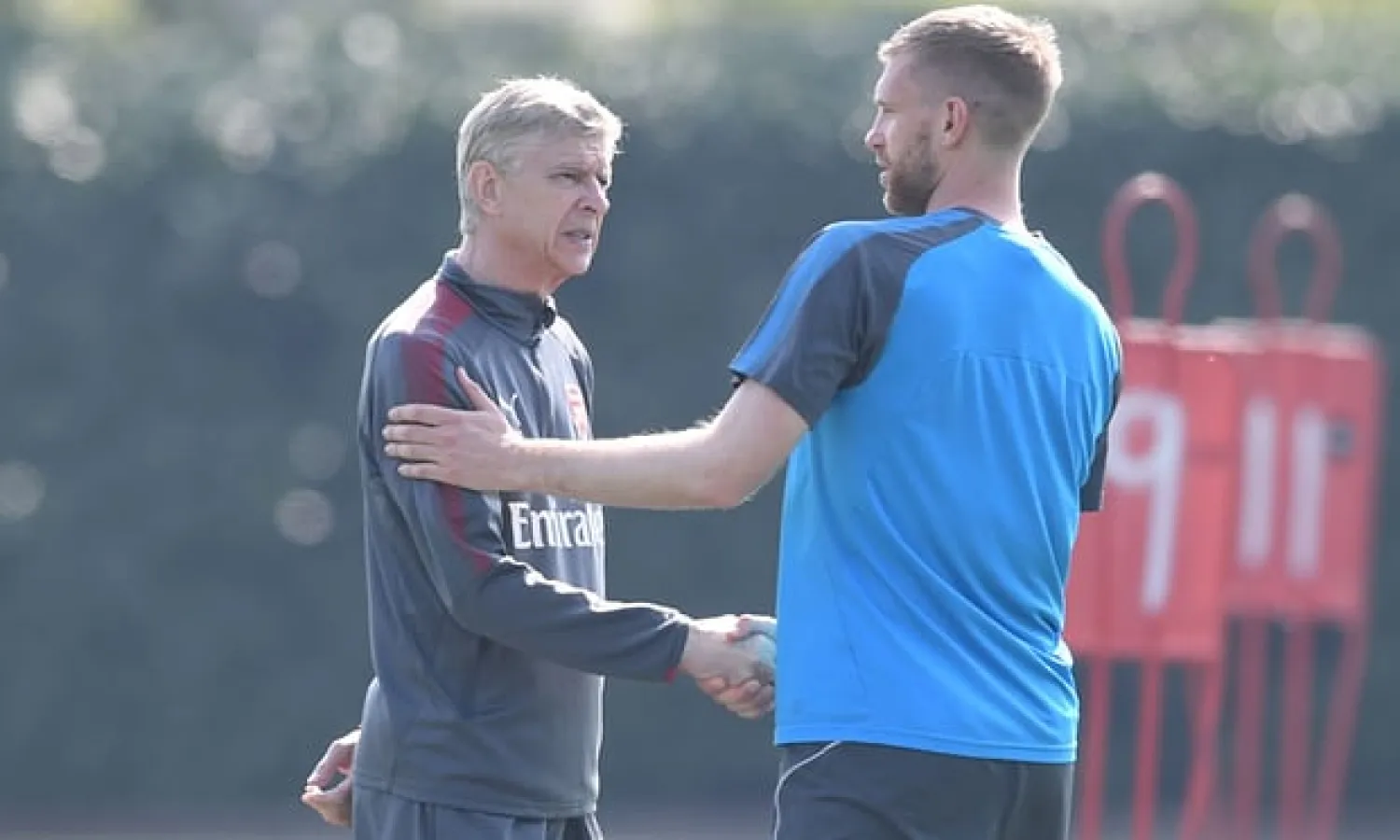
 The Arsenal manager, Arsène Wenger, shakes hands with Per Mertesacker before a training session at London Colney on Saturday. Photograph: Stuart MacFarlane/Arsenal FC via Getty Images
The Arsenal manager, Arsène Wenger, shakes hands with Per Mertesacker before a training session at London Colney on Saturday. Photograph: Stuart MacFarlane/Arsenal FC via Getty Images
TT

Arsène Wenger Stirred Arsenal Exasperation But was a Martyr to His Values

 The Arsenal manager, Arsène Wenger, shakes hands with Per Mertesacker before a training session at London Colney on Saturday. Photograph: Stuart MacFarlane/Arsenal FC via Getty Images
The Arsenal manager, Arsène Wenger, shakes hands with Per Mertesacker before a training session at London Colney on Saturday. Photograph: Stuart MacFarlane/Arsenal FC via Getty Images

It is a story that Arsène Wenger has told on more than one occasion in different company over dinner and it always has the desired effect. The Arsenal manager talks of a book he has read in which an assassin is able to stop his heart when he kills and then restart it. “I’m looking for a striker like that,” he says.

What is not to like? It has Wenger, a trained killer, resurrection, death and football. As the Frenchman’s eyes twinkle, an acquaintance who has heard the punchline describes how his audiences are hooked. “Arsène has them eating out of his hand,” he says. “He is a magnificently charming companion.”

Wenger is a bewitching raconteur when the mood takes him and as the Arsenal support – and the wider football world – pour out the sentimentality following the announcement that he is to leave his post of almost 22 years at the end of the season, it is his ability to connect on a human level that ought to be celebrated.

There have been several well‑documented phases of Wenger at Arsenal but the constants have been his front-of-house grace – even when under intolerable pressure – and behind-the-scenes encouragement.

“Beyond football, he’s inspired the people around him,” Ivan Gazidis, the club’s chief executive, says. “He does this through his human qualities; his understanding and his empathy for people. He’s able to make them believe that they can achieve great things, on and beyond the pitch. He inspired George Weah to believe not only that he could become the world’s greatest footballer but to have the conviction that he could become the president of a country.”

It has been an education and a privilege for many journalists to document Wenger’s career and all of us have experienced the moment when he smiles and calmly explains why he is right and everybody else is wrong – often in the face of challenging odds.

There have been numerous occasions when the tape been replayed and holes picked in various strands of his argument. But here’s the thing. At the time, you believe him. It all makes sense. It is easy listening, perfectly diverting.

Wenger is at his most engaging when tackling weighty issues – which are not always about football. “Why don’t we just talk about politics, that would be more interesting?” he once said. Regrettably, it did not happen. The imperatives of the day held sway.

Much is made of Wenger’s economics qualification but he is as much a psychologist and a sociologist. When he starts a sentence by saying: “We live in a society of … ” - it is invariably the cue for thought-provoking observation. He has talked of a society of opinions, of instant judgments, of an obsession with the next big thing. And so much more.

“The most important thing is to believe in human beings,” Wenger said last Christmas. “When you are such a long time in the job, you’re not naive. You know all the strengths and weaknesses and how, sometimes, people can be selfish or mean. But you still have to believe that there is a light in every human being that you can get out. The ultimate goal is to make people happy. Unfortunately, you don’t always manage that but you try to do it.”

More than anything, it has been Wenger’s dignity in press conferences that has shone brightly, particularly in the final, more traumatic phase of his reign. It is possible to count on the fingers of one hand the number of times he has lost his composure and lashed out – and the provocation has been extreme. Wenger has been asked at regular intervals over the past five years, at least, whether the time might be right for him to stand down, with the interference being that the questioner thought he was no longer up to the job.

Following one of the rare occasions when Wenger did lose it – before a Champions League game against Bayern Munich in February 2013, after being asked about his contract – a Manchester-based colleague remarked that there was no way journalists would have dared speak to Sir Alex Ferguson in similar fashion. Perhaps it is because Wenger does not have a confrontational bone in his body.

Wenger’s relationship with the press has cooled to the point of freezing and most journalists feel the decline began when he stopped holding his newspaper briefing in a separate room. When he used to do that, the mood was invariably more relaxed and often light-hearted. The conversation would flow.

There has always been a fascination to uncovering any detail on Wenger and in the more intimate environment he coughed up a few. Who would have guessed that he liked the singer Plastic Bertrand?

Wenger is more than happy to discuss the issues of the day but he is notoriously guarded about his private life and personal feelings. As such, his admission that he thought the uncertainty over his future last season had affected the team was faintly shocking.

Wenger has consciously maintained a distance between himself and the 21st-century British press, whom he views not as individuals but as an amorphous mass. He never addresses journalists by name and he never goes off the record. The us-and-them feeling has become pronounced.

As his tenure hit the buffers he has become increasingly introspective and evasive.

Some of his briefings have been as short as five minutes, shaped at the outset by him taking a long and deliberate look at his watch. The twinkle in his eye has been missing, the answers predictable – both of which have felt symbolic.

Yet Wenger retains the capacity to flick a switch and bring the room to life, to stir feelings of genuine fondness. When his departure was announced on Friday many Arsenal supporters were happy. It was what they had wanted. Yet why were they also upset?

It is because, above all, Wenger is a gentleman, who has been a part of many people’s lives for so long. For Arsenal fans under the age of 30, he is the only manager they have really known – a strangely reassuring presence in an ever changing world, in spite of the frustrations he has caused them.

A martyr to his values, Wenger will keep fighting until the final day. After all of the turmoil, there is the sense of appreciation.

The Guardian Sport


Irish Boxer Lee Reeves Dies at Age 31, Three Months after Dublin Title Fight Injury

Irish boxer Lee Reeves. Reuters
TT

Irish Boxer Lee Reeves Dies at Age 31, Three Months after Dublin Title Fight Injury

Irish boxer Lee Reeves. Reuters

Irish boxer Lee Reeves has died more than three months after being injured during a fight in Dublin, promoter Queensberry said Tuesday. He was 31.

"Everyone at Queensberry is devastated to learn of the passing of Lee Reeves," Queensberry Promotions said in a statement.

Reeves was hospitalized after being knocked out by compatriot Gary Cully in the 10th and final round of their Boxing Union of Ireland Celtic super-lightweight title fight on Aug. 1.

Reeves was carried from the ring on a stretcher after receiving initial treatment.

Queensberry had said after the fight that his condition was critical but stable.

“Lee was an immensely talented boxer, as well as a true role model and inspiration to his community,” the statement added Tuesday, according to The Associated Press. “Our deepest condolences go to Lee’s family, friends and all those who loved him. We ask that their privacy be respected at this incredibly difficult time. Rest in peace, Lee.”


Alonso to Enter Dakar Rally with Loeb and Aston Martin Team

November 5, 2026 Aston Martin's Fernando Alonso during a press conference ahead of the F1 Sao Paulo Grand Prix. (Reuters)
TT

Alonso to Enter Dakar Rally with Loeb and Aston Martin Team

November 5, 2026 Aston Martin's Fernando Alonso during a press conference ahead of the F1 Sao Paulo Grand Prix. (Reuters)

Double Formula One champion Fernando Alonso will compete in next January's Dakar Rally in an Aston Martin Dreadnought entry run by engineering partner Prodrive.

The 45-year-old Spaniard, a 32-time Grand Prix winner and two-time Le Mans 24 Hours winner, will be racing in the annual event for the second time after competing with Toyota in 2020, finishing 13th.

France's nine-time world rally champion Sebastien Loeb and Brazil's reigning world rally-raid champion Lucas Moraes will be his teammates in a three-car entry.

The 49th edition of the Dakar Rally will ‌be held in ‌Morocco from January 9 to 23, with a prologue and first ‌stage ⁠in Portugal, after ⁠being moved from Saudi Arabia due to security concerns.

The 24-round Formula One season is due to start in Bahrain in March after testing in late February.

Alonso, who will again have compatriot and five-time motorcycle Dakar winner Marc Coma as co-driver, is racing in the Las Vegas Grand Prix this weekend. He said he had turned his thoughts to Dakar after deciding to continue in Formula One with Aston Martin.

“In the end, the decision became simple. I wanted to embrace ⁠the challenge completely and take on both Formula One and the ‌Dakar Rally in the same year," he explained in ‌a statement.

"In 2020, Dakar was one of the most challenging and enjoyable experiences of my career. ‌I have enormous respect for this race and the specialists who have mastered it.

"Formula One ‌remains my priority. But I am a racing driver, and challenges like this are why I love competing. I’m looking forward to seeing what we can achieve."

LOEB CHASES FIRST DAKAR WIN

In October, Alonso told reporters at the Singapore Grand Prix that he felt the desert endurance race would be physically ‌incompatible with his Formula One commitments.

Loeb, 52, will also be chasing a first Dakar win after 10 previous attempts that have brought ⁠him 28 stage ⁠wins to date.

“Winning the Dakar is very important to me,” said the Frenchman, who will be partnered by Belgian Fabian Lurquin. “We have come close several times, and the motivation is there to keep working until we achieve it."

The Dreadnought is a digital-only tactical SUV created exclusively for gamers playing "Call of Duty: Modern Warfare 4" that will now be brought into the real world by Prodrive, Aston Martin's partners in endurance GT racing.

The Dakar will be Aston Martin Racing’s debut in the world rally-raid championship.

"Aston Martin's ambition for this program has been clear from the outset: to create a car capable of competing at the front of the world's toughest motorsport event," said Prodrive Chairman David Richards.

"By combining Aston Martin's vision with Prodrive's experience in rallying, endurance racing and Dakar competition, we have built a strong foundation. With an exceptional driver line-up and a highly capable engineering team, we look forward to seeing Dreadnought take on this remarkable challenge."


Owono Does Not Deserve 12-Match Ban Over De Miguel Death, Says Andorra Owner Pique

Equatorial Guinea's goalkeeper #01 Jesus Owono leaves the pitch at half time during the Africa Cup of Nations (CAN) Group E football match between Equatorial Guinea and Algeria at Moulay Hassan Stadium in Rabat on December 31, 2025. (AFP)
TT

Owono Does Not Deserve 12-Match Ban Over De Miguel Death, Says Andorra Owner Pique

Equatorial Guinea's goalkeeper #01 Jesus Owono leaves the pitch at half time during the Africa Cup of Nations (CAN) Group E football match between Equatorial Guinea and Algeria at Moulay Hassan Stadium in Rabat on December 31, 2025. (AFP)

FC Andorra owner Gerard ‌Pique said goalkeeper Jesus Owono did not deserve the 12-match suspension he received following the challenge that led to the death of Tenerife forward Jesus de Miguel.

Owono and De Miguel collided during a Spanish second-tier match on November 2. De Miguel was taken to intensive care and died the following day.

The disciplinary committee of the Spanish football federation (RFEF) banned Owono for violent conduct which resulted in serious ‌injury last week.

"Players, ‌former players, coaches, goalkeepers, everyone has ‌called ⁠it an accident," ⁠Pique said in a video posted on social media late on Monday.

"I truly believe that imposing the maximum sanction on Jesus for this action puts him in a situation he does not deserve, because he is not to blame for all of ⁠this having happened."

Former Barcelona player Pique ‌pointed to the three-match ‌ban handed to Albacete's Jose Corpas for accidentally kicking Sabadell ‌player Quadri Liameed in the head during a ‌recent match in Spain.

"Fortunately Quadri is fine, the consequences in this case were not fatal, and the committee decided to sanction Corpas with three matches," Pique added.

"With ‌all this, my reflection is: what is being sanctioned, the action or the ⁠consequences?"

The RFEF ⁠did not immediately respond to a request for comment outside regular business hours in Spain.

Owono, 25, has withdrawn from Equatorial Guinea's squad for Africa Cup of Nations qualifiers against Zimbabwe this month and Pique said it was unlikely the goalkeeper would return to action as soon as his suspension is up.

"Jesus is going to need far more than 12 matches before he is available and able to compete," he added. "No sanction is going to bring Demi (De Miguel) back to us."