Manchester United Remind Arsenal What's at Stake When Replacing Wenger

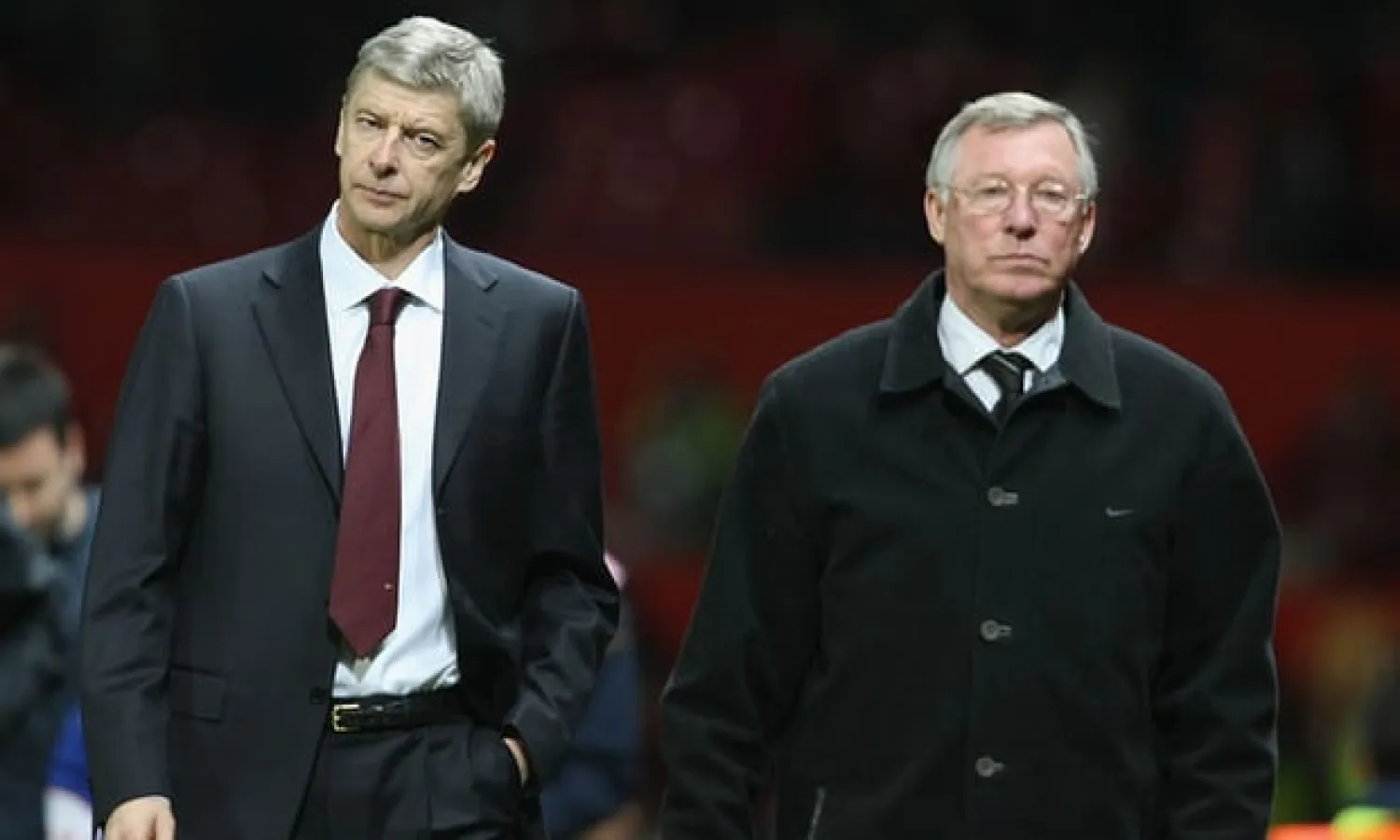
 Arsène Wenger and Sir Alex Ferguson after Manchester United’s 1-0 victory in the Champions League semi-final first leg in April 2009. Photograph: Matthew Peters/Man Utd via Getty Images
Arsène Wenger and Sir Alex Ferguson after Manchester United’s 1-0 victory in the Champions League semi-final first leg in April 2009. Photograph: Matthew Peters/Man Utd via Getty Images
TT

Manchester United Remind Arsenal What's at Stake When Replacing Wenger

 Arsène Wenger and Sir Alex Ferguson after Manchester United’s 1-0 victory in the Champions League semi-final first leg in April 2009. Photograph: Matthew Peters/Man Utd via Getty Images
Arsène Wenger and Sir Alex Ferguson after Manchester United’s 1-0 victory in the Champions League semi-final first leg in April 2009. Photograph: Matthew Peters/Man Utd via Getty Images

Arsenal have only three away games left in the Premier League this season but happily there is still time for Arsène Wenger to return to Manchester United, the scene of many of the highs and lows in his extraordinary career.

One suspects the image that will surface most often this weekend is the iconic one of Wenger banished to the stands in 2009, arms outstretched at the pettiness of it all after being told by match officials that kicking a water bottle in frustration was far too grievous an offence to be allowed to remain on the sidelines.

There are other, happier memories. A win at Old Trafford put Wenger on the way to his first Double, a single Marc Overmars goal in March 1998 cutting Manchester United’s lead at the top of the table to six points – some Manchester bookmakers had already paid out on bets on Alex Ferguson’s team retaining the title – as Arsenal entered a 10-game winning sequence that would see them crowned champions by a single point.

Slender as that margin appeared at the time, Arsenal’s tremendous run-in gave an early indication of the consistency of which they would prove capable under Wenger, as well as usefully preventing United winning six titles in a row to draw unflattering comparisons with the Scottish league.

Later there would be the Battle of Old Trafford and then the Battle of the Buffet as Arsenal grew into their role as United’s chief challengers in the early noughties, even if another few years brought the infamous 8-2 defeat that confirmed by 2011 they had rather lost their way.

More than anything, though, more than the prospect even of a last touchline grimace with José Mourinho or a cheery hello from Alexis Sánchez, Arsenal are visiting a stadium that stands as an enormous monument to what is at stake when the time comes to replace the sort of transformative manager who has given years of service to the task of successfully reinventing a club.

No one could dispute that Wenger is up there with the very best in that regard. While some might quibble about the lack of a European Cup, all the deserved testimonials have stressed the fact that this is a man who altered English football, not only the club of which he was in charge.

There is no need to run through Wenger’s achievements and innovations here when they have been all over the news for the past few days. Only the very best managers make themselves unsackable, and in the years of gradual Arsenal decline, that became part of a unique problem.

Ferguson before him had assumed such a position of strength and control at his club that he was able to choose his own retirement date, yet crucially United kept winning. Even with comparatively ordinary sides in unremarkable seasons, even with the emergence of Chelsea and Manchester City as rivals with deep pockets, Ferguson averaged a title every other season or better right until the end. That is what big clubs want and need. Wenger was unable to produce it for Arsenal after the dizzy heights of the first decade and, as he himself admitted, around the time that Mourinho was labelling him a specialist in failure: “You cannot pretend you are a big club.”

That, nevertheless, is what Arsenal seem to have been doing these last dozen or so years. There were mitigating circumstances, the move to a new ground being one of them and the arrival of petro-dollars in the English game another, though it is hard to sell yourself as the biggest of clubs when you make do with Champions League qualification income and the occasional FA Cup.

What has just happened, though presented as sympathetically as possible, is presumably linked to Arsenal struggling to make the top four for a second successive season and empty seats becoming a feature at the Emirates. In those circumstances even the Arsène Wenger Appreciation Society – branches inside and outside the Emirates and apparently all over the world – would find it difficult to maintain the big club pretence. While Mourinho might have been twisting the knife when implying that most clubs in the Champions League bracket would demand more, he was not necessarily wrong.

That is why Wenger struck a slightly sour note with his most recent public utterance, when he appeared to blame the fans for sending images of impatience and disunity all around the world. There were faults on all sides, surely? There is no doubt that some of the terrace protests were excessive, unfeeling and went on for too long, but the plain truth is the whole Wenger endgame went on for too long. It was allowed to become a tiresome sideshow, which was something no one really wanted or deserved.

Other parties were involved in that lassitude apart from the fans, the story here is not only the usually stated case of over-entitled supporters and their short memories. Even Wenger admits he understands why the fans are not happy. The club now seem to have an inkling as well. If Arsenal’s image has been tarnished, in other words, the buck stops higher than the terraces.

It is tempting to wonder, as Arsenal prepare to visit Old Trafford, whether Wenger’s 22 years at the same club would have been possible without Ferguson’s 26. Were Arsenal persuaded of the value of patience and the rewards longevity can bring by Ferguson’s peerless example? Both were exceptional managers, neither feat is likely to achieved again at elite level, but while the United template was one of unpromising beginnings followed by undreamed of glory, the Arsenal version had the ingredients in the wrong order. Hence the somewhat stickier ending.

Perhaps a clue can be found in all the tributes to Wenger from the last few days. English football was still a provincial, insular game when he arrived here, the sort of self-contained comfort zone where you might find a decent manager aiming to stick around for a decade or longer. Ferguson had already done 10 years at United by the time Wenger turned up at Arsenal.

It will not be going back there any time soon, not at the top level at any rate. That is the pair’s great modernising achievement, if you like, and it is also the reason why United miscalculated the Ferguson succession so badly.

Arsenal still have all that potential disruption to come but they could do worse than be guided by the wise words of their departing leader. “What I like about Arsenal,” Wenger once said. “Is that they respect traditional values while not being scared to move forward.”

That sentiment is probably more true of the Arsenal he joined rather than the Arsenal he will leave, though at least there need be no more agitating or pretending. The time to move forward is definitely here.

The Guardian Sport


Irish Boxer Lee Reeves Dies at Age 31, Three Months after Dublin Title Fight Injury

Irish boxer Lee Reeves. Reuters
TT

Irish Boxer Lee Reeves Dies at Age 31, Three Months after Dublin Title Fight Injury

Irish boxer Lee Reeves. Reuters

Irish boxer Lee Reeves has died more than three months after being injured during a fight in Dublin, promoter Queensberry said Tuesday. He was 31.

"Everyone at Queensberry is devastated to learn of the passing of Lee Reeves," Queensberry Promotions said in a statement.

Reeves was hospitalized after being knocked out by compatriot Gary Cully in the 10th and final round of their Boxing Union of Ireland Celtic super-lightweight title fight on Aug. 1.

Reeves was carried from the ring on a stretcher after receiving initial treatment.

Queensberry had said after the fight that his condition was critical but stable.

“Lee was an immensely talented boxer, as well as a true role model and inspiration to his community,” the statement added Tuesday, according to The Associated Press. “Our deepest condolences go to Lee’s family, friends and all those who loved him. We ask that their privacy be respected at this incredibly difficult time. Rest in peace, Lee.”


Alonso to Enter Dakar Rally with Loeb and Aston Martin Team

November 5, 2026 Aston Martin's Fernando Alonso during a press conference ahead of the F1 Sao Paulo Grand Prix. (Reuters)
TT

Alonso to Enter Dakar Rally with Loeb and Aston Martin Team

November 5, 2026 Aston Martin's Fernando Alonso during a press conference ahead of the F1 Sao Paulo Grand Prix. (Reuters)

Double Formula One champion Fernando Alonso will compete in next January's Dakar Rally in an Aston Martin Dreadnought entry run by engineering partner Prodrive.

The 45-year-old Spaniard, a 32-time Grand Prix winner and two-time Le Mans 24 Hours winner, will be racing in the annual event for the second time after competing with Toyota in 2020, finishing 13th.

France's nine-time world rally champion Sebastien Loeb and Brazil's reigning world rally-raid champion Lucas Moraes will be his teammates in a three-car entry.

The 49th edition of the Dakar Rally will ‌be held in ‌Morocco from January 9 to 23, with a prologue and first ‌stage ⁠in Portugal, after ⁠being moved from Saudi Arabia due to security concerns.

The 24-round Formula One season is due to start in Bahrain in March after testing in late February.

Alonso, who will again have compatriot and five-time motorcycle Dakar winner Marc Coma as co-driver, is racing in the Las Vegas Grand Prix this weekend. He said he had turned his thoughts to Dakar after deciding to continue in Formula One with Aston Martin.

“In the end, the decision became simple. I wanted to embrace ⁠the challenge completely and take on both Formula One and the ‌Dakar Rally in the same year," he explained in ‌a statement.

"In 2020, Dakar was one of the most challenging and enjoyable experiences of my career. ‌I have enormous respect for this race and the specialists who have mastered it.

"Formula One ‌remains my priority. But I am a racing driver, and challenges like this are why I love competing. I’m looking forward to seeing what we can achieve."

LOEB CHASES FIRST DAKAR WIN

In October, Alonso told reporters at the Singapore Grand Prix that he felt the desert endurance race would be physically ‌incompatible with his Formula One commitments.

Loeb, 52, will also be chasing a first Dakar win after 10 previous attempts that have brought ⁠him 28 stage ⁠wins to date.

“Winning the Dakar is very important to me,” said the Frenchman, who will be partnered by Belgian Fabian Lurquin. “We have come close several times, and the motivation is there to keep working until we achieve it."

The Dreadnought is a digital-only tactical SUV created exclusively for gamers playing "Call of Duty: Modern Warfare 4" that will now be brought into the real world by Prodrive, Aston Martin's partners in endurance GT racing.

The Dakar will be Aston Martin Racing’s debut in the world rally-raid championship.

"Aston Martin's ambition for this program has been clear from the outset: to create a car capable of competing at the front of the world's toughest motorsport event," said Prodrive Chairman David Richards.

"By combining Aston Martin's vision with Prodrive's experience in rallying, endurance racing and Dakar competition, we have built a strong foundation. With an exceptional driver line-up and a highly capable engineering team, we look forward to seeing Dreadnought take on this remarkable challenge."


Owono Does Not Deserve 12-Match Ban Over De Miguel Death, Says Andorra Owner Pique

Equatorial Guinea's goalkeeper #01 Jesus Owono leaves the pitch at half time during the Africa Cup of Nations (CAN) Group E football match between Equatorial Guinea and Algeria at Moulay Hassan Stadium in Rabat on December 31, 2025. (AFP)
TT

Owono Does Not Deserve 12-Match Ban Over De Miguel Death, Says Andorra Owner Pique

Equatorial Guinea's goalkeeper #01 Jesus Owono leaves the pitch at half time during the Africa Cup of Nations (CAN) Group E football match between Equatorial Guinea and Algeria at Moulay Hassan Stadium in Rabat on December 31, 2025. (AFP)

FC Andorra owner Gerard ‌Pique said goalkeeper Jesus Owono did not deserve the 12-match suspension he received following the challenge that led to the death of Tenerife forward Jesus de Miguel.

Owono and De Miguel collided during a Spanish second-tier match on November 2. De Miguel was taken to intensive care and died the following day.

The disciplinary committee of the Spanish football federation (RFEF) banned Owono for violent conduct which resulted in serious ‌injury last week.

"Players, ‌former players, coaches, goalkeepers, everyone has ‌called ⁠it an accident," ⁠Pique said in a video posted on social media late on Monday.

"I truly believe that imposing the maximum sanction on Jesus for this action puts him in a situation he does not deserve, because he is not to blame for all of ⁠this having happened."

Former Barcelona player Pique ‌pointed to the three-match ‌ban handed to Albacete's Jose Corpas for accidentally kicking Sabadell ‌player Quadri Liameed in the head during a ‌recent match in Spain.

"Fortunately Quadri is fine, the consequences in this case were not fatal, and the committee decided to sanction Corpas with three matches," Pique added.

"With ‌all this, my reflection is: what is being sanctioned, the action or the ⁠consequences?"

The RFEF ⁠did not immediately respond to a request for comment outside regular business hours in Spain.

Owono, 25, has withdrawn from Equatorial Guinea's squad for Africa Cup of Nations qualifiers against Zimbabwe this month and Pique said it was unlikely the goalkeeper would return to action as soon as his suspension is up.

"Jesus is going to need far more than 12 matches before he is available and able to compete," he added. "No sanction is going to bring Demi (De Miguel) back to us."