Germany's Merkel Presses CDU to Attract More Women

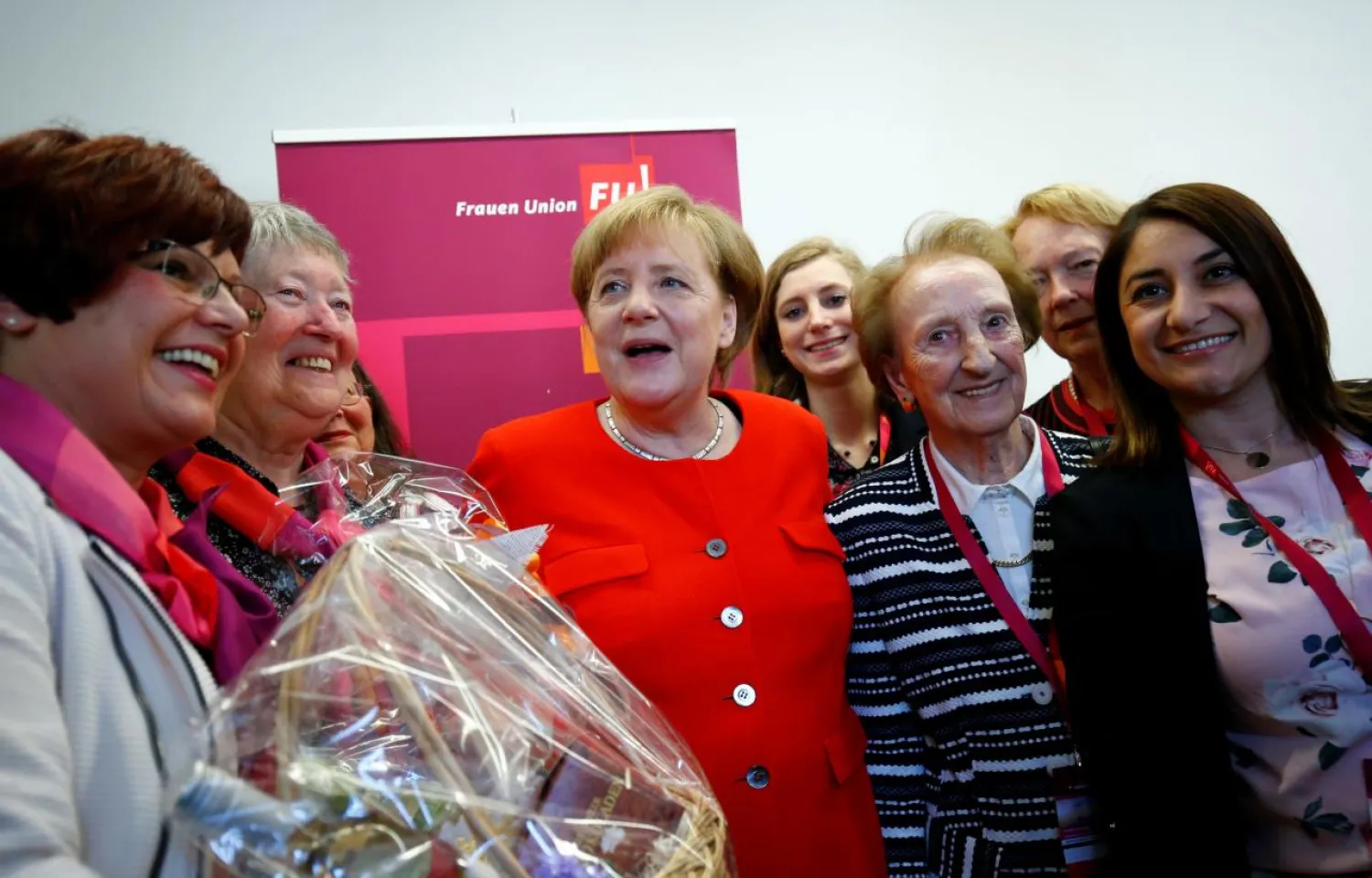
German Chancellor Angela Merkel celebrates the 70th anniversary of the "Women's Union" of the Christian Democratic Union (CDU) in Frankfurt, Germany, May 5, 2018. REUTERS/Ralph Orlowski
TT

Germany's Merkel Presses CDU to Attract More Women

German Chancellor Angela Merkel celebrates the 70th anniversary of the "Women's Union" of the Christian Democratic Union (CDU) in Frankfurt, Germany, May 5, 2018. REUTERS/Ralph Orlowski

Chancellor Angela Merkel pressed her conservative Christian Democrats (CDU) on Saturday to attract more women to their ranks or else lose their status as one of Germany’s two big popular parties, or ‘Volksparteien’.

Speaking on the 70th anniversary of her conservatives’ women’s union, Merkel said the CDU needed to boost the proportion of women in its membership above some 25 percent if it wanted to win more than 40 percent of the vote.

“That’s why this is not just a question of women who want to make a career, but it is a survival matter for this Volkspartei,” she said.

Both the mainstream political blocs - the CDU and their Bavarian allies, and the left-leaning Social Democrats (SPD) - suffered their worst post-war election results in last September’s national election - 33 and 21 percent respectively.

Frustration about the influx of more than a million migrants since 2015 propelled the far-right Alternative for Germany (AfD) into parliament for the first time.

Despite a 1996 CDU rule to reserve a third of all party "list" candidacies for women, that quorum was "no longer sufficient for us," Merkel told the Women's Union anniversary gathering at a Frankfurt monastery.

CDU men typically won direct, electorate mandates instead of entering parliament via candidacy lists under Germany's proportional system whereby each voter picks a local candidate and exercises a second vote on competing lists of candidates submitted by parties.

The Women's Union led by Annette Widmann-Mauz in a resolution Saturday demanded that half of such lists be allocated to women – "placed evenly across the top, the middle and rear of lists."

Merkel, 63, is the CDU’s first female leader and the first woman to be German chancellor. Earlier this year, the CDU elected another woman, Annegret Kramp-Karrenbauer, who is sometimes dubbed ‘mini-Merkel’, as party general-secretary, putting her in pole position to succeed Merkel as chancellor.

The CDU's Women's Union or Frauen Union, founded on May 1, 1948 in Frankfurt, currently has about 110,000 members.


Netanyahu Warns Iran May Try to Disrupt Election, Says ‘Don’t Test Us’

Rappelling workers hang a large-scale Likud Party election billboard reading "We have one chance to win!" and featuring Israeli Prime Minister Benjamin Netanyahu (L) with US President Donald Trump and fighter jets, in Tel Aviv, Israel, 25 October 2026. (EPA)
TT

Netanyahu Warns Iran May Try to Disrupt Election, Says ‘Don’t Test Us’

Rappelling workers hang a large-scale Likud Party election billboard reading "We have one chance to win!" and featuring Israeli Prime Minister Benjamin Netanyahu (L) with US President Donald Trump and fighter jets, in Tel Aviv, Israel, 25 October 2026. (EPA)

Prime Minister Benjamin Netanyahu said that Iran and its allies might try to disrupt Tuesday's Israeli elections, warning the Islamic republic against any hostile acts.

The premier has campaigned heavily on his security credentials, touting the war he launched against Iran in February alongside the United States and suggesting that he alone can see it through.

"We have intelligence signs that our enemies, Iran and its proxies, could challenge us with attacks in order to disrupt the elections," Netanyahu said in a video released by his office on Sunday.

"Don't test us. You will suffer disproportionate blows," he added, noting the military was ready for both defensive and offensive operations.

Earlier in the day, the premier posted an AI-generated image of a mushroom cloud engulfing Tel Aviv, alongside text attributed to a right-wing political commentator calling Iran an existential threat and arguing that all the other issues discussed this election season were trivial in comparison.

Netanyahu, Israel's longest-serving prime minister, has focused heavily on hawkish national security statements in the final days of the campaign.

On Wednesday, he said he had sent a directive to Israel's security forces to topple Iran's clerical state. A day earlier, he posted a video of himself in front of a fighter jet speaking to US President Donald Trump by phone saying they would "finish the job" together.


Police Made 1,314 Arrests in France’s Protests, Says Govt

A pedestrian walks past a broken window, a day after a demonstration in favor of purchasing power, the protection of public services, and fiscal and social justice, in Paris on October 25, 2026 as part of a nationwide call for mobilization bringing together former members of the Yellow Vest movement, labor unions, high school and university students. (AFP)
TT

Police Made 1,314 Arrests in France’s Protests, Says Govt

A pedestrian walks past a broken window, a day after a demonstration in favor of purchasing power, the protection of public services, and fiscal and social justice, in Paris on October 25, 2026 as part of a nationwide call for mobilization bringing together former members of the Yellow Vest movement, labor unions, high school and university students. (AFP)

Police arrested 1,314 people in weekend protests across France, the interior ministry said Sunday, adding that 53 officers were hurt in clashes.

The arrests occurred as violence broke out on the margins of mass demonstrations in major cities on Saturday over the high cost of living.

It was the second consecutive weekend of unrest in France, which is heading to presidential elections in April and May to choose a successor to Emmanuel Macron, who is reaching his two-term limit.

The interior ministry said police responded to 75 fires during Saturday's protests, adding that 24 shops were looted.

"Several investigations have been opened," it said in a statement, without giving details. It said that the rest of Saturday night, after the clashes had died down, was "calm".

The ministry statement on Sunday did not say how many protesters were hurt.

Late Saturday, Interior Minister Laurent Nunez spoke of two serious injuries among protesters: one in Toulouse and one in Clermont-Ferrand.

- Protesters hurt -

The Toulouse prefecture, which reports to the interior ministry, told AFP that a 20-year-old man was seriously hurt with a wound to his hand.

A street medic who tended demonstrators told AFP, on condition of anonymity, that the man had "several fingers" blown off his right hand.

The prefecture covering Clermont-Ferrand said a man there also had a hand hurt, but did not suffer the loss of any fingers.

A French regional daily, La Nouvelle Republique, reported that a man in Poitiers was hurt in his left eye, showing a photo of a man holding his face.

The newspaper's photographer told AFP he was a 19-year-old who was wounded during a charge by riot police firing stun grenades and tear gas.

There have been several instances in recent weeks, during student protests in France, of people being maimed by police stun grenades or tear gas grenades.

It was not known if the injuries reported from Saturday were from those police weapons. Officials said investigations had been opened in at least some of the cases.


Far-right Leader Le Pen Kicks Off Tilt at French Presidency amid Nationwide Protests

26 September 2026, France, Paris: Jordan Bardella and Marine Le Pen arrive at Place de la Concorde ahead of Pope Leo XIV's Mass in Paris. Photo: Pierre Teyssot / Agf/AGF via ZUMA Press/dpa
TT

Far-right Leader Le Pen Kicks Off Tilt at French Presidency amid Nationwide Protests

26 September 2026, France, Paris: Jordan Bardella and Marine Le Pen arrive at Place de la Concorde ahead of Pope Leo XIV's Mass in Paris. Photo: Pierre Teyssot / Agf/AGF via ZUMA Press/dpa

Marine Le Pen, France's far-right candidate to succeed President Emmanuel Macron in elections in six months, was to give her first campaign speech on Sunday, a day after protests sweeping the country again flared into violence.

Le Pen -- the frontrunner according to surveys -- is seen benefiting from the convulsions France has been going through for weeks, punctuated by mass rallies and violent clashes on Saturday and a week earlier, said AFP.

More than 400,000 people marched in major French cities on Saturday to protest the rising cost of living, with groups of masked youths breaking away to provoke police, who responded with tear gas and water cannon. Police made more than 1,000 arrests.

Officers faced "an extremely elevated level of violence" from black-clad "ultra-left" extremists who had trailed in the demonstrations, Interior Minister Laurent Nunez said late Saturday.

A week earlier, on October 17, similar nationwide marches took place, also against rising inflation sent surging by the war in the Middle East. They, too, degenerated into street violence, with public buildings vandalized and hundreds of shops looted.

The mass rallies were fed by four weeks of student protests across France, over classroom conditions and access to university places, which at times also descended into clashes.

Unions and Yellow Vest protesters have vowed to keep up their street marches in the weeks ahead, pointing to a febrile period as the elections draw near.

- Anger at Macron -

Le Pen, who will address 10,000 members of her National Rally (RN) party in the city of Orleans, has accused Macron's centrist government of being soft on violent protesters and lacking authority.

Police were on Sunday filtering traffic going into Orleans, after thousands of counter-protesters opposed to Le Pen and her anti-immigration, nationalist RN marched in the city on Saturday chanting anti-fascist slogans.

Police put their numbers at 13,000, while organizers estimated the turnout at twice that.

If Le Pen wins the two-stage presidential elections in April and May, she has vowed to cut the cost of living through capped household energy bills, reduced taxes and trimming France's contribution to the European Union.

She is also critical of NATO, and of France's support of Ukraine as it battles Russia's invasion.

The RN, which portrays itself as a party of law and order, has also sided strongly with the police in the current unrest.

The head of Le Pen's party, Jordan Bardella, whom she intends to make prime minister if she becomes president, has visited police stations to underline that credential.

French voters, angry over Macron's perceived detachment over his two terms and his recent orders to curb the protests, are turning to more extremist politics, polling shows.

An Ipsos survey published Saturday suggested Le Pen would score 32 to 34 percent of the vote in the first round of the election, with a far-left rival, Jean-Luc Melenchon, getting 17 percent. Centrist candidates from mainstream parties trailed them.

Asked about the protest violence, a majority of the 1,500 people questioned in the survey -- 58 percent -- said they felt anger.

It found 81 percent believed the government was "responsible for this situation", while 79 percent thought radical political groups were, 62 percent blamed the left, and 52 percent blamed the police.

- No money -

Whoever wins the presidency will find limited room to throw money around to placate various clamoring interest groups.

France's public debt and budget deficit have climbed well beyond the ceilings EU member countries are meant to stick to.

Macron's government is trying to get a cost-cutting budget adopted, but faces headwinds from both the sustained protests demanding more spending and the political jockeying by parties eyeing power.

As Macron sees out the final months of his presidency, he has to tread a line between cracking down on street violence and opening dialogue with unions, students and other groups to attempt to restore order.

Although the French president has not invoked a state of emergency, he has ordered bans on non-union demonstrations deemed "illegitimate", and officials under him have imposed bans on protests in city centers and localized curfews in certain zones.

Many protesters on Saturday raged against the measures, describing them as an assault on the French right to protest.

The Yellow Vest movement, which challenged Macron eight years ago with street disruptions, has called for another day of protests next Saturday.

And the powerful CGT union, prominent in the demonstrations, is urging a campaign of strikes starting from November 5.